
A complete issue · 16 pages · 1885
Life — February 5, 1885
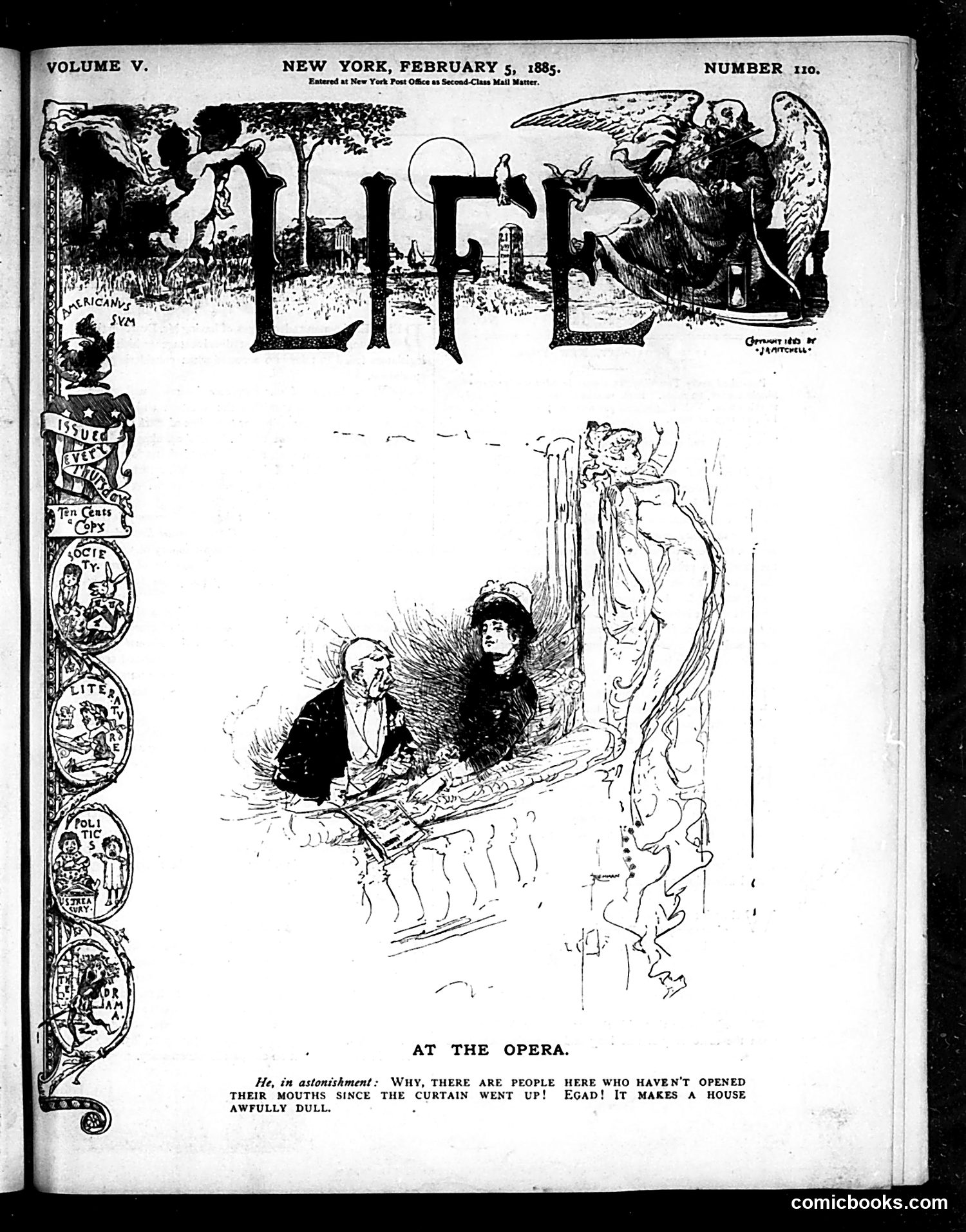
This cartoon satirizes the social pretension and boredom of opera-goers in 1880s New York. The illustration shows two well-dressed audience members sitting together during a performance. The caption's joke is that some patrons have literally not spoken since the curtain rose—implying the opera is so tedious that attendees remain silent throughout, making "a house awfully dull." The satire targets the *fashionable society* obligation to attend opera as a status symbol rather than for genuine enjoyment. The cartoon mocks both the stuffiness of opera culture and the silent, disconnected social experience it creates among the elite classes who attend primarily to be seen rather than entertained.
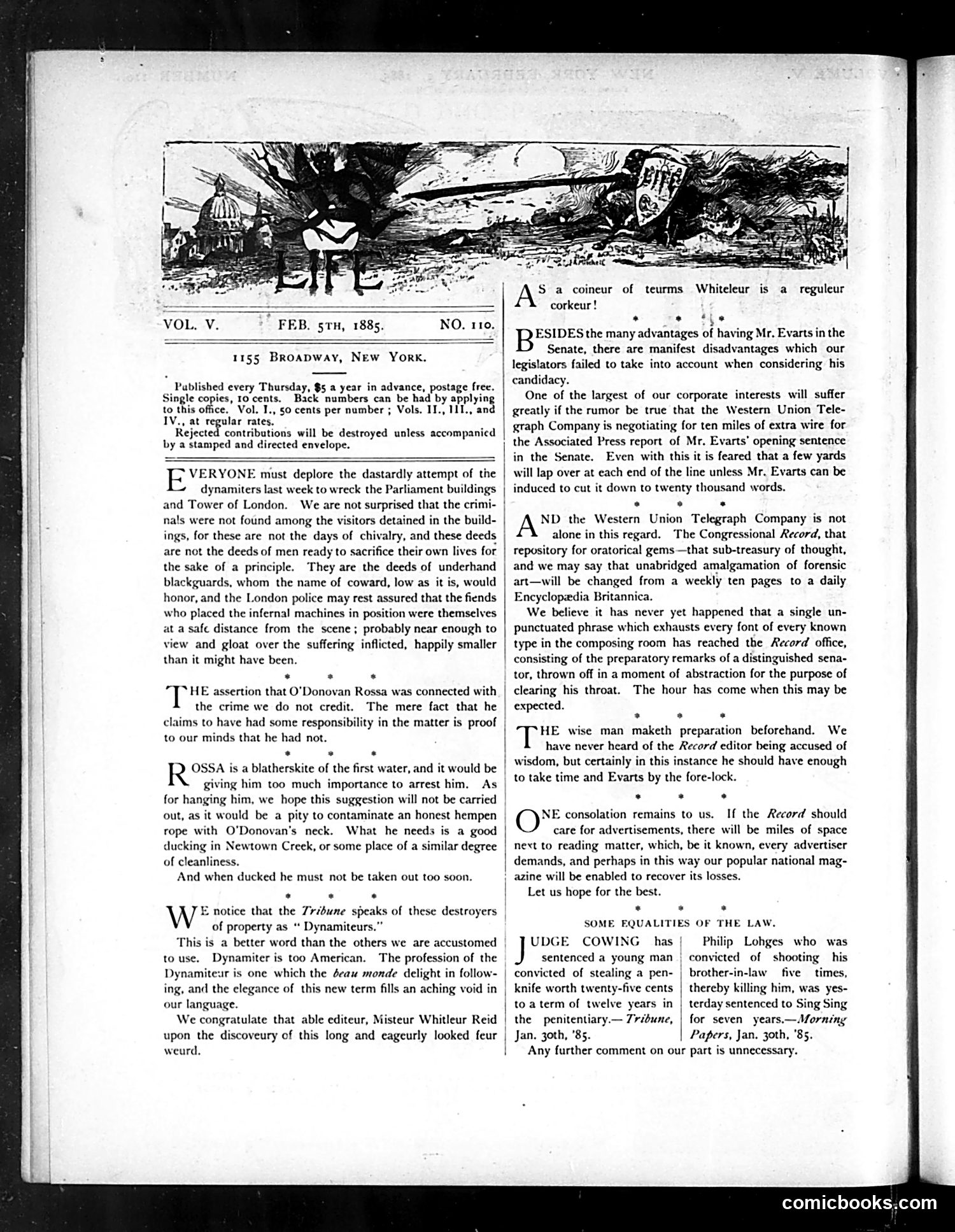
The masthead cartoon depicts a figure labeled "LIFE" sitting atop a tree, overlooking a landscape. The accompanying article criticizes a "dastardly attempt of the dynamitards last week to wreck the Parliament buildings and Tower of London," referencing actual dynamite attacks by Irish nationalist extremists during this period. The text condemns the violence while defending honest debate, distinguishing between legitimate political opposition and terrorism. It mocks the press for sensationalizing such acts, calling dynamite attacks "Americanized" terminology. The article also discusses Mr. Evarts's Senate candidacy and telegraph company disputes, typical political controversies of the era. The overall message: violent extremism undermines legitimate political discourse and should be unequivocally condemned, regardless of one's views on the underlying cause.
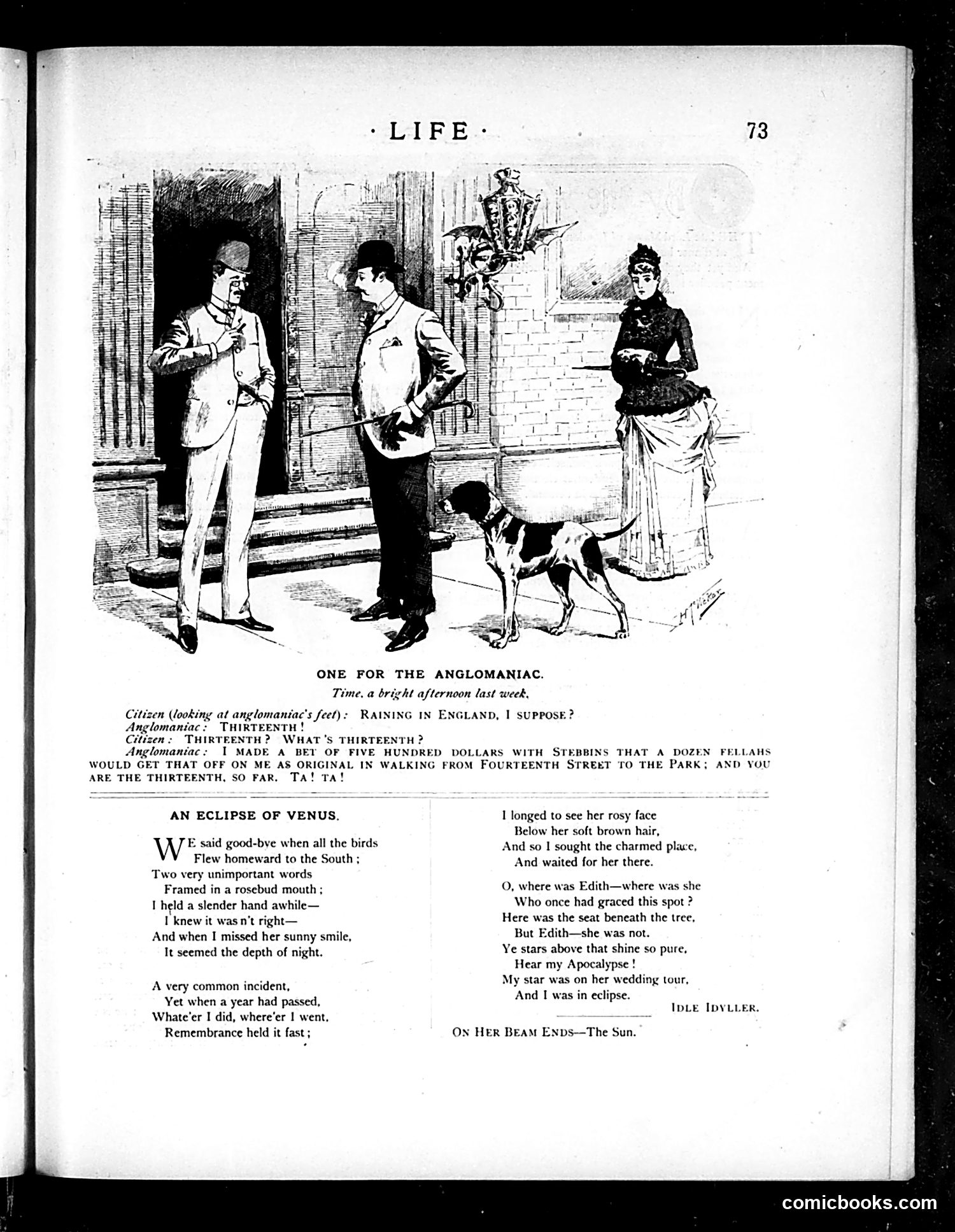
This cartoon satirizes wealthy Americans who affected British mannerisms and fashion. A well-dressed "citizen" confronts an "Anglomaniac" (a person obsessed with English culture) about his absurdly expensive walking shoes—allegedly costing $500 and made from leather of "a dozen pellahs" (likely "fellaheen," Egyptian peasants). The joke targets conspicuous consumption and pretentious Anglophilia: the Anglomaniac has adopted British affectations while paying exorbitant sums for status symbols. The citizen's sarcastic comment about being "the thirteenth" to wear such shoes mocks the absurdity of the expense. The page also contains unrelated romantic poetry ("An Eclipse of Venus") by Idle Idvller, suggesting typical magazine miscellany of the era.
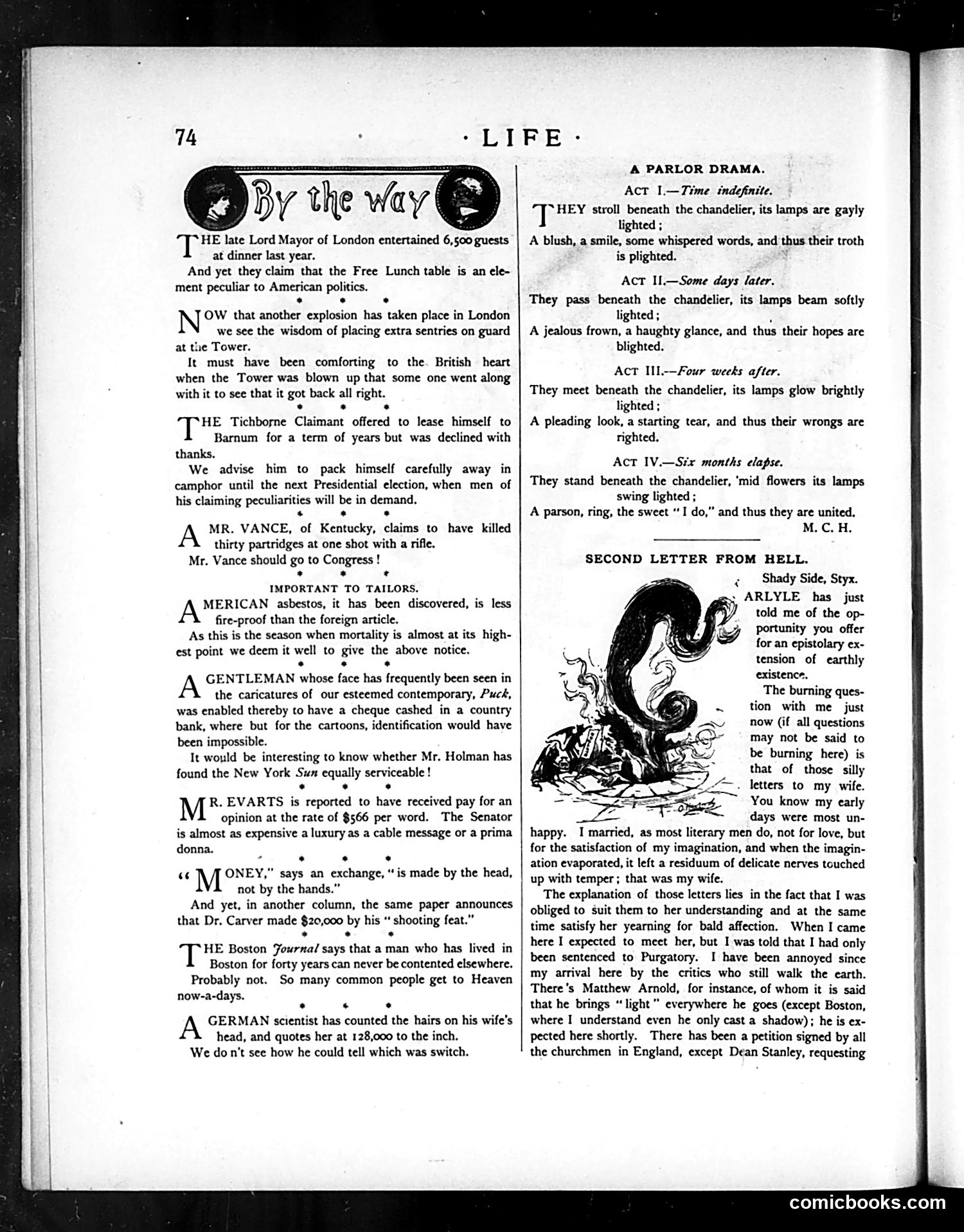
This page contains two distinct sections: **"By the Way"** (left): A satirical gossip column mocking contemporary figures and events. It references: - A Lord Mayor of London's dinner (6,500 guests) - Tower of London security measures (likely post-explosion) - A Kentucky man claiming to have killed thirty partridges - American asbestos as fire-proof material - Mr. Evarst receiving $366 per word for opinions - Dr. Carver's "$20,000 shooting feat" **Right side**: "A Parlor Drama" and "Second Letter from Hell" — the latter appears to be humorous literary satire involving marriage complaints and references to Purgatory, Matthew Arnold, and Dean Stanley. The overall tone is gentle mockery of contemporary society, politics, and human foibles rather than sharp political commentary. Without clearer context on specific dates or events, precise identification of most references remains uncertain.
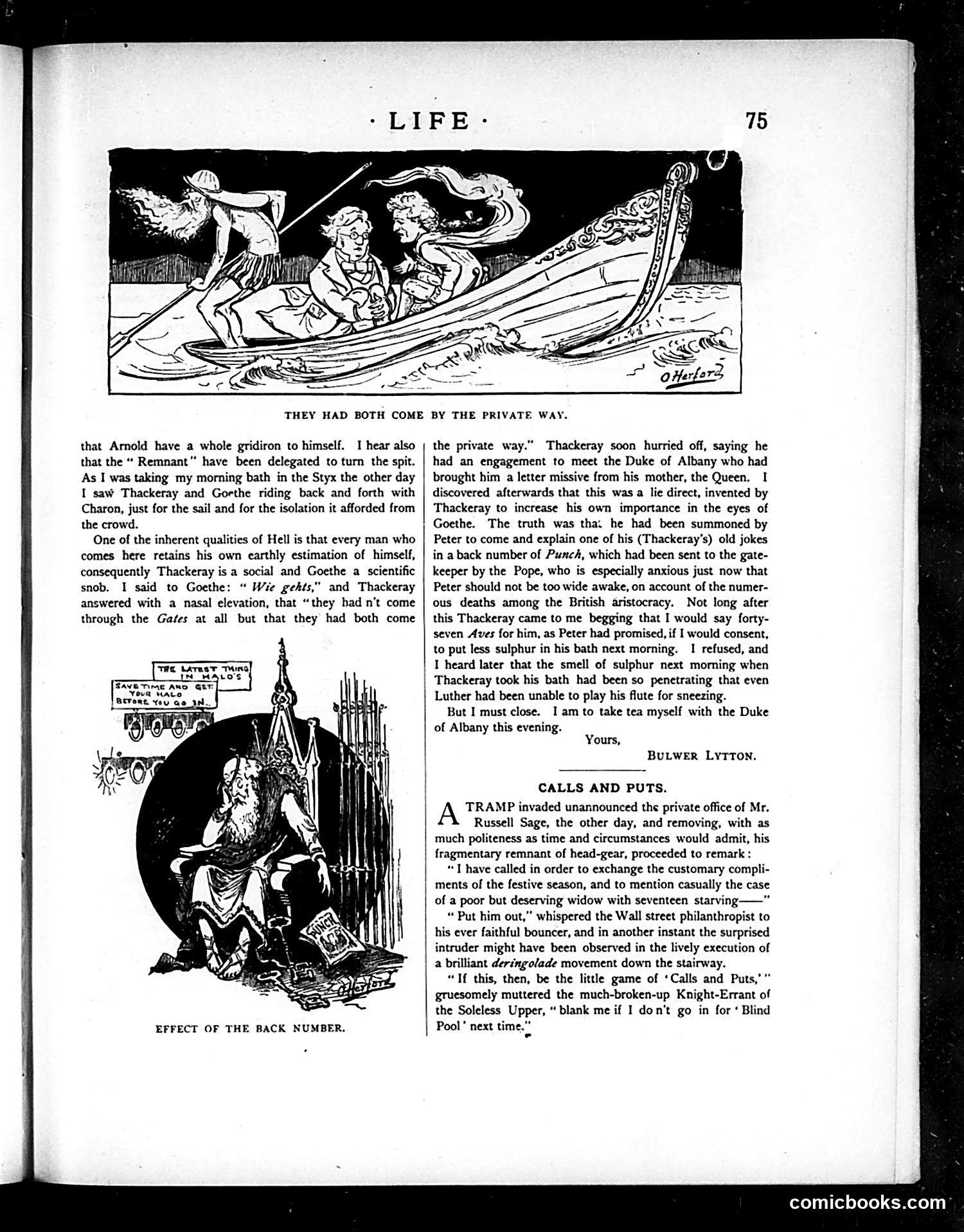
**Top Cartoon ("They Had Both Come by the Private Way"):** This cartoon depicts figures in a gondola, likely referencing a romantic or illicit rendezvous. The "private way" suggests discretion or secrecy. The accompanying text discusses Thackeray and Goethe as historical figures who maintained social propriety while engaging in questionable behavior—the satire mocks society's hypocrisy about public versus private conduct. **Bottom Cartoon ("Effect of the Back Number"):** A bearded figure (possibly representing an older establishment figure or philosopher) sits surrounded by books and architectural elements. The caption suggests satirizing outdated ideas or obsolete thinking—how "back numbers" (old issues, outdated people) become irrelevant despite their former prominence. Both cartoons appear to critique social pretense and the gap between public reputation and private reality.
This page consists primarily of **book reviews and literary criticism**, not political cartoons. The decorative header "Bookshelf" contains ornamental typography but no satirical imagery. The content reviews several books, including E.W. Howe's "The Mystery of the Locks," and includes biographical sketches of writers Émile Zola and Francis Burnand. The text discusses literary style and merit rather than current political events. The only potentially satirical element is the implicit critique of American governmental overreach mentioned in the first review—comparing Congressional power unfavorably to British parliamentary systems—but this appears to be serious political commentary rather than visual satire. This is a **literary criticism page**, not a cartoon or humor page.
This page contains primarily **literary and theatrical criticism**, not political cartoons. The "DRAMA" header introduces reviews of a production of Hamlet, likely from the late 19th century. The criticism discusses various actors' performances: Mr. Booth's Hamlet receives praise; the Ghost's appearance is critiqued as unhealthy-looking and unconvincing; Laertes' stage death is praised; and Mr. Barrett's Cassius (likely from *Julius Caesar*) is commended for scholarly interpretation, though the reviewer suggests Barrett would benefit from studying stage management. The page also includes poetry and unrelated editorial items about fan grass altitude and church furnishings—typical of Life's miscellaneous content format. **No political satire or caricatures are present.**
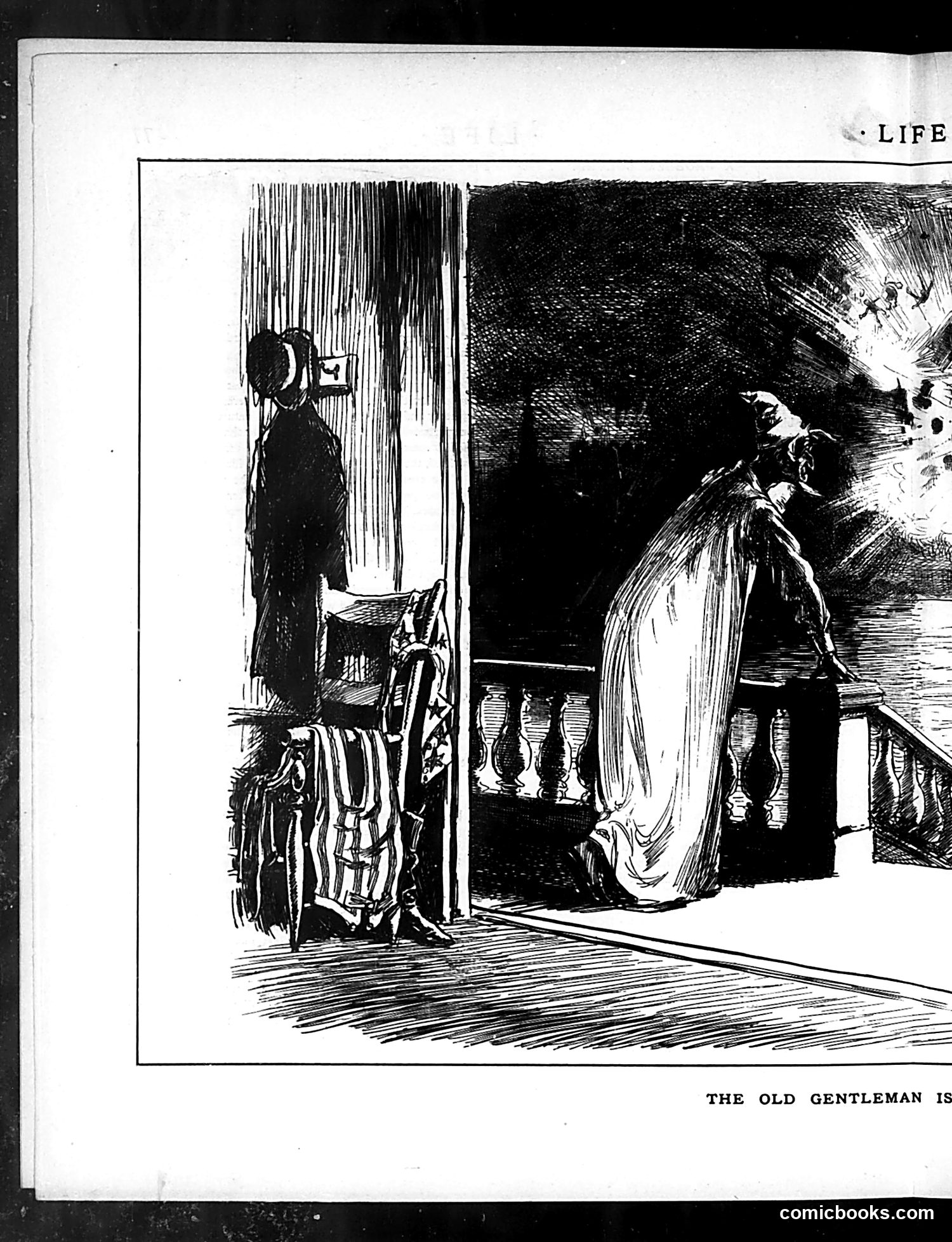
This is a pen-and-ink illustration from *Life* magazine showing a domestic scene. On the left, a man stands at a doorway wearing a hat and coat, appearing to arrive home. On the right, a woman in an elaborate cape or gown stands on what appears to be a balcony or elevated platform, gesturing expressively toward the interior of the home. The caption reads "THE OLD GENTLEMAN IS..." but is cut off, making the specific satirical point unclear without the complete text. The sketch likely satirizes Victorian-era domestic dynamics or social pretensions—possibly mocking either the man's formal manner of entry or the woman's theatrical, ostentatious presentation. The exaggerated artistic style suggests social commentary, but the incomplete caption prevents definitive interpretation of the intended joke.
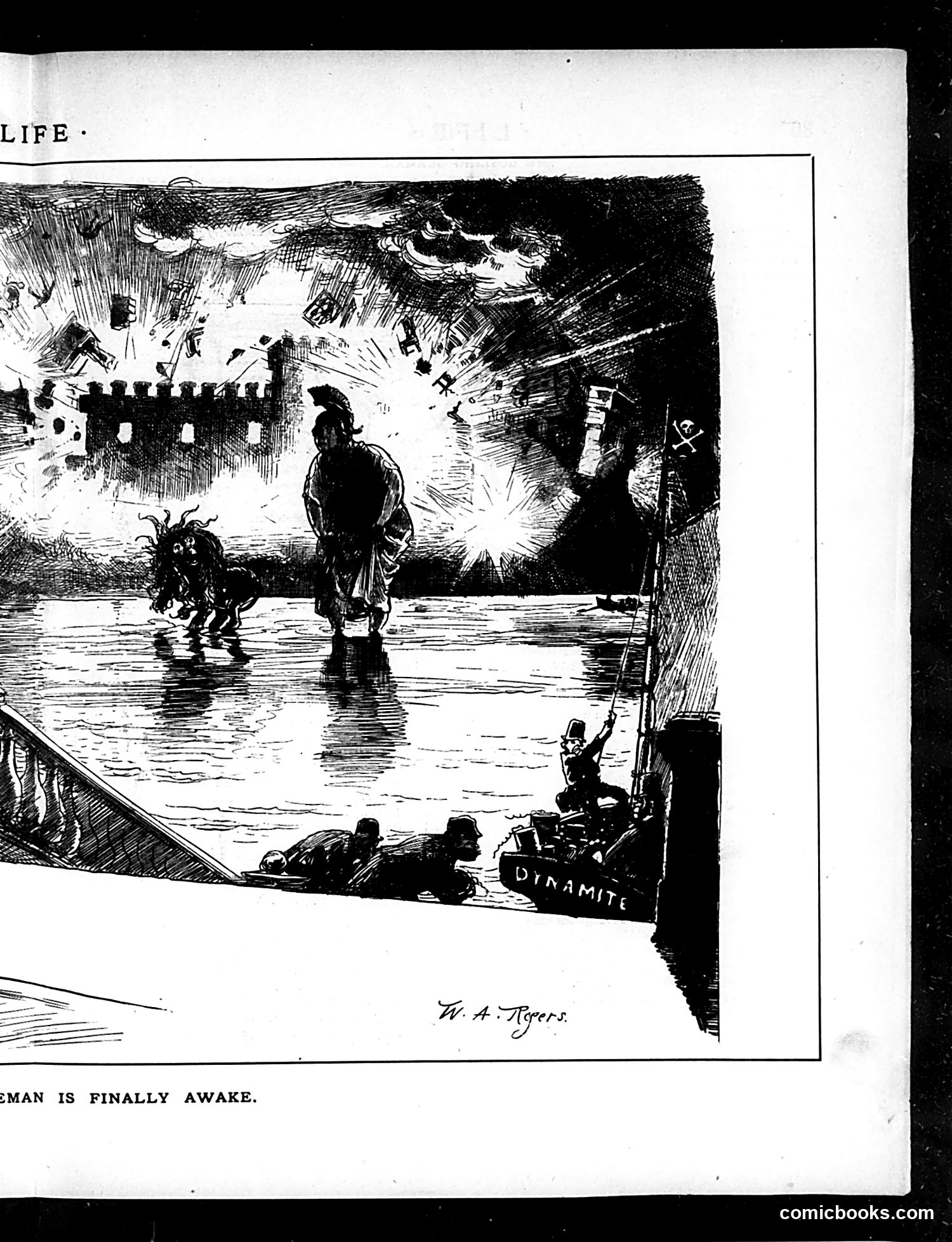
This is a political cartoon by W.A. Rogers titled "Man Is Finally Awake," depicting what appears to be a military or wartime scene. The image shows figures on what looks like a fortified position or ship (marked "DYNAMITE"), with explosions and military action in the background. A central figure stands alert, seemingly observing or responding to conflict. The cartoon's message—that "man is finally awake"—suggests commentary on nations or peoples becoming aware of or mobilized for a significant threat or conflict. Without the specific publication date visible, the exact historical event referenced remains unclear, though the military imagery and wartime setting suggest this comments on American involvement in or response to international conflict, likely from the early 20th century.
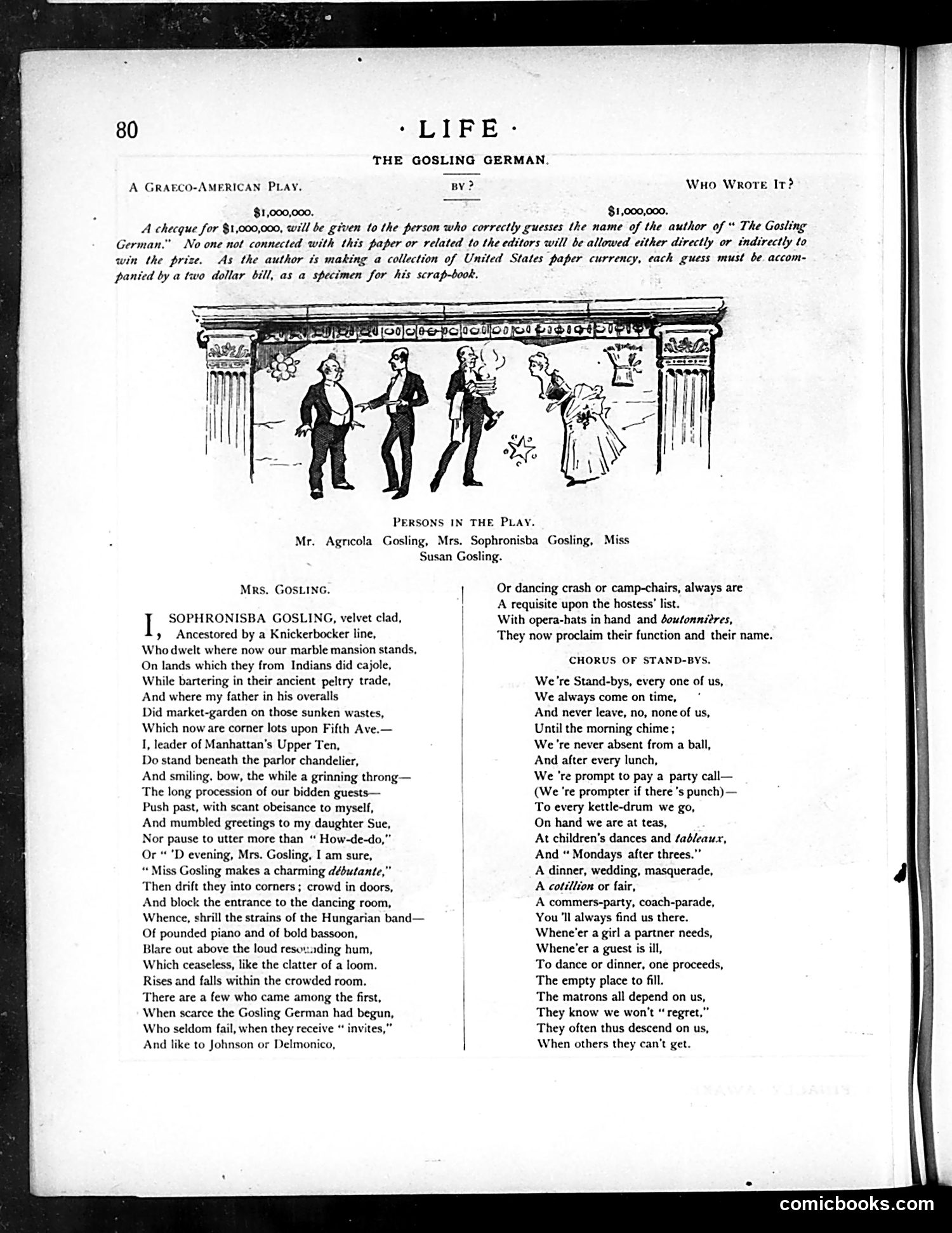
This page presents a Greco-American theatrical satire mocking New York's wealthy social elite. The play centers on Mrs. Sophronisba Gosling, whose family typifies the nouveau riche: her ancestors were Dutch traders, her father was a market gardener on what are now valuable Fifth Avenue lots, yet she now claims leadership of "Manhattan's Upper Ten" (the city's highest society). The humor targets social pretension and the disposable "stand-by" guests who attend every event. The chorus of stand-bys satirizes professional party attendees—people who show up promptly to dinners, dances, and teas not from genuine friendship but from social obligation or availability. They're interchangeable fixtures, filling empty seats when preferred guests decline. The $1,000,000 prize for guessing the author (paid in two-dollar bills, which the author collects) is itself a joke about wealthy eccentricity. Overall, Life ridicules both social-climbing nouveau riche hosts and the dependent hangers-on sustaining their pretense of elite status.
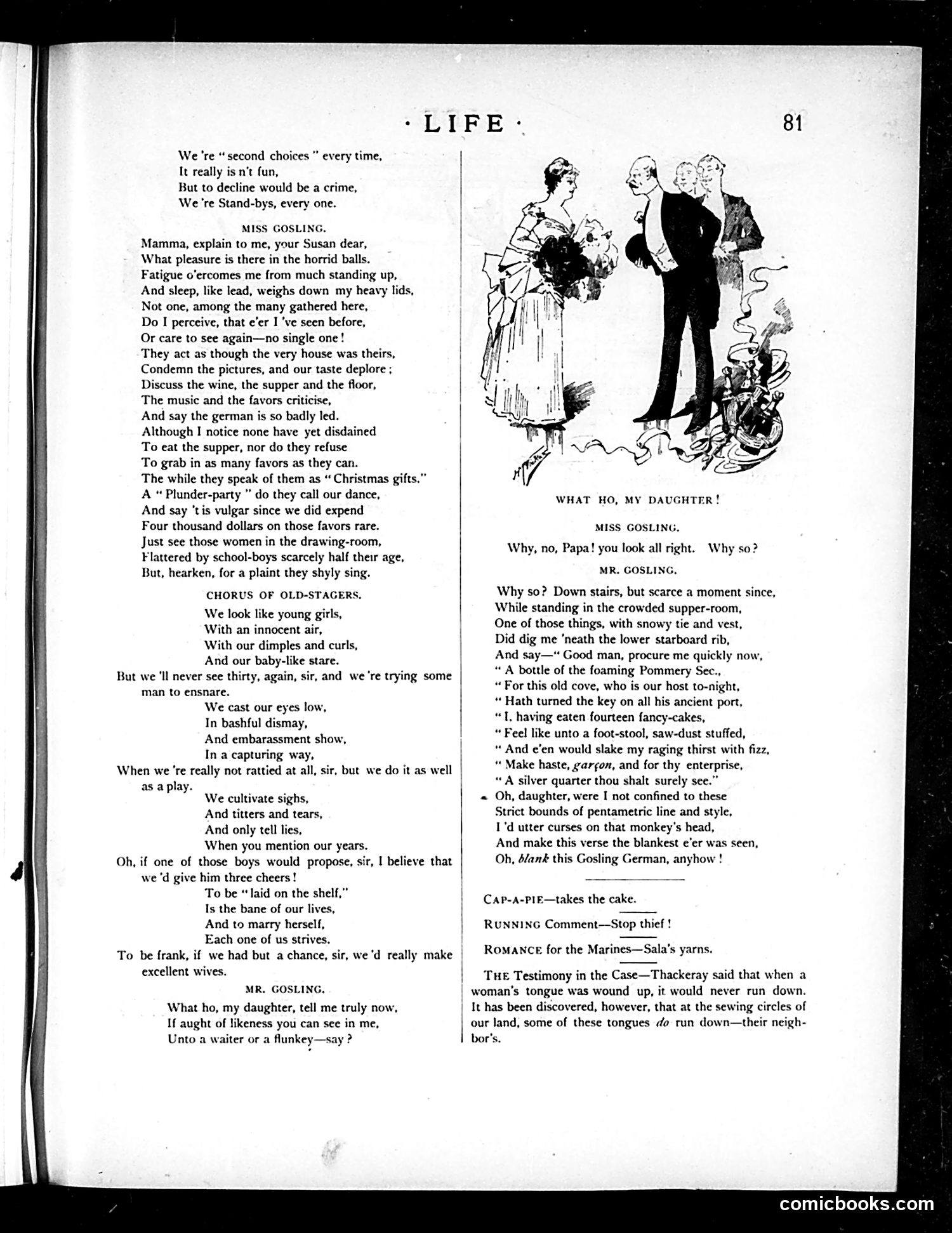
This satirical piece mocks the social pretensions and hypocrisies of wealthy Americans attending elaborate balls and parties, likely from the Gilded Age era. **The Main Satire:** Miss Gosling complains to her mother about a fashionable ball—guests are tedious, the music poor, the dancing badly led. Yet these same critics greedily consume expensive supper and favors while dismissing the event as a vulgar "plunder-party." **The "Chorus of Old-Stagers"** features aging women pretending to be innocent young girls, deliberately cultivating sighs and tears to attract proposals, while admitting they're performing ("we do it as well as a play"). **Mr. Gosling's anecdote** depicts a rude young guest demanding champagne from him, mistaking him for a servant, then offering a quarter as payment—satirizing nouveau riche rudeness and class confusion. **The Point:** Life ridicules the contradiction between wealth (spending four thousand dollars on party favors) and lack of genuine refinement or decency. The wealthy perform elaborate social roles while maintaining no real standards or kindness.
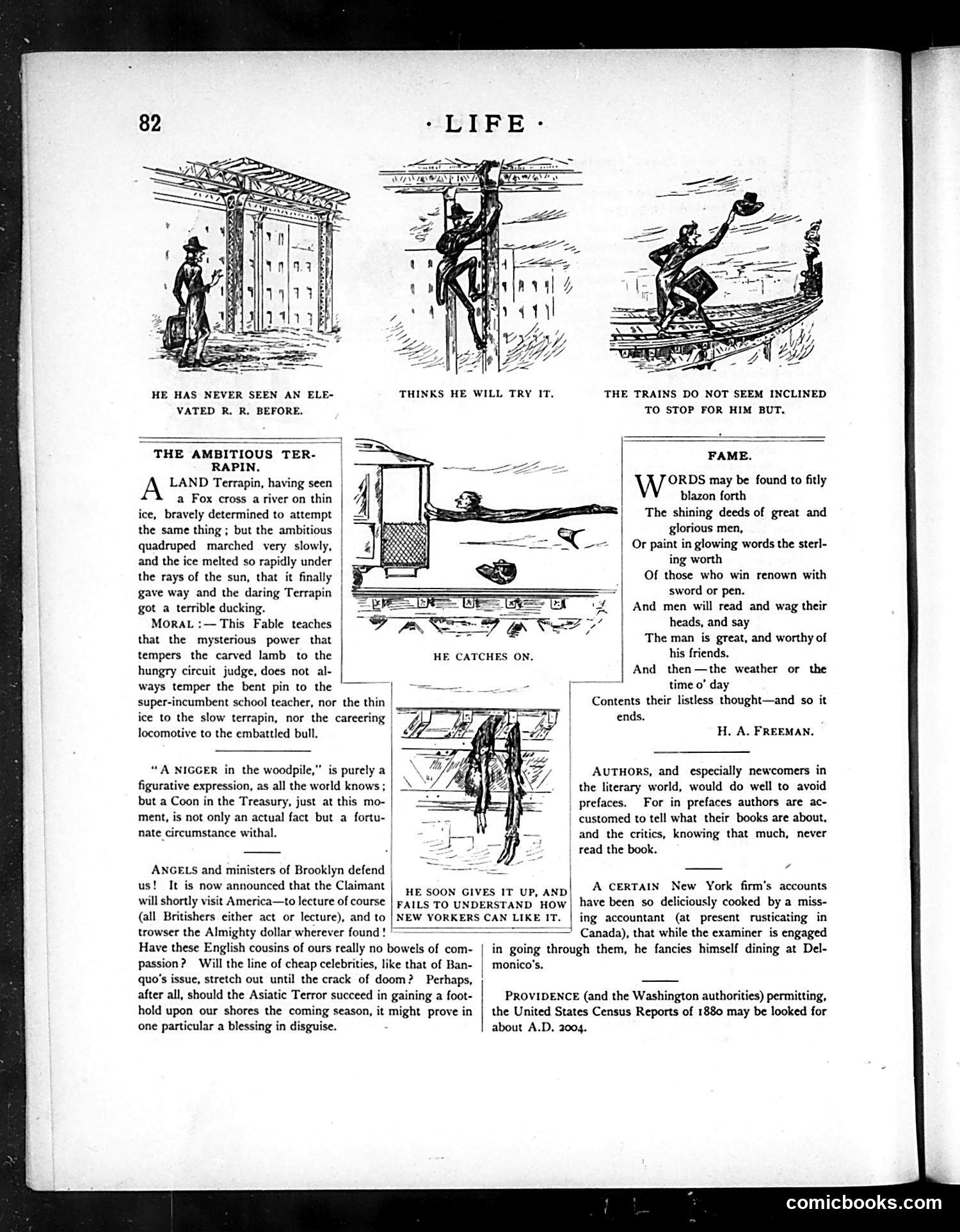
This page contains several unrelated satirical pieces typical of 19th-century *Life* magazine: **"The Ambitious Terrapin"** is an Aesop's Fable parody mocking overconfidence. A turtle attempts to cross thin ice after seeing a fox succeed, but melts through and nearly drowns. The moral sardonically notes that natural forces don't consistently protect the foolish—a dig at those who naively imitate others' risky behavior. **The three vignettes at top** humorously depict a country person's first encounter with an elevated railway, attempting increasingly dangerous stunts (climbing the structure, standing on a moving train car). **Other brief satirical notes** target: Brooklyn clergy ("Angels"), a visiting British "Claimant" (likely a fraudulent heir seeking American lecture fees), corrupt accountants embezzling from New York firms, and the sluggish pace of government census reporting. **"Fame"** is a serious poem by H.A. Freeman about how true greatness transcends temporary recognition. The page reflects *Life's* signature blend of visual humor, fables, social commentary on urban life, and literary content.
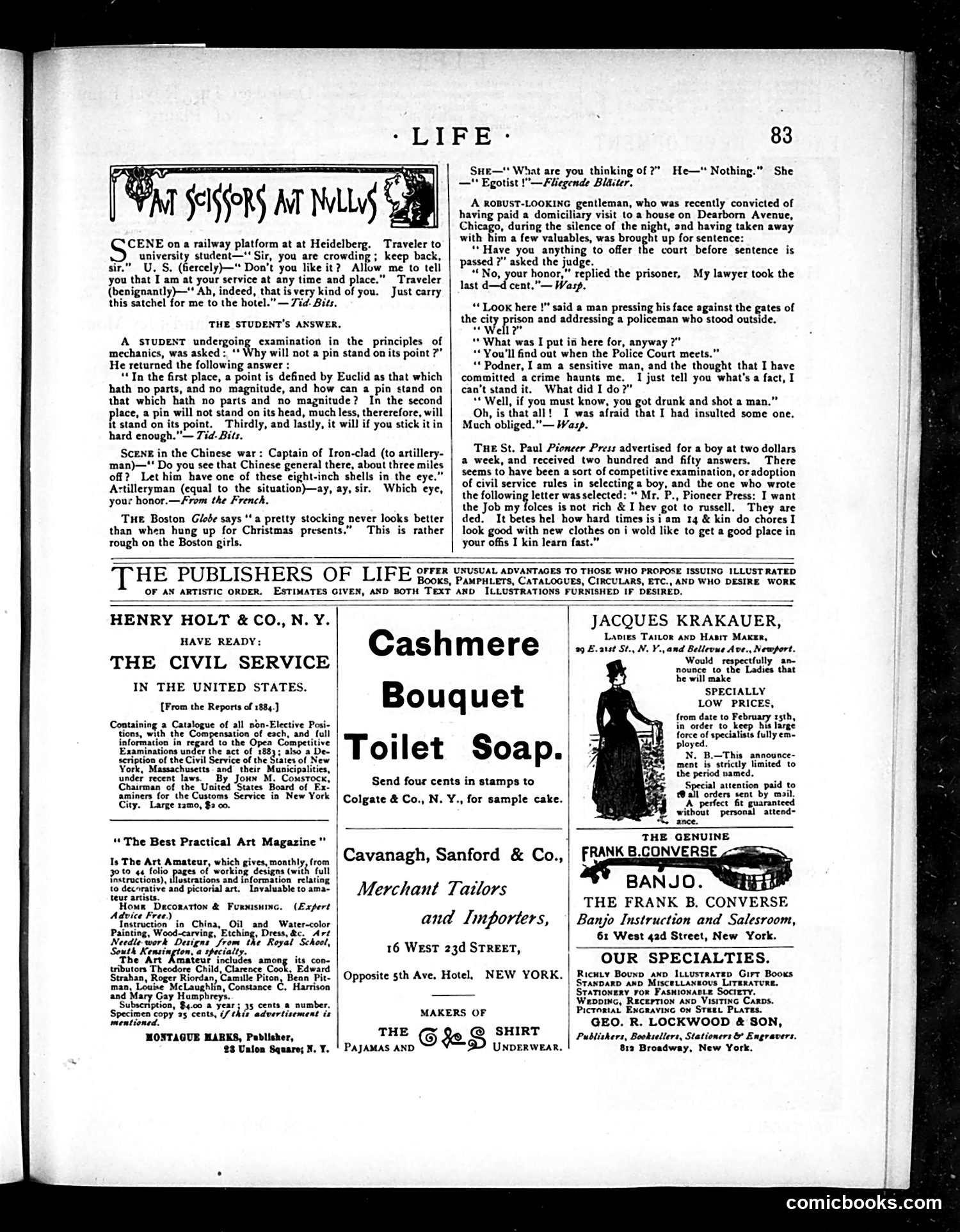
This is primarily a **humor/jokes page** from an American satirical magazine, with minimal cartooning. The page collects short humorous anecdotes and quips, mostly reprinted from other publications (acknowledged in attributions like "—Tid-Bits," "—Wasp," "—Fliegende Blatter"). The jokes illustrate period concerns: American arrogance abroad (a U.S. student blustering to a German traveler), class dynamics and poverty (a boy's misspelled job application), corruption in law enforcement (a prisoner saying his lawyer took his money), and judicial sarcasm (a drunk man insisting he's "insulted" rather than violent—implying criminal violence was less shameful than disrespect). The page is otherwise filled with **advertisements** for services (tailors, soap, books on civil service) and a note about Life's publishing services. The humor relies on wordplay, irony, and period social assumptions that modern readers would need context to fully appreciate.
This page is primarily **advertisements and humor anecdotes**, not political cartoons. The satirical content consists of brief jokes typical of 1880s American magazines: **The Humor:** - A Southern funeral orator mispronounces "panegyrics" as "paregorics" (a laxative), creating absurdist comedy - An Irish character complains about "absentees" ruining Ireland—likely referencing the real 19th-century Irish land issue where English landlords lived elsewhere - A child asks naively if people will live 500 years; the reply jokes that humanity was "too bad" and needed drowning (biblical reference) - A young farmer compliments a bride by saying the groom "got the pick of the batch"—insulting her sisters - A boy can't swear because he's "not big enough"—innocent/crude humor **The Point:** These are gentle, observational jokes about language mishaps, Irish grievances, social awkwardness, and childhood innocence—typical *Life* magazine humor. Nothing overtly political; mostly advertising with comedic filler between ads.
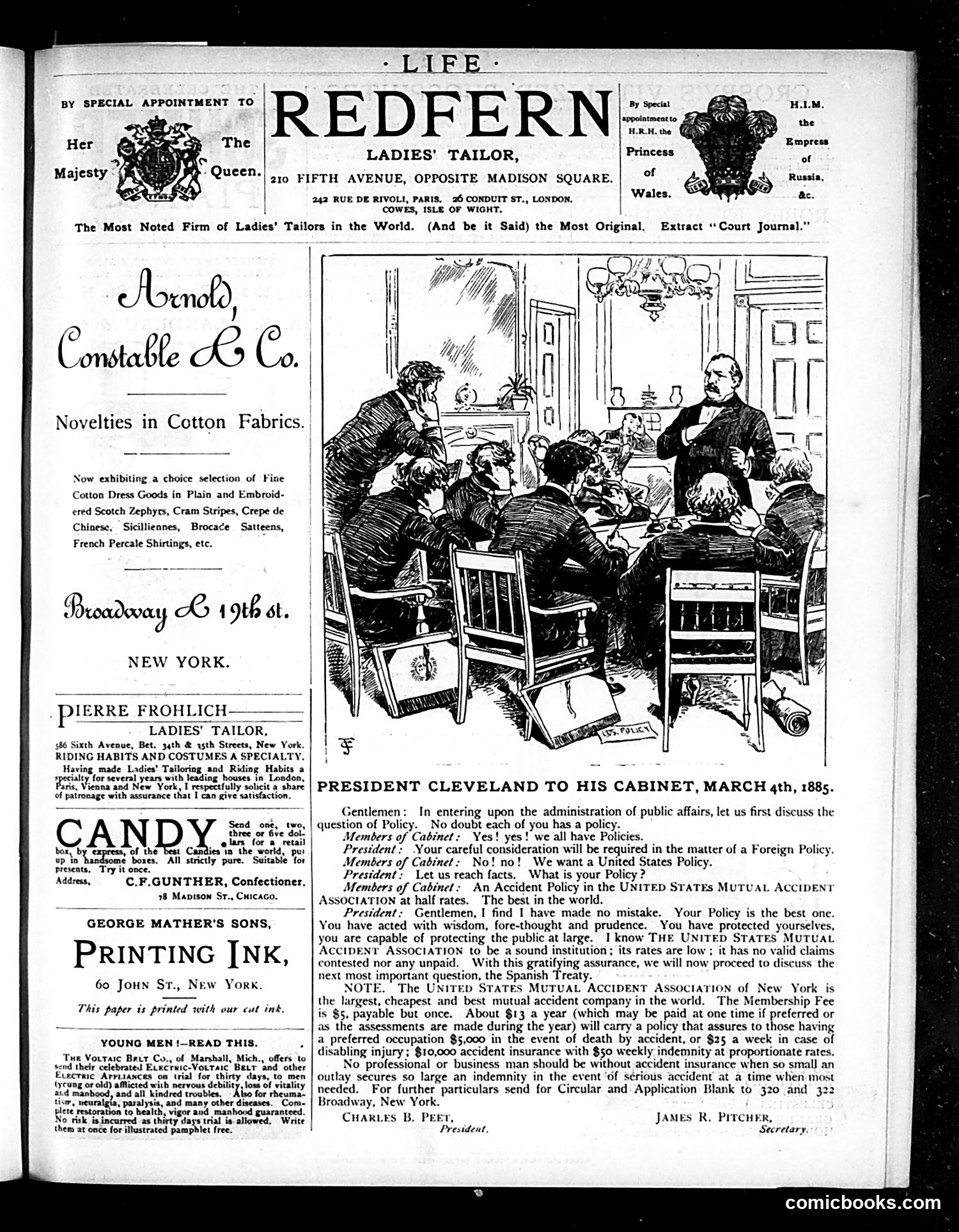
This Life magazine page (March 4, 1885) contains a satirical cartoon mocking President Cleveland's new cabinet meeting. The joke depicts Cleveland and his cabinet members discussing "Policy," which appears to be a pun—the cabinet members all claim their policy is accident insurance from the United States Mutual Accident Association. The satire suggests that Cleveland's cabinet is more concerned with protecting themselves through insurance than with serious governmental matters like foreign policy or the Spanish Treaty. By having the cabinet prioritize accident insurance over actual policy decisions, the cartoon implies the administration is either incompetent, self-serving, or absurdly unprepared for office. The advertisement for the insurance company below the cartoon is either genuine or part of the satire itself—it's unclear whether Life is genuinely promoting the company or extending the joke.
This page is primarily **advertisements** with no significant political cartoons or satirical content requiring historical context. The one illustrated element—a small cartoon labeled "What Can Cuticura Do For Me?"—depicts a baby and advertises a skin-care product. It's a straightforward commercial illustration, not satire. The page showcases late 19th-century patent medicines and services typical of the era: Crosby's "Vitalized Phosphites" (a nerve tonic), Cuticura (a skin treatment), and Vichy water (marketed for gout and kidney disease). These reflect the period's unregulated medical claims before FDA oversight. Also advertised: theatrical performances, fine carriages, tailoring services, and piano manufacturers—reflecting urban upper-class consumer culture of the time. The "Beware of Imitations" warning for Vichy indicates contemporary concerns about counterfeit products.