
Life, 1885-02-05 · page 10 of 16
Life — February 5, 1885 — page 10: what you’re looking at
What you’re looking at
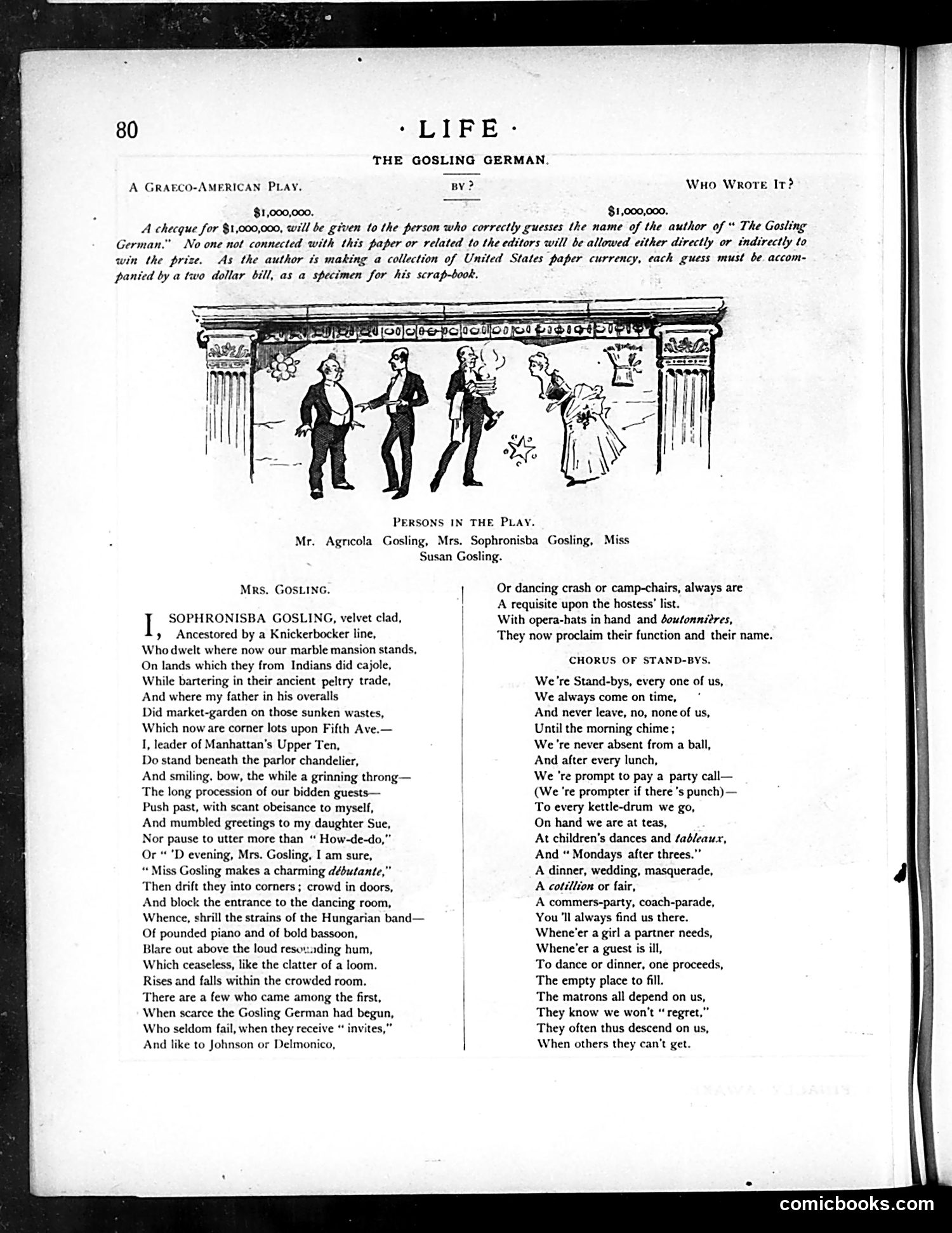
This page presents a Greco-American theatrical satire mocking New York's wealthy social elite. The play centers on Mrs. Sophronisba Gosling, whose family typifies the nouveau riche: her ancestors were Dutch traders, her father was a market gardener on what are now valuable Fifth Avenue lots, yet she now claims leadership of "Manhattan's Upper Ten" (the city's highest society). The humor targets social pretension and the disposable "stand-by" guests who attend every event. The chorus of stand-bys satirizes professional party attendees—people who show up promptly to dinners, dances, and teas not from genuine friendship but from social obligation or availability. They're interchangeable fixtures, filling empty seats when preferred guests decline. The $1,000,000 prize for guessing the author (paid in two-dollar bills, which the author collects) is itself a joke about wealthy eccentricity. Overall, Life ridicules both social-climbing nouveau riche hosts and the dependent hangers-on sustaining their pretense of elite status.
📄 Transcribed text from this page (OCR, searchable)
Machine-transcribed from the original scan — historical spelling and the odd misread are preserved.
80 ‘LIFE: THE GOSLING GERMAN. A GRAECO-AMERICAN PLAY. By? Wuo Wrote It? $1,000,000, $1,000,000, A checgue for $1,000,000, will be given to the person who correctly guesses the name of the author of “ The Gosling German.” No one not connected with this paper or related to the editors will be allowed either directly or indirectly to win the prise. As the author is making a collection of United States paper currency, each guess must be accom- panied by a two dollar bill, as a specimen for his scrap-book. PERSONS IN THE PLAy. Mr. Agricola Gosling, Mrs. Sophronisba Gosling, Miss Susan Gosling. Mrs. GOSLING. Or dancing crash or camp-chairs, always are A requisite upon the hostess’ list. With opera-hats in hand and doutonnieres, They now proclaim their function and their name. SOPHRONISBA GOSLING, velvet clad, » Ancestored by a Knickerbocker line, Who dwelt where now our marble mansion stands, On lands which they from Indians did cajole, While bartering in their ancient peltry trade, And where my father in his overalls Did market-garden on those sunken wastes, Which now are corner lots upon Fifth Ave.— I, leader of Manhattan's Upper Ten, Do stand beneath the parlor chandelier, And smiling, bow, the while a grinning throng— The long procession of our bidden guests— Push past, with scant obeisance to myself, And mumbled greetings to my daughter Sue, Nor pause to utter more than “ How-de-do,” Or “'D evening, Mrs. Gosling, I am sure, “Miss Gosling makes a charming débutante,” Then drift they into corners ; crowd in doors, And block the entrance to the dancing room, Whence, shrill the strains of the Hungarian band— Of pounded piano and of bold bassoon, Blare out above the loud resox:nding hum, Which ceaseless, like the clatter of a loom. Rises and falls within the crowded room. There are a few who came among the first, When scarce the Gosling German had begun, Who seldom fail, when they receive “ invites,” And like to Johnson or Delmonico, CHORUS OF STAND-BYS. We're Stand-bys, every one of us, We always come on time, And never leave, no, none of us, Until the morning chime; We're never absent from a ball, And after every lunch, We ‘re prompt to pay a party call— (We're prompter if there 's punch) — To every kettle-drum we go, On hand we are at teas, At children’s dances and fad/eaux, And “ Mondays after threes.”” A dinner, wedding, masquerade, A cotillion or fair, A commers-party, coach-parade, You ‘Il always find us there. Whene'er a girl a partner needs, Whene’er a guest is ill, To dance or dinner, one proceeds, The empty place to fill. The matrons all depend on us, They know we won't “regret,” They often thus descend on us, When others they can’t get. comicbooks.com