
Life, 1885-02-05 · page 7 of 16
Life — February 5, 1885 — page 7: what you’re looking at
What you’re looking at
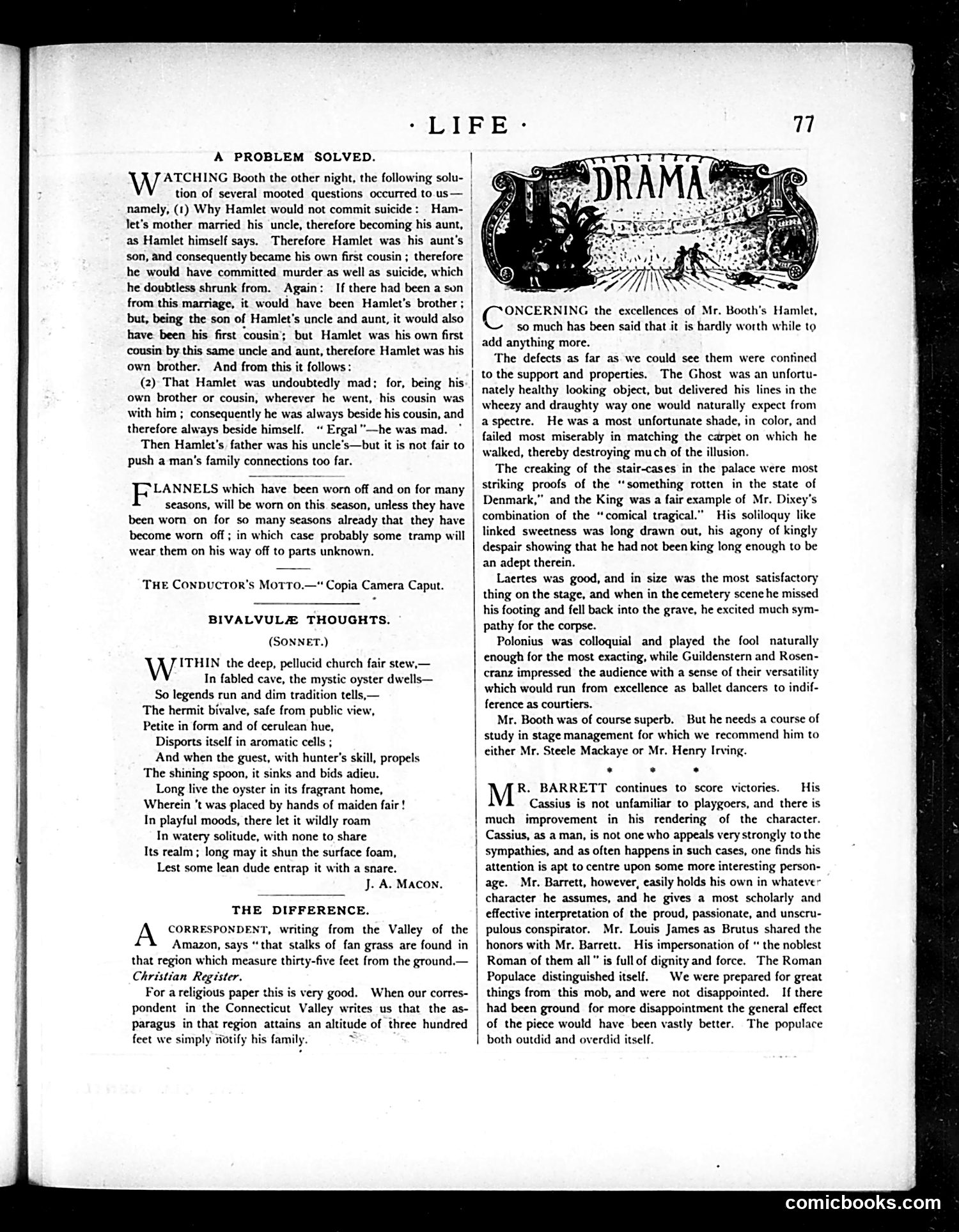
This page contains primarily **literary and theatrical criticism**, not political cartoons. The "DRAMA" header introduces reviews of a production of Hamlet, likely from the late 19th century. The criticism discusses various actors' performances: Mr. Booth's Hamlet receives praise; the Ghost's appearance is critiqued as unhealthy-looking and unconvincing; Laertes' stage death is praised; and Mr. Barrett's Cassius (likely from *Julius Caesar*) is commended for scholarly interpretation, though the reviewer suggests Barrett would benefit from studying stage management. The page also includes poetry and unrelated editorial items about fan grass altitude and church furnishings—typical of Life's miscellaneous content format. **No political satire or caricatures are present.**
📄 Transcribed text from this page (OCR, searchable)
Machine-transcribed from the original scan — historical spelling and the odd misread are preserved.
A PROBLEM SOLVED. ATCHING Booth the other night, the following solu tion of several mooted questions occurred to us— | namely, (1) Why Hamlet would not commit suicide: Ham- let's mother married his uncle, therefore becoming his aunt, as Hamlet himself says. Therefore Hamlet was his aunt's son, and consequently became his own first cousin ; therefore he would have committed murder as well as suicide, which he doubtless shrunk from. Again: If there had been a son from this marriage, it would have been Hamlet's brother ; but, being the son of Hamlet's uncle and aunt, it would also have been his first cousin’; but Hamlet was his own first cousin by this same uncle and aunt, therefore Hamlet was his own brother. And from this it follows: (2) That Hamlet was undoubtedly mad; for, being his own brother or cousin, wherever he went, his cousin was with him ; consequently he was always beside his cousin, and therefore always beside himself.“ Ergal "—he was mad. Then Hamlet's, father was his uncle’s—but it is not fair to push a man’s family connections too far. LANNELS which have been worn off and on for many seasons, will be worn on this. season, unless they have been worn on for so many seasons already that they have become worn off; in which case probably some tramp will wear them on his way off to parts unknown. THE ConpUCTOR's MotTo.—* Copia Camera Caput. BIVALVULZ& THOUGHTS. (SONNET.) ITHIN the deep, pellucid church fair stew,— In fabled cave, the mystic oyster dwells— So legends run and dim tradition tells,— The hermit bivalve, safe from public view, Petite in form and of cerulean hue, Disports itself in aromatic cells ; And when the guest, with hunter's skill, propels The shining spoon, it sinks and bids adieu. Long live the oyster in its fragrant home, Wherein ‘t was placed by hands of maiden fair! In playful moods, there let it wildly roam In watery solitude, with none to share Its realm; long may it shun the surface foam, Lest some lean dude entrap it with a snare. J. A. Macon, THE DIFFERENCE. CORRESPONDENT, writing from the Valley of the Amazon, says “that stalks of fan grass are found in that region which measure thirty-five feet from the ground.— Christian Register. For a religious paper this is very good. When our corres- pondent in the Connecticut Valley writes us that the as- paragus in that region attains an altitude of three hundred feet we simply tiotify his family. 3 ONCERNING the excellences of Mr. Booth’s Hamlet, so much has been said that it is hardly worth while to add anything more. The defects as far as we could see them were contined to the support and properties. The Ghost was an unfortu- nately healthy looking object, but delivered his lines in the | wheezy and draughty way one would naturally expect from a spectre. He was a most unfortunate shade, in color, and | failed most miserably in matching the carpet on which he walked, thereby destroying much of the illusion. The creaking of the stair-cases in the palace were most striking proofs of the “something rotten in the state of Denmark,” and the King was a fair example of Mr. Dixey’s combination of the “comical tragical.”” His soliloquy like linked sweetness was long drawn out, his agony of kingly despair showing that he had not been king long enough to be an adept therein. Laertes was good, and in size was the most satisfactory thing on the stage, and when in the cemetery scene he missed his footing and fell back into the grave, he excited much sym- pathy for the corpse. Polonius was colloquial and played the fool naturally enough for the most exacting, while Guildenstern and Rosen- cranz impressed the audience with a sense of their versatility which would run from excellence as ballet dancers to indif- ference as courtiers. Mr. Booth was of course superb. But he needs a course of study in stage management for which we recommend him to either Mr. Steele Mackaye or Mr. Henry Irving. . . . R. BARRETT continues to score victories. His Cassius is not unfamiliar to playgoers, and there is much improvement in his rendering of the character. | Cassius, as a man, is not one who appeals very strongly tothe sympathies, and as often happens in such cases, one finds his attention is apt to centre upon some more interesting person- age. Mr. Barrett, however, easily holds his own in whatever | character he assumes, and he gives a most scholarly and | effective interpretation of the proud, passionate, and unscru- pulous conspirator. Mr. Louis James as Brutus shared the honors with Mr. Barrett. His impersonation of “ the noblest Roman of them all” is full of dignity and force. The Roman Populace distinguished itself. | We were prepared for great things from this mob, and were not disappointed. If there | had been ground for more disappointment the general effect of the piece would have been vastly better. both outdid and overdid itself. The populace comicbooks.com