
Life, 1885-02-05 · page 6 of 16
Life — February 5, 1885 — page 6: what you’re looking at
What you’re looking at
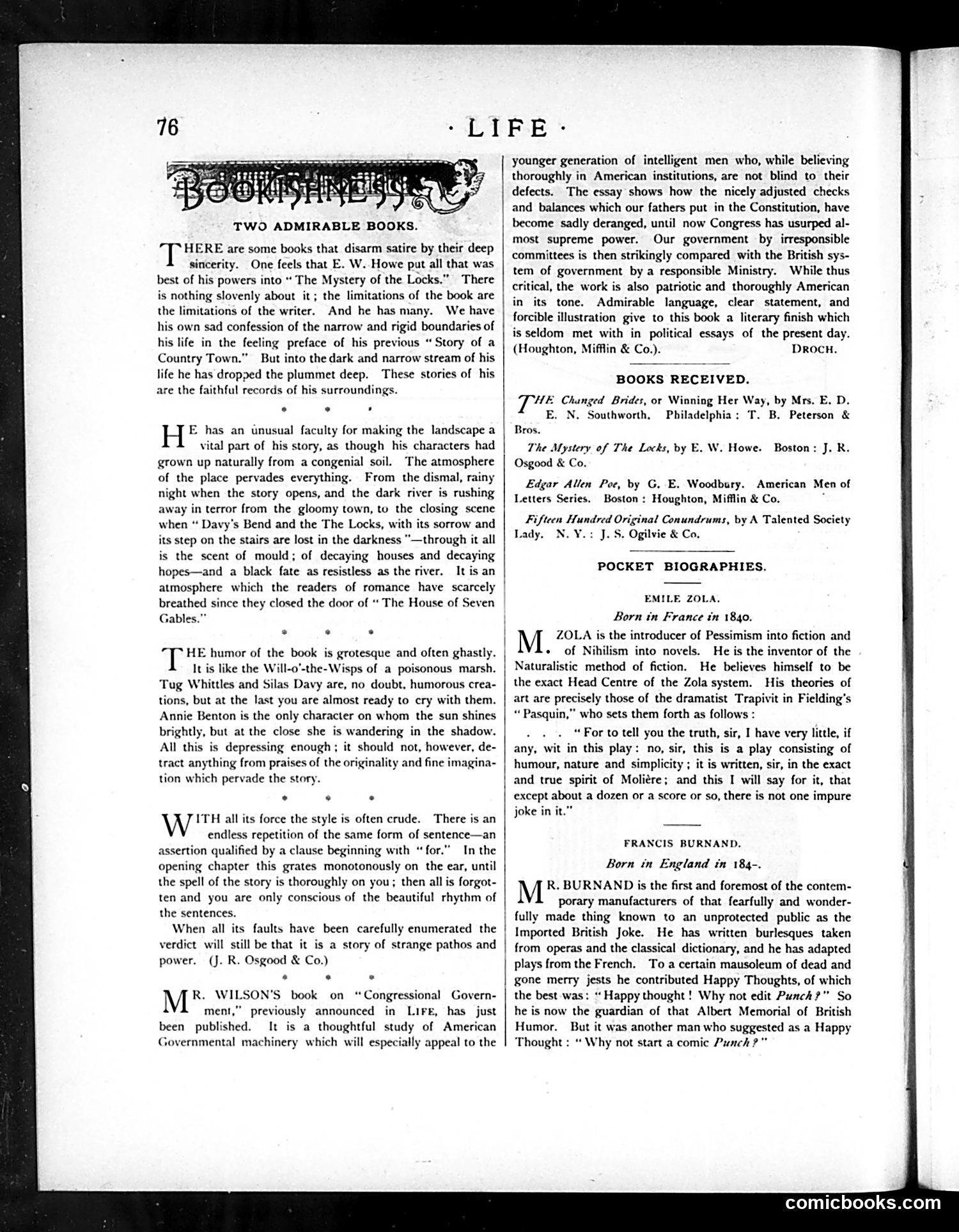
This page consists primarily of **book reviews and literary criticism**, not political cartoons. The decorative header "Bookshelf" contains ornamental typography but no satirical imagery. The content reviews several books, including E.W. Howe's "The Mystery of the Locks," and includes biographical sketches of writers Émile Zola and Francis Burnand. The text discusses literary style and merit rather than current political events. The only potentially satirical element is the implicit critique of American governmental overreach mentioned in the first review—comparing Congressional power unfavorably to British parliamentary systems—but this appears to be serious political commentary rather than visual satire. This is a **literary criticism page**, not a cartoon or humor page.
📄 Transcribed text from this page (OCR, searchable)
Machine-transcribed from the original scan — historical spelling and the odd misread are preserved.
- LIFE: TWO ADMIRABLE BOOKS. HERE are some books that disarm satire by their deep sincerity. One feels that E. W. Howe put all that was best of his powers into The Mystery of the Locks.” There is nothing slovenly about it ; the limitations of the book are the limitations of the writer. And he has many. We have his own sad confession of the narrow and rigid boundaries of his life in the feeling preface of his previous “Story of a Country Town.” But into the dark and narrow stream of his life he has dropped the plummet deep. These stories of his are the faithful records of his surroundings. has an unusual faculty for making the landscape a | E H vital part of his story, as though his characters had grown up naturally from a congenial soil. The atmosphere of the place pervades everything. From the dismal, rainy night when the story opens, and the dark river is rushing away in terror from the gloomy town, to the closing scene when “ Davy’s Bend and the The Locks, with its sorrow and its step on the stairs are lost in the darkness "—through it all is the scent of mould; of decaying houses and decaying hopes—and a black fate as resistless as the river. It is an atmosphere which the readers of romance have scarcely breathed since they closed the door of ‘ The House of Seven Gables.” * e . HE humor of the book is grotesque and often ghastly. It is like the Will-o'-the-Wisps of a poisonous marsh. Tug Whittles and Silas Davy are, no doubt, humorous crea- tions, but at the last you are almost ready to cry with them. Annie Benton is the only character on whom the sun shines brightly, but at the close she is wandering in the shadow. All this is depressing enough; it should not, however, de- tract anything from praises of the originality and fine imagina- tion which pervade the story. . * . ITH all its force the style is often crude. There is an endless repetition of the same form of sentence—an assertion qualified by a clause beginning with “for.” In the opening chapter this grates monotonously on the ear, until the spell of the story is thoroughly on you; then all is forgot- ten and you are only conscious of the beautiful rhythm of the sentences. When all its faults have been carefully enumerated the verdict will still be that it is a story of strange pathos and power. (J. R. Osgood & Co.) . . « R. WILSON’S book on “Congressional Govern- i ment,” previously announced in LiFe, has just been published. It is a thoughtful study of American Governmental machinery which will especially appeal to the younger generation of intelligent men who, while believing thoroughly in American institutions, are not blind to their defects. The essay shows how the nicely adjusted checks | and balances which our fathers put in the Constitution, have become sadly deranged, until now Congress has usurped al- most supreme power. Our government by irresponsible committees is then strikingly compared with the British sys- tem of government by a responsible Ministry. While thus critical, the work is also patriotic and thoroughly American in its tone. Admirable language, clear statement, and forcible illustration give to this book a literary finish which is seldom met with in political essays of the present day. (Houghton, Mifflin & Co.). DrRocu. BOOKS RECEIVED. WE Changed Brides, or Winning Her Way, by Mrs. E. D. E. N, Southworth, Philadelphia: T. B. Peterson & Bros. The Mystery of The Locks, by E. W. Howe. Osgood & Co. Edgar Allen Poe, by G. E. Woodbury. American Men of Letters Series. Boston: Houghton, Mifflin & Co. i Fifteen Hundred Original Conundrums, by A Talented Society Lady. N.Y.: J. S. Ogilvie & Co, Boston : J. R. EMILE ZOLA. Born in France in 1840. ZOLA is the introducer of Pessimism into fiction and ¢ of Nihilism into novels. He is the inventor of the Naturalistic method of fiction. He believes himself to be the exact Head Centre of the Zola system. His theories of art are precisely those of the dramatist Trapivit in Fielding’s “ Pasquin,” who sets them forth as follows : F “For to tell you the truth, sir, I have very little, if any, wit in this play: no, this is a play consisting of humour, nature and simplicity ; it is written, sir, in the exact and true spirit of Moliére; and this I will say for it, that except about a dozen or a score or so, there is not one impure joke in it.” FRANCIS BURNAND. Born in England in 184-. R. BURNAND is the first and foremost of the contem- porary manufacturers of that fearfully and wonder- | fully made thing known to an unprotected public as the Imported British Joke. He has written burlesques taken from operas and the classical dictionary, and he has adapted plays from the French. To a certain mausoleum of dead and its he contributed Happy Thoughts, of which * Happy thought ! Why not edit Punch?" So he is now the guardian of that Albert Memorial of British Humor. But it was another man who suggested as a Happy Thought : “ Why not start a comic Punch?" comicbooks.com