
A complete issue · 16 pages · 1885
Life — January 8, 1885
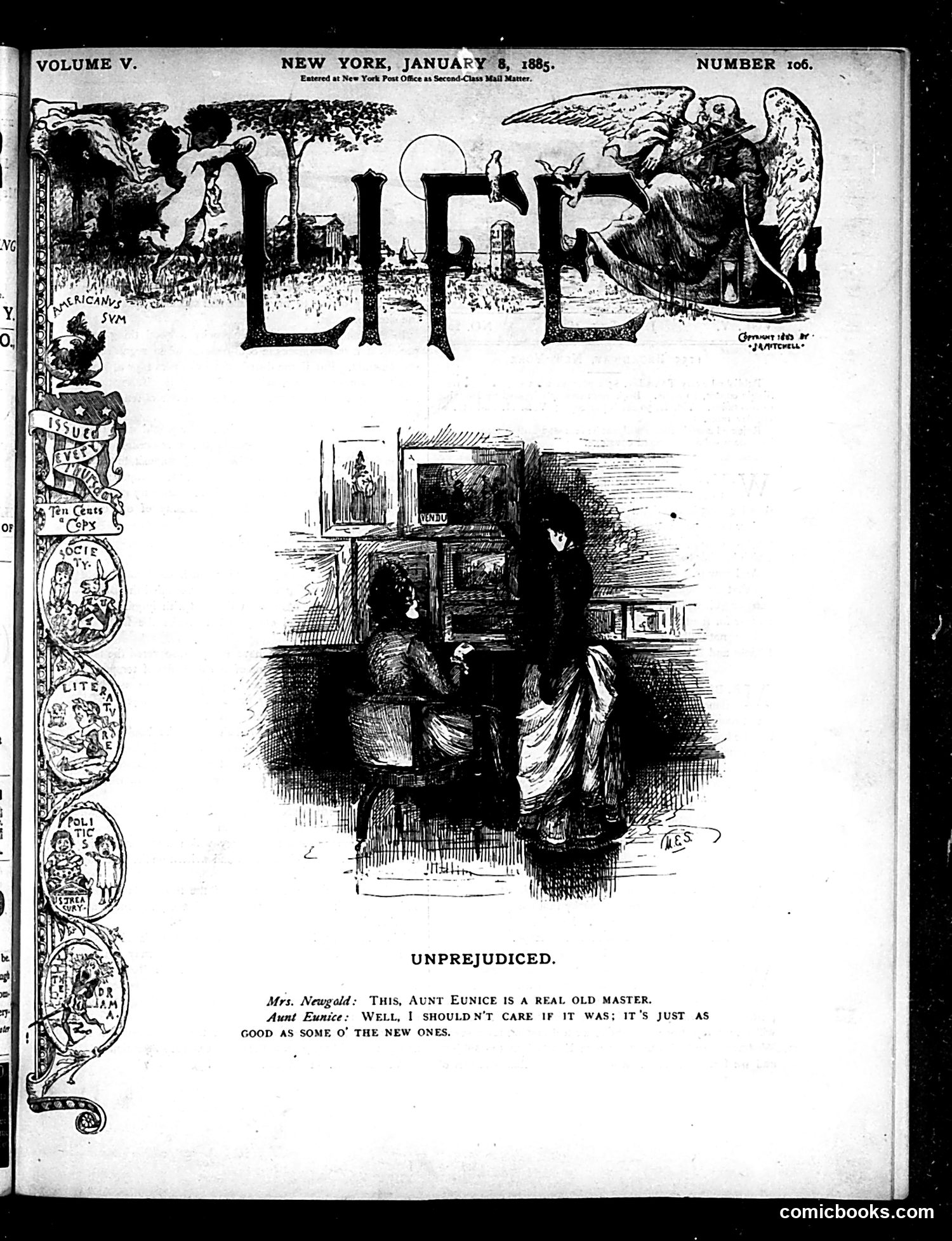
This page features a sketch titled "Unprejudiced" depicting two women in conversation by a window. The dialogue presents a social commentary on artistic taste and modernism. Mrs. Newgald praises "Aunt Eunice" as "a real old master"—likely referring to her painting or artistic work in traditional style. Aunt Eunice dismissively responds that she wouldn't care if it were traditional; it's "just as good as some o' the new ones." The satire mocks contemporary debates about modern versus classical art. Aunt Eunice's indifference to whether work follows old or new artistic conventions suggests criticism of both pretentious art criticism and the dismissal of new artistic movements. The joke lies in her practical, unpretentious view cutting through affected aesthetic arguments of the era.
The page contains editorial commentary rather than cartoons. The text addresses three political figures: **Mr. Blaine** (likely James G. Blaine, prominent Republican politician) is criticized for retiring to privacy after political defeat, with a quote comparing him to "skim-milk masquerades as cream." **Mr. Edson** is dismissed as insignificant and unworthy of discussion. **Spain and Nicaragua** treaties are discussed; the editors consult with "experts" before commenting, indicating Senate debate over foreign policy. The editors notably respond to **Mr. Sunset Cox's** accusation that *Life* plagiarized a play called "The Buntling Ball." They defend themselves by claiming ignorance of the book's authorship, sarcastically suggesting Cox himself wrote it. The tone is typical 1880s satirical journalism—dismissive, witty, and politically engaged.
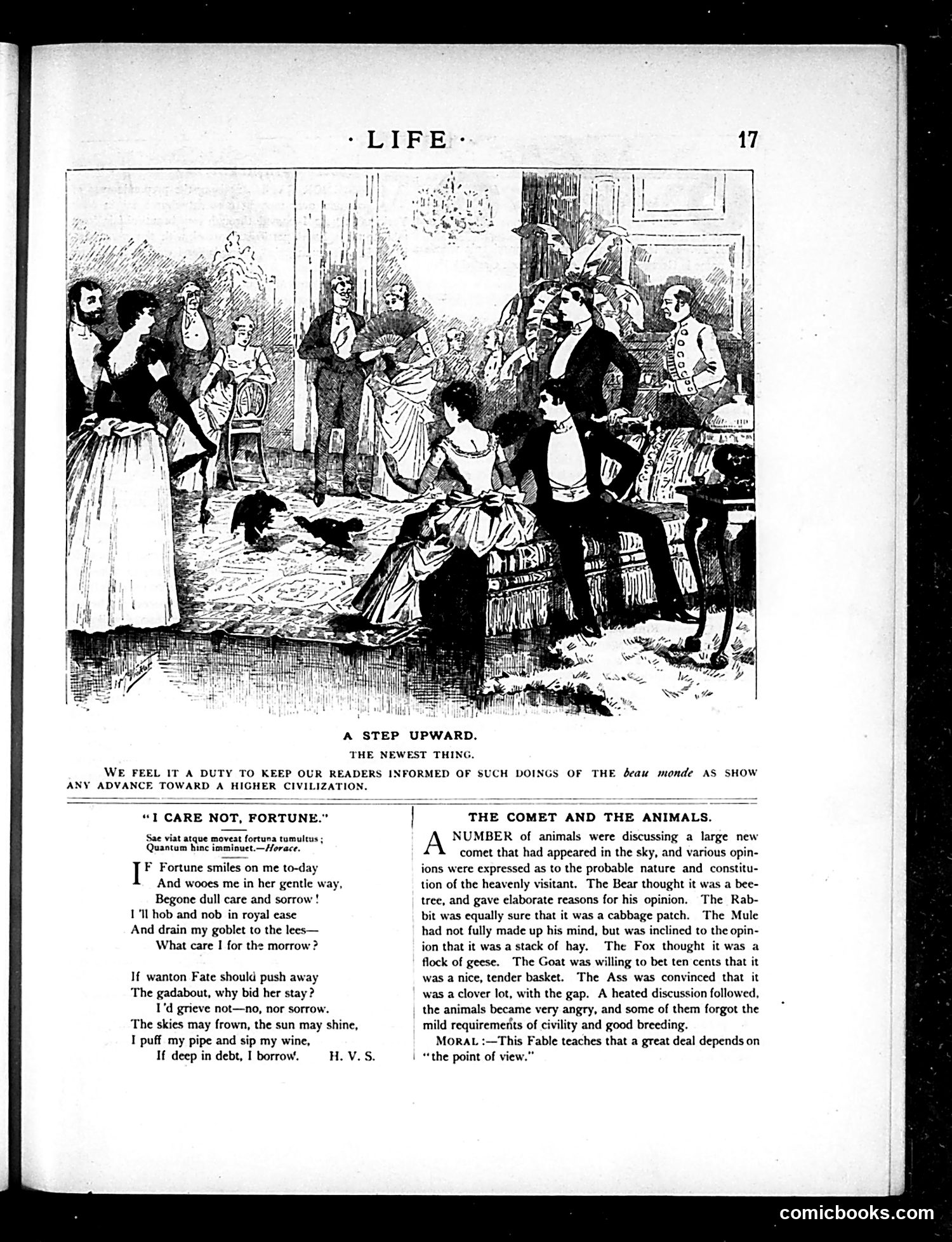
**"A Step Upward"** depicts a fashionable salon scene where well-dressed society figures gather. The caption notes this illustrates "the newest thing" in *beau monde* (high society) "doings" showing "advance toward a higher civilization." **"I Care Not, Fortune"** is a poem about stoic acceptance of fate's reversals, attributed to H.V.S. **"The Comet and the Animals"** is an Aesop's fable parody where various animals debate the nature of a newly-appeared comet. Their disagreement—tree, rabbit, mule, goose, goat, and ass each propose different explanations—escalates into anger. The moral teaches that "a great deal depends on the point of view," satirizing how people interpret the same phenomena through their own limited perspectives and biases.
This page contains **short satirical commentary** rather than political cartoons. The "By the Way" section critiques various topics: - A Pennsylvania infant named George Whitfield Scott Hancock Cortfield Partison Hendricks Cleveland Yerks, mocking excessively long naming conventions - English handling of tomato catsup and fishing poles (unclear what specific incident referenced) - A bridge theft in New York/Brooklyn - R. F. Flower's desire to bloom in the White House (likely a political figure, though identity unclear from context alone) - Butter smuggling across Niagara into Canada - South American political instability - A typographical error about a "blind pool" described as a "Blind Fool in Cotton" The "Bookishness" section reviews short-story collections. The humor relies on wordplay and absurdist exaggeration typical of satirical magazines of this era.
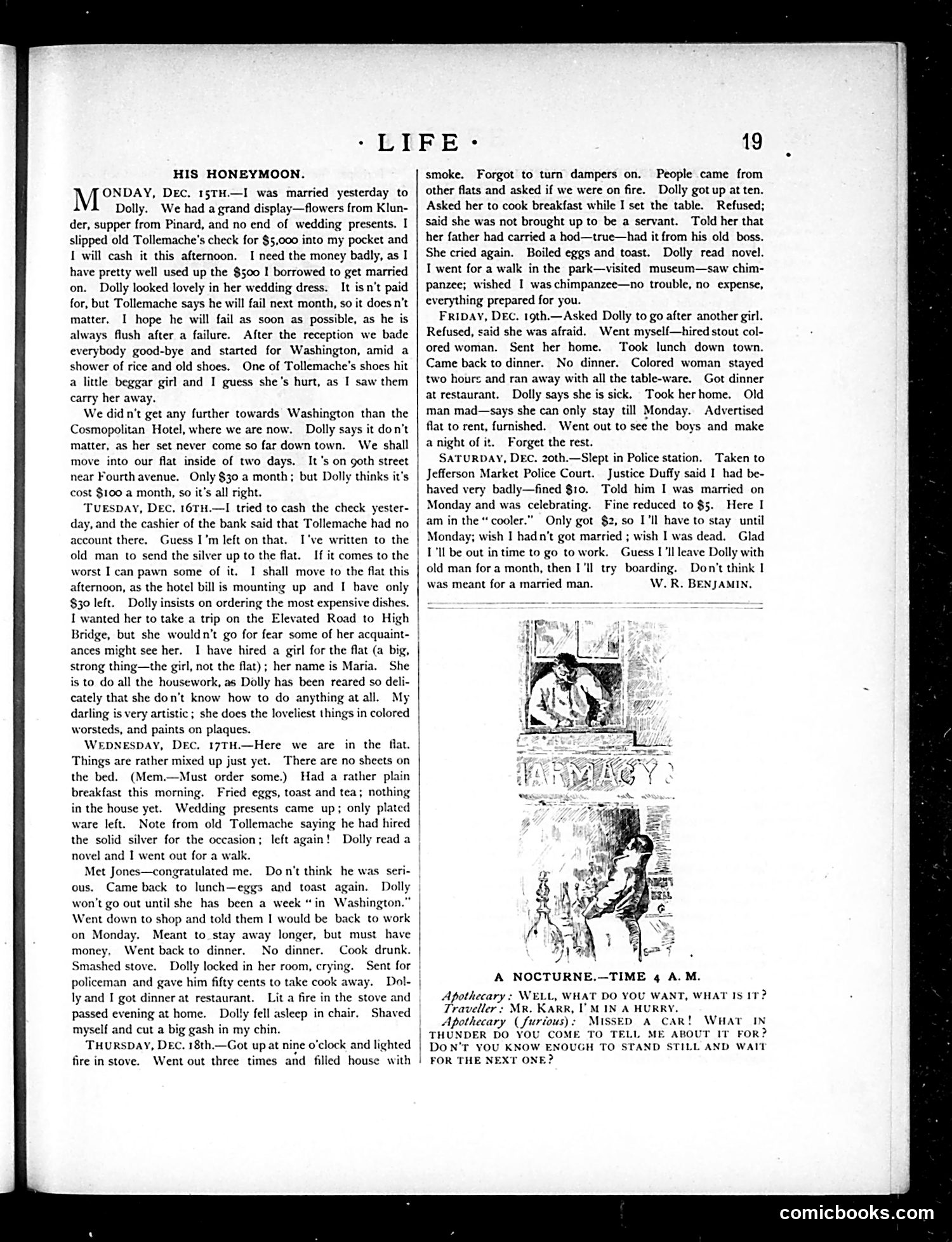
This page contains a first-person diary account titled "His Honeymoon" by W.R. Benjamin, describing newlywed struggles in a Washington, D.C. apartment. The text humorously documents domestic mishaps—unpaid bills, hiring household help, marital tensions, and a night in police custody over a cooking incident. The two sketched illustrations accompanying the text appear to depict scenes from this narrative: a man in domestic situations, likely illustrating the comedic misadventures described. Below is a separate satirical piece titled "A Nocturne" featuring dialogue between an Apothecary, Traveller, and Mr. Kark about missing a cab—wordplay-based humor typical of Life's satirical style. The humor targets newlywed domestic life and urban inconveniences of the era.
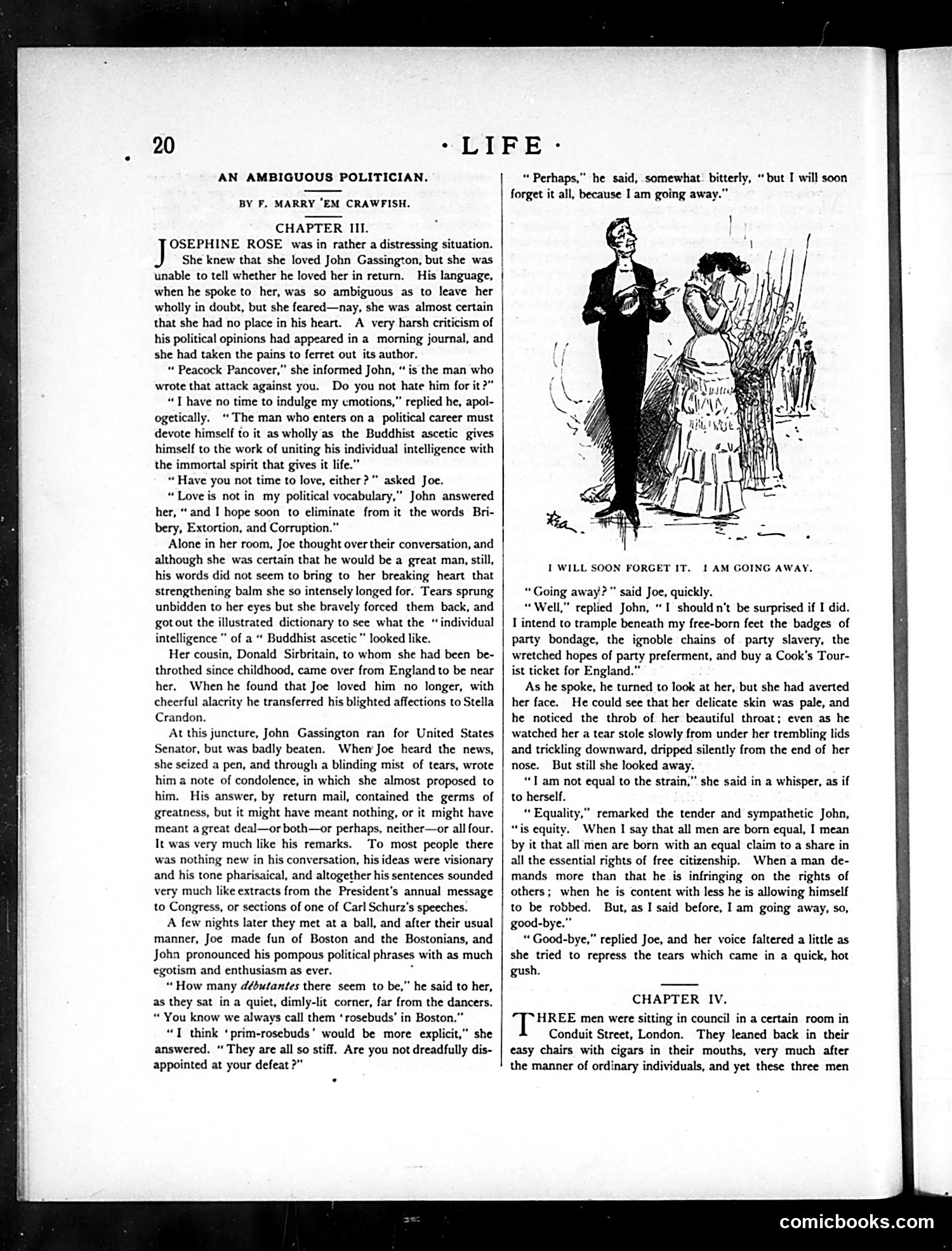
This page presents a serialized story rather than a political cartoon. The illustration shows a man in formal attire speaking to a woman in an emotional state, depicting a scene from the narrative about John Gassington, described as a politician with deliberately vague positions. The satire targets the "ambiguous politician"—a figure who speaks in abstract, idealistic language ("individual intelligence," "immortal gifts") while avoiding concrete commitments. John's dismissal of love and personal relationships as incompatible with political ambition, combined with his flowery but meaningless rhetoric, mocks politicians who hide behind elaborate phrasing rather than taking clear stances. The story critiques the detachment and duplicity of political figures of this era.
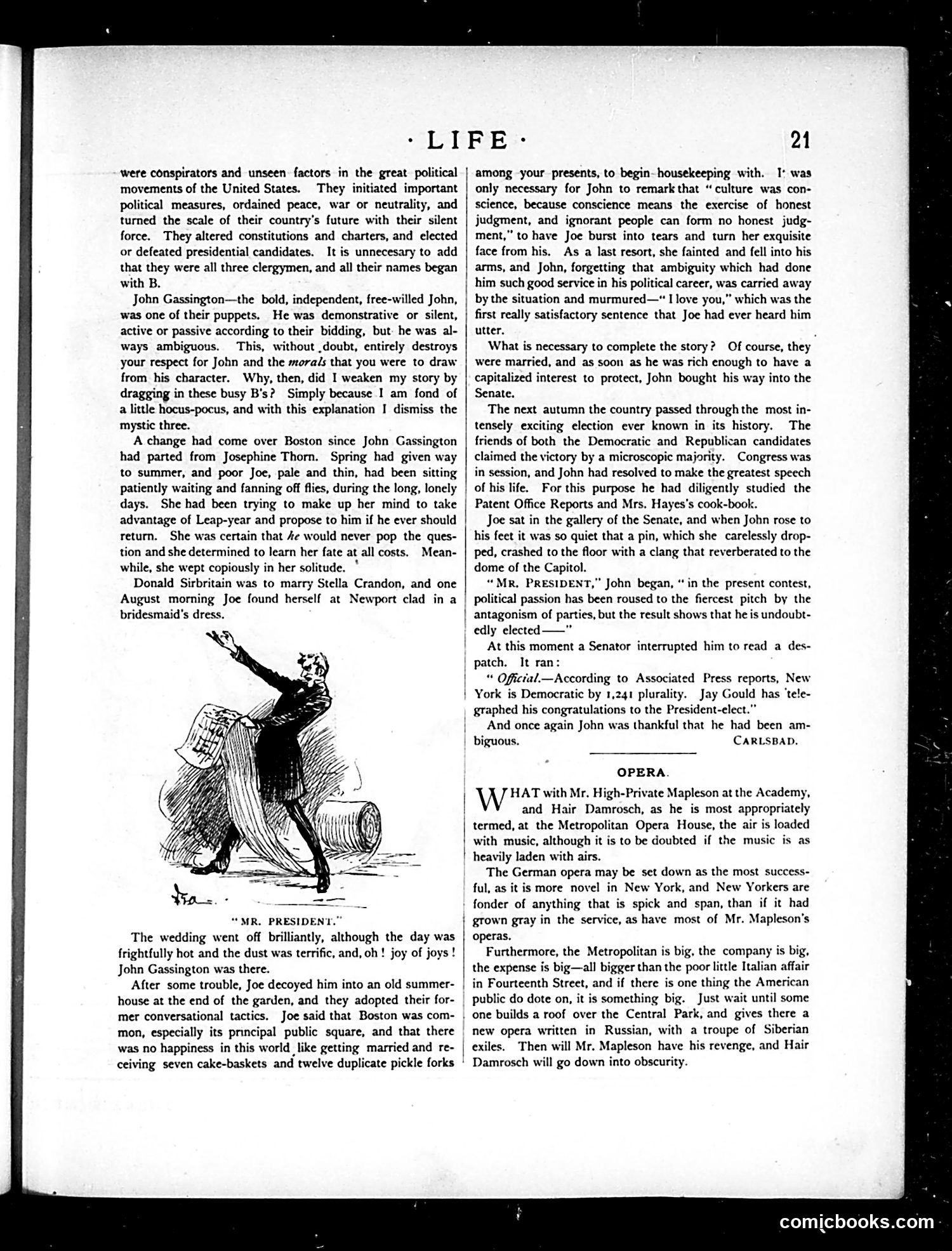
The cartoon titled "MR. PRESIDENT" depicts a figure in formal attire striking a triumphant pose. Based on the surrounding text discussing a recent presidential election where the Democratic candidate won by a narrow "microscopic majority," this likely represents the newly elected president celebrating victory. The satirical point targets the intense partisan conflict during the election—described as "the most intensely exciting election ever known in its history." The exaggerated, almost absurd victory pose mocks both the razor-thin margin of victory and the candidate's celebratory demeanor despite such a contentious, divisive campaign. The illustration captures the era's bitter political antagonism, suggesting the president's triumph is less impressive given how narrowly he prevailed.
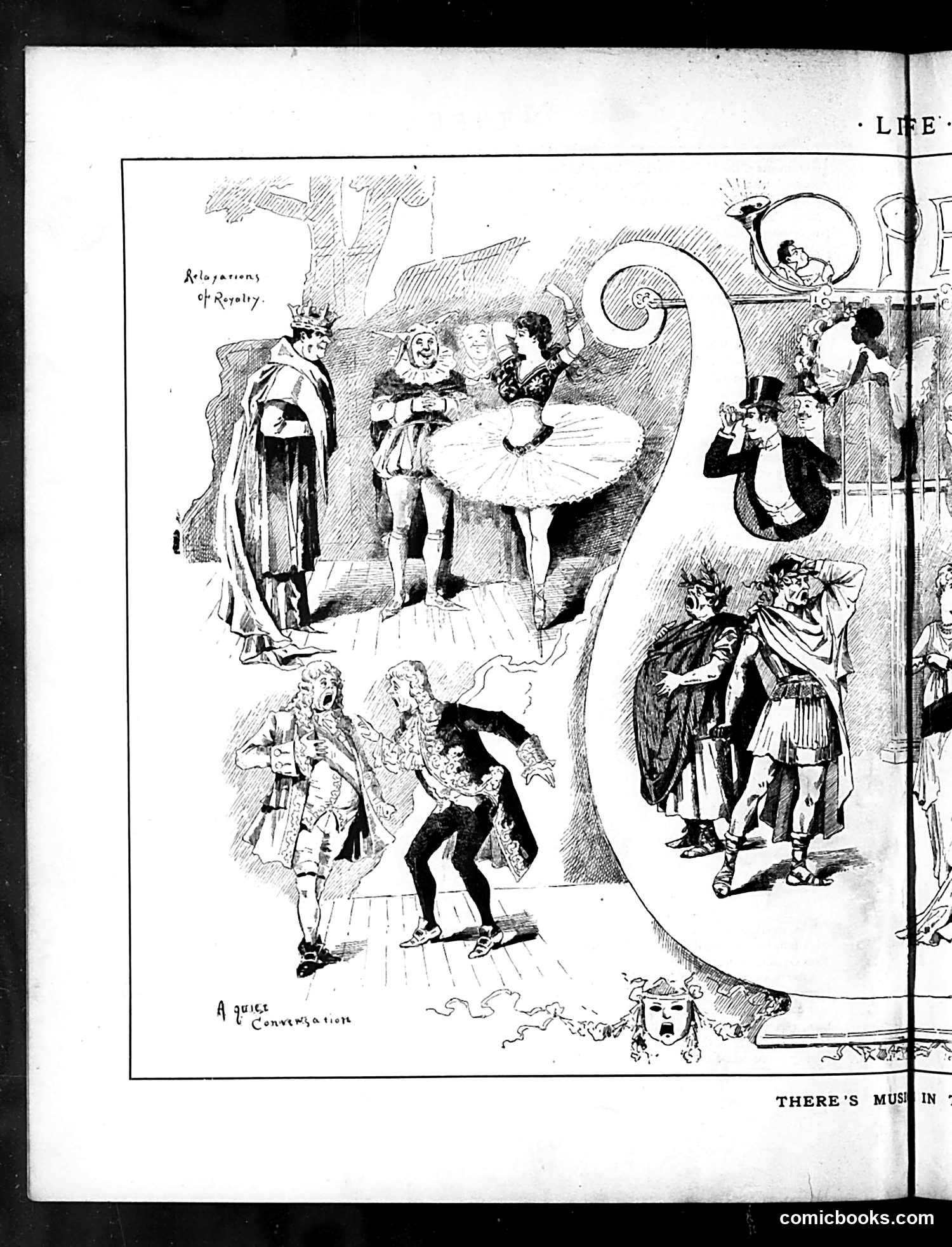
This page contains two satirical scenes labeled "Relaxation of Royalty" (top) and "A quiet Conversation" (bottom). The top scene depicts royal and aristocratic figures in an informal backstage or private setting. A crowned figure (likely a king) observes while performers—including what appears to be a ballerina and various entertainers—interact casually. The humor derives from the contrast between formal royal dignity and the undignified, relaxed behavior visible in private moments away from public view. The bottom scene shows what appears to be military or political figures engaged in animated discussion. The satire likely mocks how powerful figures conduct themselves when they believe no one of importance is watching. Both cartoons employ the common Life magazine formula of exposing the gap between public personas and private behavior among the elite.
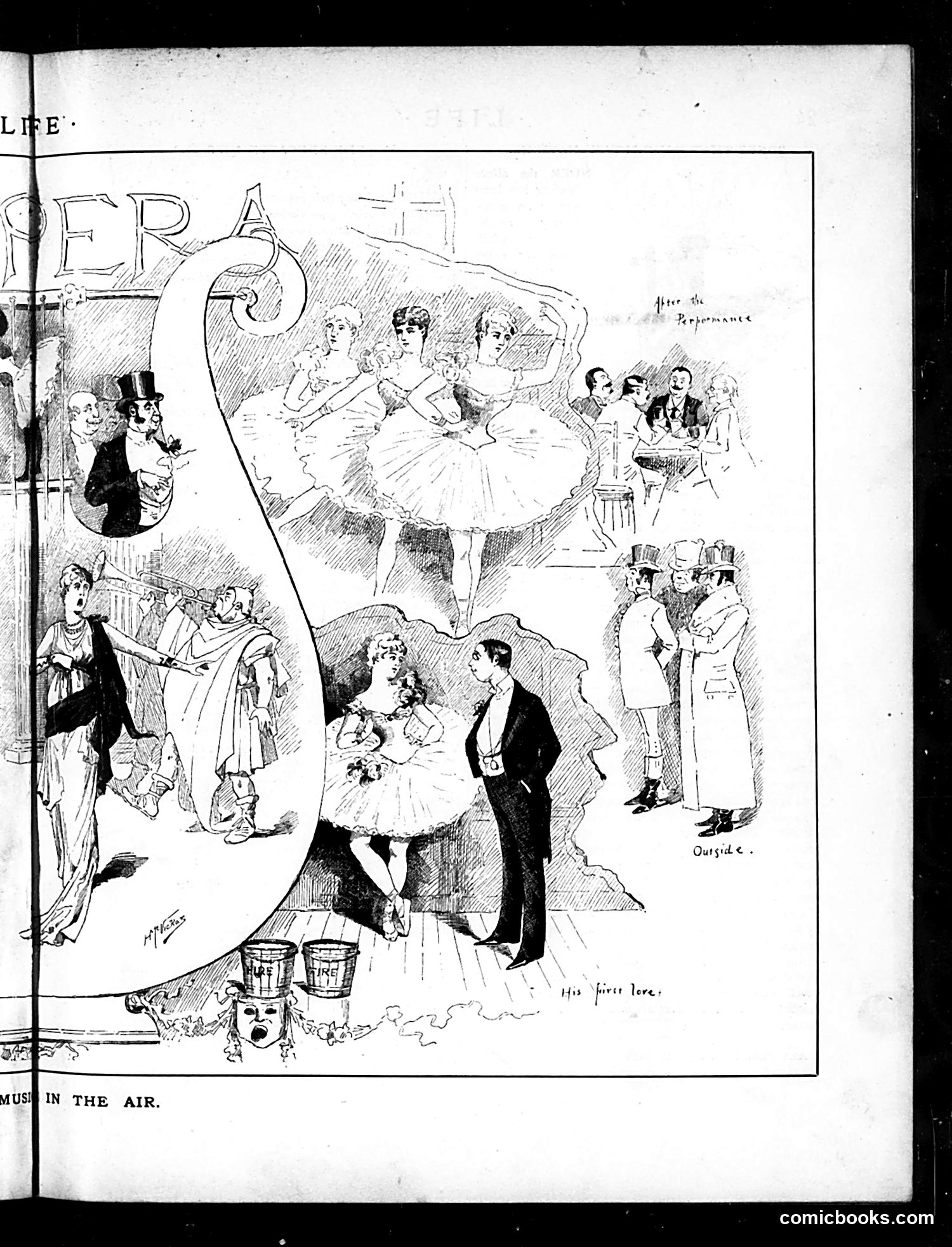
This satirical illustration depicts the social world of opera-going in what appears to be the late 19th or early 20th century. The central image shows a large opera house interior as a bubble or balloon, with various scenes of theatrical performance and audience behavior scattered around it. The cartoon satirizes different aspects of opera culture: performers on stage (center), wealthy patrons in boxes, and various social interactions among attendees. Handwritten labels reference "After the Performance" and "Outside," suggesting commentary on both the theatrical spectacle and the social pretensions surrounding it. The clown face at the bottom and the overall surreal composition suggest the artist is mocking the artificiality and absurdity of opera society—treating the entire cultural institution as inflated and somewhat ridiculous. The "air" in the title likely puns on both the musical arias and the pretentious "airs" of opera society.
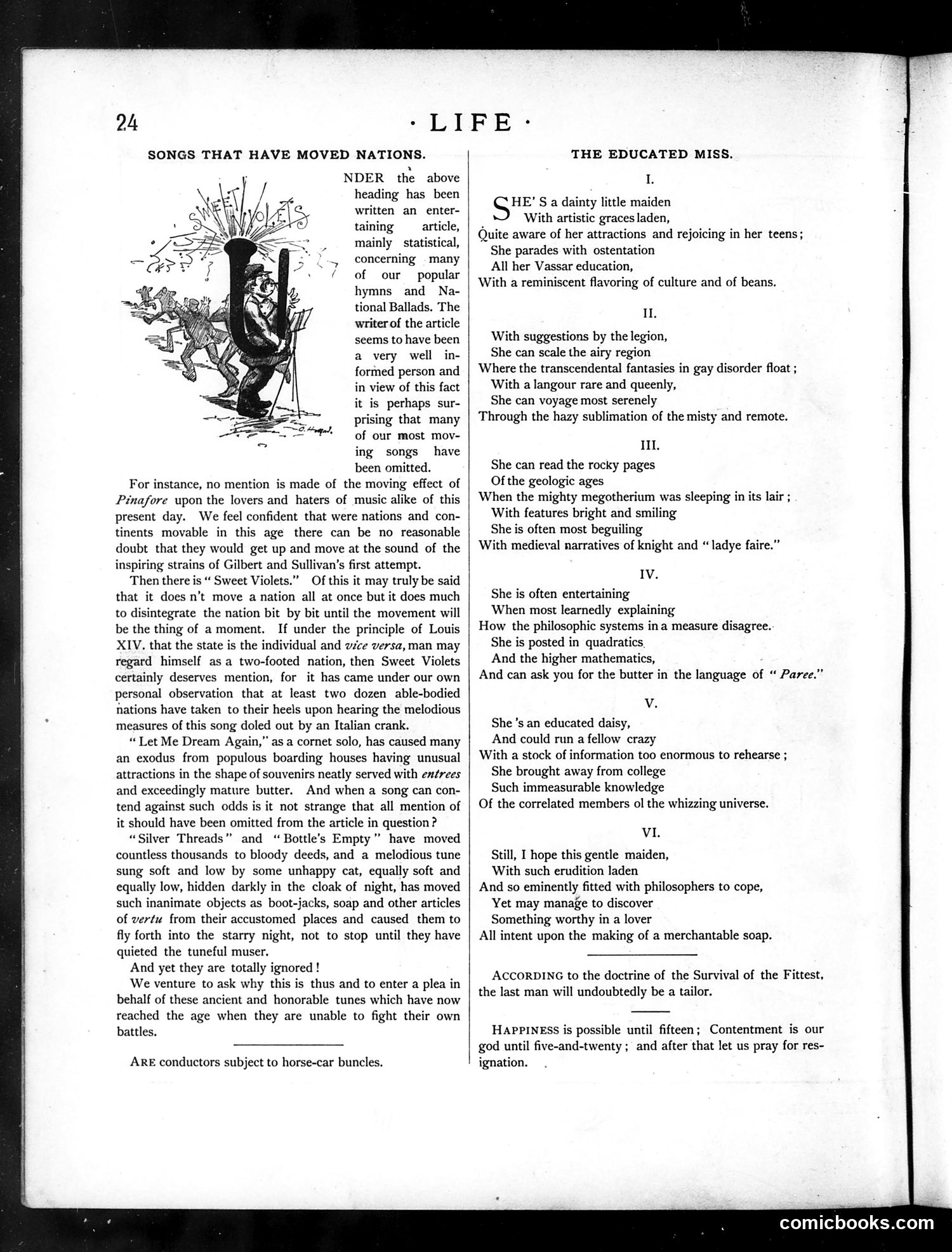
This page features a humorous satirical poem mocking the newly educated young woman of the era. The target is the "Vassar girl"—a graduate of the prestigious women's college—portrayed as intellectually pretentious yet fundamentally shallow. The satire works through exaggeration: she displays her education ostentatiously ("parades with ostentation"), discusses transcendental philosophy and geology, yet reduces her knowledge to parlor tricks and affected behavior. The joke culminates in stanza IV, where despite all her learning in quadratics and higher mathematics, she reverts to asking for butter—the ultimate deflation of her intellectual pretensions. The poem reflects late-19th-century anxieties about women's education, suggesting that female college graduates were impractical, affected, and ultimately unchanged in their fundamental domestic role. The left column discusses patriotic songs, creating an ironic juxtaposition between genuinely moving cultural works and this trivial "educated" figure.
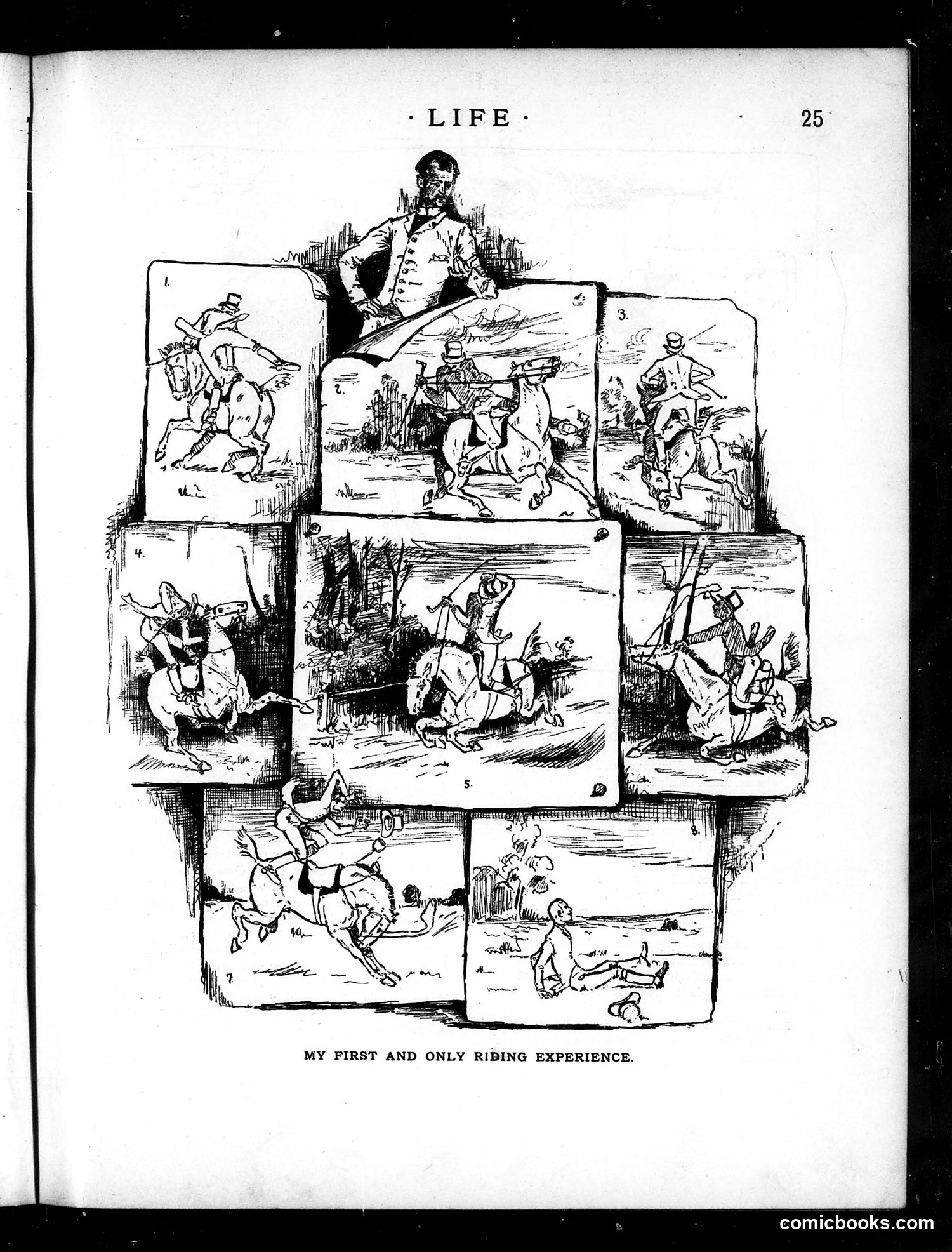
This is a humorous comic strip showing an instructor (in formal dress, prominently displayed at top) overseeing a novice rider's disastrous first horseback riding lesson. The eight sequential panels depict escalating comedy: the rider appears to fall or struggle with the horse repeatedly, ending in what looks like a complete tumble to the ground in the final panels. The joke is autobiographical satire—likely the cartoonist's own embarrassing introduction to horseback riding. The titled framing ("first and only") signals the punchline: after this experience, they never rode again. The formal instructor presiding over the increasingly chaotic scenes adds to the humor, suggesting this was meant to be a dignified learning experience that went comically wrong. The satire targets wealthy leisure activities and the gap between expectations and reality.
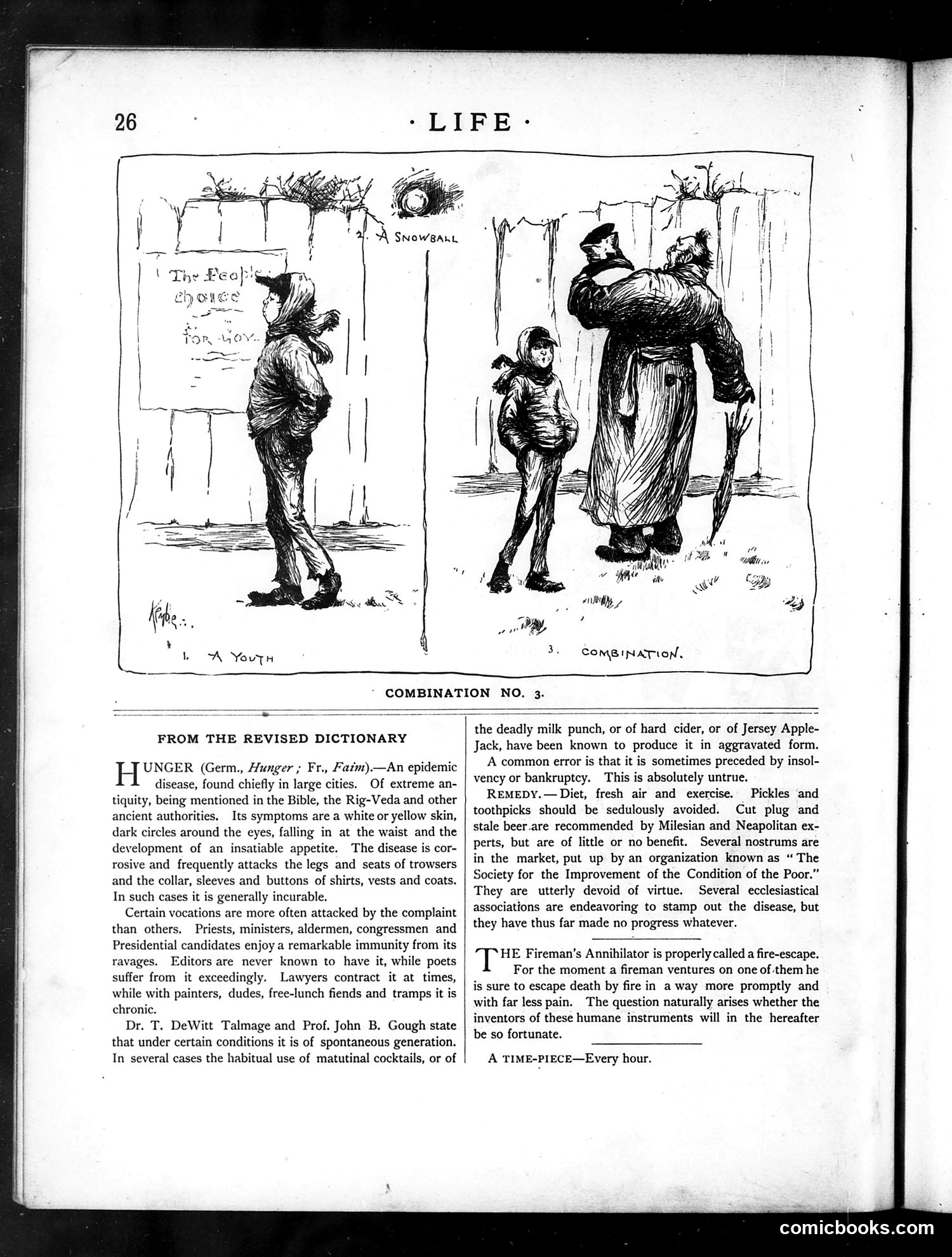
This page contains two satirical cartoons about urban poverty and a mock-dictionary entry on "Hunger." **The Cartoons:** The sketches show street scenes—a youth reading a "Real Estate" notice on a wall, and a woman with children. These illustrate the entry's subject. **The Satire:** The "Revised Dictionary" entry defines "Hunger" as a disease afflicting the poor, with bitter humor. It notes that politicians, clergy, editors, and officials are immune, while "poets suffer exceedingly" and it's "chronic" for "tramps." The remedy section mocks charitable organizations ("The Society for the Improvement of the Condition of the Poor") as useless. **The Point:** This is scathing social commentary on class inequality and hypocrisy. Life's editors mock both the wealthy's indifference to poverty and the ineffectiveness of contemporary charity. The joke is dark: "hunger" isn't really a disease—it's a symptom of systemic inequality that only affects the powerless, while the privileged remain untouched.
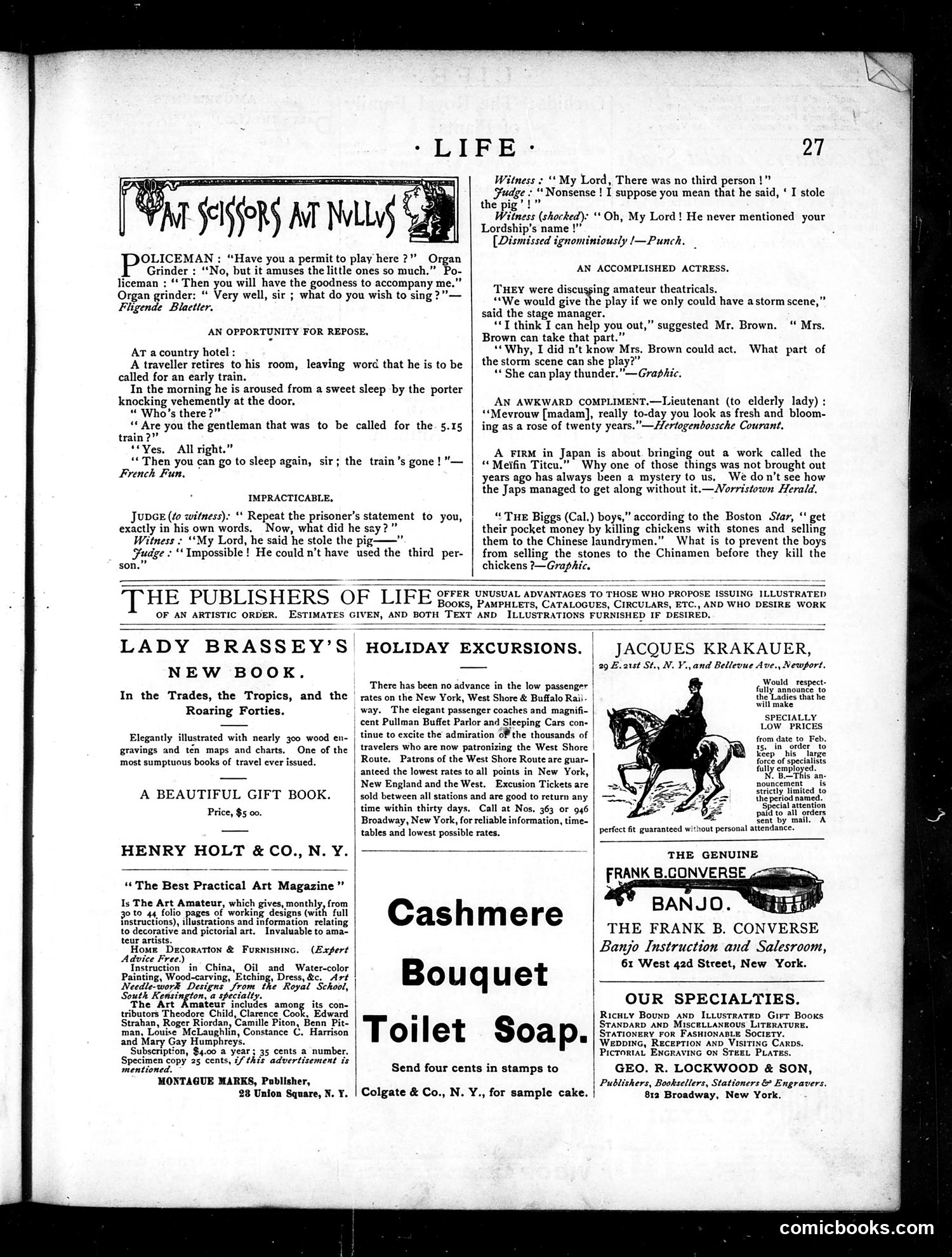
This page is primarily **advertising and reprinted jokes** rather than original political cartoons. The content consists of several brief, mostly non-political humorous anecdotes: Key items: A policeman stops an organ grinder (street musician), a hotel porter accidentally wakes a guest to announce the train has already left, a judge confused by a witness's testimony about a pig theft, and a stage manager joking that an actress "can play thunder" for a storm scene. **Political/social context**: The humor reflects period anxieties—street musicians were seen as nuisances requiring permits, railway timing was important in an industrial society, and amateur theatricals were popular middle-class entertainment. The judge's confusion satirizes legal pedantry. These are reprinted jokes from European publications (marked as from *Punch*, *Graphic*, *French Fun*), indicating *Life* magazine's practice of translating international humor for American readers. No specific modern political figures or events are referenced—the satire is purely domestic social observation.
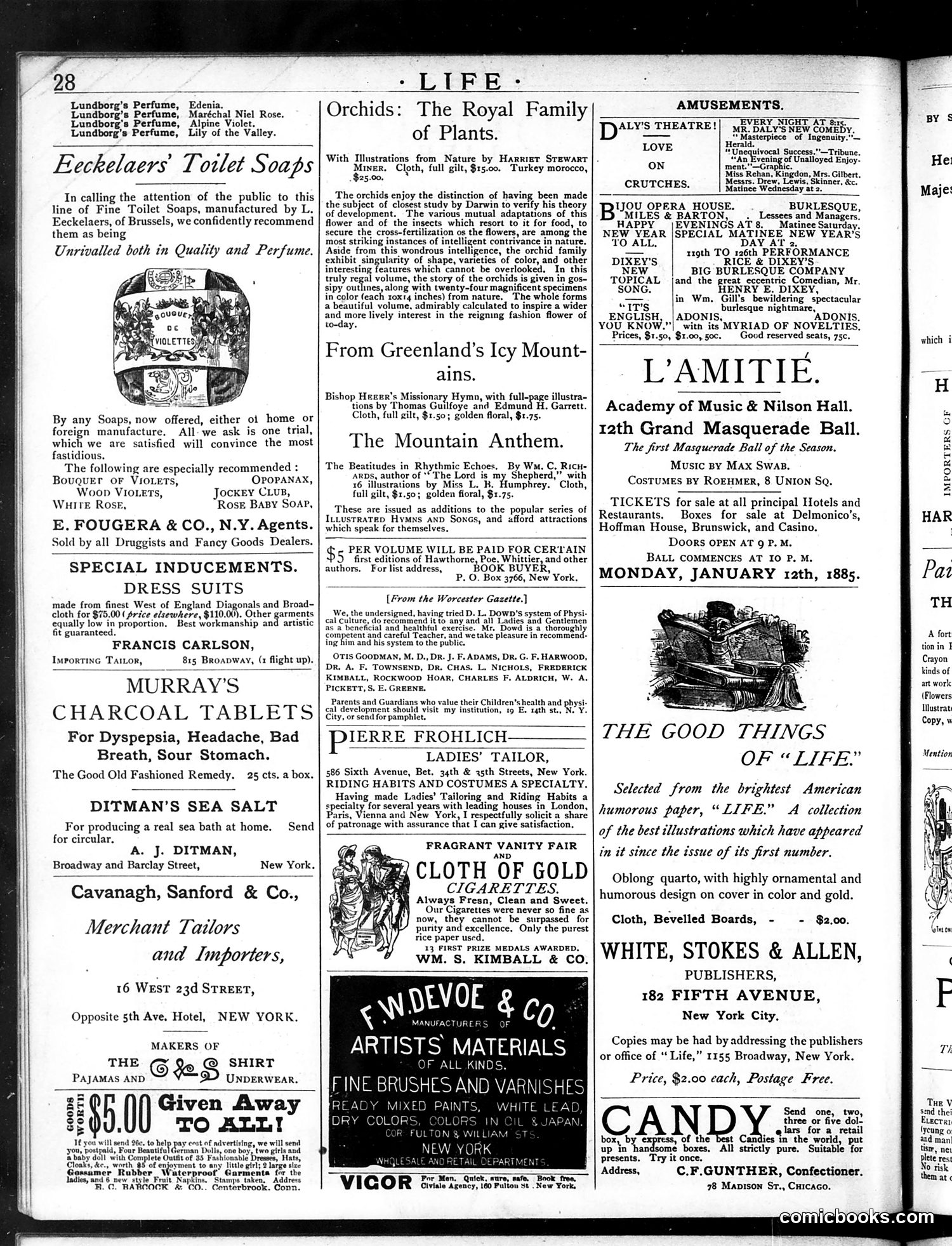
This page is almost entirely **advertisements and notices**, with minimal satirical content. The main illustrated elements are commercial ads: Eeckelaers' Toilet Soaps (Belgian luxury products), Eeckelaers' perfume, and at bottom, Cloth of Gold Cigarettes, featuring a woman's face. There is also an ad for F.W. Devoe & Co. Artists' Materials. The page includes book advertisements (orchids, religious hymns) and a substantial promotion for free dolls and goods as payment for helping with advertising distribution—a direct-mail giveaway scheme typical of 1880s marketing. **No clear political cartoon or satire is visible.** This appears to be a standard advertising page from *Life* magazine (January 12, 1885, based on visible text). While *Life* was known for satirical content, this particular page serves primarily as commercial space, reflecting how 19th-century magazines funded themselves through advertising.
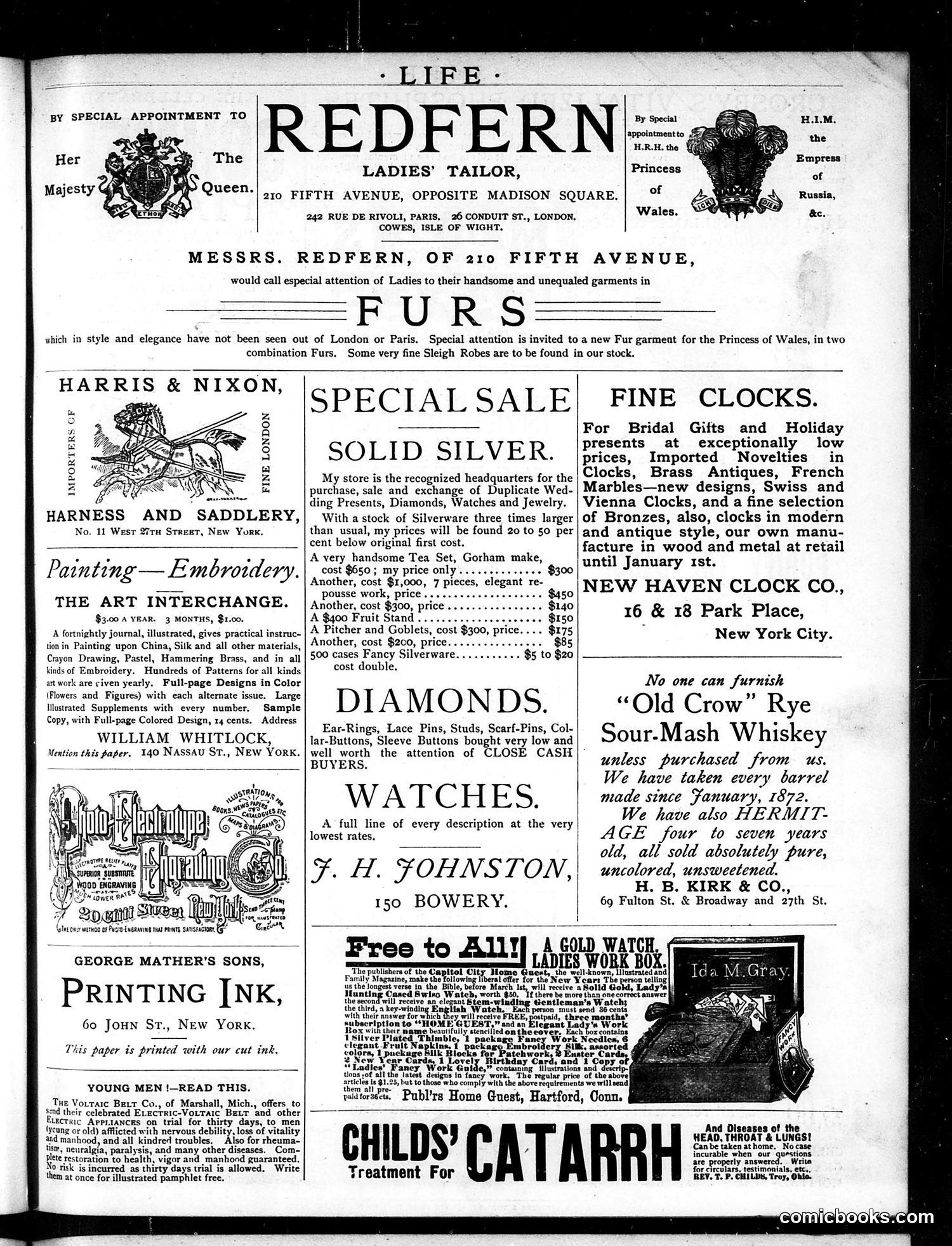
This is primarily an **advertising page** from Life magazine, not a satirical cartoon. The page is filled with commercial advertisements for luxury goods and services aimed at wealthy American consumers of the late 19th century. The most prominent advertisement is for **Redfern**, a prestigious ladies' tailor with locations in New York, Paris, and London. The advertisement boasts royal patronage (by appointment to the Queen and the Princess of Wales, and the Empress of Russia) and highlights their fur garments, particularly a new design for the Princess of Wales. Other notable ads include jewelry dealers, printing ink, clocks, silverware, watches, diamonds, and patent medicines (an electric belt claiming to cure various male ailments). The page reflects the era's class divisions: such goods and services were accessible only to the wealthy elite. The repeated emphasis on royal appointments and imported European goods reveals aspirational consumer culture among America's wealthy—the prestige of European luxury goods was a major marketing appeal.
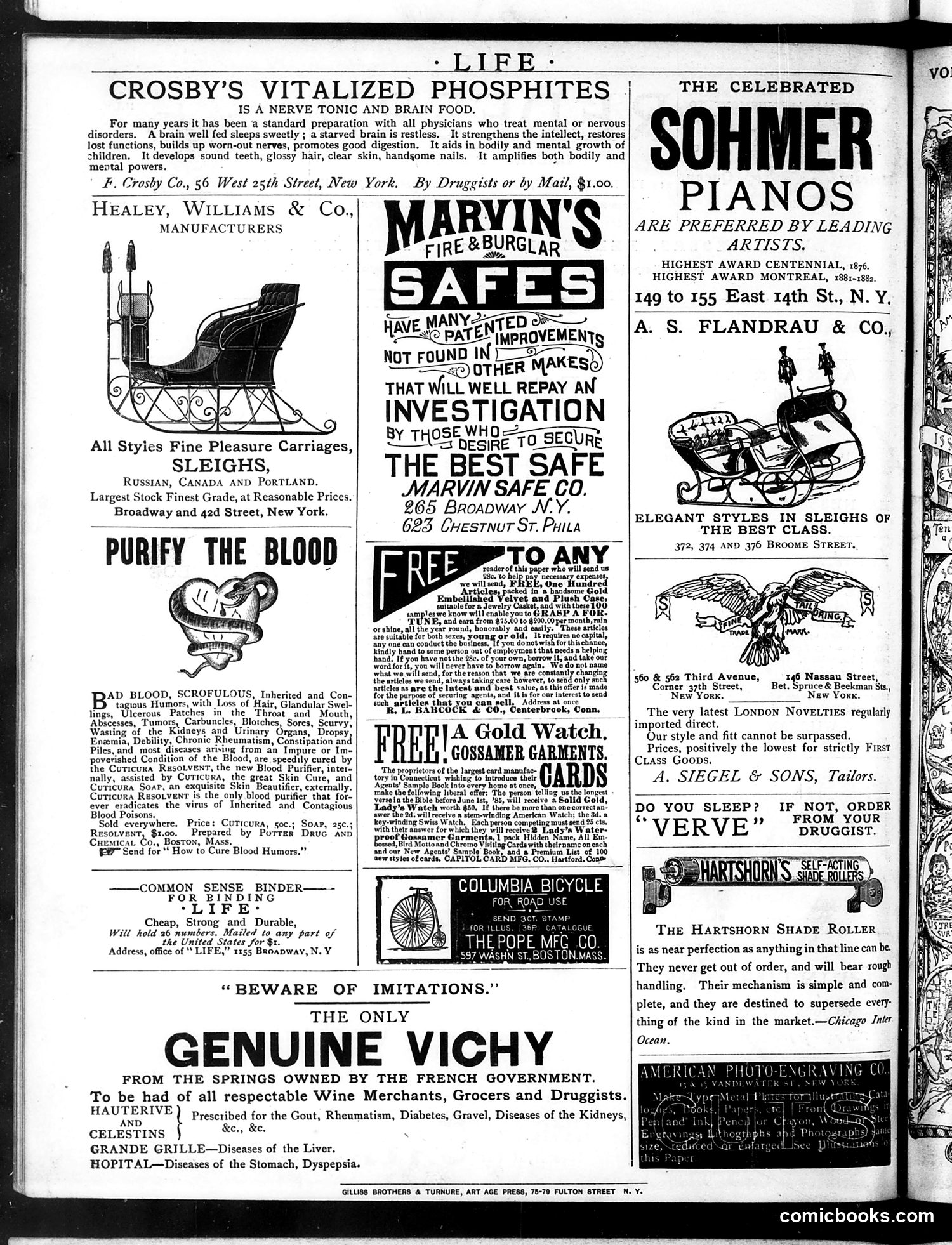
This page is primarily **advertising**, not editorial content or satire. It contains roughly a dozen product advertisements typical of early 20th-century American commerce, including: - Crosby's Vitalized Phosphites (nerve tonic) - Marvin's Fire & Burglar Safes - Sohmer Pianos - Fine pleasure carriages/sleighs - Blood purifiers - Vichy water (mineral spring beverage) - Columbia bicycles - Hartshorn Shade Rollers The ads reflect period concerns: health tonics for "mental or nervous disorders," home security safes, and luxury goods. There are no political cartoons or social satire visible—this appears to be a standard revenue page from *Life* magazine's advertising section, showcasing consumer products and services marketed to middle and upper-class readers of that era.