
Life, 1885-01-08 · page 4 of 16
Life — January 8, 1885 — page 4: what you’re looking at
What you’re looking at
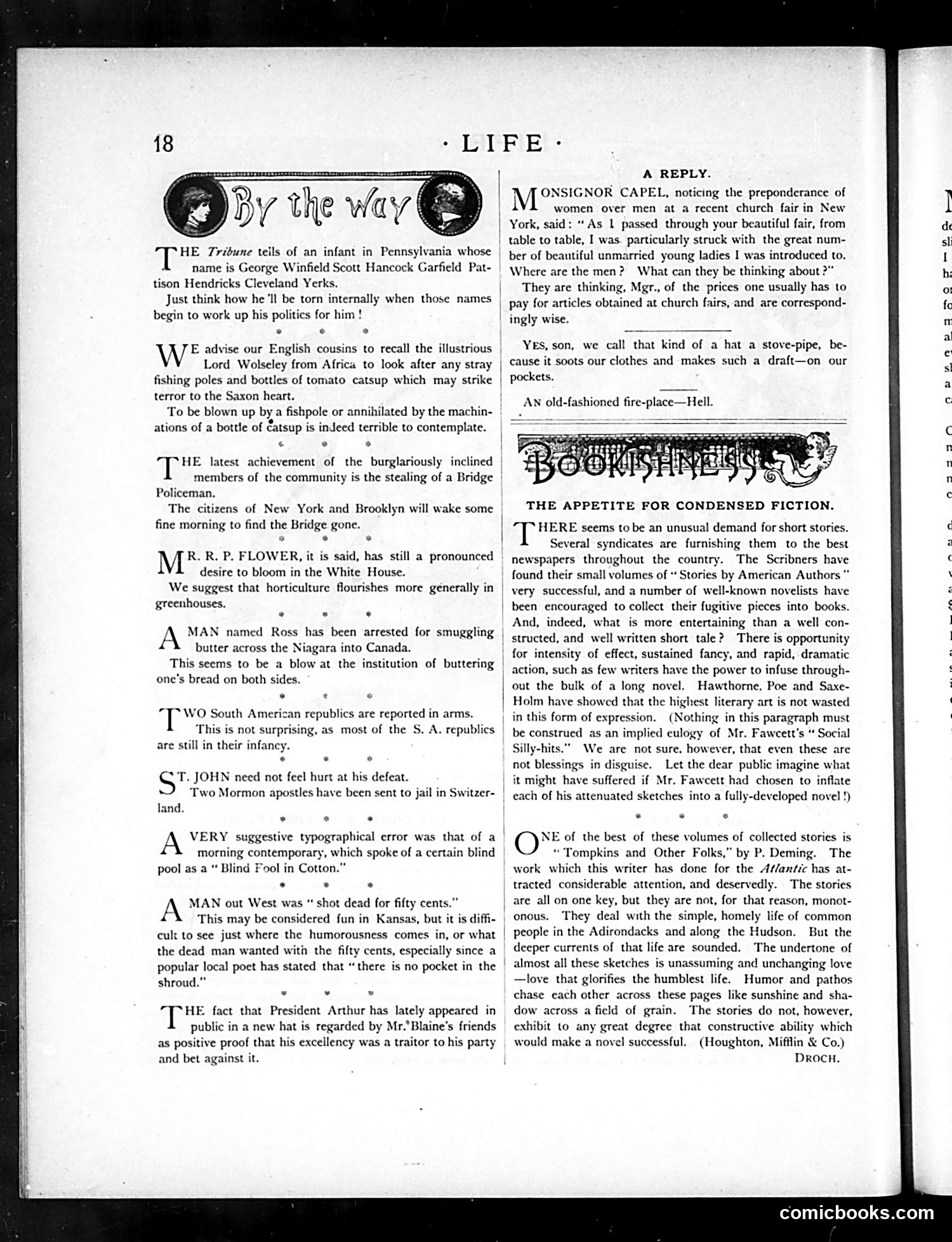
This page contains **short satirical commentary** rather than political cartoons. The "By the Way" section critiques various topics: - A Pennsylvania infant named George Whitfield Scott Hancock Cortfield Partison Hendricks Cleveland Yerks, mocking excessively long naming conventions - English handling of tomato catsup and fishing poles (unclear what specific incident referenced) - A bridge theft in New York/Brooklyn - R. F. Flower's desire to bloom in the White House (likely a political figure, though identity unclear from context alone) - Butter smuggling across Niagara into Canada - South American political instability - A typographical error about a "blind pool" described as a "Blind Fool in Cotton" The "Bookishness" section reviews short-story collections. The humor relies on wordplay and absurdist exaggeration typical of satirical magazines of this era.
📄 Transcribed text from this page (OCR, searchable)
Machine-transcribed from the original scan — historical spelling and the odd misread are preserved.
-LIFE: HE 7rsbune teils of an infant in Pennsylvania whose name is George Winfield Scott Hancock Garfield Pat- tison Hendricks Cleveland Yerks. Just think how he ‘ll be torn internally when those names begin to work up his politics for him! * e * WE advise our English cousins to recall the illustrious Lord Wolseley from Africa to look after any stray | fishing poles and bottles of tomato catsup which may strike | terror to the Saxon heart. To be blown up by a fishpole or annihilated by the machin- ations of a bottle of éatsup is indeed terrible to contemplate. * . * HE latest achievement of the burglariously inclined members of the community is the stealing of a Bridge Policeman. The citizens of New York and Brooklyn will wake some fine morning to find the Bridge gone. ° * . R.R. P. FLOWER, it is said, has still a pronounced desire to bloom in the White House. We suggest that horticulture flourishes more generally in greenhouses, * . * MAN named Ross has been arrested for smuggling butter across the Niagara into Canada. This seems to be a blow at the institution of buttering one's bread on both sides. . ‘ « p WO South American republics are reported in arms. This is not surprising, as most of the S. A. republics are still in their infancy. ° * * ~ T. JOHN need not feel hurt at his defeat. Two Mormon apostles have been sent to jail in Switzer- land. . * . VERY suggestive typographical error was that of a morning contemporary, which spoke of a certain blind pool as a “ Blind Fool in Cotton.” . . * L MAN out West was “ shot dead for fifty cents.” This may be considered fun in Kansas, but it is diffi- cult to see just where the humorousness comes in, or what the dead man wanted with the fifty cents, especially since a popular local poet has stated that “there is no pocket in the shroud.” * . » HE fact that President Arthur has lately appeared in public in a new hat is regarded by Mr.*Blaine’s friends as positive proof that his excellency was a traitor to his party and bet against it. A REPLY. | Mossicnok CAPEL, noticing the preponderance of I women over men at a recent church fair in New York, said: “As 1 passed through your beautiful fair, from | table to table, I was. particularly struck with the great num- ber of beautiful unmarried young ladies | was introduced to. Where are the men? What can they be thinking about ?” They are thinking, Mgr., of the prices one usually has to pay for articles obtained at church fairs, and are correspond- ingly wise. YES, son, we call that kind of a hat a stove-pipe, be- cause it soots our clothes and makes such a draft—on our pockets. AN old-fashioned fire-place—Hell. THE APPETITE FOR CONDENSED FICTION. HERE seems to be an unusual demand for short stories. Several syndicates are furnishing them to the best newspapers throughout the country. The Scribners have found their small volumes of * Stories by American Authors ” very successful, and a number of well-known novelists have been encouraged to collect their fugitive pieces into books. And, indeed, what is more entertaining than a well con- structed, and well written short tale? There is opportunity for intensity of effect, sustained fancy, and rapid, dramatic action, such as few writers have the power to infuse through- | out the bulk of a long novel. Hawthorne, Poe and Saxe- Holm have showed that the highest literary art is not wasted in this form of expression. (Nothing in this paragraph must be construed as an implied eulogy of Mr. Fawcett's “ Social Silly-hits.” We are not sure, however, that even these are not blessings in disguise. Let the dear public imagine what it might have suffered if Mr. Fawcett had chosen to inflate each of his attenuated sketches into a fully-developed novel !) . . . NE of the best of these volumes of collected stories is “Tompkins and Other Folks,” by P. Deming. The work which this writer has done for the Af/antic has at- tracted considerable attention, and deservedly. The stories are all on one key, but they are not, for that reason, monot- onous. They deal with the simple, homely life of common people in the Adirondacks and along the Hudson. But the deeper currents of that life are sounded. The undertone of almost all these sketches is unassuming and unchanging love —love that glorifies the humblest life. Humor and pathos chase each other across these pages like sunshine and sha- dow across a field of grain. The stories do not, however, exhibit to any great degree that constructive ability which would make a novel successful. (Houghton, Mifflin & Co.) Drocu. comicbooks.com