
Life, 1885-01-08 · page 6 of 16
Life — January 8, 1885 — page 6: what you’re looking at
What you’re looking at
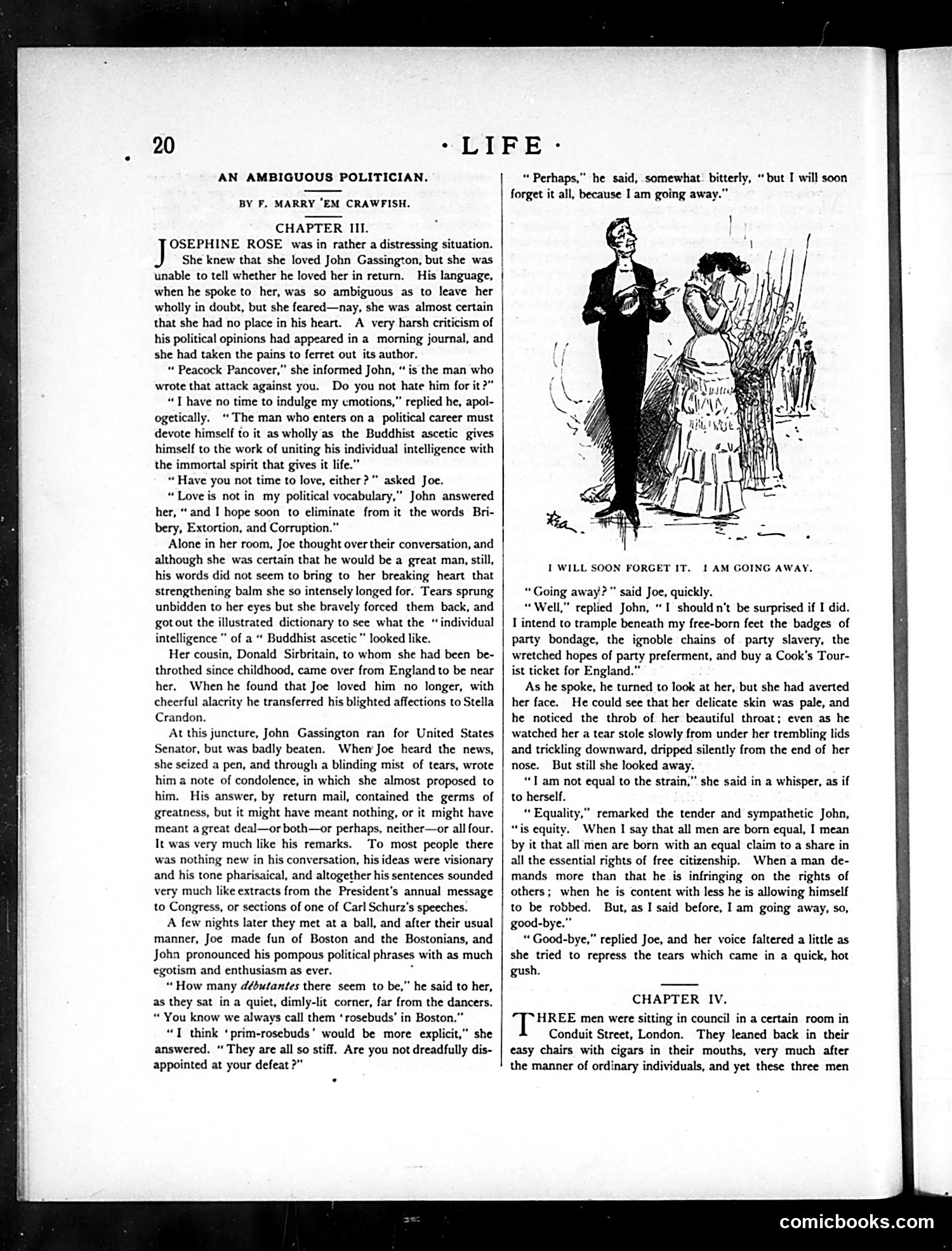
This page presents a serialized story rather than a political cartoon. The illustration shows a man in formal attire speaking to a woman in an emotional state, depicting a scene from the narrative about John Gassington, described as a politician with deliberately vague positions. The satire targets the "ambiguous politician"—a figure who speaks in abstract, idealistic language ("individual intelligence," "immortal gifts") while avoiding concrete commitments. John's dismissal of love and personal relationships as incompatible with political ambition, combined with his flowery but meaningless rhetoric, mocks politicians who hide behind elaborate phrasing rather than taking clear stances. The story critiques the detachment and duplicity of political figures of this era.
📄 Transcribed text from this page (OCR, searchable)
Machine-transcribed from the original scan — historical spelling and the odd misread are preserved.
* LIFE: AN AMBIGUOUS POLITICIAN. | BY F. MARRY 'EM CRAWFISH. CHAPTER III. OSEPHINE ROSE was in rather a distressing situation. She knew that she loved John Gassington, but she was unable to tell whether he loved her in return. His language, | when he spoke to her, was so ambiguous as to leave her | wholly in doubt, but she feared—nay, she was almost certain that she had no place in his heart. A very harsh criticism of his political opinions had appeared in a morning journal, and she had taken the pains to ferret out its author. “ Peacock Pancover,” she informed John, “is the man who wrote that attack against you. Do you not hate him for it?” “T have no time to indulge my emotions,” replied he, apol- ogetically. ‘‘ The man who enters on a political career must devote himself to it as wholly as the Buddhist ascetic gives himself to the work of uniting his individual intelligence with the immortal spirit that gives it life.” “ Have you not time to love, either?” asked Joe. “Love is not in my political vocabulary,” John answered her, “and I hope soon to eliminate from it the words Bri- bery, Extortion, and Corruption.” Alone in her room, Joe thought over their conversation, and although she was certain that he would be a great man, still, his words did not seem to bring to her breaking heart that strengthening balm she so intensely longed for. Tears sprung unbidden to her eyes but she bravely forced them back, and gotout the illustrated dictionary to see what the “ individual intelligence " of a ‘* Buddhist ascetic" looked like. Her cousin, Donald Sirbritain, to whom she had been be- throthed since childhood, came over from England to be near her. When he found that Joe loved him no longer, with cheerful alacrity he transferred his blighted affections to Stella Crandon. At this juncture, John Gassington ran for United States Senator, but was badly beaten. When Joe heard the news, she seized a pen, and through a blinding mist of tears, wrote him a note of condolence, in which she almost proposed to him. His answer, by return mail, contained the germs of | greatness, but it might have meant nothing, or it might have | meant a great deal—or both—or perhaps, neither—or all four. It was very much like his remarks. To most people there was nothing new in his conversation, his ideas were visionary and his tone pharisaical, and altogether his sentences sounded very much like extracts from the President's annual message to Congress, or sections of one of Carl Schurz’s speeches. A few nights later they met at a ball, and after their usual manner, Joe made fun of Boston and the Bostonians, and John pronounced his pompous political phrases with as much egotism and enthusiasm as ever. i “How many débutantes there seem to be,” he said to her, as they sat in a quiet, dimly-lit corner, far from the dancers. “ You know we always call them ‘rosebuds’ in Boston.” “I think ‘prim-rosebuds’ would be more explicit,” she answered. “ They are all so stiff. Are you not dreadfully dis- appointed at your defeat ?” “ Perhaps,” he said, somewhat. bitterly, “but I will soon forget it all, because I am going away.” I WILL SOON FORGET IT. 1 AM GOING AWAY. “Going away?” said Joe, quickly. “Well,” replied John, “I shouldn't be surprised if I did. I intend to trample beneath my free-born feet the badges of party bondage, the ignoble chains of party slavery, the wretched hopes of party preferment, and buy a Cook's Tour- ist ticket for England.” As he spoke, he turned to look at her, but she had averted her face. He could see that her delicate skin was pale, and he noticed the throb of her beautiful throat; even as he watched her a tear stole slowly from under her trembling lids and trickling downward, dripped silently from the end of her nose. But still she looked away. “T am not equal to the strain,” she said in a whisper, as if to herself. “ Equality,” remarked the tender and sympathetic John, “is equity. When I say that all men are born equal, I mean by it that all men are born with an equal claim to a share in all the essential rights of free citizenship. When a man de- mands more than that he is infringing on the rights of others; when he is content with less he is allowing himself to be robbed. But, as I said before, I am going away, so, good-bye.” “Good-bye,” replied Joe, and her voice faltered a little as she tried to repress the tears which came in a quick, hot gush. CHAPTER IV. HREE men were sitting in council in a certain room in Conduit Street, London. They leaned back in their easy chairs with cigars in their mouths, very much after the manner of ordinary individuals, and yet these three men comicbooks.com