
Life, 1885-01-08 · page 2 of 16
Life — January 8, 1885 — page 2: what you’re looking at
What you’re looking at
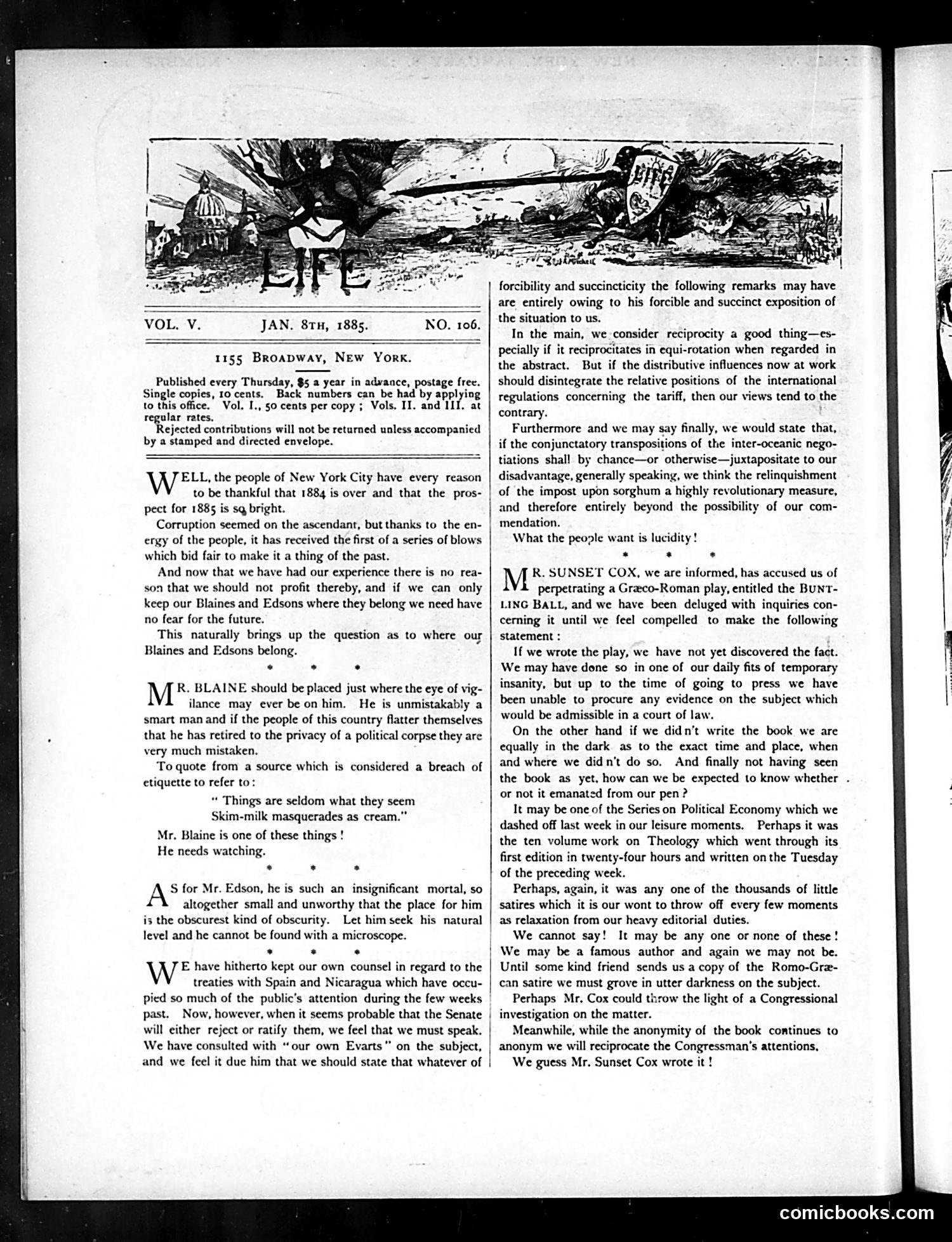
The page contains editorial commentary rather than cartoons. The text addresses three political figures: **Mr. Blaine** (likely James G. Blaine, prominent Republican politician) is criticized for retiring to privacy after political defeat, with a quote comparing him to "skim-milk masquerades as cream." **Mr. Edson** is dismissed as insignificant and unworthy of discussion. **Spain and Nicaragua** treaties are discussed; the editors consult with "experts" before commenting, indicating Senate debate over foreign policy. The editors notably respond to **Mr. Sunset Cox's** accusation that *Life* plagiarized a play called "The Buntling Ball." They defend themselves by claiming ignorance of the book's authorship, sarcastically suggesting Cox himself wrote it. The tone is typical 1880s satirical journalism—dismissive, witty, and politically engaged.
📄 Transcribed text from this page (OCR, searchable)
Machine-transcribed from the original scan — historical spelling and the odd misread are preserved.
1155 Broapway, NEw York. Published every Thursday, $5 a year in advance, postage free. Single copies, 10 cents. Back numbers can be had by applying to this office. Vol. I., 50 cents per copy ; Vols. II. and IIT. at regular rates. Rejected contributions will not be returned unless accompanied by a stamped and directed envelope. ELL, the people of New York City have every reason to be thankful that 1884 is over and that the pros- | pect for 1885 is sq bright. Corruption seemed on the ascendant, but thanks to the en- ergy of the people, it has received the first of a series of blows which bid fair to make it a thing of the past. And now that we have had our experience there is no rea- son that we should not profit thereby, and if we can only keep our Blaines and Edsons where they belong we need have no fear for the future. This naturally brings up the question as to where our Blaines and Edsons belong. . ° . R. BLAINE should be placed just where the eye of vig- ilance may ever be on him. He is unmistakably a smart man and if the people of this country flatter themselves that he has retired to the privacy of a political corpse they are very much mistaken. To quote from a source which is considered a breach of etiquette to refer to: “ Things are seldom what they seem Skim-milk masquerades as cream.” Mr. Blaine is one of these things ! He needs watching. . . * S for Mr. Edson, he is such an insignificant mortal, so altogether small and unworthy that the place for him is the obscurest kind of obscurity. Let him seek his natural level and he cannot be found with a microscope. . . . E have hitherto kept our own counsel in regard to the treaties with Spain and Nicaragua which have occu- pied so much of the public's attention during the few weeks past. Now, however, when it seems probable that the Senate | will either reject or ratify them, we feel that we must speak. | We have consulted with “our own Evarts” on the subject, and we feel it due him that we should state that whatever of | forcibility and succincticity the following remarks may have | are entirely owing to his forcible and succinct exposition of the situation to us. In the main, we consider reciprocity a good thing—es- pecially if it reciprocitates in equi-rotation when regarded in the abstract. But if the distributive influences now at work should disintegrate the relative positions of the international regulations concerning the tariff, then our views tend to the contrary. Furthermore and we may say finally, we would state that, if the conjunctatory transpositions of the inter-oceanic nego- tiations shal! by chance—or otherwise—juxtapositate to our disadvantage, generally speaking, we think the relinquishment of the impost upon sorghum a highly revolutionary measure, and therefore entirely beyond the possibility of our com- mendation. What the people want is lucidity ! * . . R. SUNSET COX, we are informed, has accused us of perpetrating a Greco-Roman play, entitled the BUNT- LING BALL, and we have been deluged with inquiries con- cerning it until we feel compelled to make the following statement : If we wrote the play, we have not yet discovered the fact. We may have done so in one of our daily fits of temporary insanity, but up to the time of going to press we have been unable to procure any evidence on the subject which would be admissible in a court of law. | On the other hand if we didn’t write the book we are equally in the dark as to the exact time and place, when and where we didn’t do so, And finally not having seen or not it emanated from our pen ? It may be one of the Series on Political Economy which we dashed off last week in our leisure moments. Perhaps it was the ten volume work on Theology which went through its first edition in twenty-four hours and written onthe Tuesday of the preceding week. Perhaps, again, it was any one of the thousands of little satires which it is our wont to throw off every few moments as relaxation from our heavy editorial duties. We cannot say! It may be any one or none of these! | We may be a famous author and again we may not be. Until some kind friend sends us a copy of the Romo-Grz- can satire we must grove in utter darkness on the subject. Perhaps Mr. Cox could throw the light of a Congressional investigation on the matter. Meanwhile, while the anonymity of the book continues to anonym we will reciprocate the Congressman’s attentions, We guess Mr. Sunset Cox wrote it! the book as yet, how can we be expected to know whether . comicbooks.com