
A complete issue · 16 pages · 1884
Life — July 31, 1884
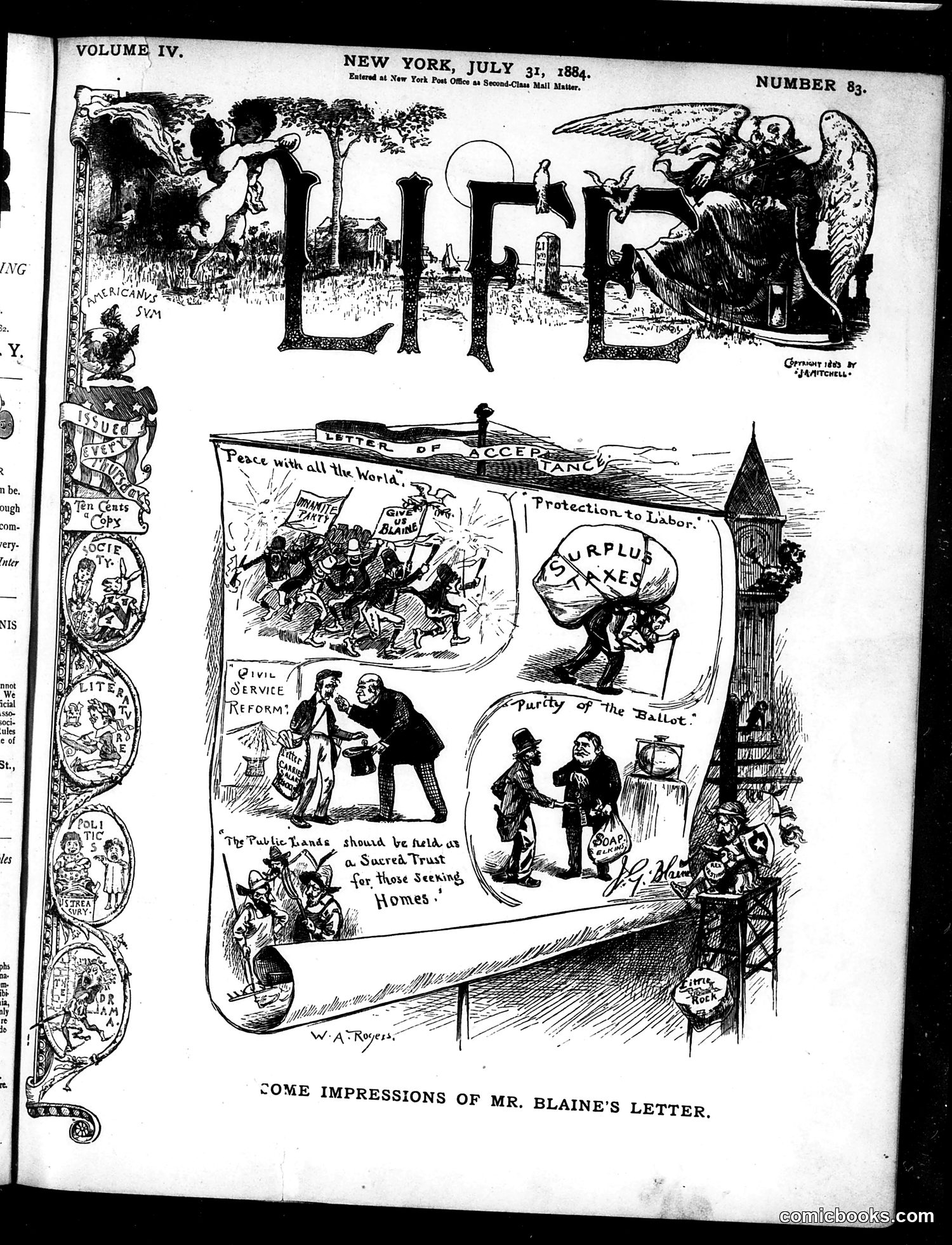
This satirical page mocks a political letter from James G. Blaine, likely the Republican presidential candidate that year. The cartoons present hostile interpretations of his positions: - "Peace with all the World" depicts chaos and violence, suggesting his foreign policy promises ring hollow - "Protection to Labor" shows a figure crushed by "surplus taxes," implying his protectionist stance harms workers - "Civil Service Reform" portrays bureaucratic manipulation - "Purity of the Ballot" depicts electoral corruption The cartoonist (W.A. Rogers) uses the word "impressions" ironically—presenting Blaine's stated ideals inverted into their opposite meanings. This reflects contemporary Democratic attacks on Blaine's record and credibility during the contentious 1884 election.
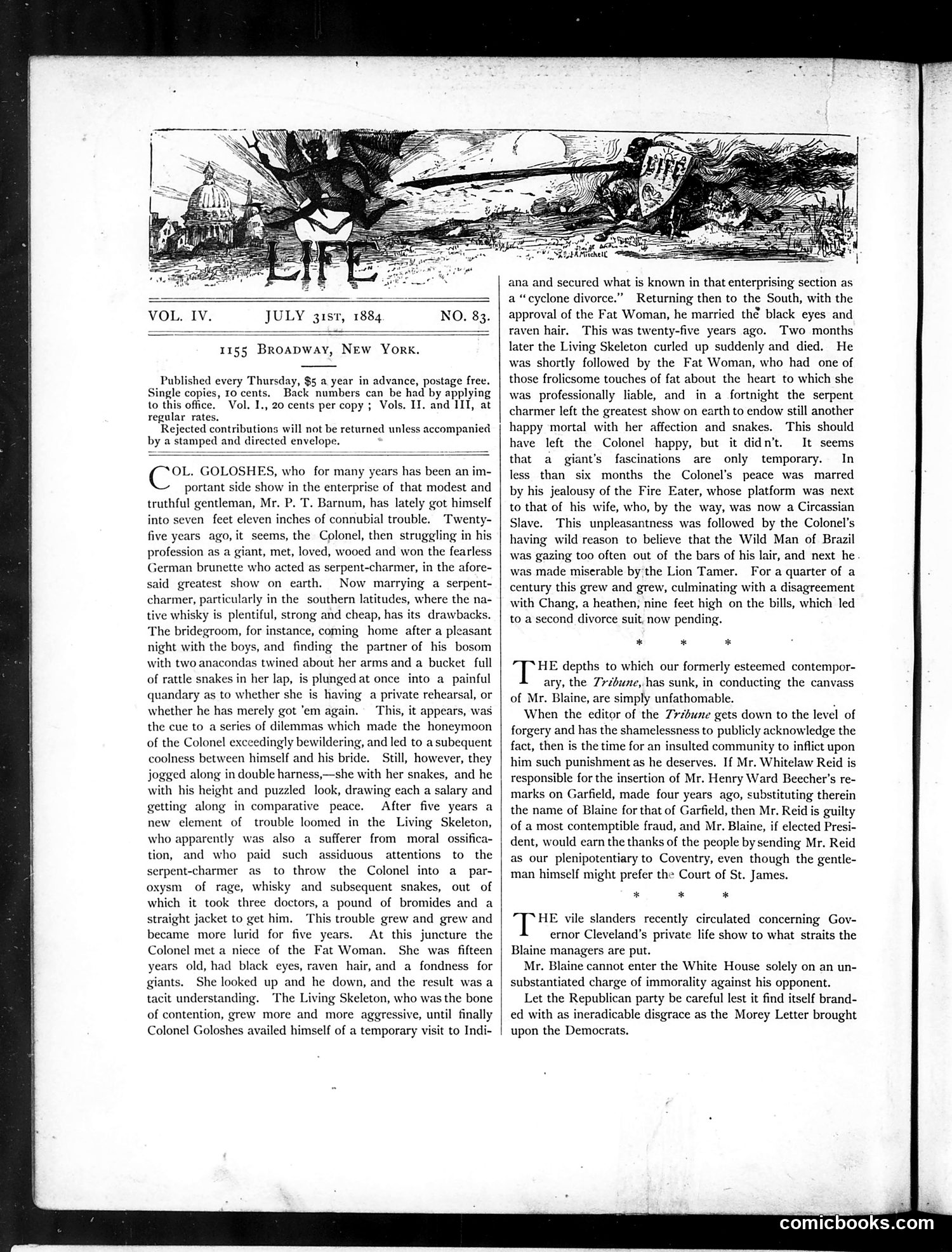
The page contains three separate satirical pieces about 1884 political scandals, particularly targeting James G. Blaine, the Republican presidential candidate. The top cartoon (image unclear in detail) appears to illustrate one of these scandals. The text discusses: 1. **Colonel Gould's marital troubles** - a complicated love triangle involving the "Fat Woman" and "Living Skeleton," mocking sensationalized relationships 2. **The Tribune's credibility crisis** - criticizing the newspaper for acknowledging forged documents and "shamelessness" in the Blaine campaign 3. **Anti-Blaine attacks** - accusing Blaine of immoral conduct and questioning his fitness for the White House, while criticizing Democratic tactics as potentially equally damaging The satire targets both political sides during a contentious election year, emphasizing scandal and character assassination.
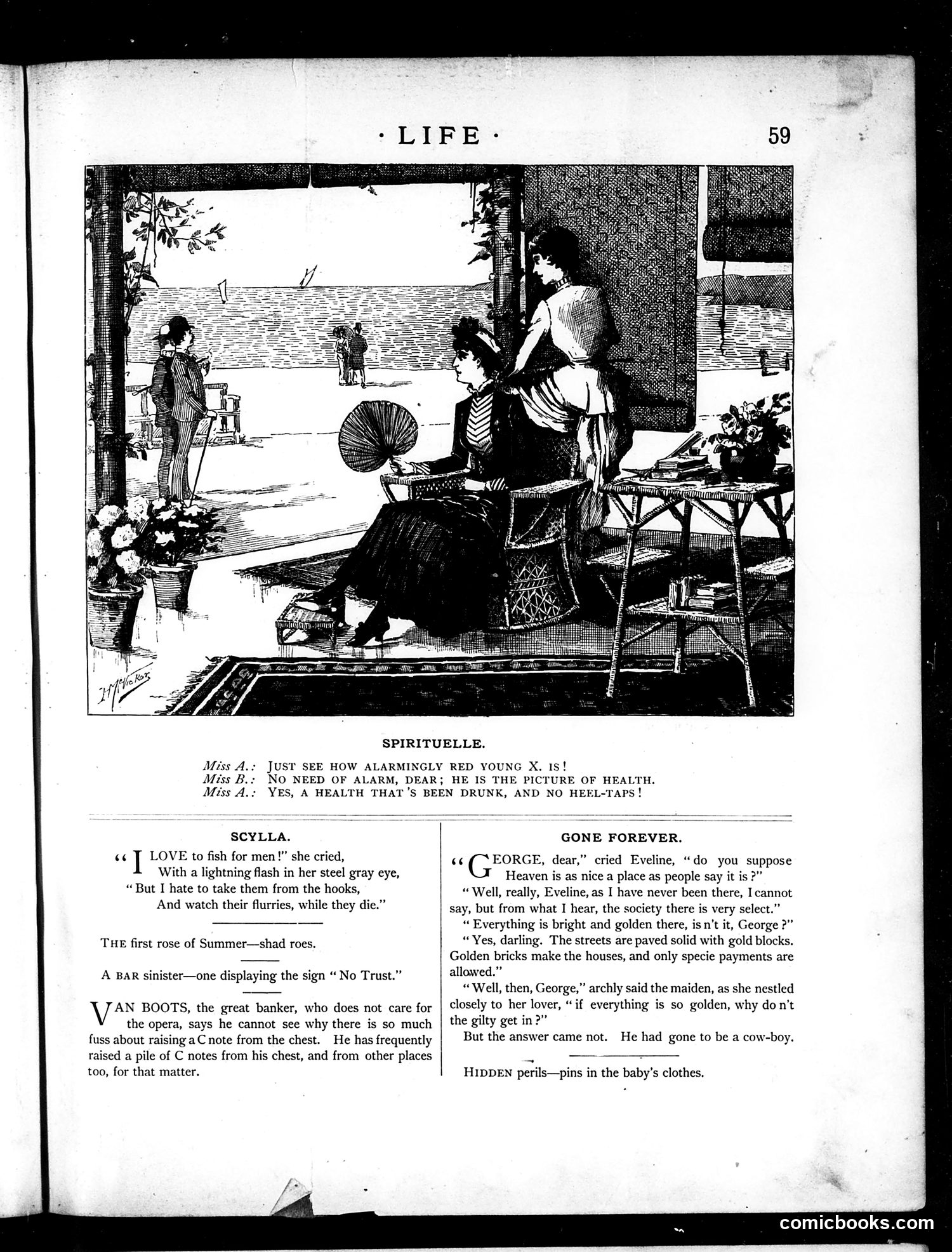
The page contains three unrelated satirical items: **"Spirituelle"** is a cartoon depicting women in a parlor discussing a young man named X. The joke plays on social pretense—the women praise his health while one admits he's actually a drunk who doesn't wear heels (suggesting he's effeminate or dissolute). It satirizes shallow society gossip masking obvious truths. **"Scylla"** is a brief poem about fishing, seemingly unrelated satirical filler. **"Gone Forever"** presents a dialogue between "George" and "Eveline" about Heaven. The satire targets romantic idealism—when Eveline asks why the poor don't get into Heaven if it's so golden, George has no answer and becomes a cow-boy instead. This mocks both religious platitudes and class inequality. The final item warns of "hidden perils—pins in the baby's clothes," likely safety commentary.
This page contains political **boomlets** (satirical short pieces) mocking prominent figures of the 1880s era. The jokes target: - **Cleveland and the Irish vote**: References to Grover Cleveland's potential mistakes with Democratic voters regarding Irish Home Rule in Central Africa - **George Washington plagiarism**: A jab suggesting someone plagiarized Washington's farewell address - **Whitelaw Reid's name**: Mockery of Reid (likely the politician/editor) lacking a middle name, making "Whitelaw Reid" sound inadequate for a potential English Minister - **Cleveland's vetoes**: Criticism of his Republican opposition as absurd - **Oscar Wilde**: A brief reference to Wilde's famous phrase about "unkissed kisses" - **Blaine's banner**: Derisive commentary on a political banner's prominent feature The right column reviews books and discusses municipal nuisances, unrelated to satire.
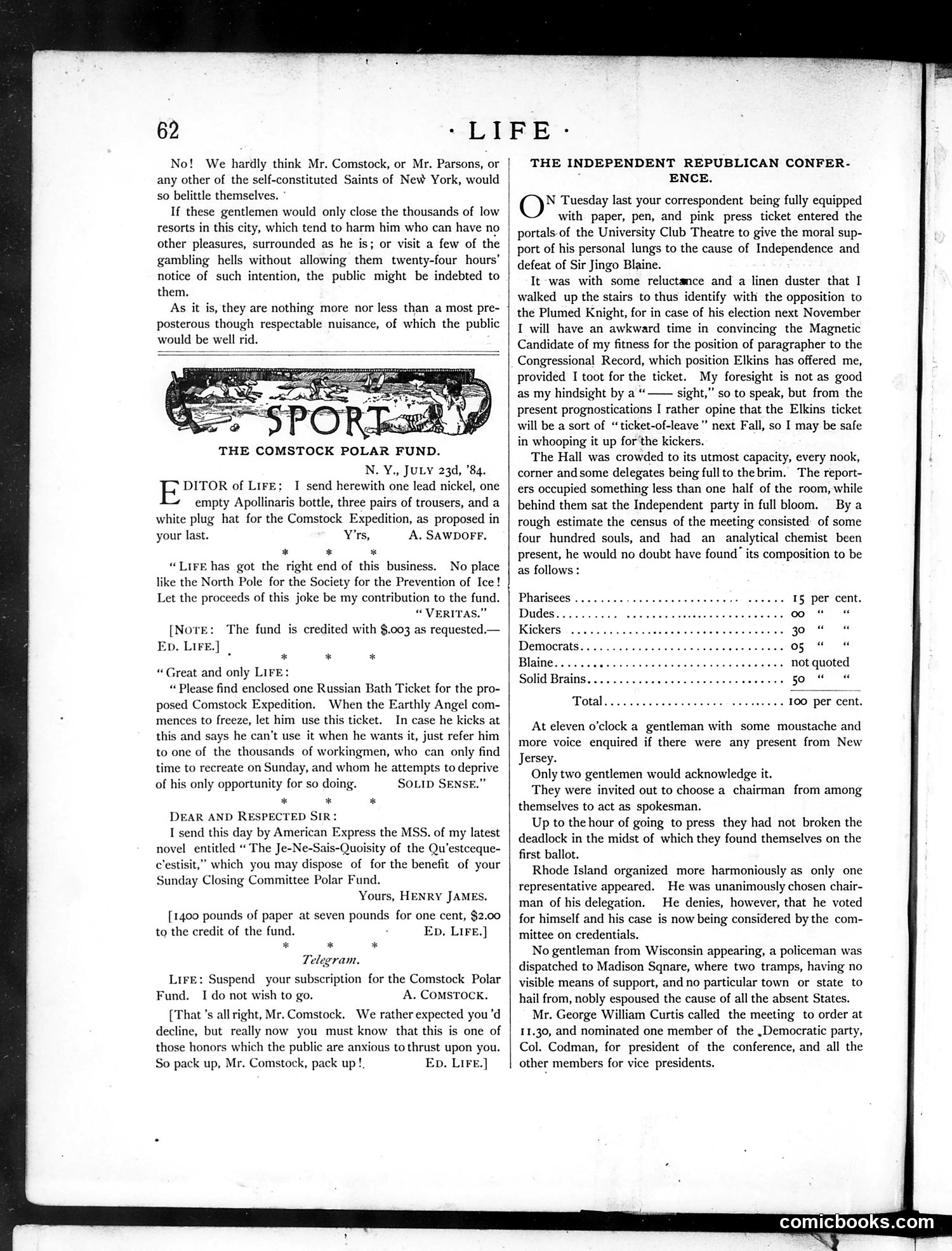
This page contains **no political cartoon**, only text content from *Life* magazine's satirical sections. The "SPORT" section humorously presents **"The Comstock Polar Fund"** — readers' contributions mocking Anthony Comstock, the famous vice crusader. Letters describe absurd donations (lead nickels, empty bottles, worn trousers) toward a supposed Comstock expedition, sarcastically suggesting his restrictive morality campaigns be geographically removed. The main article, **"The Independent Republican Conference,"** reports on a political meeting where delegates struggled to select leadership and establish positions. The satirical tone mocks the group's apparent disorganization and internal divisions, particularly targeting their inability to agree on a chairman or unified stance. Both pieces exemplify *Life*'s method: using humor to critique public figures and political ineffectiveness.
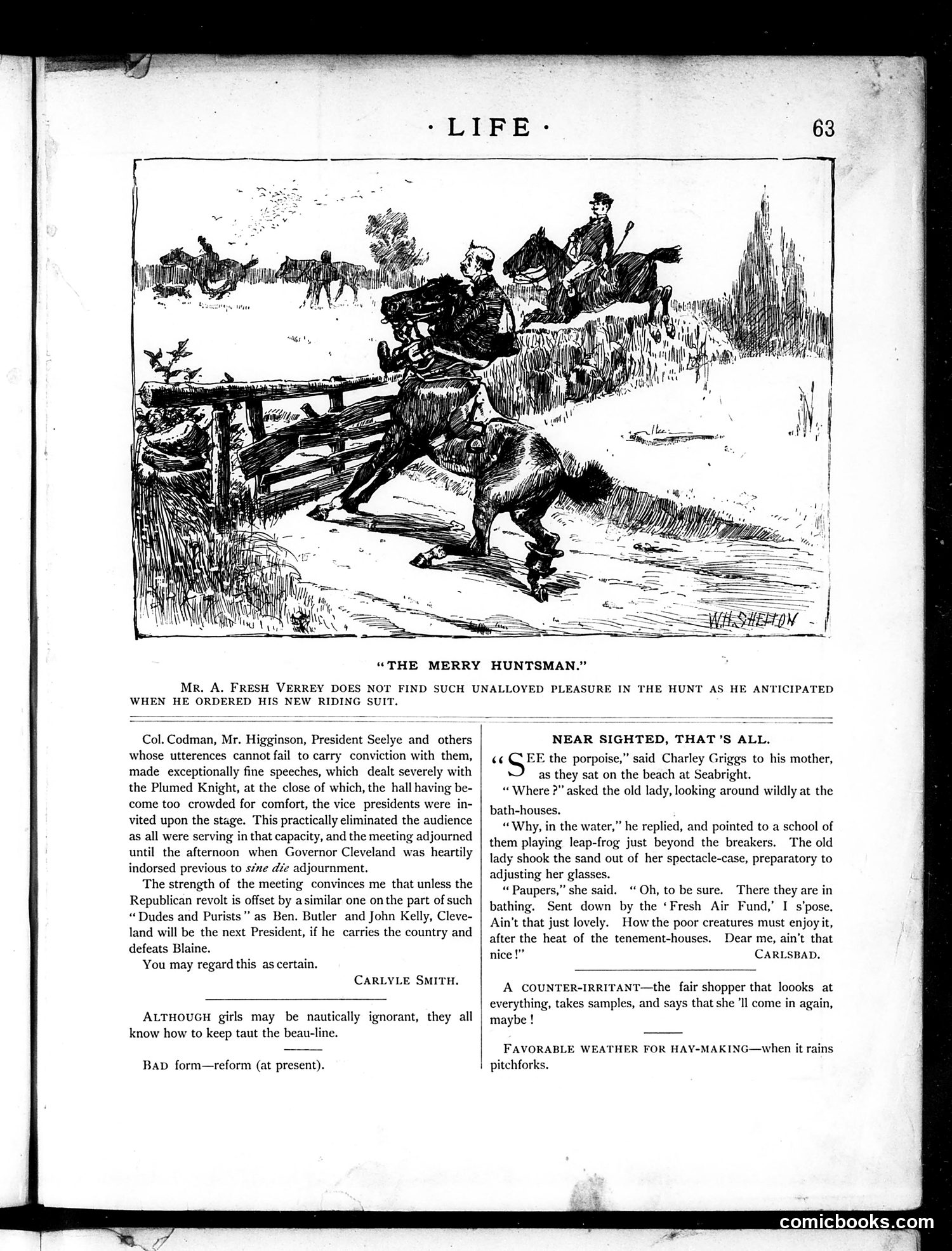
The cartoon depicts **A. Fresh Verbey** having an unpleasant riding experience—his horse is bucking or rearing wildly while he attempts to control it. The caption states he "does not find such unallayed pleasure in the hunt as he anticipated when he ordered his new riding suit." This is a straightforward visual joke: despite acquiring fashionable hunting attire, Verbey cannot manage his horse, suggesting the clothes don't make the rider. The satire mocks someone investing in proper appearance for a sporting activity while lacking actual competence or control—a commentary on superficial status-seeking over genuine skill. The accompanying text items are brief social observations unrelated to the main cartoon.
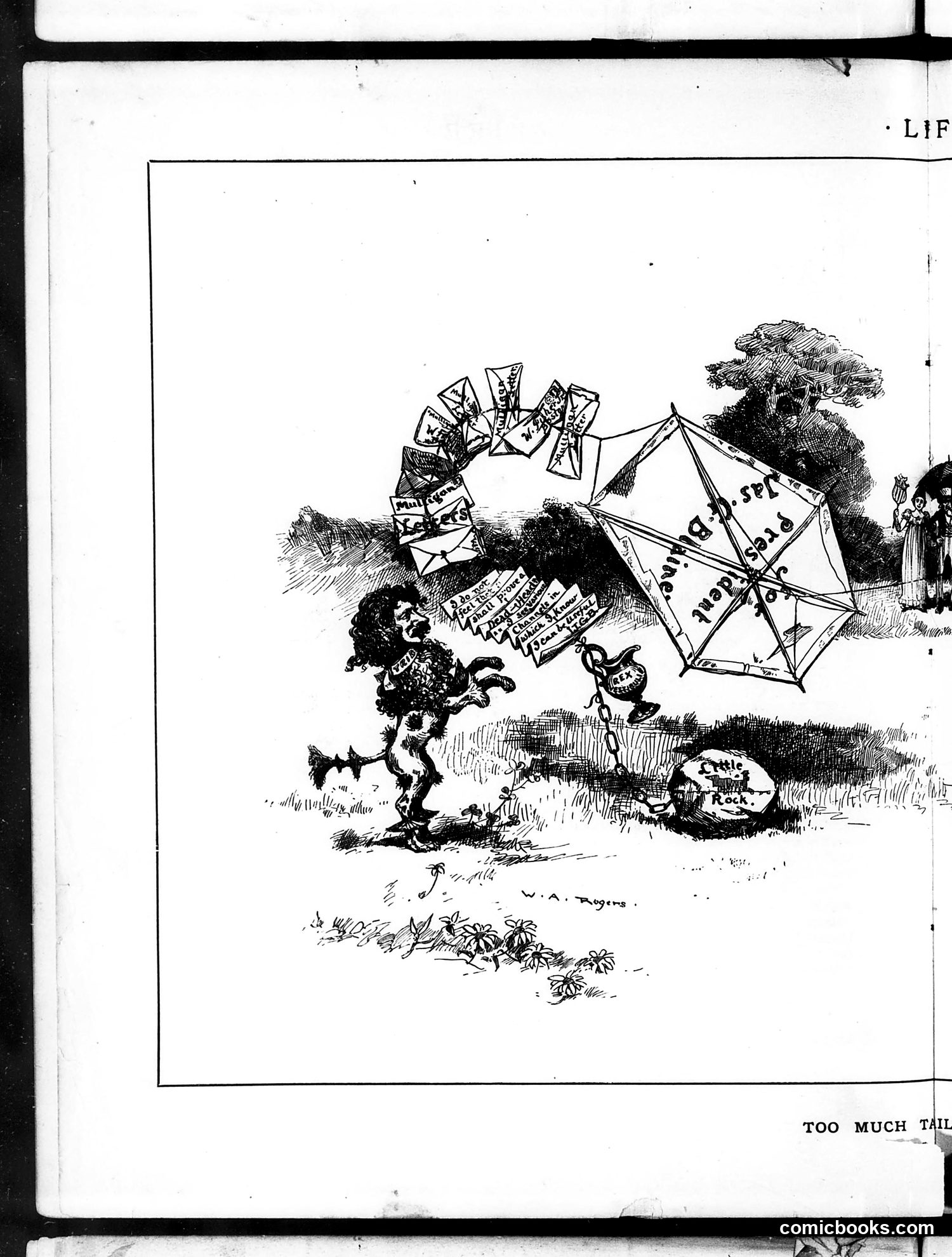
This political cartoon depicts a figure struggling to control an enormous umbrella or parasol covered with text and flags. The umbrella appears to be labeled with various inscriptions (text is difficult to read clearly in the image), and the figure—rendered in a style suggesting a caricatured person or perhaps representing a nation or institution—is being overwhelmed or blown about by the large structure. The title "TOO MUCH TAIL" suggests the cartoon criticizes something having become unwieldy or out of control—likely referring to overextension, excessive ambition, or bureaucratic bloat. Without clearer text visibility, the specific historical reference remains unclear, but the visual metaphor of being dominated by an oversized burden is evident. This appears to be satirical commentary on mismanagement or overreach.
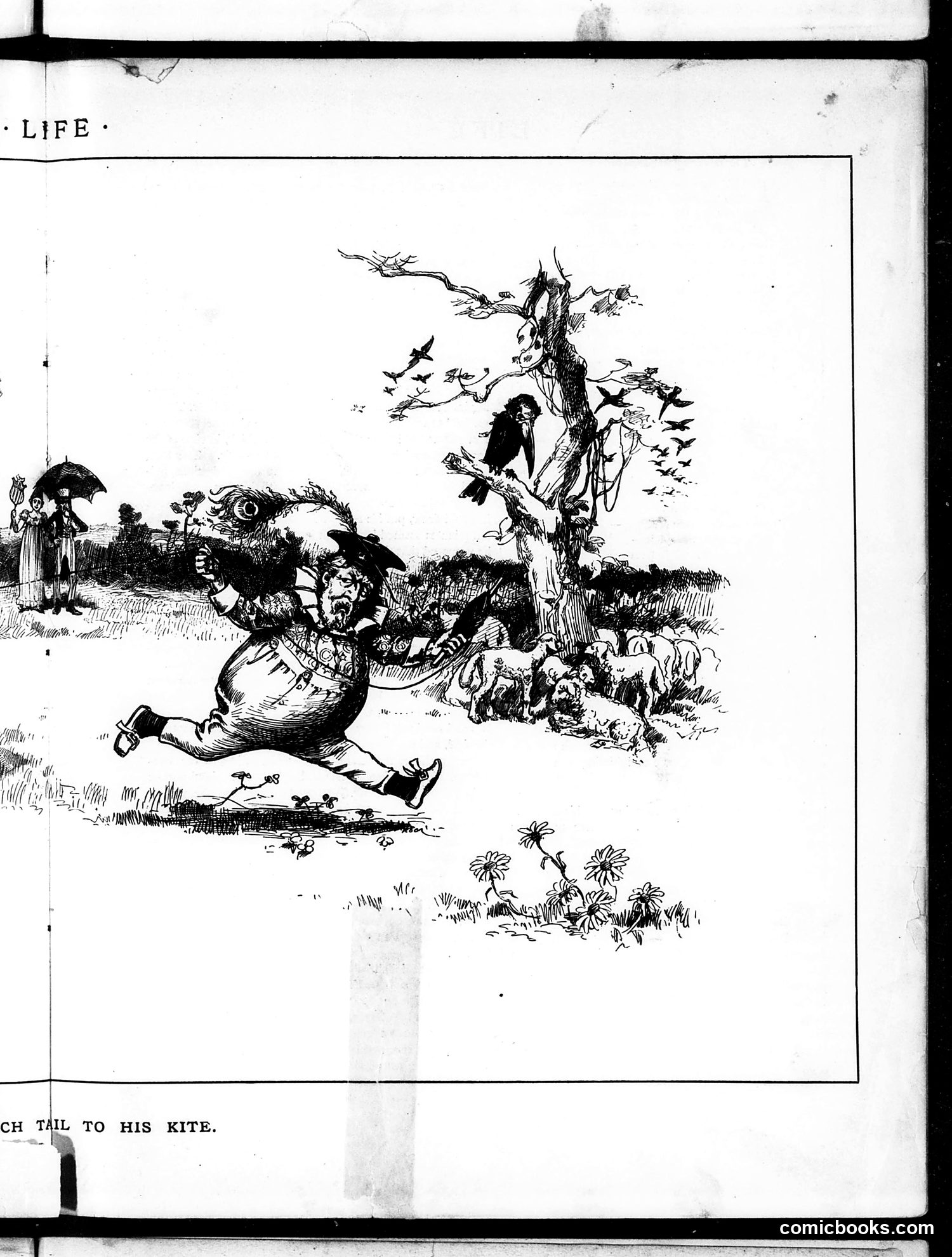
This satirical cartoon from *Life* magazine shows a rotund, caricatured figure in military dress running frantically through a landscape, trailing his tail to his kite. The exaggerated body and military uniform suggest a political or military leader being mocked for losing control of something significant—the "kite" representing his authority or power slipping away. The caption reads "CH TAIL TO HIS KITE," though the full text is partially cut off. The stark, bare tree and desolate landscape reinforce the sense of loss or downfall. Without the complete publication date and caption visible, the specific political figure and historical event remain unclear, but the imagery unmistakably ridicules a leader's loss of command or credibility through visual absurdity and slapstick metaphor.
This page contains two distinct satirical pieces: **"Te Duce Jacobum!"** is a mock-heroic poem mocking James G. Blaine, a Maine politician and Republican "Stalwart." The satire catalogs corruption accusations against Blaine—dubious financial dealings, the "Mulligan letter" scandal, involvement with Fort Smith and Little Rock, and "Guano Jim" references (likely kickback schemes). The poem's repetitive chorus insists no one calls him a "chump" or "wooden Injun," which obviously undercuts itself by constantly invoking these insults. This is political ridicule of a figure suspected of financial impropriety. **"The Thompson St. Poker Club"** is a humorous vignette about a clergy member (Rev. Thankful Smith) proposing a solution to poker club members' reluctance to play during financially anxious times (likely the 1880s financial panic). The joke satirizes how even ostensibly respectable men engage in gambling, and how a minister cleverly manipulates the situation for profit. Both pieces mock late-19th-century political corruption and social hypocrisy through exaggeration and irony.
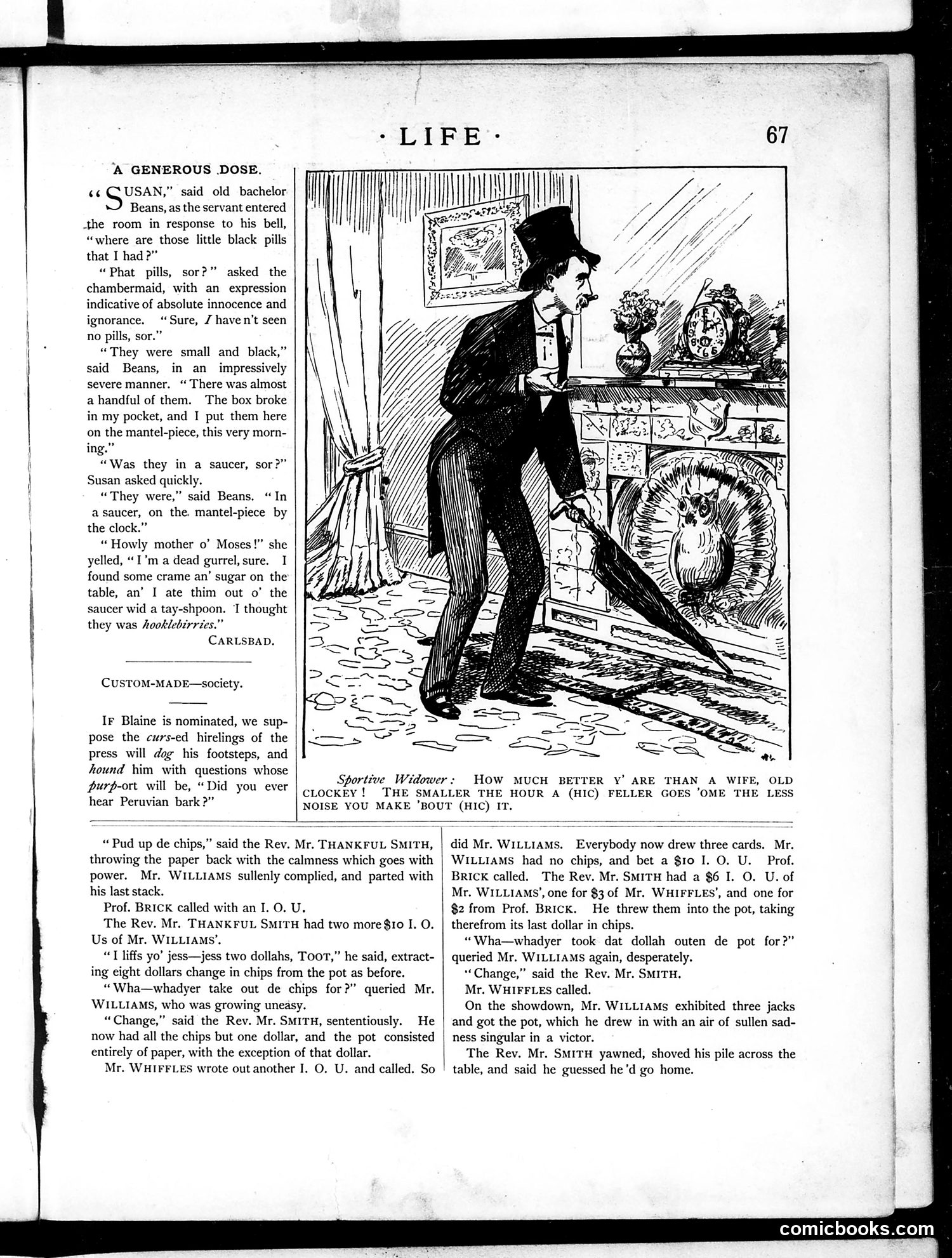
**"A Generous Dose"** (top): A comedic Irish dialect story where a servant girl, Susan, accidentally eats her employer's laxative pills (from Carlsbad spa treatments—known digestive aids), believing the white residue in the saucer was cream and sugar for tea. The humor relies on the servant's malapropism ("hookleberries") and the embarrassing misunderstanding. **"Sportive Widower"** (illustration): Shows a drunk man praising his clock over a wife, joking that the later he returns home intoxicated, the less noise the clock makes—implying wives complain about late arrivals while clocks remain silent. The satire targets male irresponsibility and domestic complaint. **"Custom-Made Society"** (brief note): References James G. Blaine (likely 1884 presidential candidate), predicting the press will hound him with questions about "Peruvian bark"—possibly referencing scandal or dubious business dealings.
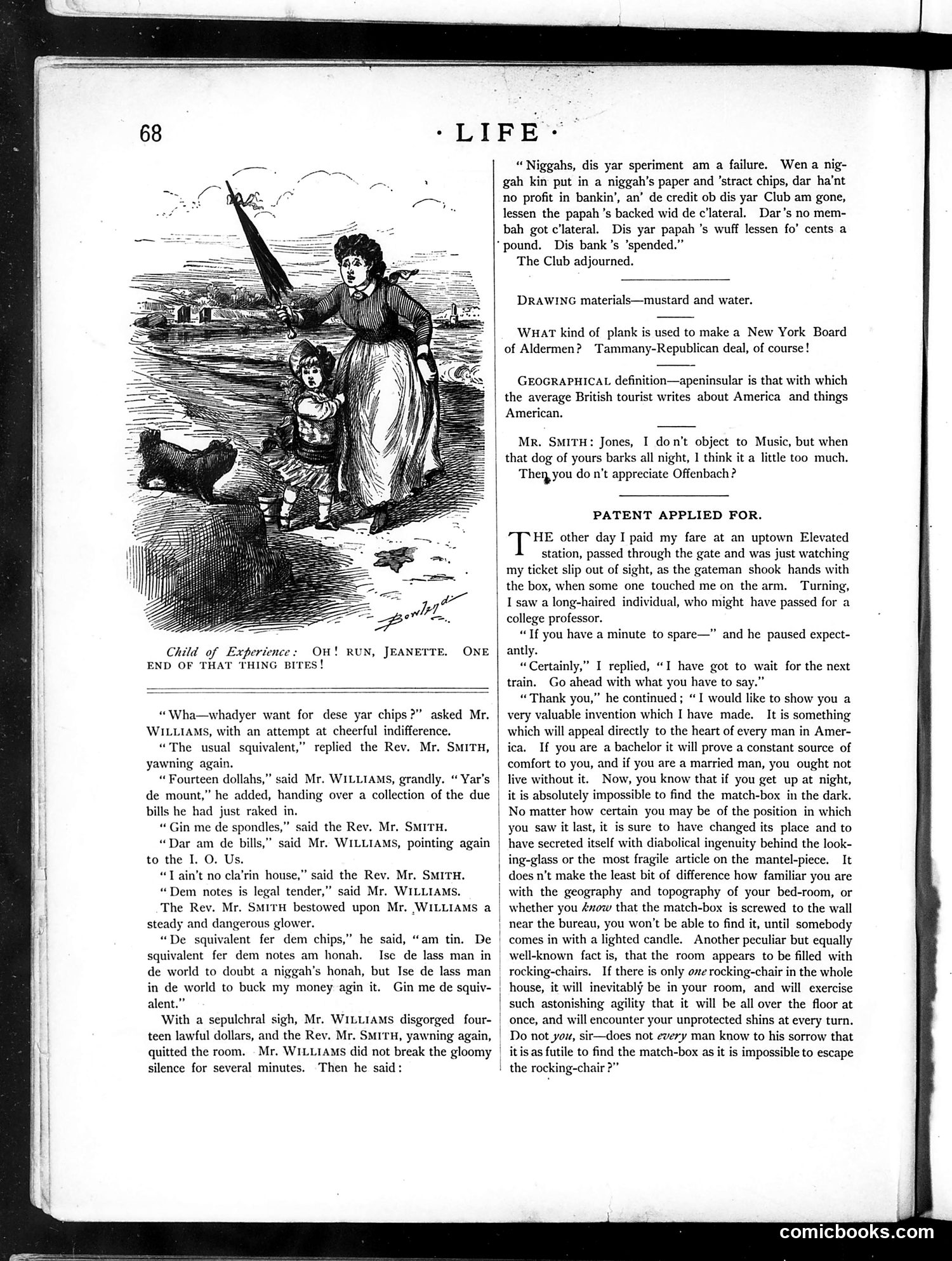
This page contains two distinct satirical pieces: **"Child of Experience"** (illustrated): A dialogue between Mr. Williams and Rev. Mr. Smith, depicting a failed banking scheme among African Americans using dialect humor typical of 19th-century American comedy. Williams attempts to operate a bank using personal IOUs as currency, but Smith demands actual money, exposing the scheme's worthlessness. The satire targets either foolish financial schemes or—given the dialect presentation—reflects period stereotypes. **"Patent Applied For"**: A humorous anecdote about an inventor pitching a match-box holder to prevent the common domestic annoyance of losing matches in the dark. The joke escalates absurdly, describing how match-boxes mysteriously relocate and rocking chairs materialize mysteriously at night—poking fun at both trivial "inventions" and the tendency of ambitious inventors to overcomplicate simple problems. Both pieces exemplify Life's satirical approach to American social pretension and human folly.
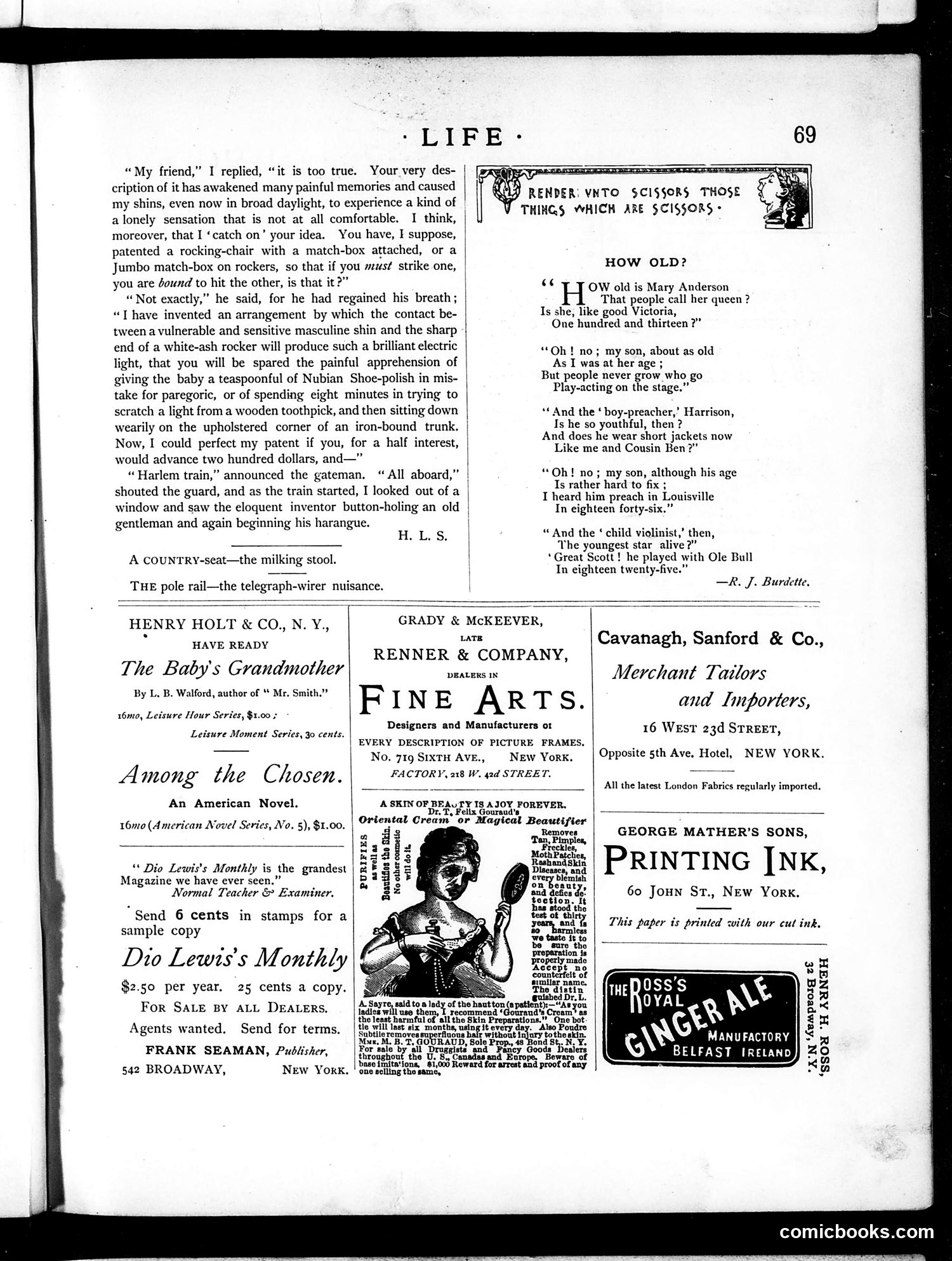
This page contains a short satirical story (signed H.L.S.) about an inventor pitching a dubious patent—a device that produces electric light when you strike your shin against a rocking chair. The humor lies in the absurdity: the "solution" creates an impractical contraption to address mundane household mishaps (accidentally giving babies shoe polish, struggling to light lamps). The inventor buttonholes strangers trying to secure investment, a recognizable type of 19th-century patent charlatan. Below the story is a poem titled "How Old?" (by R.J. Burdette) that humorously plays on the deceptive longevity of entertainers—questioning whether famous performers like "Mary Anderson" (likely the actress) and "boy-preacher Harrison" are actually as young as they claim, with punchlines revealing they performed decades earlier. The remainder is advertising for books and commercial products typical of the era.
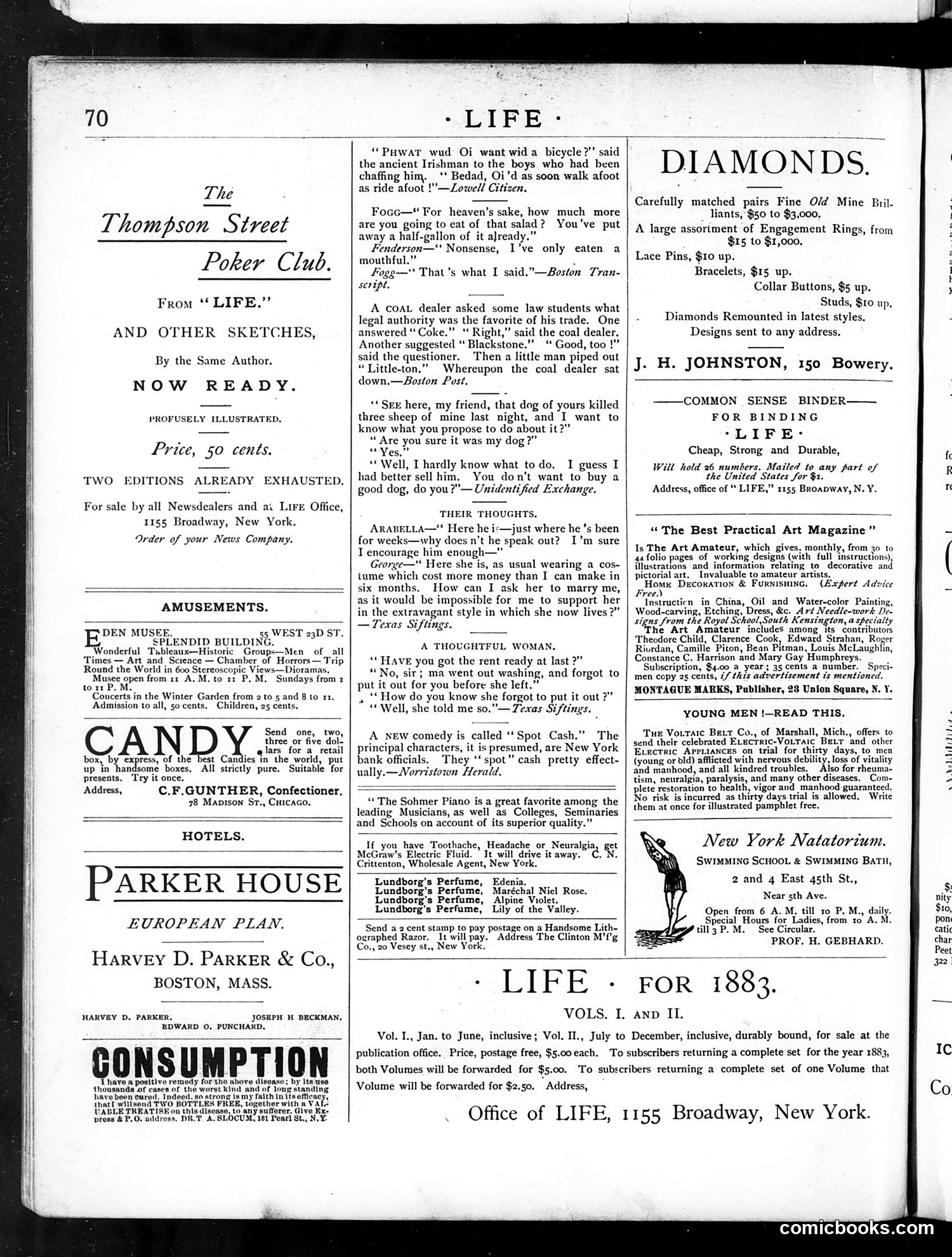
This is primarily a **title page and advertising section**, not a satirical cartoon page. The main content announces a book called *"The Thompson Street Poker Club and Other Sketches"* by Life's author—a collection of humorous anecdotes priced at 50 cents, already in its third edition. The page includes various **short jokes and quips** scattered throughout (about Irish immigrants, food, coal dealers, dogs, rent, pianos, and toothaches), typical of Life's satirical humor style. These are brief, generic jokes rather than pointed political commentary—mostly **wordplay and everyday domestic situations** meant to amuse middle-class readers. The bottom half features **advertisements** for hotels, candies, perfumes, pianos, and patent medicines—standard 1880s magazine fare. The consumption remedy ad is particularly notable as representative of dubious medical claims of the era. This page serves as a **promotional/commercial issue** rather than showcasing Life's primary satirical content.
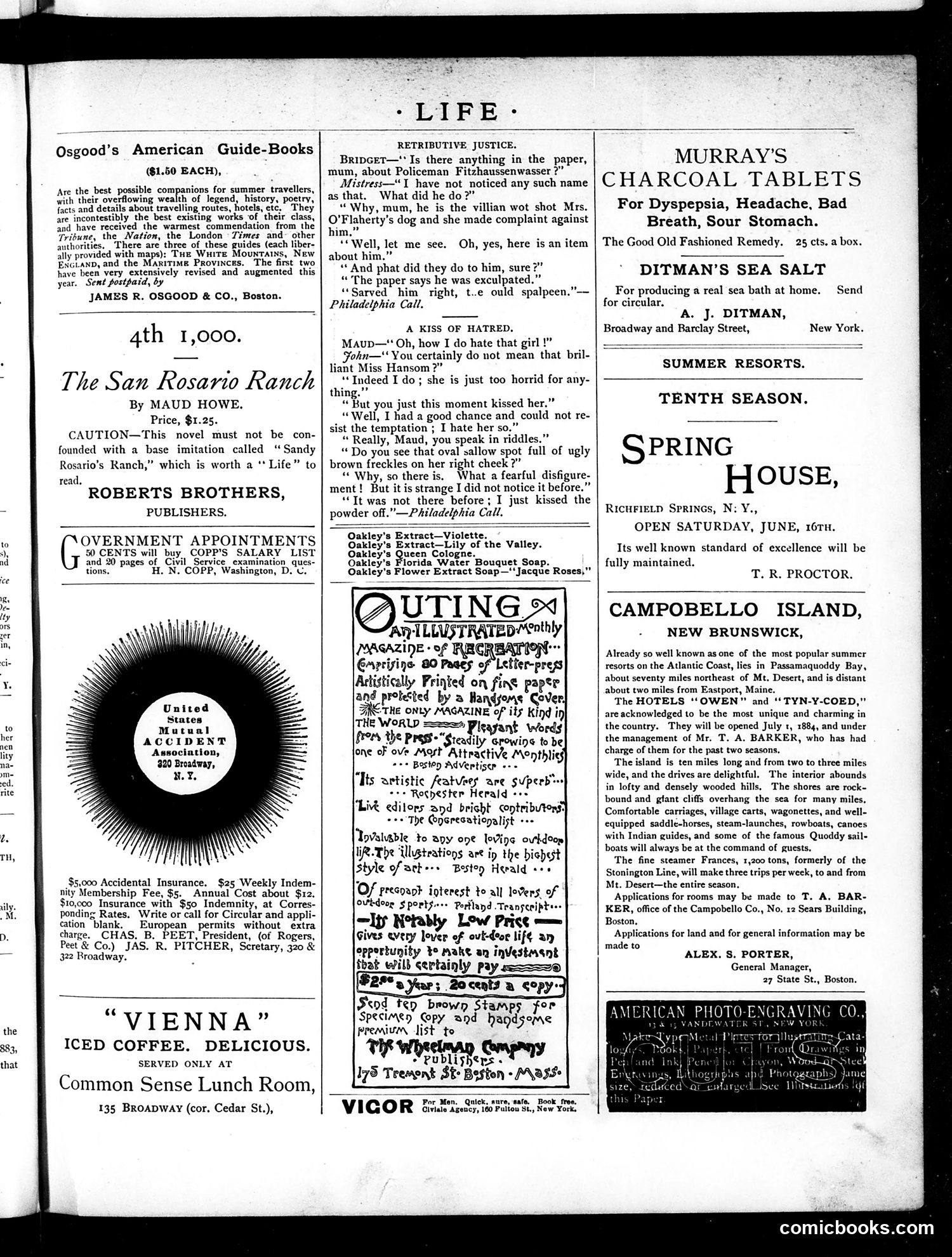
This page is primarily **advertising and miscellaneous content** rather than political cartoons. However, it contains two brief satirical dialogues: **"Retributive Justice"** mocks Irish immigrant speech patterns and legal terminology. A maid ("Bridget") complains that Policeman Fitzhaussenwasser shot her employer's dog; she's outraged when told he was "exculpated" (legally cleared), mishearing it as approval. The joke targets both Irish dialect humor (common in period satire) and the absurdity of police escaping consequences for minor offenses. **"A Kiss of Hatred"** is a brief paradoxical joke about a woman who claims to hate another woman yet impulsively kisses her—revealing the kiss was calculated to wipe powder off the woman's face to expose unflattering freckles. It satirizes female social hypocrisy and petty vanity. Both are light, conversational humor typical of *Life* magazine's satirical style, targeting immigrant stereotypes and upper-class social behavior rather than explicit political figures.
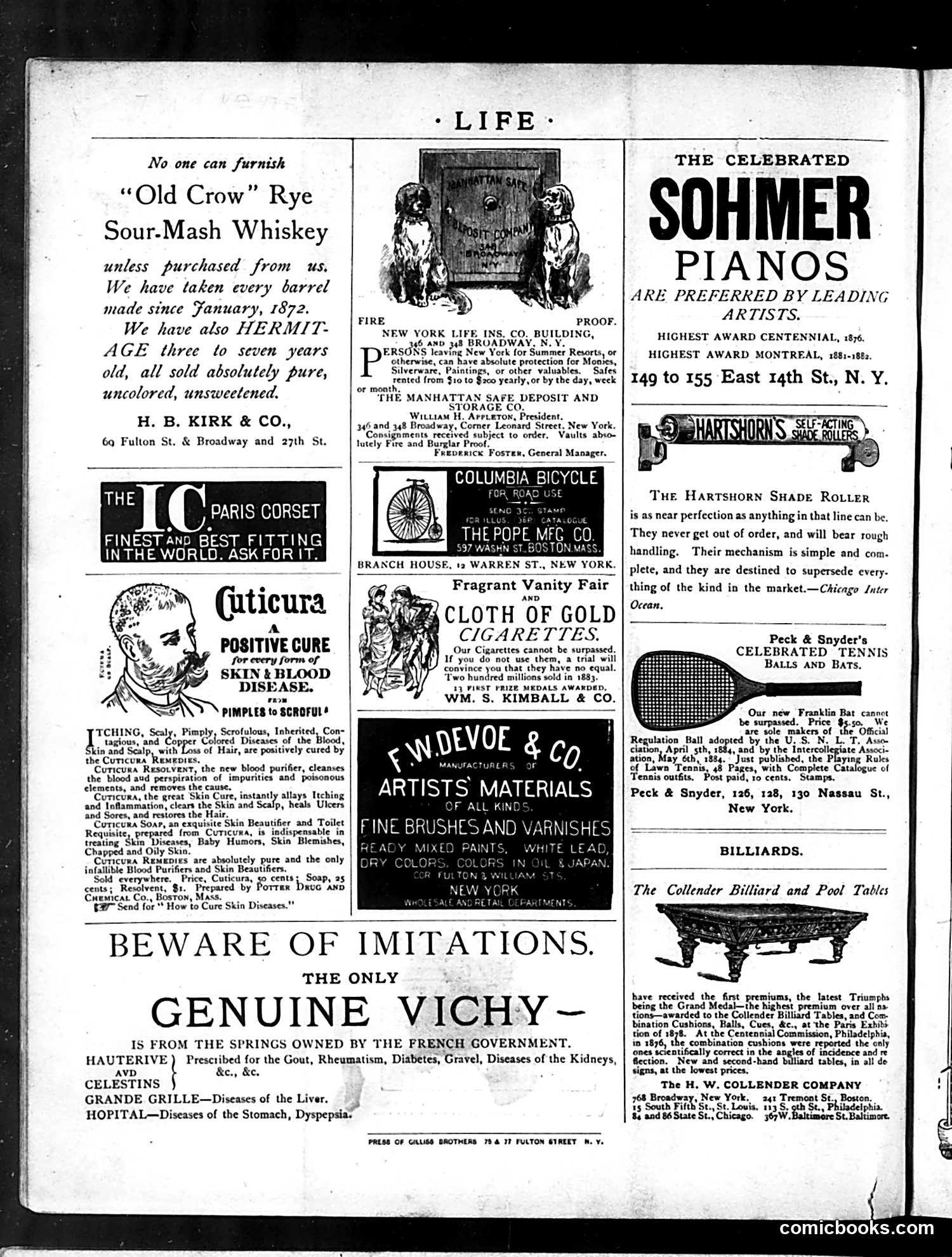
This page is primarily **advertisements**, not political commentary. There are no cartoons visible that convey satirical meaning. However, one image deserves note: the **Cuticura ad featuring a man's profile** advertising a skin cure "for every form of SKIN & BLOOD DISEASE." The crude caricatural style—exaggerated facial features—was typical of period advertising but reflects dated medical marketing. The ad promises to cure everything from "pimples to scrofula," reflecting 19th-century medical quackery and the era's casual use of fear-based marketing around disease. The page otherwise showcases period products (whiskey, corsets, bicycles, pianos, billiard tables) targeting affluent consumers. The "Beware of Imitations" warning about Vichy water reflects genuine counterfeiting concerns in an era before strong trademark protections.