
Life, 1884-07-31 · page 4 of 16
Life — July 31, 1884 — page 4: what you’re looking at
What you’re looking at
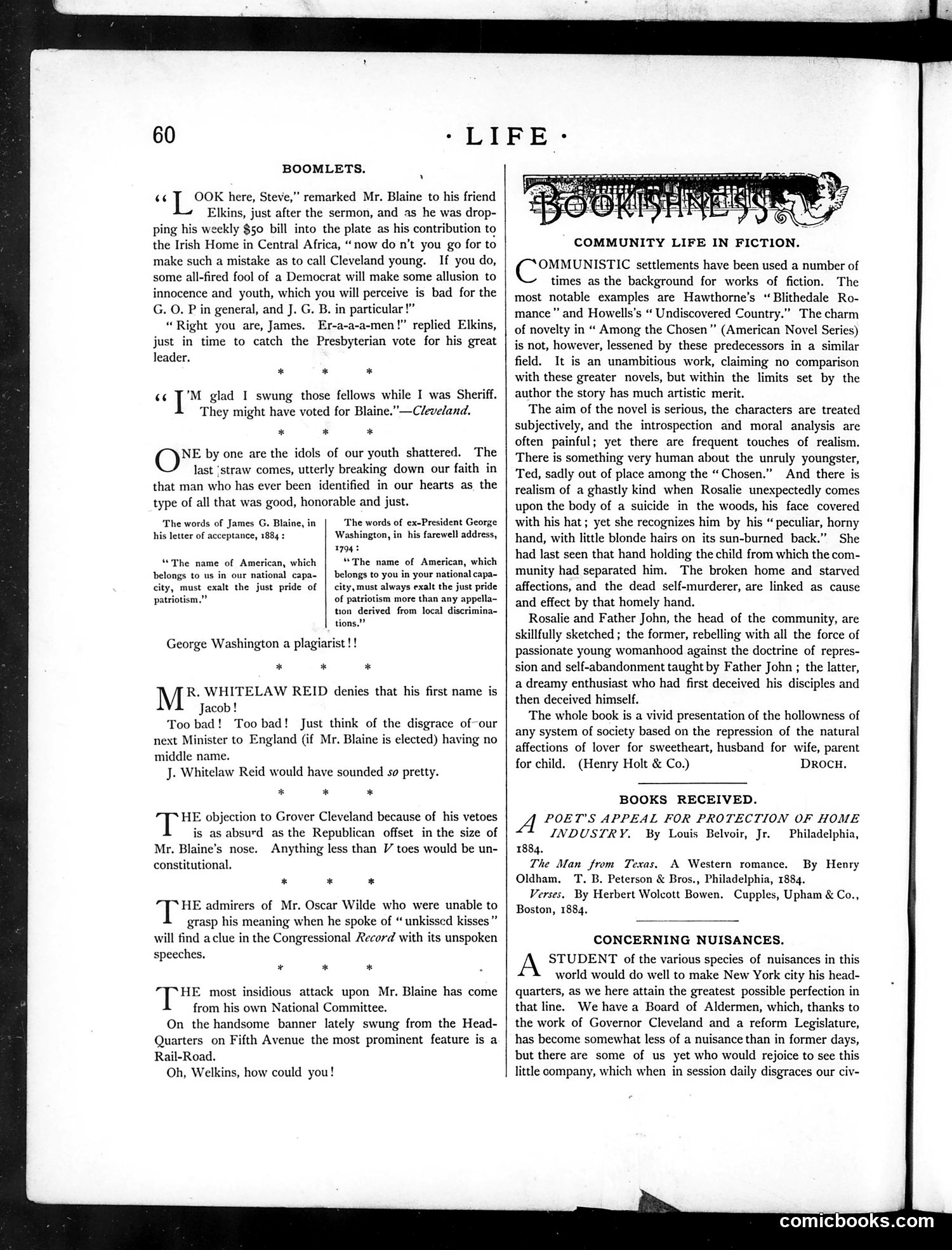
This page contains political **boomlets** (satirical short pieces) mocking prominent figures of the 1880s era. The jokes target: - **Cleveland and the Irish vote**: References to Grover Cleveland's potential mistakes with Democratic voters regarding Irish Home Rule in Central Africa - **George Washington plagiarism**: A jab suggesting someone plagiarized Washington's farewell address - **Whitelaw Reid's name**: Mockery of Reid (likely the politician/editor) lacking a middle name, making "Whitelaw Reid" sound inadequate for a potential English Minister - **Cleveland's vetoes**: Criticism of his Republican opposition as absurd - **Oscar Wilde**: A brief reference to Wilde's famous phrase about "unkissed kisses" - **Blaine's banner**: Derisive commentary on a political banner's prominent feature The right column reviews books and discusses municipal nuisances, unrelated to satire.
📄 Transcribed text from this page (OCR, searchable)
Machine-transcribed from the original scan — historical spelling and the odd misread are preserved.
60 BOOMLETS. “cc OOK here, Steve,” remarked Mr. Blaine to his friend Elkins, just after the sermon, and as he was drop- ping his weekly $50 bill into the plate as his contribution to the Irish Home in Central Africa, “now do n’t you go for to make such a mistake as to call Cleveland young. If you do, some all-fired fool of a Democrat will make some allusion to innocence and youth, which you will perceive is bad for the G. O. P in general, and J. G. B. in particular !” “Right you are, James. Er-a-a-a-men!” replied Elkins, just in time to catch the Presbyterian vote for his great leader. * * * “cc i he glad I swung those fellows while I was Sheriff. They might have voted for Blaine.” —Cleveland. * * * Ou by one are the idols of our youth shattered. The last ‘straw comes, utterly breaking down our faith in that man who has ever been identified in our hearts as the type of all that was good, honorable and just. ‘The words of ex-President George Washington, in his farewell address, 17942 “The name of American, which belongs to you in your national capa- city, must always exalt the just pride of patriotism more than any appella~ tion derived from local discrimina~ tions.” The words of James G. Blaine, in his letter of acceptance, 1884: “The name of American, which belongs to us in our national capa- city, must exalt the just pride of patriotism.” George Washington a plagiarist !! * * * R. WHITELAW REID denies that his first name is Jacob! Too bad! Too bad! Just think of the disgrace of-our next Minister to England (if Mr. Blaine is elected) having no middle name. J. Whitelaw Reid would have sounded so pretty. * * * HE objection to Grover Cleveland because of his vetoes is as absurd as the Republican offset in the size of Mr. Blaine’s nose. Anything less than V toes would be un- constitutional. * * * HE admirers of Mr. Oscar Wilde who were unable to grasp his meaning when he spoke of “ unkisscd kisses” will find aclue in the Congressional Record with its unspoken speeches, * * * HE most insidious attack upon Mr. Blaine has come from his own National Committee. On the handsome banner lately swung from the Head- Quarters on Fifth Avenue the most prominent feature is a Rail-Road. Oh, Welkins, how could you! COMMUNITY LIFE IN FICTION. OMMUNISTIC settlements have been used a number of times as the background for works of fiction. The most notable examples are Hawthorne’s “ Blithedale Ro- mance” and Howells’s “ Undiscovered Country.” The charm of novelty in “ Among the Chosen” (American Novel Series) is not, however, lessened by these predecessors in a similar field. It is an unambitious work, claiming no comparison with these greater novels, but within the limits set by the author the story has much artistic merit. The aim of the novel is serious, the characters are treated subjectively, and the introspection and moral analysis are often painful; yet there are frequent touches of realism. There is something very human about the unruly youngster, Ted, sadly out of place among the “Chosen.” And there is realism of a ghastly kind when Rosalie unexpectedly comes upon the body of a suicide in the woods, his face covered with his hat; yet she recognizes him by his “ peculiar, horny hand, with little blonde hairs on its sun-burned back.” She had last seen that hand holding the child from which the com- munity had separated him. The broken home and starved affections, and the dead self-murderer, are linked as cause and effect by that homely hand. Rosalie and Father John, the head of the community, are skillfully sketched ; the former, rebelling with all the force of passionate young womanhood against the doctrine of repres- sion and self-abandonment taught by Father John ; the latter, a dreamy enthusiast who had first deceived his disciples and then deceived himself. The whole book is a vivid presentation of the hollowness of any system of society based on the repression of the natural affections of lover for sweetheart, husband for wife, parent for child. (Henry Holt & Co.) DRocu. BOOKS RECEIVED. POET'S APPEAL FOR PROTECTION OF HOME INDUSTRY. By Louis Belvoir, Jr. 1884. The Man from Texas, A Western romance. By Henry Oldham. T. B. Peterson & Bros., Philadelphia, 1884. Verses, By Herbert Wolcott Bowen. Cupples, Upham & Co., Boston, 1884. Philadelphia, CONCERNING NUISANCES. STUDENT of the various species of nuisances in this world would do well to make New York city his head- quarters, as we here attain the greatest possible perfection in that line. We have a Board of Aldermen, which, thanks to the work of Governor Cleveland and a reform Legislature, has become somewhat less of a nuisance than in former days, but there are some of us yet who would rejoice to see this little company, which when in session daily disgraces our civ- comicbooks.com