
A complete issue · 16 pages · 1884
Life — July 24, 1884
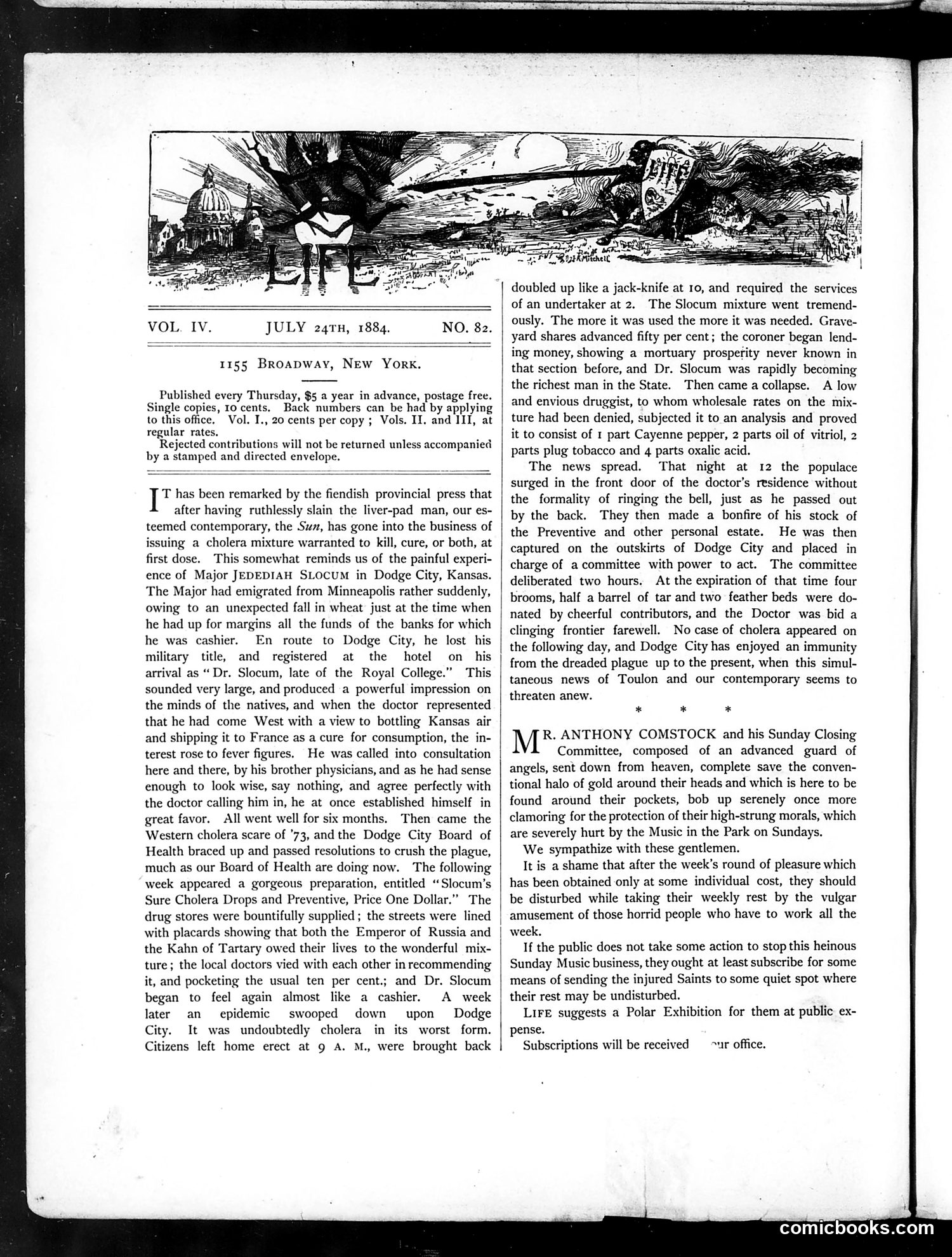
The page's main content satirizes Dr. Major Slocum, a charlatan who claimed to cure cholera with a patent medicine called "Slocum's Sure Cholera Drops and Preventive, Price One Dollar." The text mocks how Slocum exploited a cholera outbreak in Dodge City, Kansas, promoting his worthless remedy while profiting enormously. The satire targets both Slocum's fraudulent medical claims and the gullible public who believed him. The article notes he registered at hotels as "Dr. Slocum, late of the Royal College"—a fabricated credential. Life ridicules his sudden wealth and criticizes newspapers for promoting his scam through sensational coverage. The second item criticizes "Mr. Anthony Comstock's Sunday Closing Committee" for harassing musicians on Sundays while ignoring larger social evils.
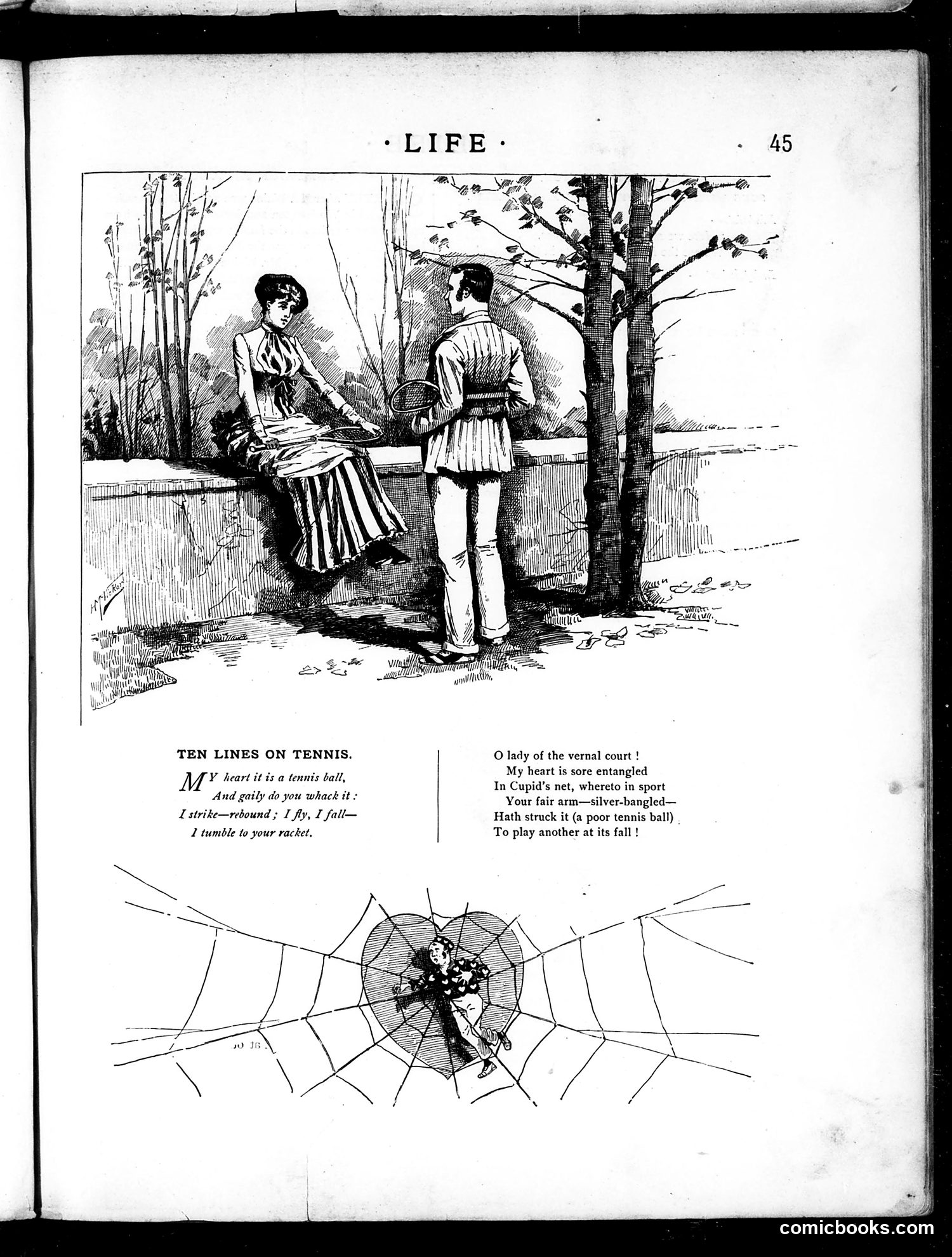
This page from *Life* magazine presents two tennis-themed illustrations with accompanying verse. The top illustration depicts two women in period dress (appearing to be late 19th or early 20th century) at a tennis court by a tree-lined shore. The poem below plays on romantic language, comparing a tennis ball to matters of the heart—the speaker's "heart is a tennis ball" that bounces and tumbles. The lower illustration shows Cupid (the Roman god of love) trapped in a spider's web, with the accompanying verse extending the romantic metaphor: Cupid has been "sore entangled" in the sport, struck by a tennis ball and unable to "play another." The satire appears gentle, using tennis as a vehicle for romantic and courtship commentary rather than political criticism. The cartoons mock the sentimental conflation of sports and romance popular in the era.
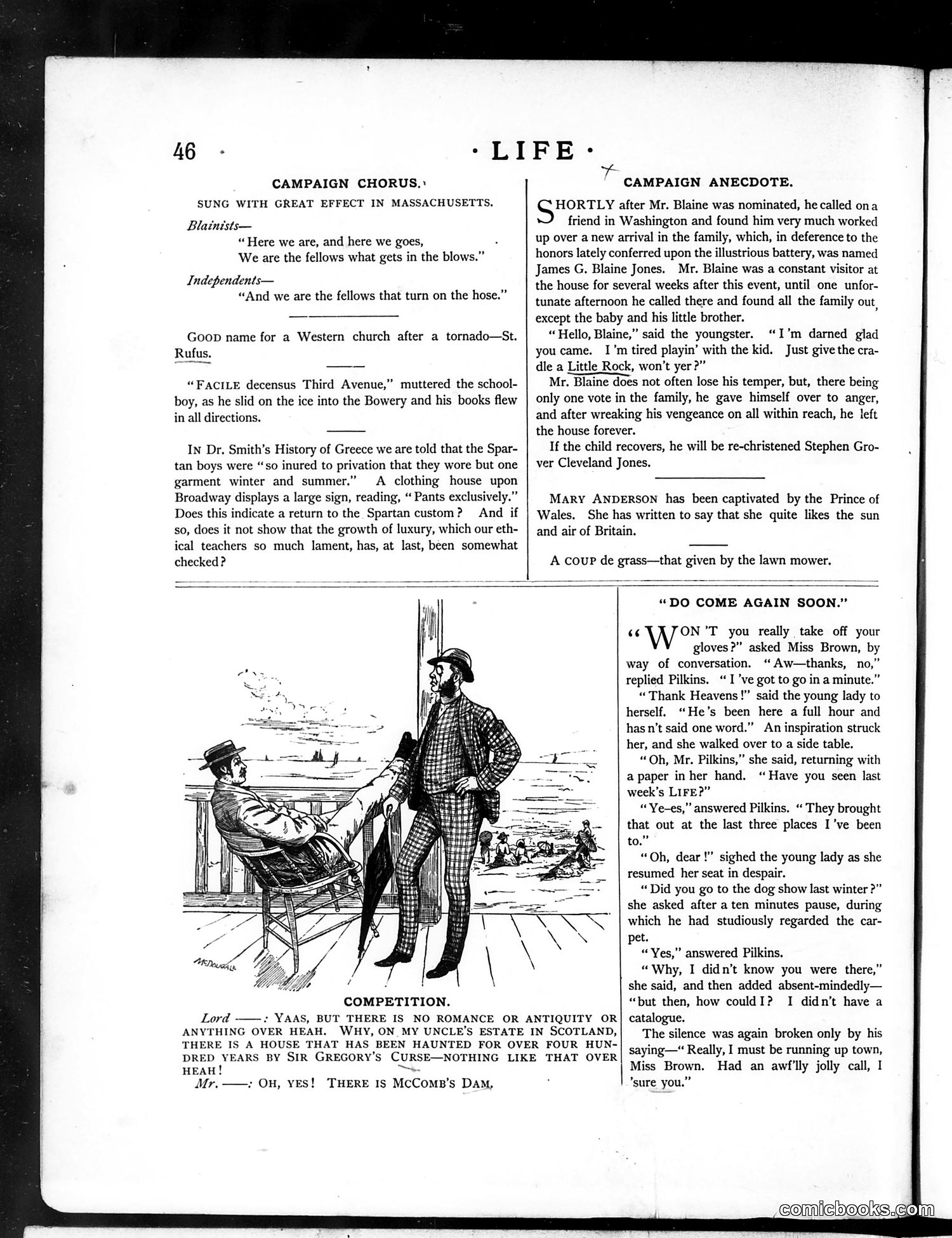
This page contains several short humorous pieces and one cartoon titled "Competition." **The Cartoon "Competition":** Shows two men in period dress (likely 19th century) having a conversation by the seaside. One sits relaxed while the other stands. The dialogue mocks Scottish heritage tourism, with one character boasting about a haunted Scottish estate "haunted for over four hundred years by Sir Gregory's Curse." The other dismisses this, countering that McCom's Dam (apparently a less romantic New York location) is equally old. **The satire** targets: the Victorian fashion for romanticizing Scottish antiquity and "authenticity," while mocking American indifference to such pretensions. The humor relies on bathos—deflating grandiose Old World claims with mundane American reality. The page also contains unrelated brief anecdotes about Blaine, a church name, and social observations, suggesting typical Life magazine miscellaneous content.
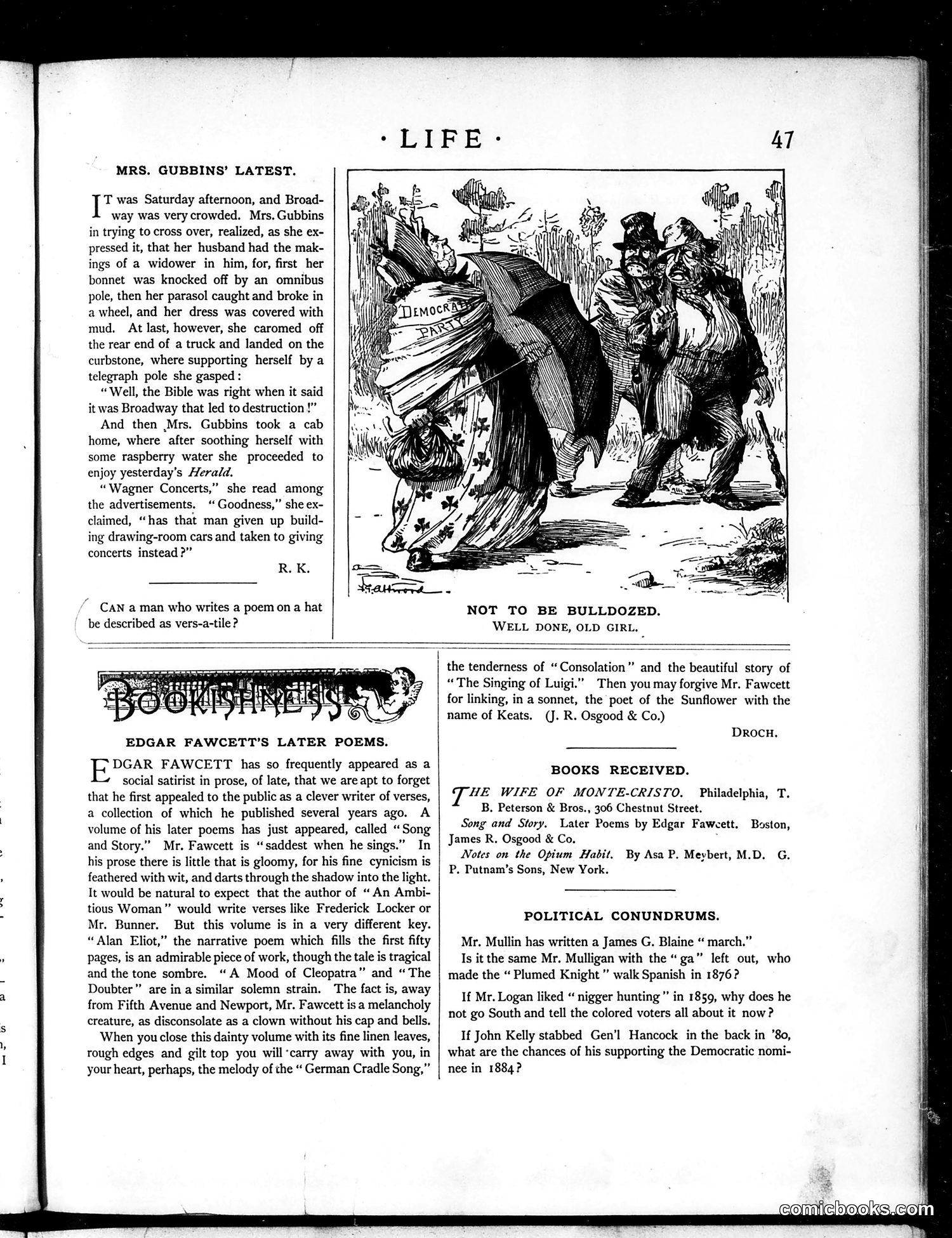
The cartoon depicts a woman labeled "Democracy" being knocked down by a figure representing an omnibus (public transit vehicle). Based on the accompanying story "Mrs. Gubbins' Latest," this satirizes the chaos of urban life on Broadway, where Mrs. Gubbins was struck by a truck and knocked into mud. The title "Not to Be Bulldozed. Well Done, Old Girl" celebrates Democracy's resilience despite being literally trampled by modern urban forces—likely representing either political corruption or the chaotic dangers of industrializing cities. The cartoon's irony suggests that despite being violently attacked (literally and figuratively), Democracy persists. It's unclear which specific political event prompted this, but it reflects late-19th-century anxieties about democracy's fragility amid rapid modernization.
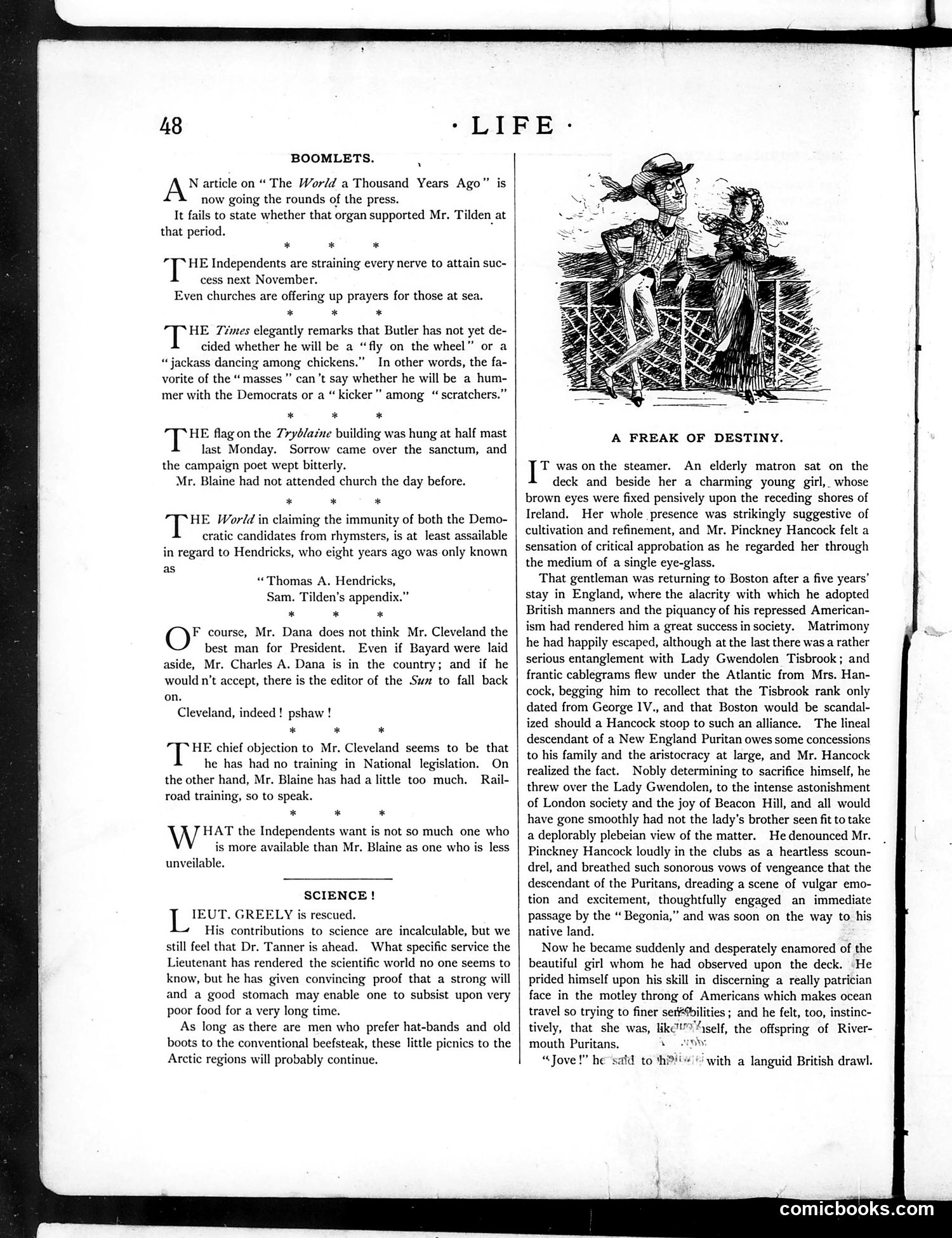
The page contains political commentary sections ("Boomlets," "Science!") and a story titled "A Freak of Destiny" illustrated with a sketch of a man and young woman on a ship deck. The cartoon depicts social satire rather than explicit political caricature. The story concerns an American gentleman returning from England who becomes enamored with an Irish girl aboard a steamer. The narrative mocks his pretensions—he's adopted British mannerisms and views himself as aristocratic, yet is descending from New England Puritans. The satire targets American social climbing and affectation of European sophistication. The "Boomlets" section references various political figures and contemporary issues (mentions of Cleveland, Independents, Democrats) but lacks sufficient context for precise modern interpretation without additional historical knowledge.
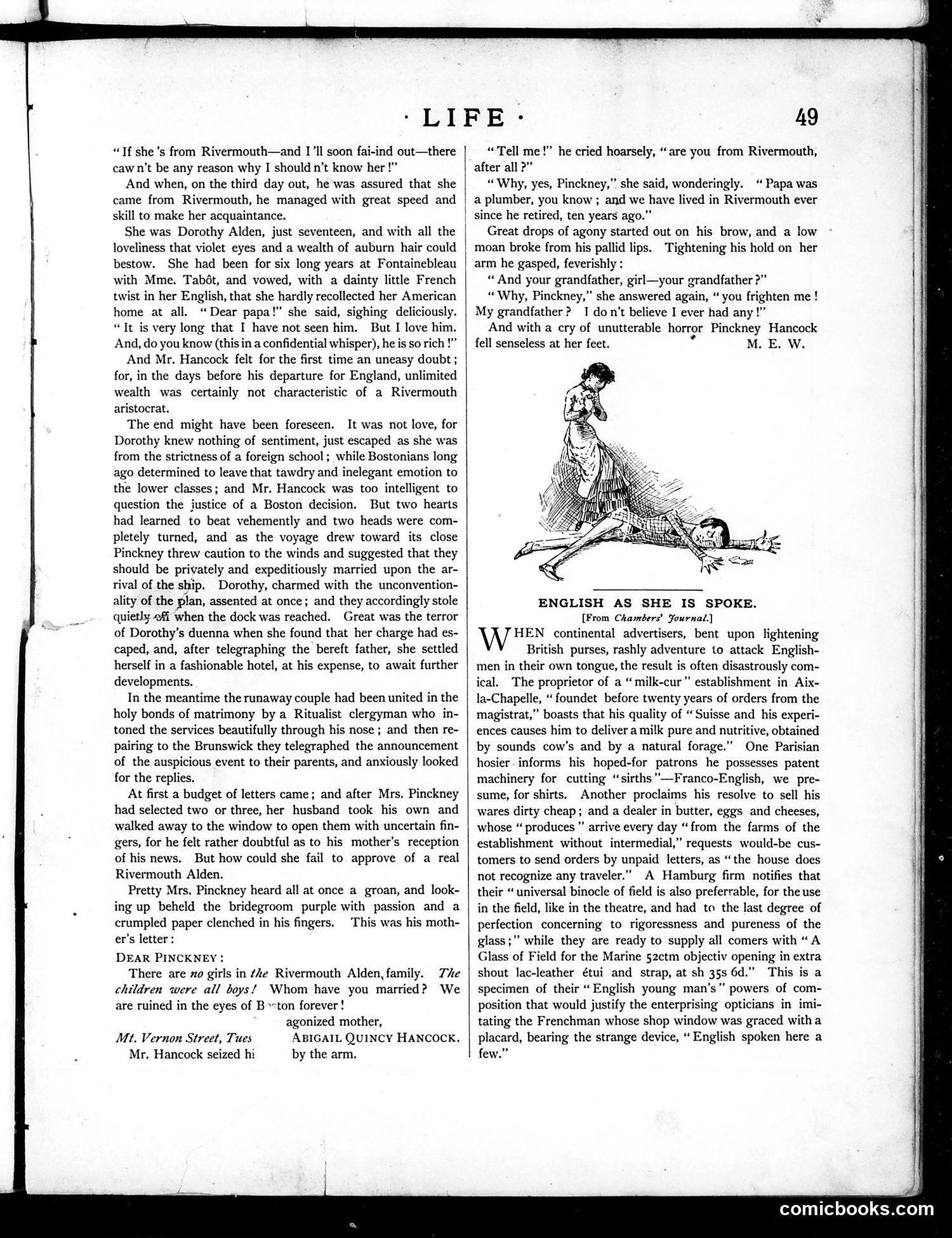
This page contains a serialized story about a couple's romantic elopement, interrupted by a letter from the groom's mother expressing disapproval of his marriage to Dorothy Alden from Rivermouth. The mother, Mrs. Pinckney, objects to the bride's background and social status. The illustration labeled "ENGLISH AS SHE IS SPOKE" satirizes French commercial establishments that use broken English advertising to appeal to English customers. The cartoon mocks pretentious French shopkeepers who make grandiose claims about their products (milk, shirts, butter) while speaking comically fractured English. The satire targets Anglo-French commercial rivalry and the absurdity of French businesses' attempts at English marketing during what appears to be the late 19th century.
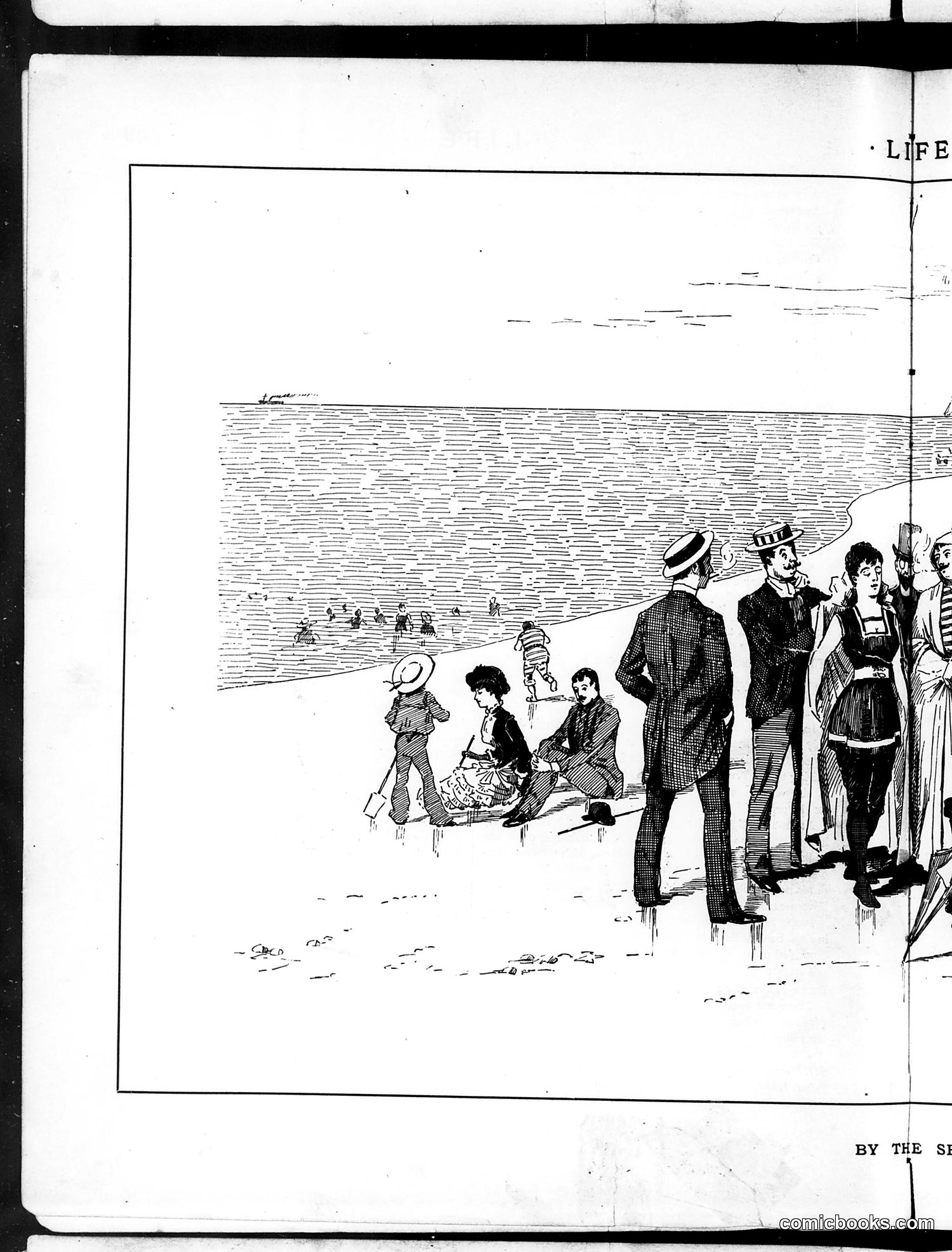
This appears to be a satirical beach scene from Life magazine. The illustration shows well-dressed gentlemen in formal attire (suits, hats) standing on a beach watching bathers in the water. The contrast between their formal dress and the casual seaside setting suggests social satire about class distinctions or pretension. The gentlemen appear to be observing or scrutinizing the swimmers with evident interest. Without visible caption text to confirm the specific joke or reference, the satire likely mocks either: Victorian-era social formality that persisted even at leisure venues, or perhaps commentary on voyeuristic behavior at public beaches. The exaggerated formal clothing worn by observers at a recreational setting is the core comedic device. The page header reads "BY THE SE[A]" (partially visible).
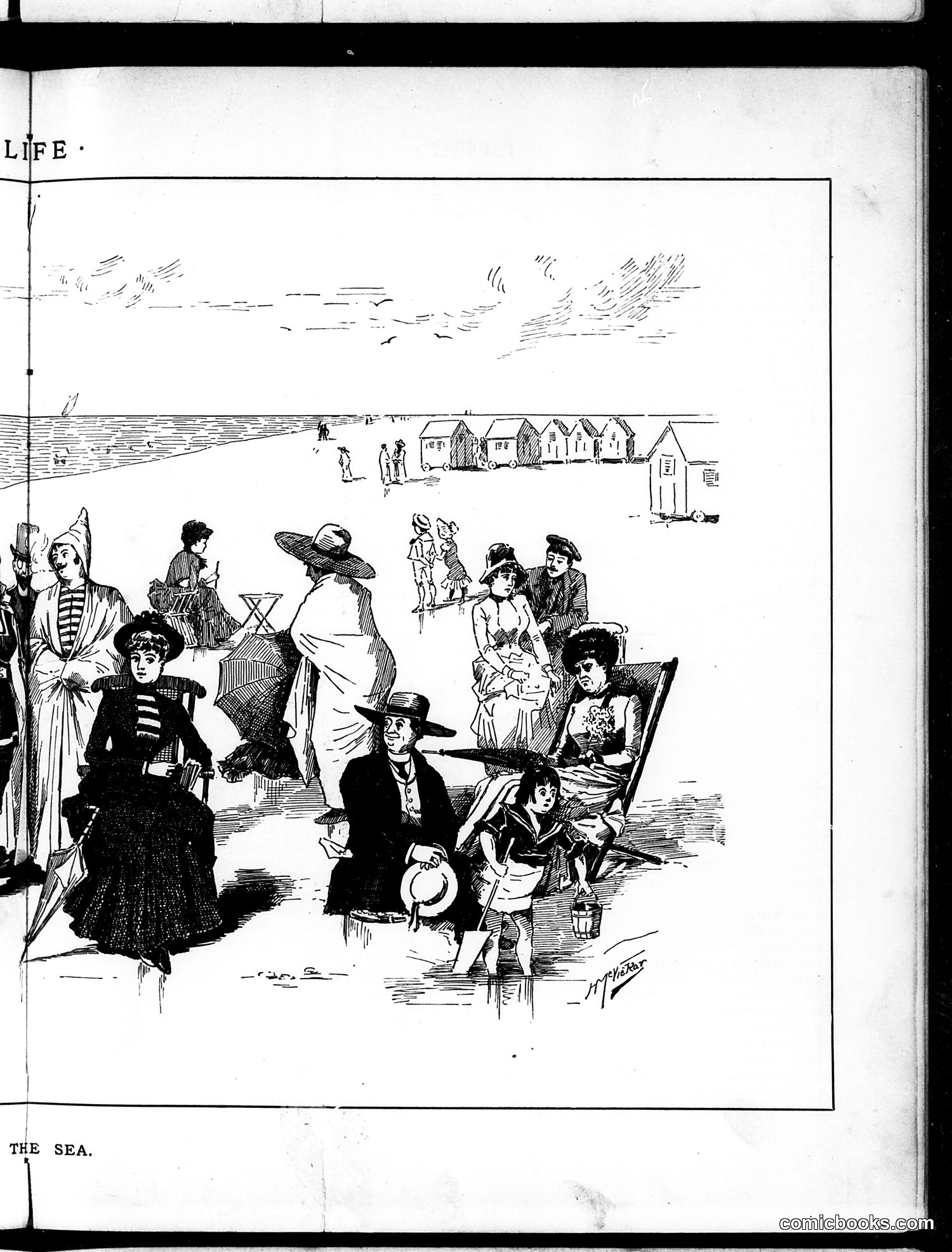
This pen-and-ink illustration depicts a seaside scene with Victorian-era beachgoers. The foreground shows well-dressed women and men in period clothing (likely late 19th or early 20th century) relaxing on the beach. In the background, beach huts line the shore with other vacationers visible. The satire likely comments on **class distinctions and social conventions at leisure resorts**—a common Life magazine theme. The carefully rendered clothing and poses of the fashionable figures suggest mockery of Victorian propriety and pretense among the wealthy at popular seaside destinations. Without additional caption text visible, the specific satirical target remains somewhat unclear, but the scene appears to be gentle social commentary on beach culture and the behaviors of the upper classes at their vacation retreats.
This page satirizes the 1884 Republican presidential campaign through mock letters written in exaggerated rural dialect. "Squire Jorkins," a country Republican, expresses doubts about supporting James G. Blaine, the party's nominee, due to rumors about his character and civil service reform record. The satire's bite lies in the response from "General" (likely a Republican operative): he uses flowery patriotic language while subtly offering a bribe—mentioning a Custom House appointment change and saying "You know for whom *I* would vote"—clearly implying patronage rewards for political loyalty. Jorkins then succumbs to this corruption, immediately reversing his concerns when promised a government job (Collector position). The hired man Pete's comment that he'll vote for Blaine "or mak traks" (leave town) further mocks the transactional nature of politics. The satire exposes how Republican operatives used federal appointments to buy votes, contradicting their stated commitment to civil service reform.
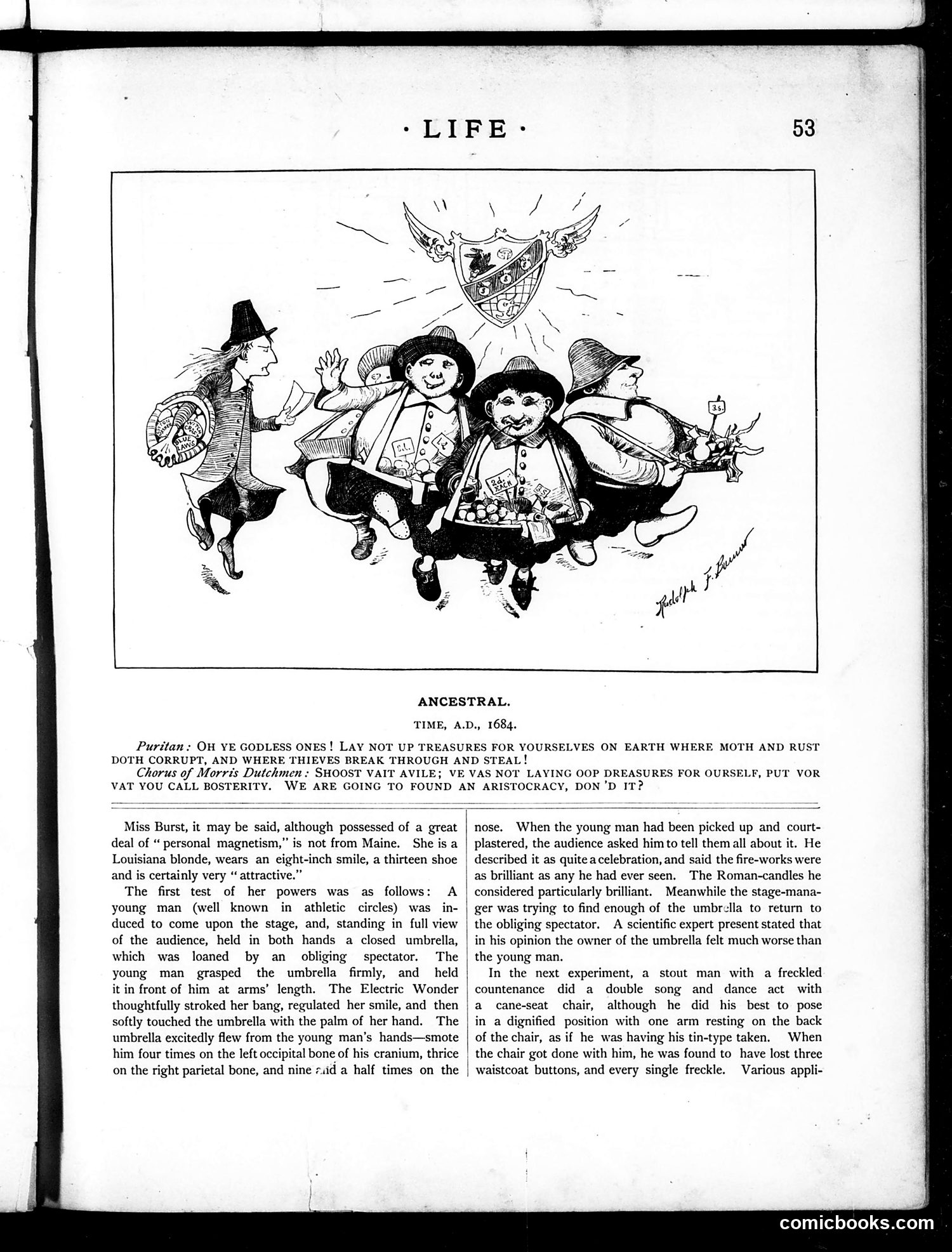
This page satirizes the contrast between American Puritan morality and Dutch colonial materialism, set in 1684. The cartoon shows a Puritan preacher denouncing worldly wealth while Dutch settlers (represented by caricatured figures with exaggerated accents) reply that they're not accumulating treasure for themselves—they're building an aristocracy for posterity, contradicting the preacher's spiritual message. The accompanying article describes "Miss Burst," "The Electric Wonder," a stage performer who uses apparent magnetic or electrical powers to violently throw objects (an umbrella, a chair) at volunteer audience members. The humor derives from the absurdity: spectators witness destructive chaos yet describe it enthusiastically as impressive entertainment. Together, the page mocks both historical hypocrisy and contemporary credulity—how people rationalize contradictions and accept obvious fakery as genuine spectacle.
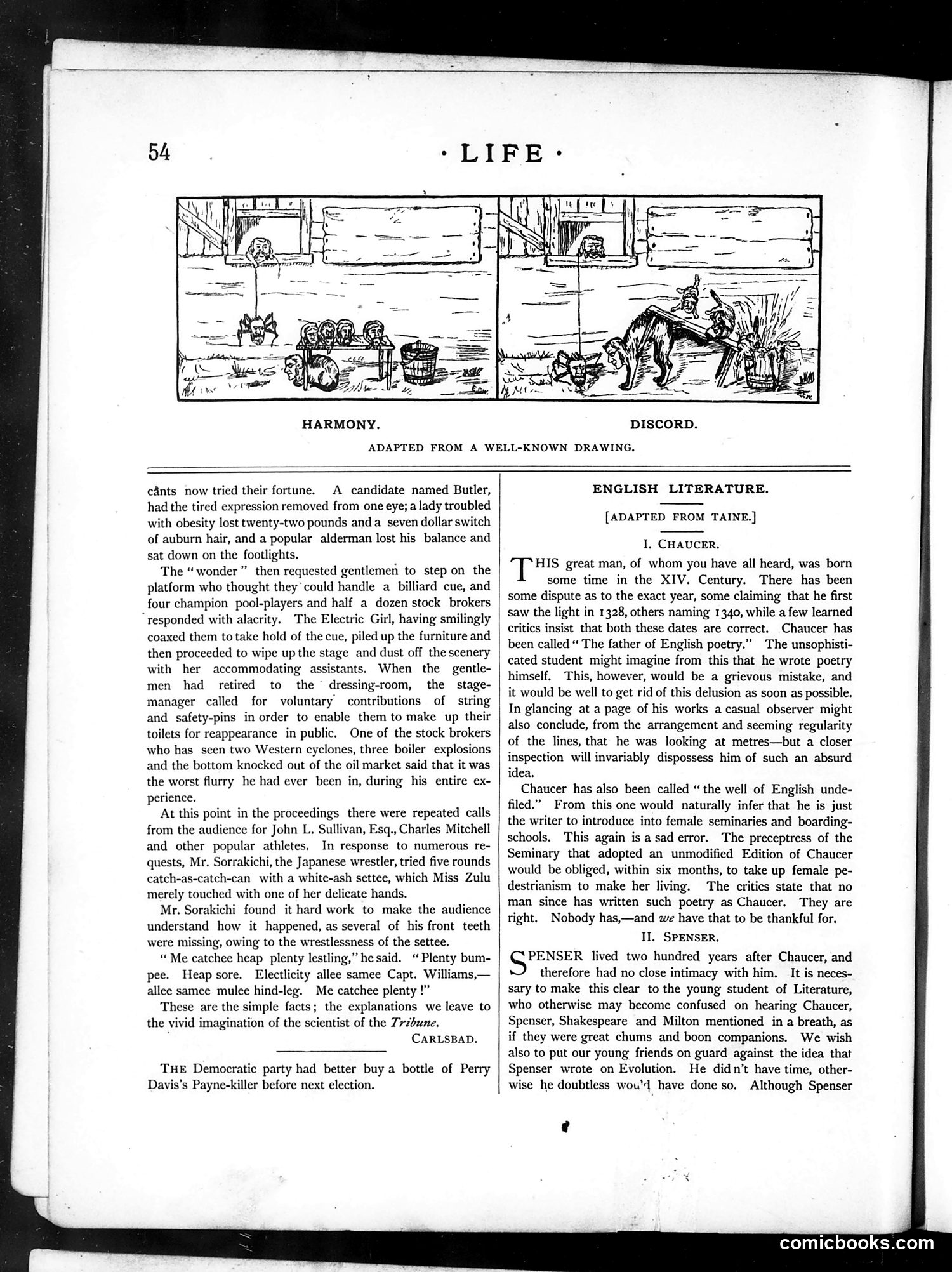
The cartoon depicts two contrasting scenes from what appears to be a stage performance by "The Electric Girl"—likely referring to a contemporary electrical attraction or vaudeville act. The left panel ("Harmony") shows an orderly performance; the right ("Discord") shows chaos. The accompanying text humorously describes the Electric Girl's demonstrations: she invites audience members (including boxers, wrestlers, stock brokers, and a Japanese wrestler named Sorrakichi) to handle props, then uses electrical power to dramatically throw them around the stage, destroying furniture and scattering the men. The Japanese wrestler loses teeth and struggles to explain what happened. The joke mocks both the gullible male spectators who eagerly participate and the supposed "scientific" explanations offered for electrical phenomena—suggesting the Electric Girl's act is theatrical trickery masquerading as scientific demonstration. The satire targets masculine pride, technological hype, and public credulity about electrical "wonders" during this era of emerging electrical technology.
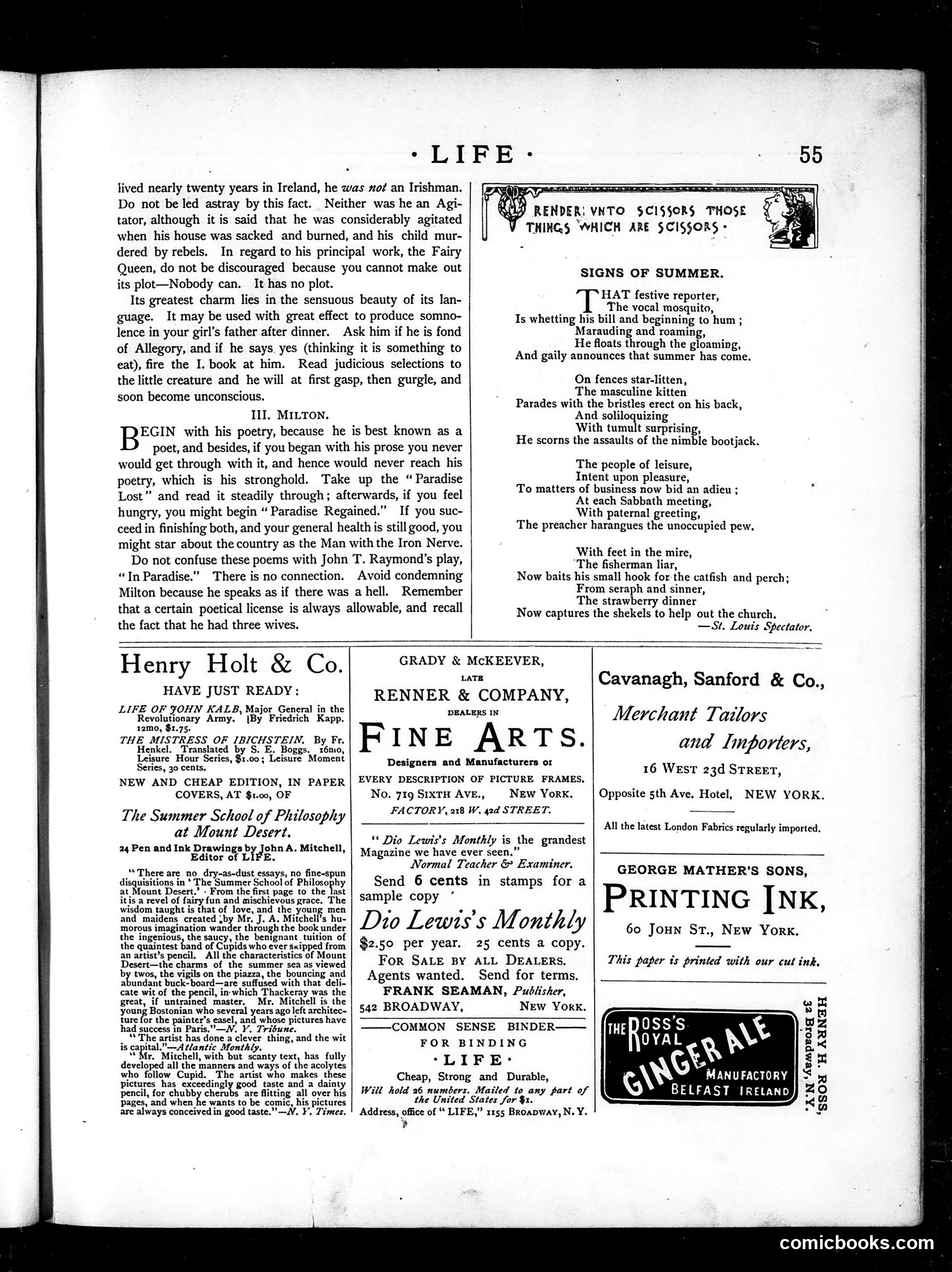
This page is primarily **literary criticism and advertising**, not political cartoons. The main content discusses how to read classic English literature—specifically Spenser, Milton—with satirical advice. The satirist mocks *The Faerie Queene* as having no plot, suggesting it induces sleep ("produce somnolence in your girl's father"). He jokes about using tedious allegory to knock people unconscious, then ironically praises its "sensuous beauty." The section on Milton humorously advises reading *Paradise Lost* sequentially, threatening reader endurance. A jab at Milton's marriages appears as a throwaway joke about his "three wives." The **"Signs of Summer"** poem is lighthearted seasonal verse about mosquitoes, cats, fishermen, and church strawberry socials—no satirical bite. The rest is period advertising for publishers, art dealers, tailors, and printing ink. There are **no visible political cartoons** on this page—just literary commentary and commercial notices typical of 1880s *Life* magazine's mixed content format.
This is primarily a **advertising and humor page** from Life magazine (1883), containing mostly classified advertisements and brief comic anecdotes rather than political cartoons. The **humorous pieces** are short, satirical quips from other publications (Hatchet, Norristown Herald, Rockland Courier). They target: - **Absent-mindedness** (Mabel losing her "fink" and "fimble"—nonsense words for comic effect) - **Bureaucratic incompetence** (a congressman's claim rejected on constitutional grounds) - **Slow mail service** (an 18-year delay in mailing a letter) - **Irish immigrant stereotypes** (servant girl's malapropisms about being a "Biddy") The **advertisements** promote pianos, candies, hotels, perfumes, iced coffee, and accident insurance—typical 1880s commerce. There are **no identifiable political figures or caricatures**. The humor relies on wordplay and everyday absurdities rather than topical satire. This page demonstrates how Life blended light entertainment with commercial notices.
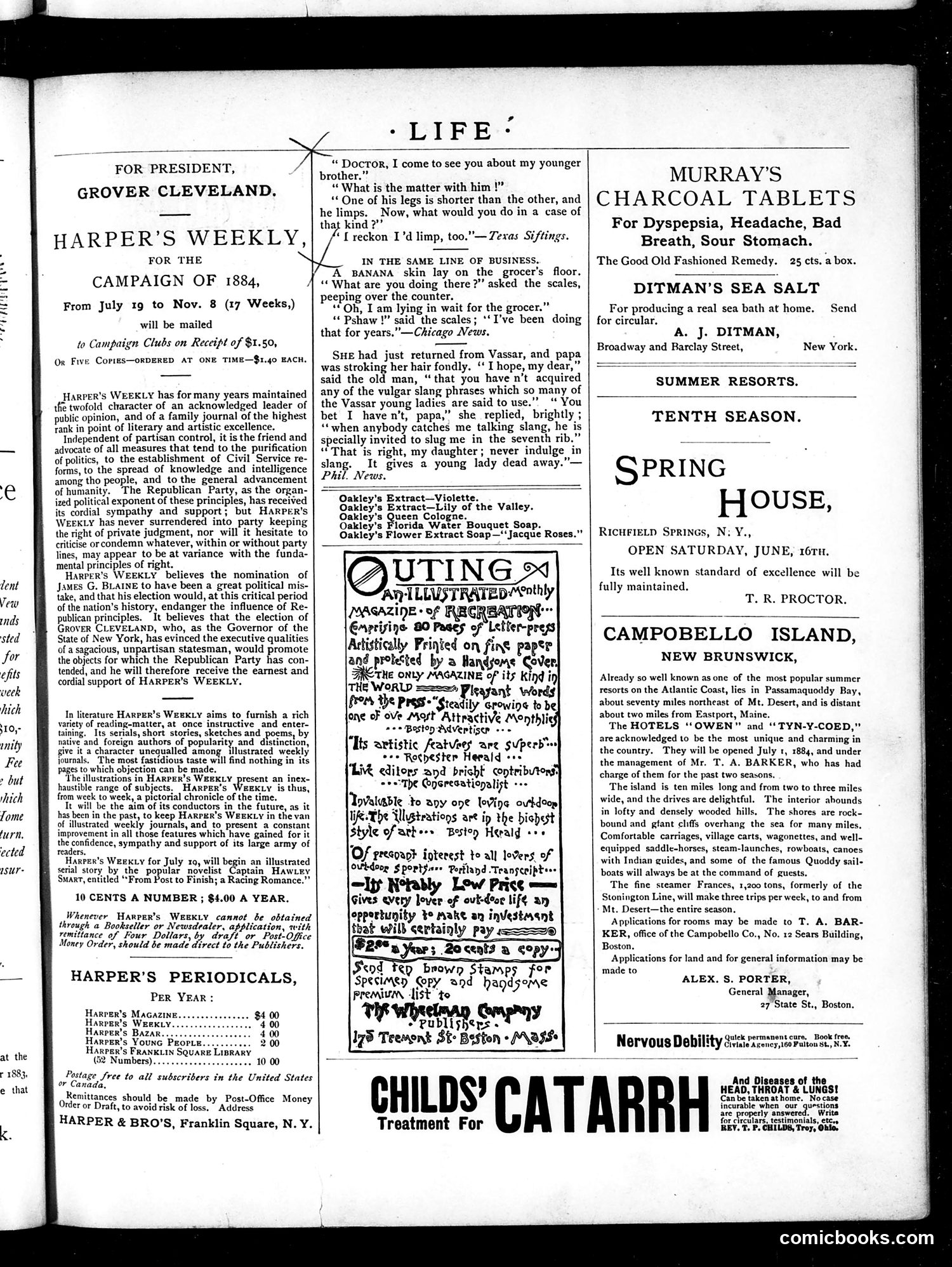
This page is primarily **advertising and editorial content** for Harper's Weekly's 1884 campaign coverage, not a political cartoon. The key political content is Harper's Weekly's **endorsement of Democrat Grover Cleveland for president**, which was remarkable—the magazine was explicitly Republican but broke ranks. The text states they believe Cleveland's election would "promote the objects for which the Republican Party has contended," while calling James G. Blaine's nomination "a great political mistake." The small comic anecdote about a doctor and a patient's brother with unequal leg length appears to be filler humor, not political satire. The page emphasizes Harper's Weekly's independence from strict party loyalty, positioning itself as principled rather than partisan—willing to support a Democrat if Republican principles are better served.
This is primarily a **commercial advertisement page** from Life magazine, likely from the 1880s based on product dates mentioned (1883 champagne vintage, 1876 Centennial award). There are no political cartoons or satirical content. The page features typical Victorian-era consumer goods: whiskey, corsets, medical remedies (Cuticura skin treatments), pianos, bicycles, cigarettes, champagne, tennis equipment, and billiard tables. Each advertisement uses period marketing conventions—testimonials, award claims, and appeals to refinement ("preferred by leading artists"). The one illustrative element is a **cherub/cupid figure** accompanying the Cuticura ad, a common Victorian decorative motif meant to suggest innocence and purity for a baby soap product. The page reflects Gilded Age consumer culture and advertising strategies rather than satire. Life magazine by this era had shifted from satirical humor toward lifestyle and consumer content.