
Life, 1884-07-24 · page 5 of 16
Life — July 24, 1884 — page 5: what you’re looking at
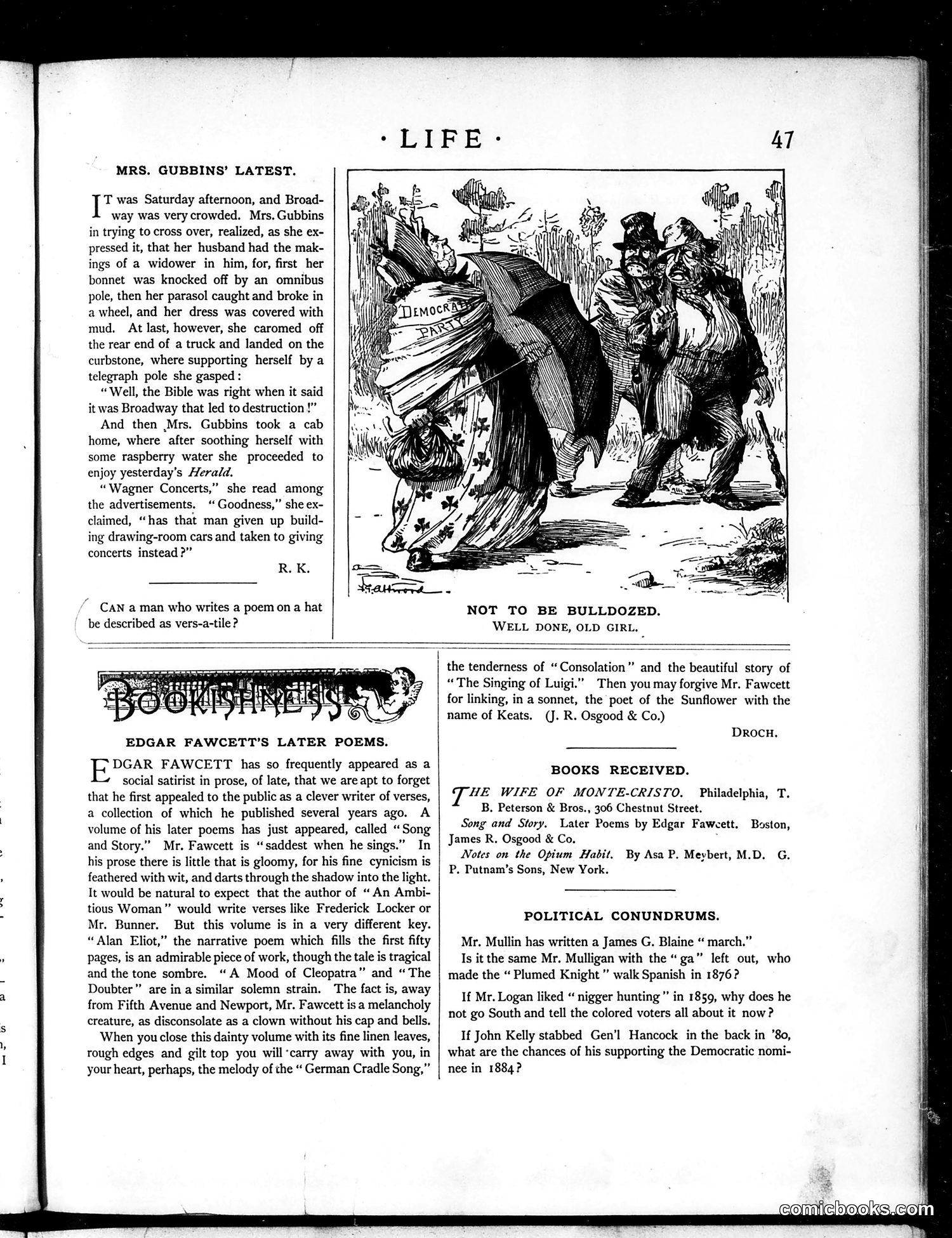
What you’re looking at
The cartoon depicts a woman labeled "Democracy" being knocked down by a figure representing an omnibus (public transit vehicle). Based on the accompanying story "Mrs. Gubbins' Latest," this satirizes the chaos of urban life on Broadway, where Mrs. Gubbins was struck by a truck and knocked into mud. The title "Not to Be Bulldozed. Well Done, Old Girl" celebrates Democracy's resilience despite being literally trampled by modern urban forces—likely representing either political corruption or the chaotic dangers of industrializing cities. The cartoon's irony suggests that despite being violently attacked (literally and figuratively), Democracy persists. It's unclear which specific political event prompted this, but it reflects late-19th-century anxieties about democracy's fragility amid rapid modernization.
📄 Transcribed text from this page (OCR, searchable)
Machine-transcribed from the original scan — historical spelling and the odd misread are preserved.
MRS. GUBBINS’ LATEST. J T was Saturday afternoon, and Broad- way was very crowded. Mrs. Gubbins in trying to cross over, realized, as she ex- pressed it, that her husband had the mak- ings of a widower in him, for, first her bonnet was knocked off by an omnibus pole, then her parasol caught and broke in a wheel, and her dress was covered with mud. At last, however, she caromed off the rear end of a truck and landed on the curbstone, where supporting herself by a telegraph pole she gasped : “Well, the Bible was right when it said it was Broadway that led to destruction !” And then .Mrs. Gubbins took a cab home, where after soothing herself with some raspberry water she proceeded to enjoy yesterday’s Herald. “Wagner Concerts,” she read among the advertisements. “Goodness,” she ex- claimed, “has that man given up build- ing drawing-room cars and taken to giving concerts instead ?” R.K. © CAN aman who writes a poem ona hat be described as vers-a-tile? NOT TO BE BULLDOZED. WELL DONE, OLD GIRL. EDGAR FAWCETT’S LATER POEMS. DGAR FAWCETT has so frequently appeared as a social satirist in prose, of late, that we are apt to forget that he first appealed to the public as a clever writer of verses, a collection of which he published several years ago. A volume of his later poems has just appeared, called “Song and Story.” Mr. Fawcett is ‘saddest when he sings.” In his prose there is little that is gloomy, for his fine cynicism is feathered with wit, and darts through the shadow into the light. It would be natural to expect that the author of “An Ambi- tious Woman” would write verses like Frederick Locker or Mr. Bunner. But this volume is in a very different key. “Alan Eliot,” the narrative poem which fills the first fifty pages, is an admirable piece of work, though the tale is tragical and the tone sombre. “A Mood of Cleopatra” and “The Doubter” are in a similar solemn strain. The fact is, away from Fifth Avenue and Newport, Mr. Fawcett is a melancholy creature, as disconsolate as a clown without his cap and bells. When you close this dainty volume with its fine linen leaves, rough edges and gilt top you will‘carry away with you, in your heart, perhaps, the melody of the “‘ German Cradle Song,” the tenderness of “Consolation” and the beautiful story of “The Singing of Luigi.” Then you may forgive Mr. Fawcett for linking, in a sonnet, the poet of the Sunflower with the name of Keats. (J. R. Osgood & Co.) Drocn. BOOKS RECEIVED. (HE WIFE OF MONTE-CRISTO, Philadelphia, T. B, Peterson & Bros., 306 Chestnut Street. Song and Story. Later Poems by Edgar Faweett. James R. Osgood & Co. Notes on the Opium Habit. P. Putnam’s Sons, New York. Boston, By Asa P. Meybert, M.D. G. POLITICAL CONUNDRUMS. Mr. Mullin has written a James G. Blaine “ march.” Is it the same Mr. Mulligan with the “ga” left out, who made the “ Plumed Knight ” walk Spanish in 1876? If Mr. Logan liked “ nigger hunting” in 1859, why does he not go South and tell the colored voters all about it now? If John Kelly stabbed Gen’l Hancock in the back in ’80, what are the chances of his supporting the Democratic nomi- nee in 1884?