
Life, 1884-07-24 · page 12 of 16
Life — July 24, 1884 — page 12: what you’re looking at
What you’re looking at
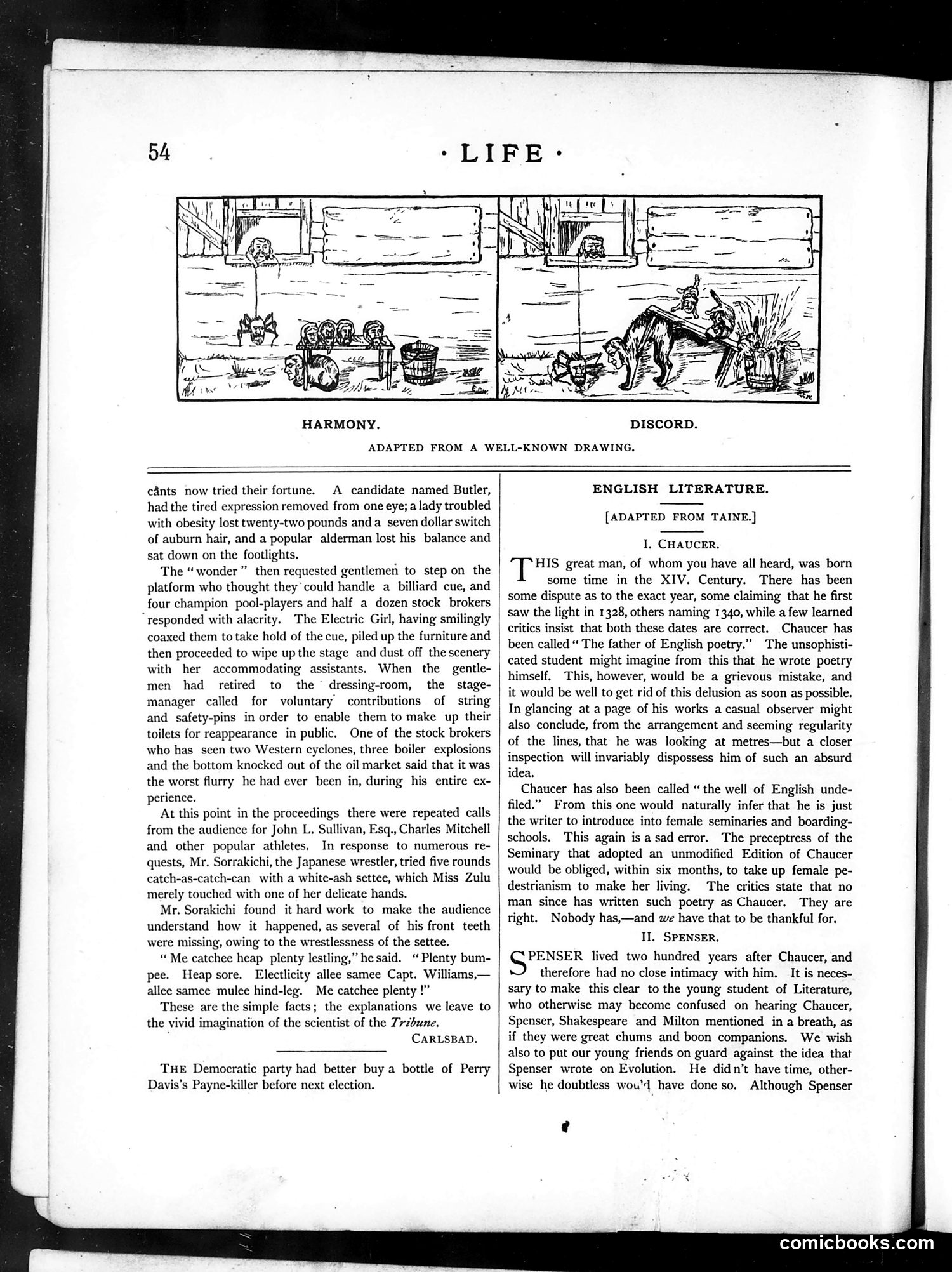
The cartoon depicts two contrasting scenes from what appears to be a stage performance by "The Electric Girl"—likely referring to a contemporary electrical attraction or vaudeville act. The left panel ("Harmony") shows an orderly performance; the right ("Discord") shows chaos. The accompanying text humorously describes the Electric Girl's demonstrations: she invites audience members (including boxers, wrestlers, stock brokers, and a Japanese wrestler named Sorrakichi) to handle props, then uses electrical power to dramatically throw them around the stage, destroying furniture and scattering the men. The Japanese wrestler loses teeth and struggles to explain what happened. The joke mocks both the gullible male spectators who eagerly participate and the supposed "scientific" explanations offered for electrical phenomena—suggesting the Electric Girl's act is theatrical trickery masquerading as scientific demonstration. The satire targets masculine pride, technological hype, and public credulity about electrical "wonders" during this era of emerging electrical technology.
📄 Transcribed text from this page (OCR, searchable)
Machine-transcribed from the original scan — historical spelling and the odd misread are preserved.
HARMONY. DISCORD. ADAPTED FROM A WELL-KNOWN DRAWING. cAnts now tried their fortune. A candidate named Butler, had the tired expression removed from one eye; a lady troubled with obesity lost twenty-two pounds anda seven dollar switch of auburn hair, and a popular alderman lost his balance and sat down on the footlights. The “wonder ” then requested gentlemen to step on the platform who thought they could handle a billiard cue, and four champion pool-players and half a dozen stock brokers “responded with alacrity. The Electric Girl, having smilingly coaxed them to take hold of the cue, piled up the furniture and then proceeded to wipe up the stage and dust off thescenery | with her accommodating assistants. When the gentle- men had retired to the ° dressing-room, the stage- manager called for voluntary’ contributions of string and safety-pins in order to enable them to make up their toilets for reappearance in public. One of the stock brokers who has seen two Western cyclones, three boiler explosions and the bottom knocked out of the oil market said that it was the worst flurry he had ever been in, during his entire ex- perience. At this point in the proceedings there were repeated calls from the audience for John L. Sullivan, Esq., Charles Mitchell and other popular athletes. In response to numerous re- quests, Mr. Sorrakichi, the Japanese wrestler, tried five rounds catch-as-catch-can with a white-ash settee, which Miss Zulu merely touched with one of her delicate hands. Mr. Sorakichi found it hard work to make the audience understand how it happened, as several of his front teeth were missing, owing to the wrestlessness of the settee. “ Me catchee heap plenty lestling,” he said. “Plenty bum- pee. Heap sore. Electlicity allee samee Capt. Williams,— allee samee mulee hind-leg. Me catchee plenty !” These are the simple facts; the explanations we leave to the vivid imagination of the scientist of the 7rzbune. CARLSBAD. THE Democratic party had better buy a bottle of Perry Davis's Payne-killer before next election. ENGLISH LITERATURE. [ADAPTED FROM TAINE.] I, CHAUCER. HIS great man, of whom you have all heard, was born some time in the XIV. Century. There has been | some dispute as to the exact year, some claiming that he first saw the light in 1328, others naming 1340, while a few learned critics insist that both these dates are correct. Chaucer has been called “ The father of English poetry.” The unsophisti- cated student might imagine from this that he wrote poetry himself. This, however, would be a grievous mistake, and it would be well to get rid of this delusion as soon as possible. In glancing at a page of his works a casual observer might also conclude, from the arrangement and seeming regularity of the lines, that he was looking at metres—but a closer inspection will invariably dispossess him of such an absurd idea. Chaucer has also been called “the well of English unde- filed.” From this one would naturally infer that he is just the writer to introduce into female seminaries and boarding- schools. This again is asad error. The preceptress of the Seminary that adopted an unmodified Edition of Chaucer would be obliged, within six months, to take up female pe- destrianism to make her living. The critics state that no man since has written such poetry as Chaucer. They are right. Nobody has,—and we have that to be thankful for. II. SPENSER. PENSER lived two hundred years after Chaucer, and therefore had no close intimacy with him. It is neces- sary to make this clear to the young student of Literature, who otherwise may become confused on hearing Chaucer, Spenser, Shakespeare and Milton mentioned in a breath, as if they were great chums and boon companions. We wish also to put our young friends on guard against the idea that Spenser wrote on Evolution. He didn’t have time, other- wise he doubtless wou'd have done so. Although Spenser e comicbooks.com