
A complete issue · 16 pages · 1884
Life — May 29, 1884
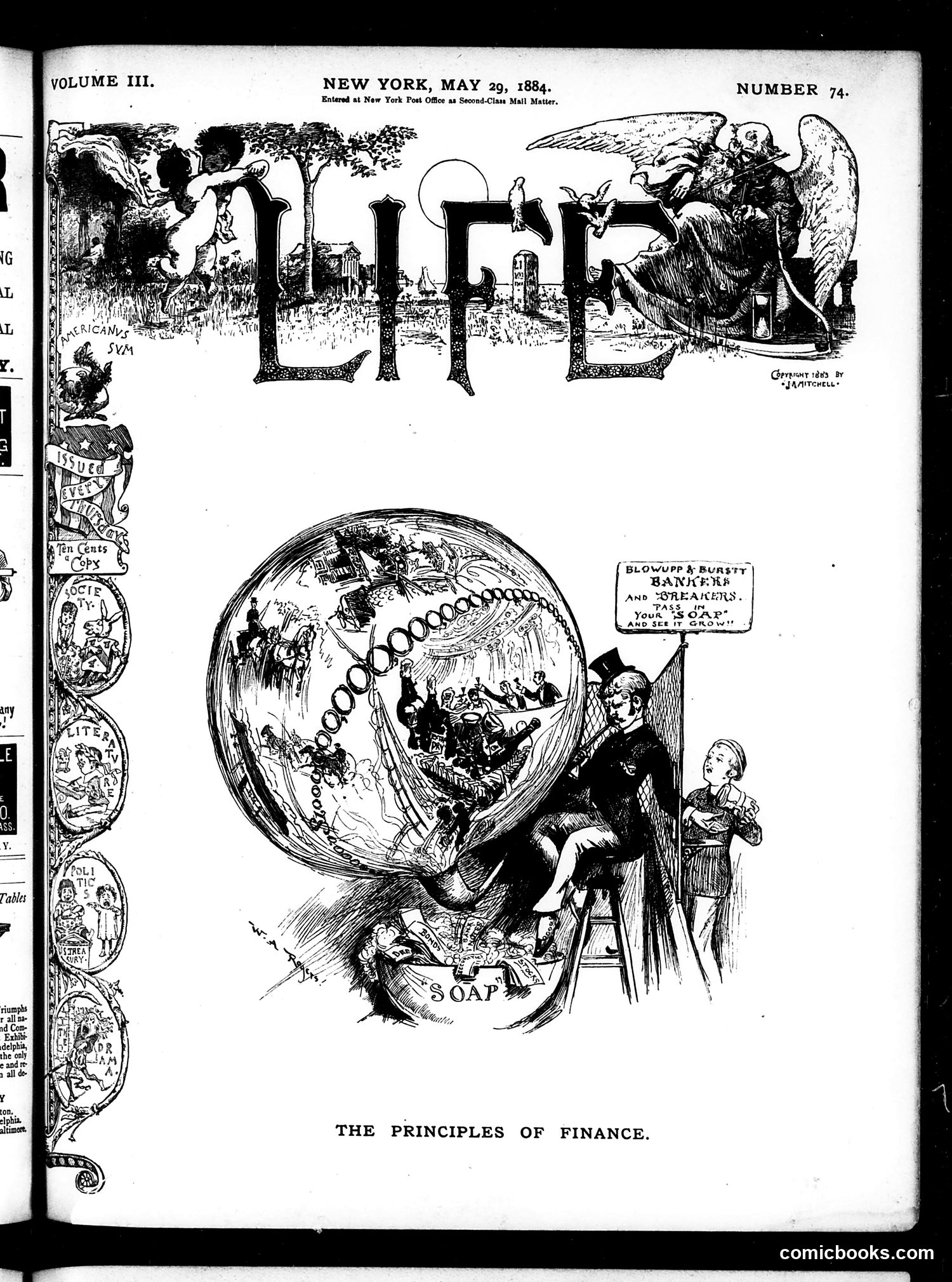
This cartoon satirizes financial speculation and banking practices of the Gilded Age. The central image depicts a large soap bubble—a metaphor for fragile, inflated investments—being blown by a wealthy banker or financier in a top hat, with another figure watching. The bubble contains scenes of financial activity inside. The soap bubble represents worthless speculation built on air, a common metaphor for unsound financial schemes. The title "The Principles of Finance" is ironic, mocking how financiers conducted business through inflated bubbles rather than solid economic principles. The accompanying advertisement for "Blowpuff & Burpett Bankers and Breakers" reinforces the joke, suggesting these financial institutions exist only to inflate and burst speculative bubbles, enriching themselves while ruining investors.
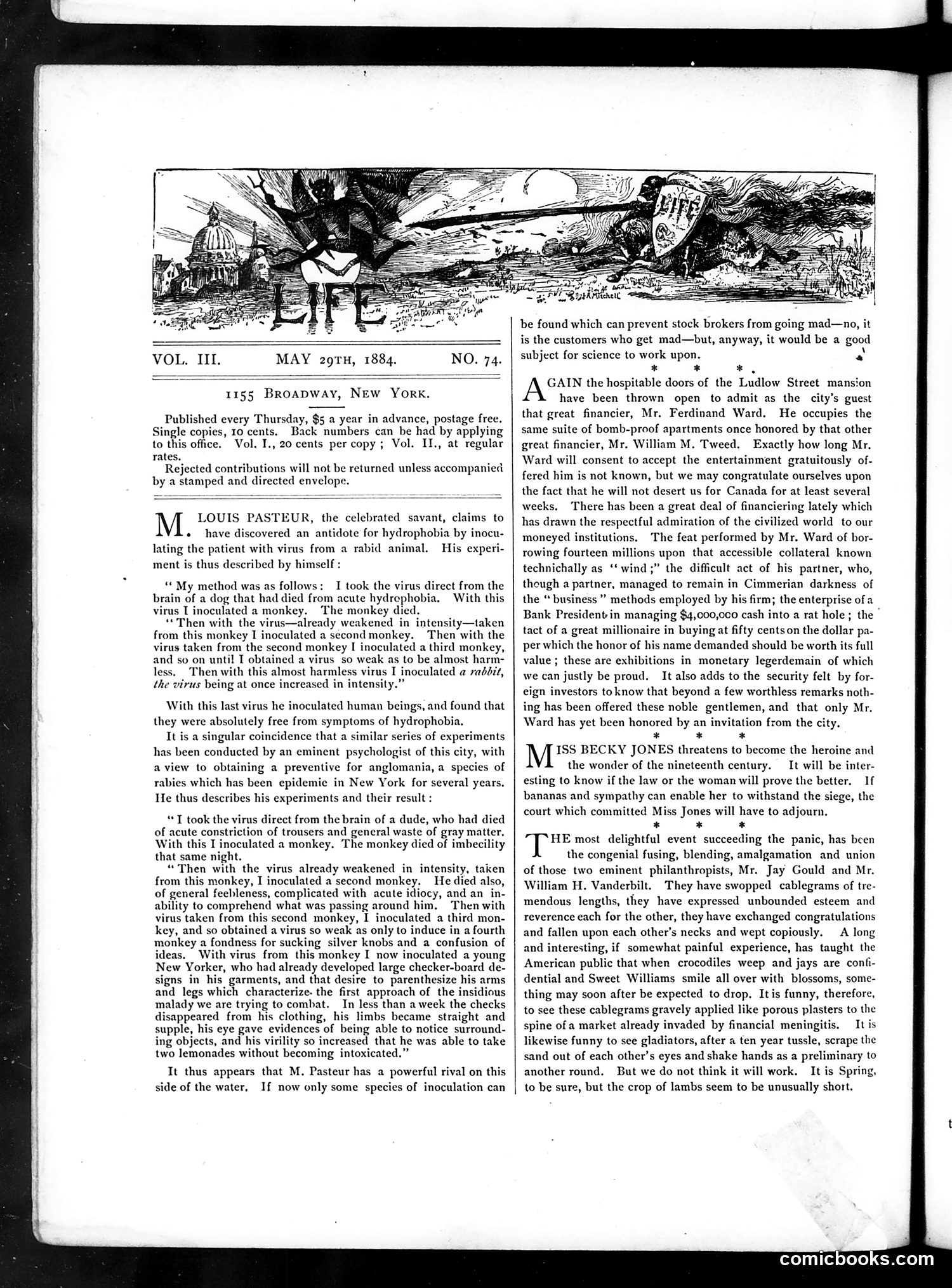
The page contains three satirical articles rather than political cartoons. The header illustration depicts allegorical figures representing "Life" itself. **Key content:** 1. **M. Louis Pasteur article**: Satirizes the famous scientist's claimed discovery of a hydrophobia cure through inoculation experiments involving rabid animals and monkeys. The satire mocks the sensational nature of the claims and the public fascination with them. 2. **Ferdinand Ward/William H. Vanderbilt piece**: References recent financial scandals involving these wealthy figures. Ward apparently mismanaged millions in borrowed funds; the satire congratulates the financiers for not abandoning New York society during the scandal. 3. **Miss Becky Jones/crocodile humor**: A brief joke about a woman named Jones who will "become the heroine" by resisting a crocodile's attack—likely absurdist humor typical of 1880s satirical magazines. The overall tone mocks wealthy financiers and scientific sensationalism of the Gilded Age.
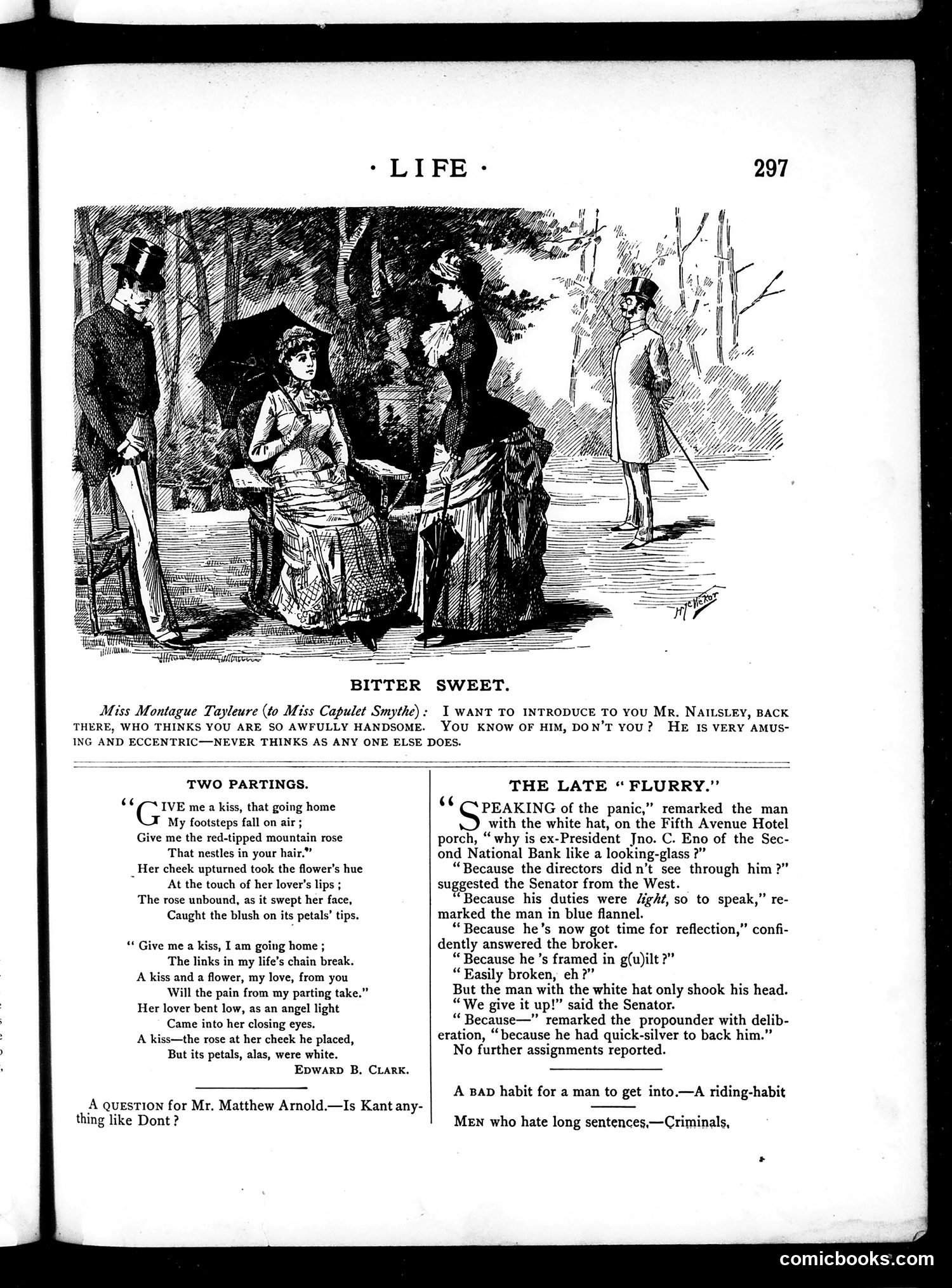
The main cartoon, "Bitter Sweet," depicts a social scene where Miss Montague Tayleure introduces Mr. Naisley to companions, noting he's "awfully handsome" but "very amusing and eccentric—never thinks as any one else does." The satire appears to target unconventional social behavior—Naisley is presented as someone whose eccentricity makes him simultaneously desirable and questionable in polite society. The cartoon mocks how the upper classes simultaneously value and dismiss individuality. The page also contains "Two Partings," a sentimental poem by Edward B. Clark about romantic separation, and "The Late 'Flurry,'" a humorous anecdote about why ex-President Jno. C. Eno avoided public scrutiny—apparently related to financial impropriety ("framed in g(u)ilt").
This page contains literary criticism and social commentary rather than political cartoons. The main content includes: **"A Fable: The Organ and the Crank"** — a moral tale about an organ (representing established institutions) displaced by a crank (representing a disruptive newcomer). The moral warns that "sarcasm is more humorous than dangerous." **Literary criticism** of F. Marion Crawford's novel "A Roman Singer," praising it as his best work despite its passionate Italian setting and themes of honor in marriage. **A section on book illustrations** featuring contributions by various artists. **"Unrecorded Sayings of Great Men"** — humorous pseudo-quotes attributed to Emerson and Carlyle. **"An Explanation"** — a brief humorous exchange about social circumstances and control. The page reflects turn-of-century literary culture and gentle social satire rather than hard political commentary.
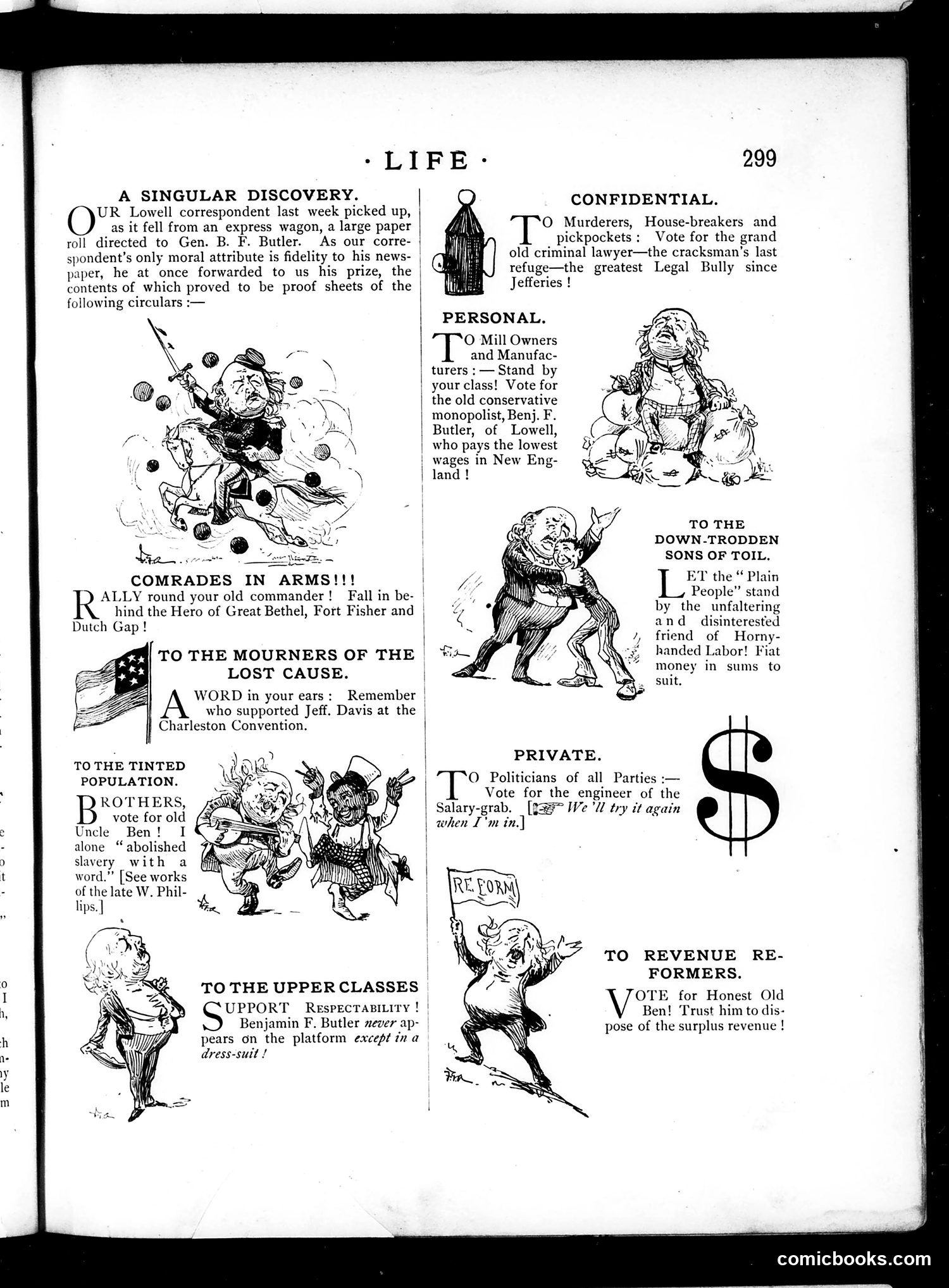
This satirical page contains multiple political appeals dressed as mock endorsements, typical of 19th-century American humor: **"A Singular Discovery"** mocks the Lowell Courier, questioning a newspaper's credibility after receiving suspicious circulars. **"Comrades in Arms"** urges support for Civil War figures at Fort Fisher and Dutch Gap—likely Republican/Union messaging. **Other sections target various groups:** - Mourners of the "Lost Cause" (Confederate sympathizers) - The "tinted population" (Black voters, using contemporary racist terminology) - Mill owners and manufacturers - Different political factions The cartoons use grotesque caricatures and sarcastic "endorsements" to mock different constituencies and political positions. The overall effect is cynical commentary on post-Civil War American politics, where various groups are satirized for their political allegiances and economic interests.
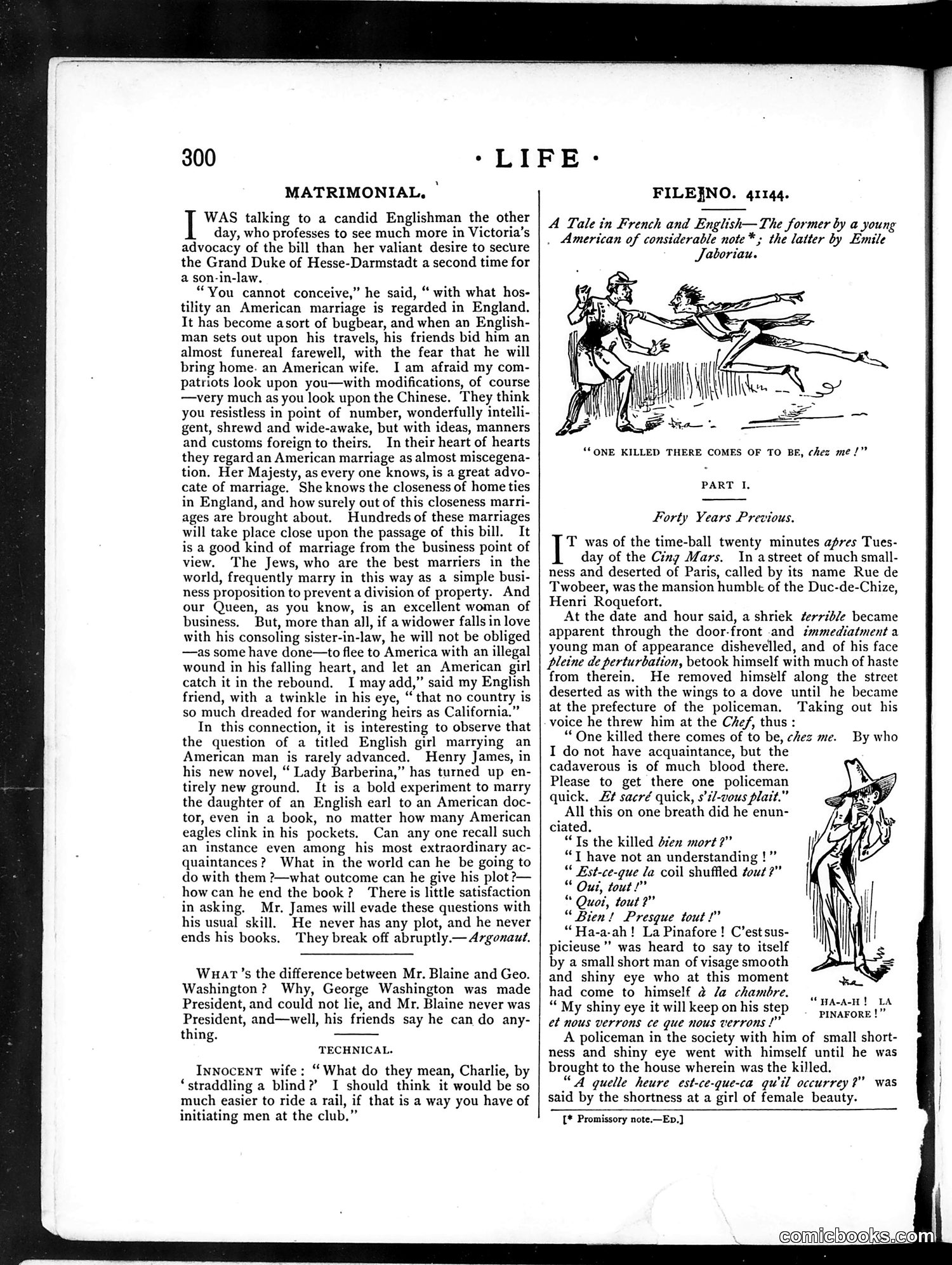
This page contains two distinct sections: **Left column ("Matrimonial")**: Social commentary criticizing American marriages, particularly involving English husbands marrying American women. The writer expresses concern that such unions are viewed negatively in England, where Americans are stereotyped as lacking refinement. The piece references Henry James's novel "Lady Barbarina" as an example exploring this cross-cultural marriage theme. The satire mocks both English snobbery and American pretension. **Right column ("Fileño 41144")**: A French-English tale titled "Forty Years Previous," featuring what appears to be a dramatic urban murder mystery. A disheveled young man announces a killing, creating confusion among Parisians and a policeman. The French phrases and theatrical tone suggest satirical fiction rather than serious crime reporting. Both sections reflect late-19th-century anxieties about class, nationality, and cultural differences.
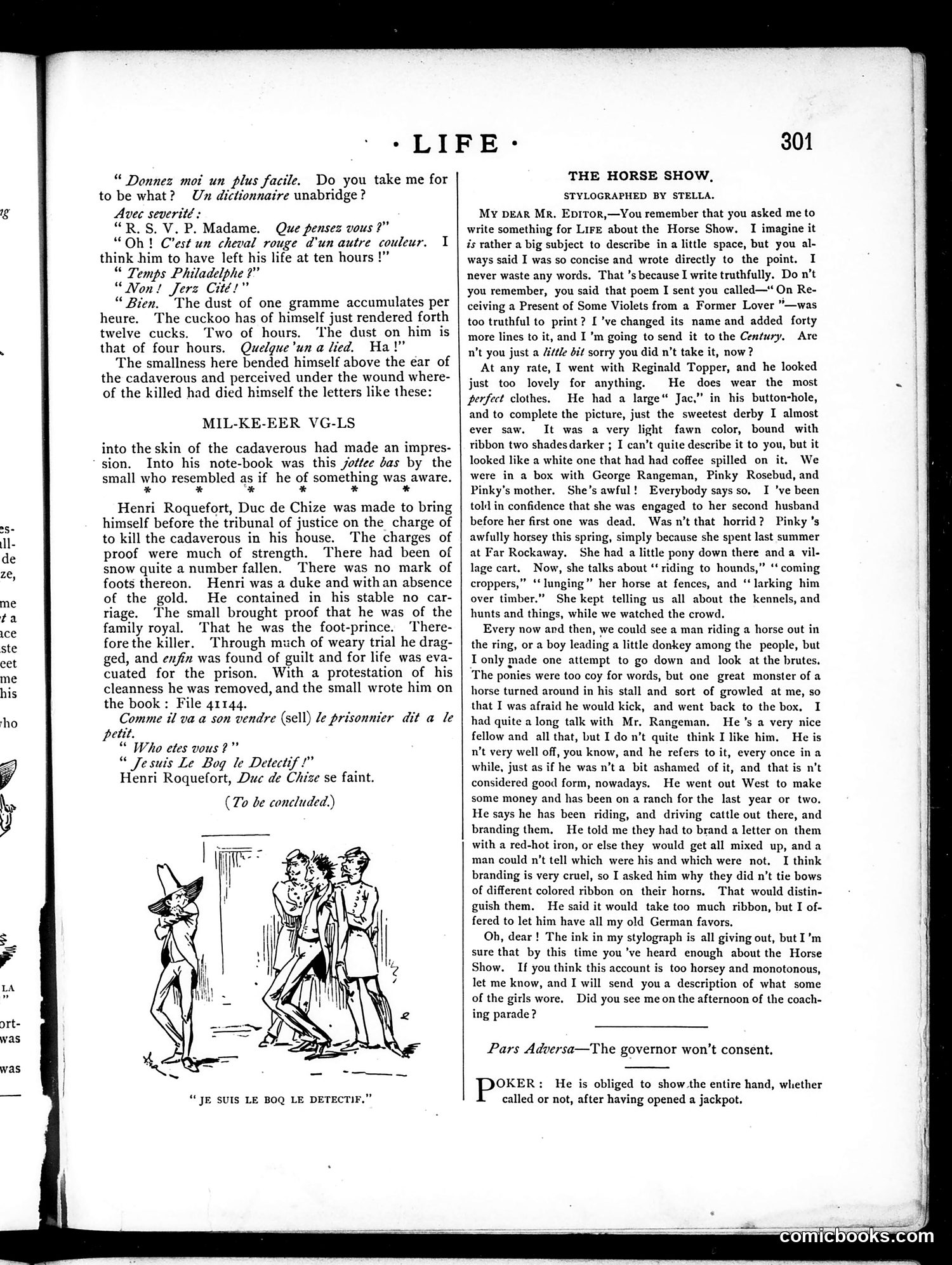
The main content is "The Horse Show," a humorous letter from a reader describing her experience at what appears to be a prominent social event. The accompanying illustration labeled "Je suis le Boq le Detectif" shows three figures in period dress, likely referencing a French detective character. The illustration's caption and context suggest satire of pretentious social situations—the writer describes encounters with horses, fashionable attendees, and aristocratic affectations (German favors, ribbon-decorated horses). The "detective" reference appears to mock those who take themselves overly seriously at such events. This represents Life's typical satirical approach: puncturing the pretensions of high society through humorous personal narratives and accompanying caricatures.
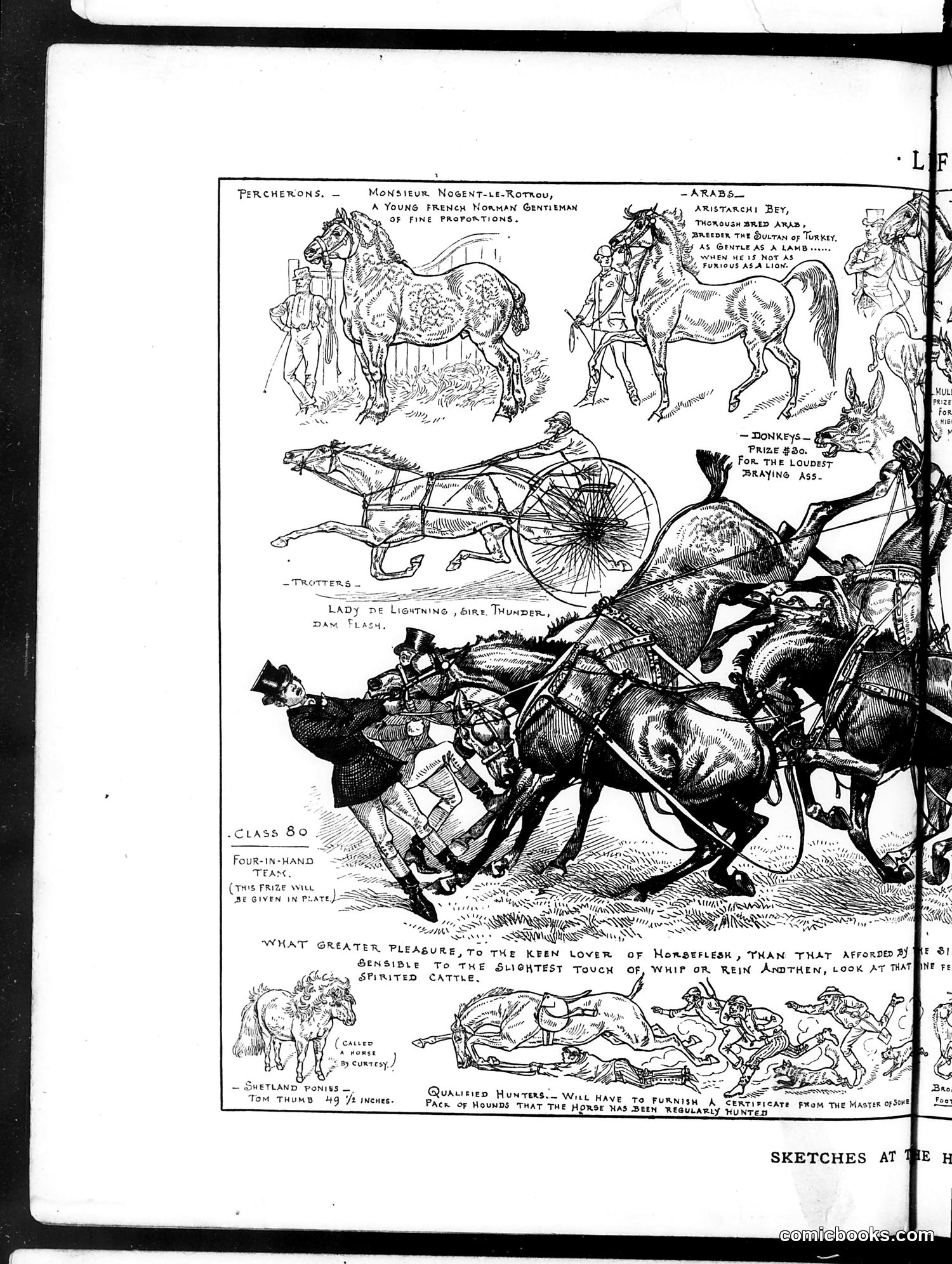
This page from *Life* magazine presents satirical sketches of horses and equestrian classes. The top section depicts various horse types with humorous captions: "Percheron" (a French Norman gentleman), "Araba" (an Aristarchian Bey), and "Donkeys" (described as having the loudest braying). The central illustration shows a chaotic "Class 80 Four-in-Hand Team" with an elegantly dressed driver struggling to control unruly horses—a common subject of period satire mocking incompetent horsemen. Below is commentary about horse-lovers and livestock handling. The bottom sketches show a "Shetland Pony" and "Qualified Hunters." The satire targets wealthy gentlemen's pretensions about horsemanship and breeding knowledge. The page mocks fashionable society's relationship with animals—suggesting that owning fine horses was more about status than actual competence or care.
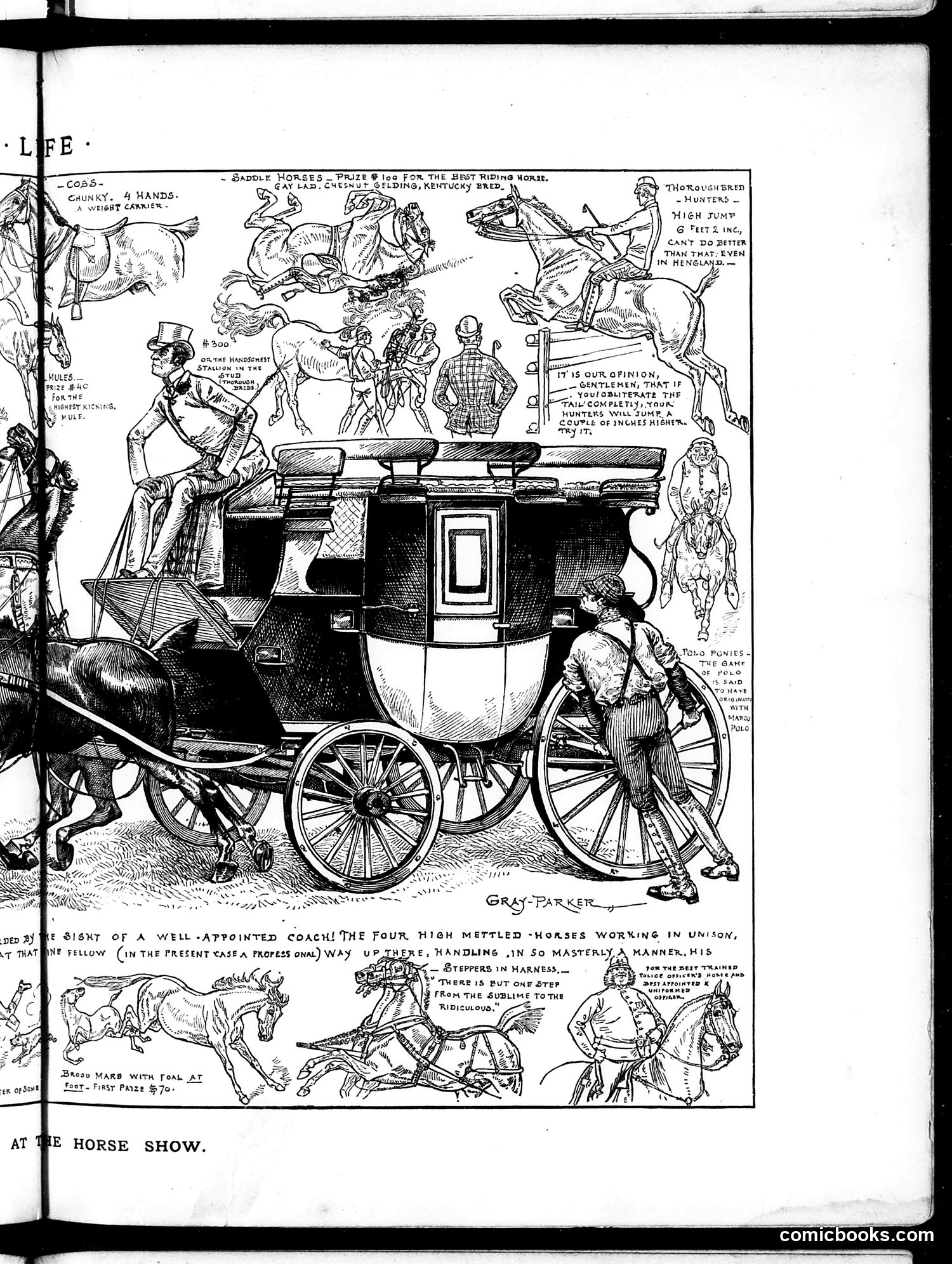
This satirical illustration depicts the social pretensions surrounding equestrian competition. The central image shows an elaborate coach pulled by four "high-mettled horses working in union," with accompanying text praising the handlers' mastery and skill. The surrounding vignettes mock various aspects of horse-show culture: saddle horses, judges' selections, and riding techniques. Text annotations include commentary on thoroughbred hunters, jumping abilities, and pony breeds—all rendered with exaggerated detail. The satire targets wealthy participants who treat horse shows as displays of status and refined taste. The meticulous, overwrought descriptions of horsemanship and breeding suggest the pretentiousness of this elite social ritual. The cartoon mocks how seriously affluent society takes these competitions as markers of sophistication and social standing.
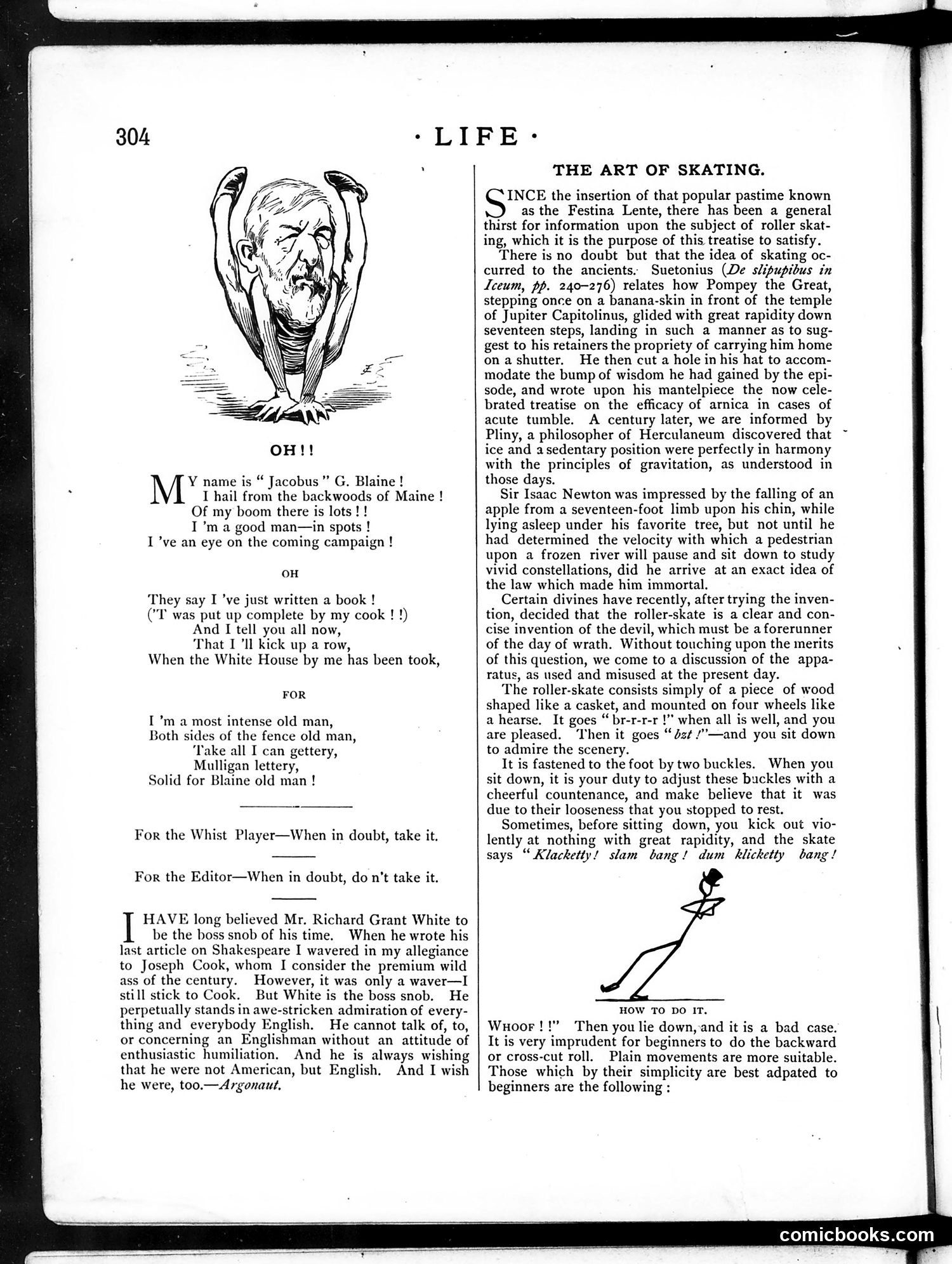
The page contains two distinct pieces of satire: **"Jacobus" G. Blaine poem (left):** This mocks James G. Blaine, likely a political figure eyeing the presidency. The caricature and verses ridicule him as an ambitious politician from Maine with dubious ethics—references to "Mulligan lettery" (likely the Mulligan Letters scandal involving Blaine) and his willingness to do anything ("both sides of the fence") to gain power. The satire suggests he'll "kick up a row" once he takes the White House. **"The Art of Skating" (right):** A humorous mock-instructional essay that uses deliberately absurd historical "evidence" (fake citations to Suetonius and Pliny) to trace roller-skating to ancient times. It's lighthearted social satire, poking fun at the new roller-skating fad and clumsy beginners. The wooden-casket description and practical advice about falling are comedic jabs at the sport's awkwardness. Both pieces exemplify Life's satirical style—political ridicule paired with humorous takes on contemporary social trends.
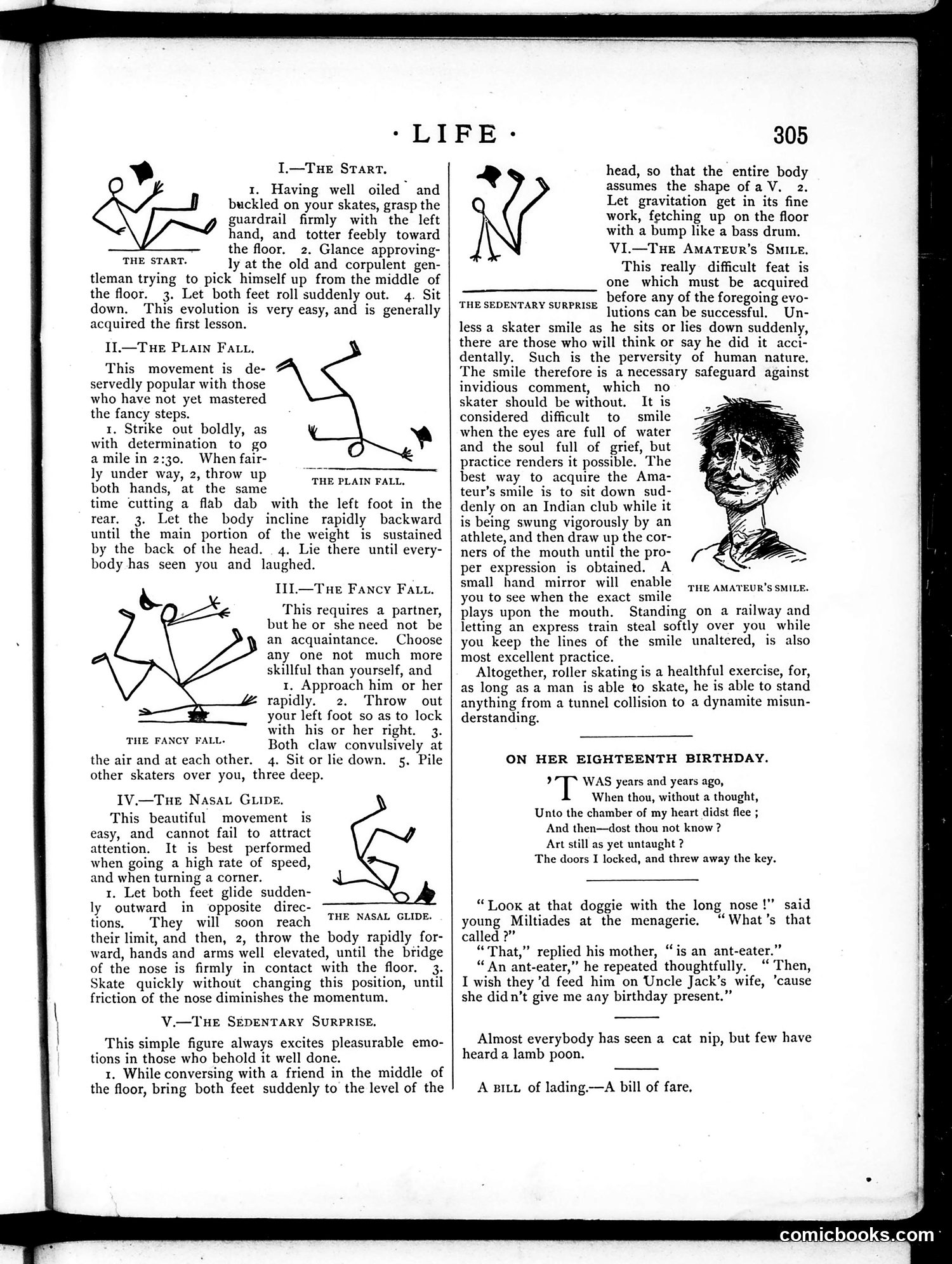
This page satirizes the newly popular craze of roller skating through mock instructional diagrams. The "lessons" humorously describe various falling techniques—the "Plain Fall," "Fancy Fall," "Nasal Glide"—treating inevitable accidents as intentional skating moves to be mastered. The satire targets two audiences: inexperienced skaters who will inevitably fall, and observers who'll judge whether falls were accidental or deliberate. The "Amateur's Smile" section is particularly pointed, suggesting skaters must smile while falling to appear intentional rather than clumsy—mocking both the vanity of performers and society's tendency to judge based on appearance rather than reality. The absurd "training" methods (sitting on swung Indian clubs, standing before express trains) heighten the comedy. This reflects Life's satirical stance on the roller skating fad sweeping America in the late 19th/early 20th century—simultaneously entertaining and gently mocking participants' pretensions and inevitable mishaps.
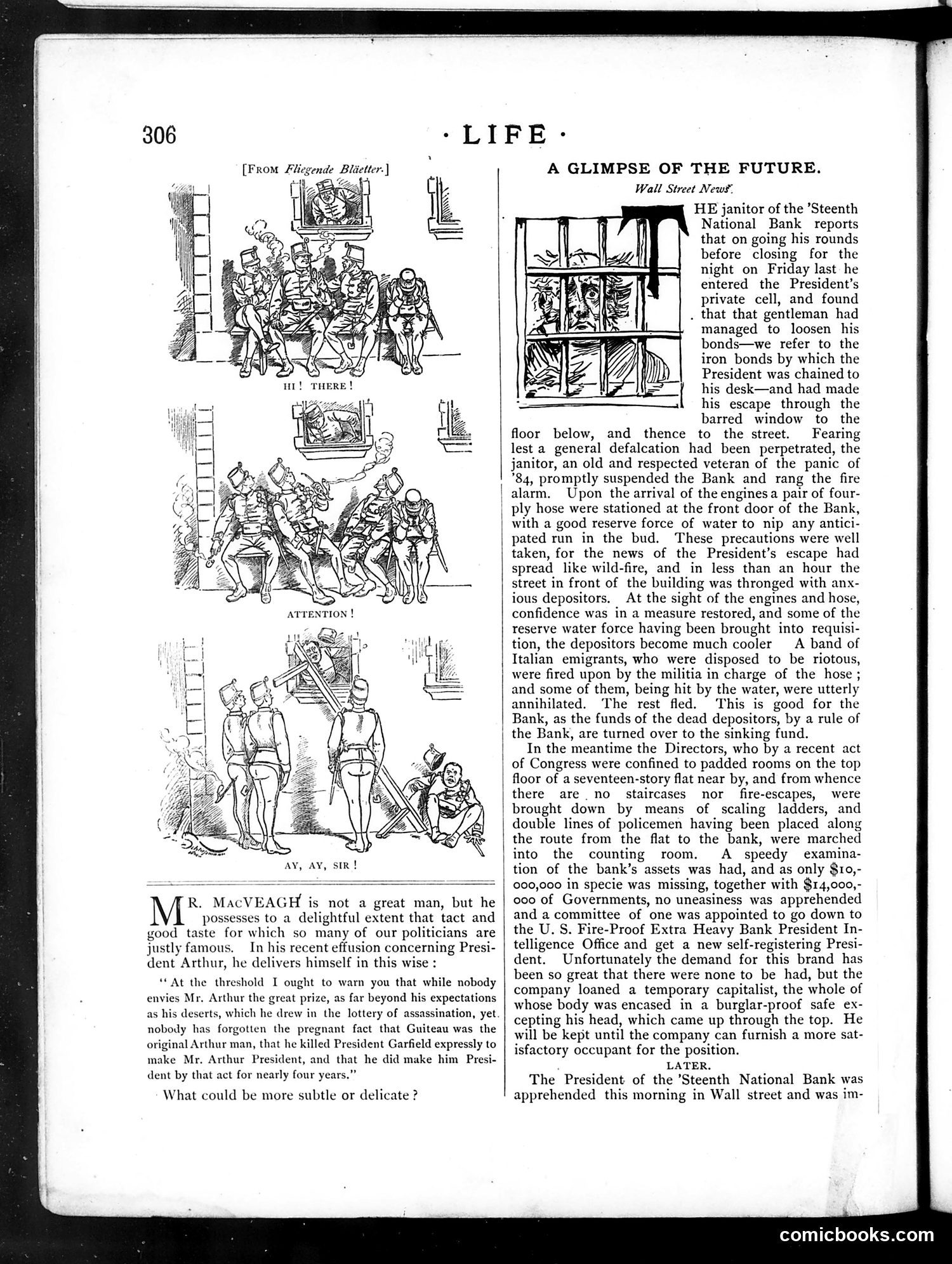
This page contains two separate political satires from *Life* magazine: **Left column:** Mocks Wayne MacVeagh's tactless remarks about President Chester Arthur. MacVeagh clumsily "warns" that while no one envies Arthur his position (gained through Garfield's assassination by Guiteau, an "Arthur man"), people remember Guiteau killed Garfield to make Arthur president. The satire targets MacVeagh's bumbling attempt at diplomacy—his "warning" actually highlights the scandalous, murderous origins of Arthur's presidency. **Right column:** A darkly comic fantasy imagining a bank president literally chained to his desk, whose escape triggers panic. The piece satirizes Gilded Age banking instability, depositor runs, and corporate negligence. It mocks the era's financial fragility and absurdly suggests banks are as replaceable as machine parts ("a new self-registering President"). Both pieces critique 1880s political corruption and financial recklessness through exaggeration and dark humor.
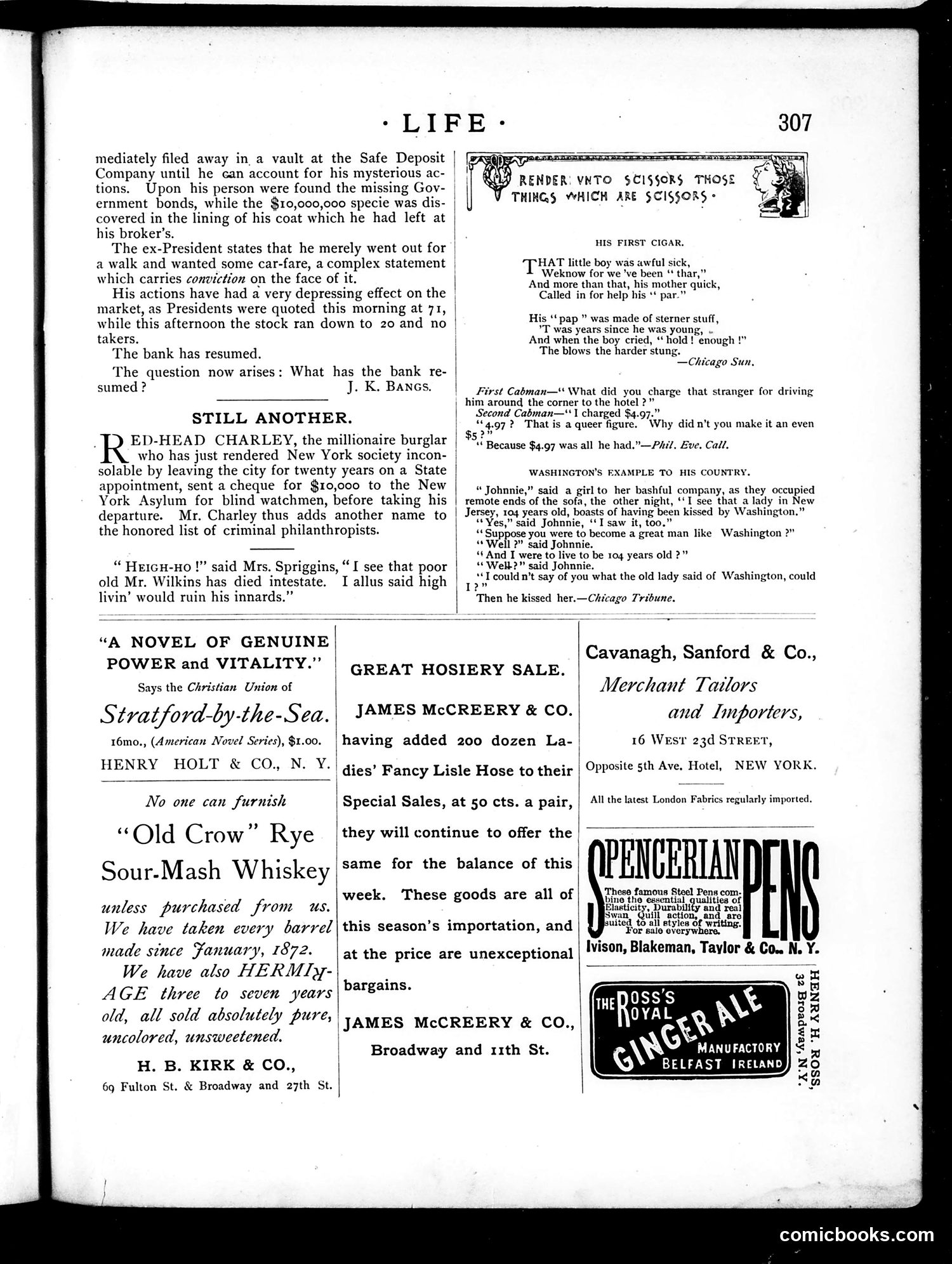
This page from Life magazine contains several short humorous pieces satirizing contemporary American society: **Main Stories:** - "Still Another" mocks wealthy criminals' philanthropic gestures—a millionaire burglar donates $10,000 to an asylum before fleeing to prison, seemingly validating criminal "philanthropy." - The "ex-President" anecdote appears to reference financial scandal, with a president claiming a casual walk as explanation for missing government bonds and massive specie discovered in his coat lining. The joke critiques implausible political explanations. **Comic Vignettes:** - "His First Cigar" depicts stern paternal discipline. - Cabman and Johnnie stories employ innocent dialogue for comedic effect. - "Washington's Example" uses a young woman's flirtation strategy referencing a 104-year-old woman kissed by George Washington, culminating in successful romantic persuasion. The page is primarily **satirical social commentary mixed with light humor**, targeting political corruption, class pretense, and social conventions of the era. The remainder comprises period advertisements.
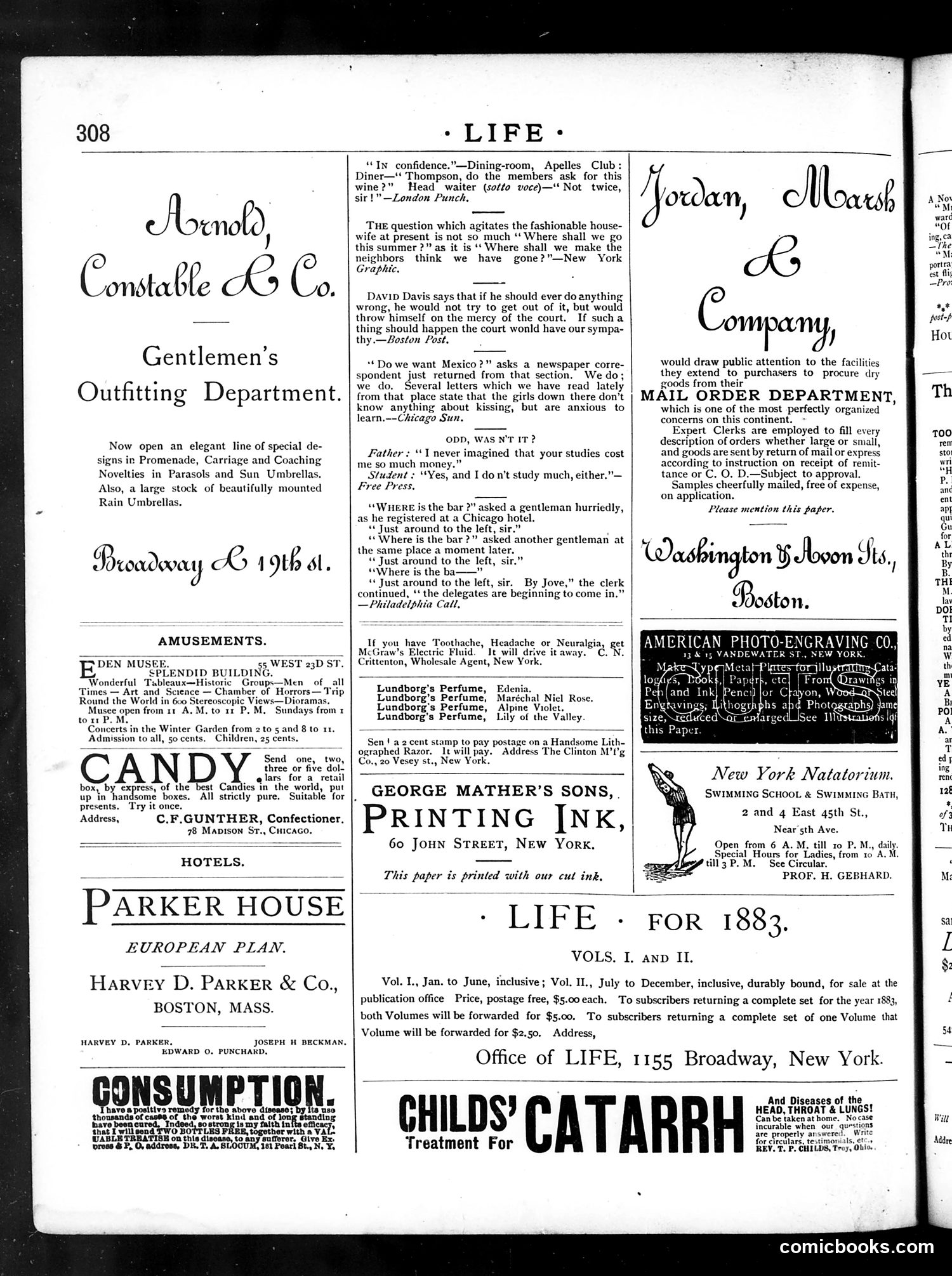
This is primarily an **advertising and humor page** from Life magazine, circa 1883. The page contains no political cartoons but rather short satirical jokes and commercial advertisements. The humor pieces are brief social observations: - A joke about fashionable wives concealing their actual vacation destinations from neighbors (social pretension) - A quip about David Davis throwing himself on court mercy if he committed wrongdoing (political/legal commentary) - A joke about Mexican women wanting to learn kissing - Repeated "bar" jokes about hotel guests and delegates (unclear reference, possibly about a political convention) The advertisements include gentlemen's outfitting stores, hotels, candy, medicines for consumption and catarrh, perfumes, and printing ink—typical 1880s commerce. The bulk is commercial, reflecting Life's business model. The humor reflects Victorian-era preoccupations: class anxiety, gender dynamics, and light political satire rather than serious critique.
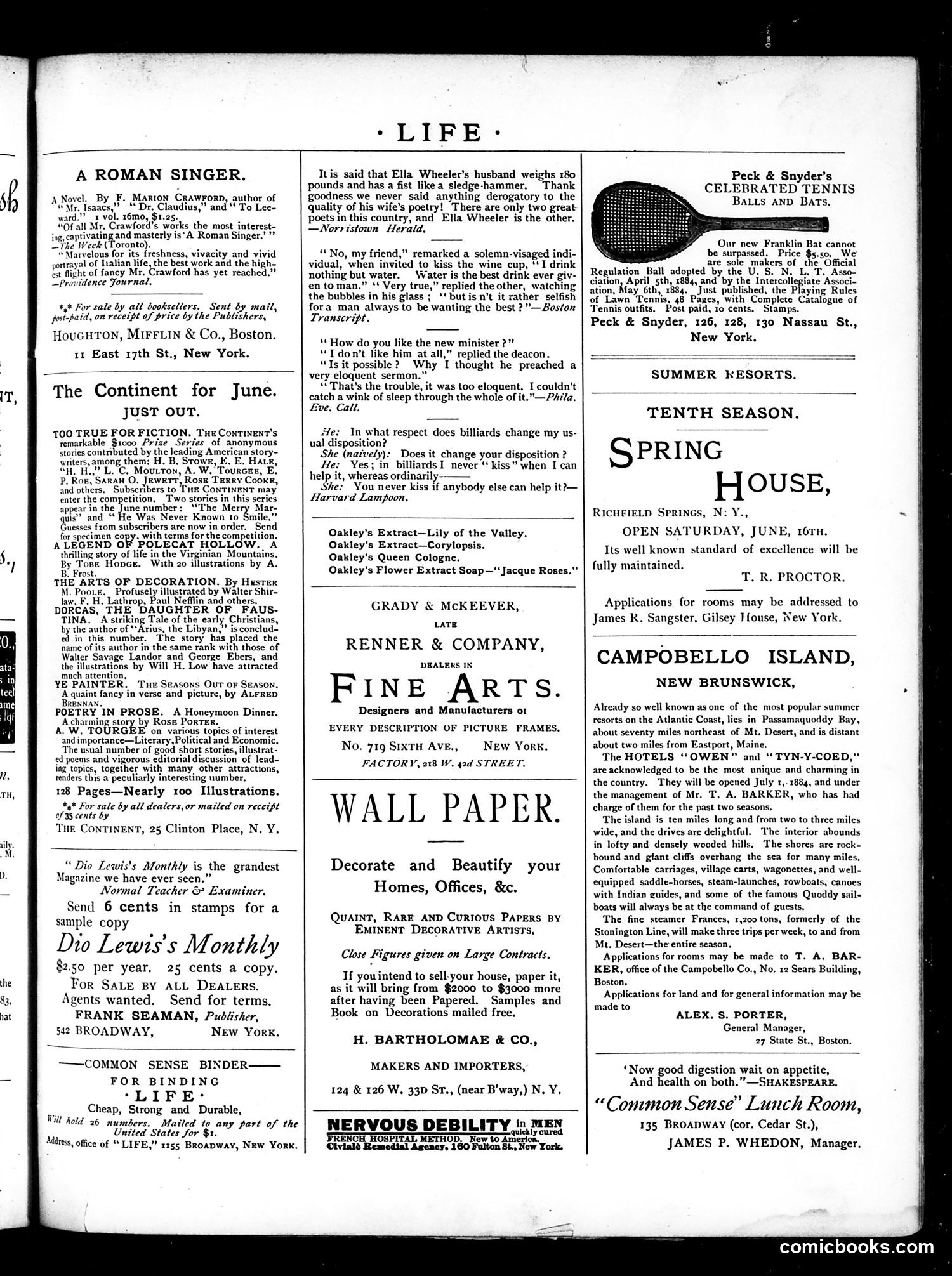
This is primarily an **advertising and literary announcement page** from Life magazine's June issue, with minimal cartoon content visible. The page features book and magazine advertisements mixed with short humorous anecdotes rather than political satire. Notable content includes: **Literary notices**: Announcements for *The Continent* magazine's "$1000 Prize Series" and various books like "A Roman Singer" by F. Marion Crawford. **Humor snippets**: Three brief jokes—one mocking poet Ella Wheeler's husband (a jab at her quality as a poet), one about a man claiming to drink only water while watching bubbles in his glass (hypocrisy joke), and one about a deacon disliking a new minister. **Advertising**: Prominent ads for wallpaper, picture frames, tennis equipment, summer resorts, and the "Common Sense Lunch Room." The page reflects late 19th-century Life magazine's format—mixing literature promotion, social commentary through brief witticisms, and commercial notices. There is **no identifiable political cartoon** on this particular page.
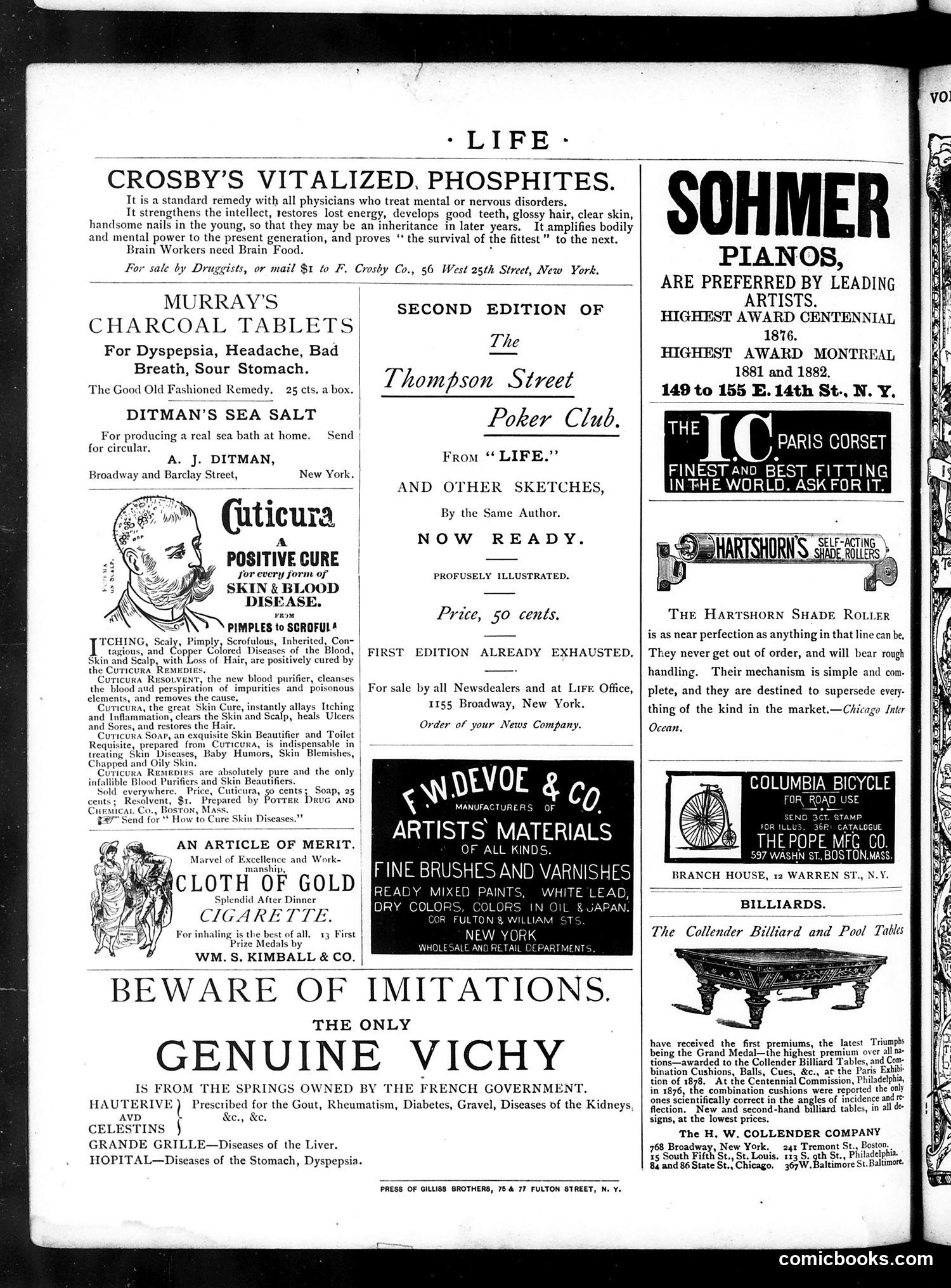
This is primarily an **advertising page** from Life magazine, not a satirical cartoon page. The content consists entirely of patent medicine and consumer product advertisements typical of the late 19th century. The ads promote dubious health remedies now recognized as fraudulent: **Crosby's Vitalized Phosphites** (claiming to cure mental disorders and improve inheritance), **Murray's Charcoal Tablets** (for digestive issues), and **Cuticura** (a skin cure). These reflect the era's unregulated patent medicine industry, when such products made extravagant health claims without scientific basis. The page also advertises legitimate goods: **Sohmer Pianos**, **Columbia Bicycles**, and **billiard tables**. The satirical *Life* magazine itself is announced here—"The Thompson Street Poker Club" book is advertised as "From Life," suggesting the magazine published humorous sketches. However, **no actual cartoons or satirical content appear on this particular page**.