
Life, 1884-05-29 · page 4 of 16
Life — May 29, 1884 — page 4: what you’re looking at
What you’re looking at
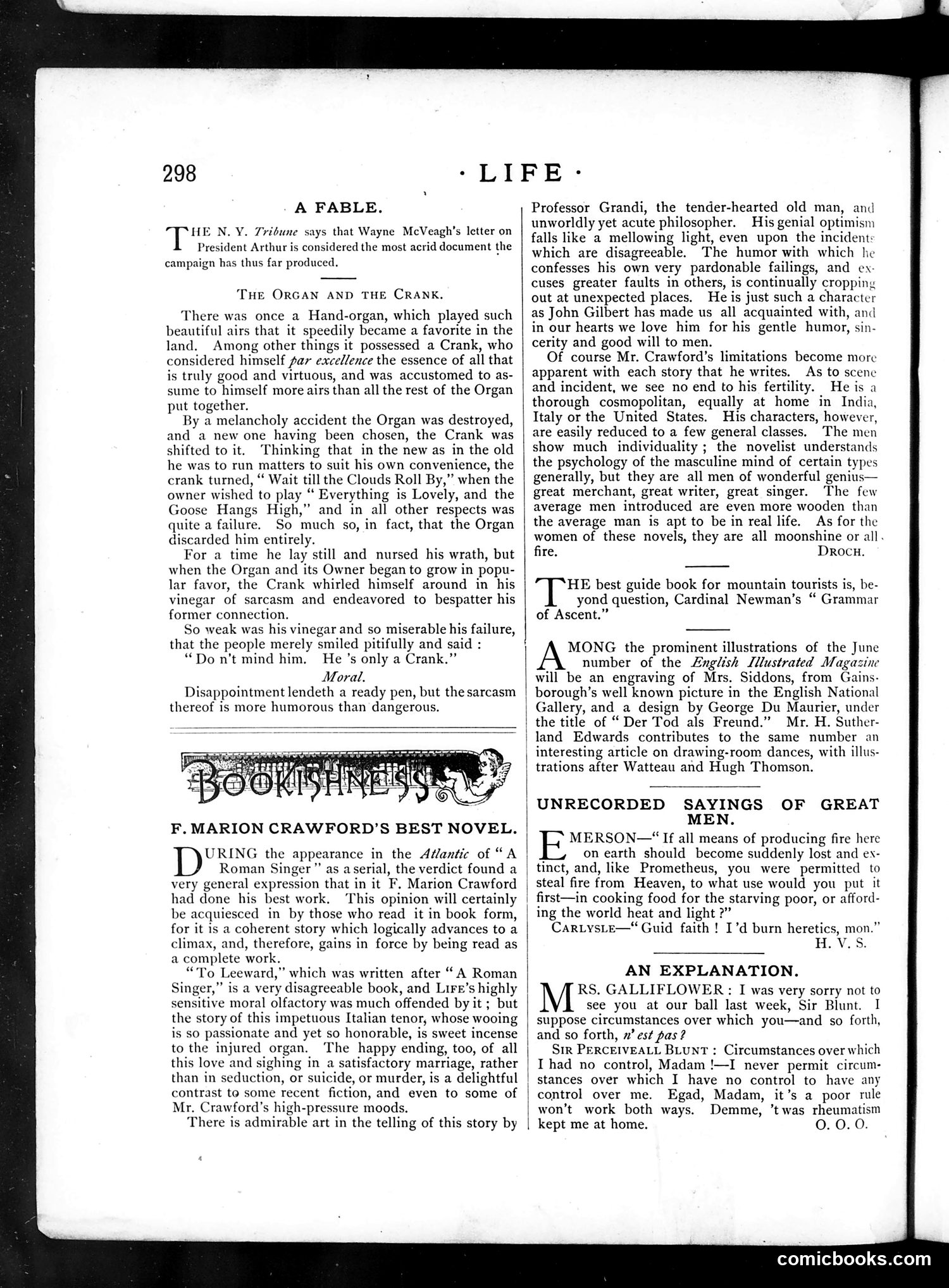
This page contains literary criticism and social commentary rather than political cartoons. The main content includes: **"A Fable: The Organ and the Crank"** — a moral tale about an organ (representing established institutions) displaced by a crank (representing a disruptive newcomer). The moral warns that "sarcasm is more humorous than dangerous." **Literary criticism** of F. Marion Crawford's novel "A Roman Singer," praising it as his best work despite its passionate Italian setting and themes of honor in marriage. **A section on book illustrations** featuring contributions by various artists. **"Unrecorded Sayings of Great Men"** — humorous pseudo-quotes attributed to Emerson and Carlyle. **"An Explanation"** — a brief humorous exchange about social circumstances and control. The page reflects turn-of-century literary culture and gentle social satire rather than hard political commentary.
📄 Transcribed text from this page (OCR, searchable)
Machine-transcribed from the original scan — historical spelling and the odd misread are preserved.
298 A FABLE. HE N.Y. Tribune says that Wayne McVeagh's letter on President Arthur is considered the most acrid document the campaign has thus far produced. THE ORGAN AND THE CRANK. ‘There was once a Hand-organ, which played such beautiful airs that it speedily became a favorite in the land. Among other things it possessed a Crank, who considered himself par excellence the essence of all that is truly good and virtuous, and was accustomed to as- sume to himself more airs than all the rest of the Organ put together. By a melancholy accident the Organ was destroyed, and a new one having been chosen, the Crank was shifted to it. Thinking that in the new as in the old he was to run matters to suit his own convenience, the crank turned, “ Wait till the Clouds Roll By,” when the owner wished to play “ Everything is Lovely, and the Goose Hangs High,” and in all other respects was quite a failure. So much s0, in fact, that the Organ discarded him entirely. For a time he lay still and nursed his wrath, but when the Organ and its Owner began to grow in popu- lar favor, the Crank whirled himself around in his vinegar of sarcasm and endeavored to bespatter his former connection. So weak was his vinegar and so miserable his failure, that the people merely smiled pitifully and said : “Do n't mind him. He ’s only a Crank.” Moral. Disappointment lendeth a ready pen, but the sarcasm thereof is more humorous than dangerous. F. MARION CRAWFORD’S BEST NOVEL. pres the appearance in the AMantic of “A | Roman Singer” as aserial, the verdict found a very general expression that in it F, Marion Crawford had done his best work. This opinion will certainly be acquiesced in by those who read it in book form, for it is a coherent story which logically advances to a climax, and, therefore, gains in force by being read as a complete work. “To Leeward,” which was written after “A Roman Singer,” is a very disagreeable book, and Lire’s highly sensitive moral olfactory was much offended by it ; but the story of this impetuous Italian tenor, whose wooing is so passionate and yet so honorable, is sweet incense to the injured organ. The happy ending, too, of all this love and sighing in a satisfactory marriage, rather than in seduction, or suicide, or murder, is a delightful contrast to some recent fiction, and even to some of Mr. Crawford's high-pressure moods. There is admirable art in the telling of this story by * LIFE: Professor Grandi, the tender-hearted old man, and unworldly yet acute philosopher. His genial optimism falls like a mellowing light, even upon the incident: which are disagreeable. The humor with which he confesses his own very pardonable failings, and ex- cuses greater faults in others, is continually cropping out at unexpected places. He is just such a character as John Gilbert has made us all acquainted with, and in our hearts we love him for his gentle humor, sin- cerity and good will to men. Of course Mr. Crawford’s limitations become more apparent with each story that he writes. As to scene and incident, we see no end to his fertility. He is a thorough cosmopolitan, equally at home in India, Italy or the United States. His characters, however, are easily reduced to a few general classes. The men show much individuality ; the novelist understands the psychology of the masculine mind of certain types generally, but they are all men of wonderful genius— great merchant, great writer, great singer. The few average men introduced are even more wooden than the average man is apt to be in real life. As for the women of these novels, they are all moonshine or all. fire, Drocu. HE best guide book for mountain tourists is, be- yond question, Cardinal Newman’s “ Grammar of Ascent.” MONG the prominent illustrations of the June number of the Lnglish Iilustrated Magazine will be an engraving of Mrs. Siddons, from Gains- | borough’s well known picture in the English National | Gallery, and a design by George Du Maurier, under | the title of “Der Tod als Freund.” | land Edwards contributes to the same number Mr. H. Suther- an interesting article on drawing-room dances, with illus- trations after Watteau and Hugh Thomson. | UNRECORDED SAYINGS OF GREAT MEN. MERSON—“ If all means of producing fire here on earth should become suddenly lost and ex- tinct, and, like Prometheus, you were permitted to steal fire from Heaven, to what use would you put it first-—in cooking food for the starving poor, or afford- ing the world heat and light ?” CarLystE—‘ Guid faith ! I’d burn heretics, mon.” H.V. AN EXPLANATION. RS. GALLIFLOWER : I was very sorry not to see you at our ball last week, Sir Blunt. | | suppose circumstances over which you—and so forth, and so forth, n’ est pas? Sir PERCEIVEALL BLUNT : Circumstances over which Thad no control, Madam !—I never permit circum- stances over which I have no control to have any control over me. Egad, Madam, it’s a poor tule won’t work both ways. Demme, ’t was rheumatism kept me at home. 0. 0. O. comicbooks.com