
Life, 1884-05-29 · page 6 of 16
Life — May 29, 1884 — page 6: what you’re looking at
What you’re looking at
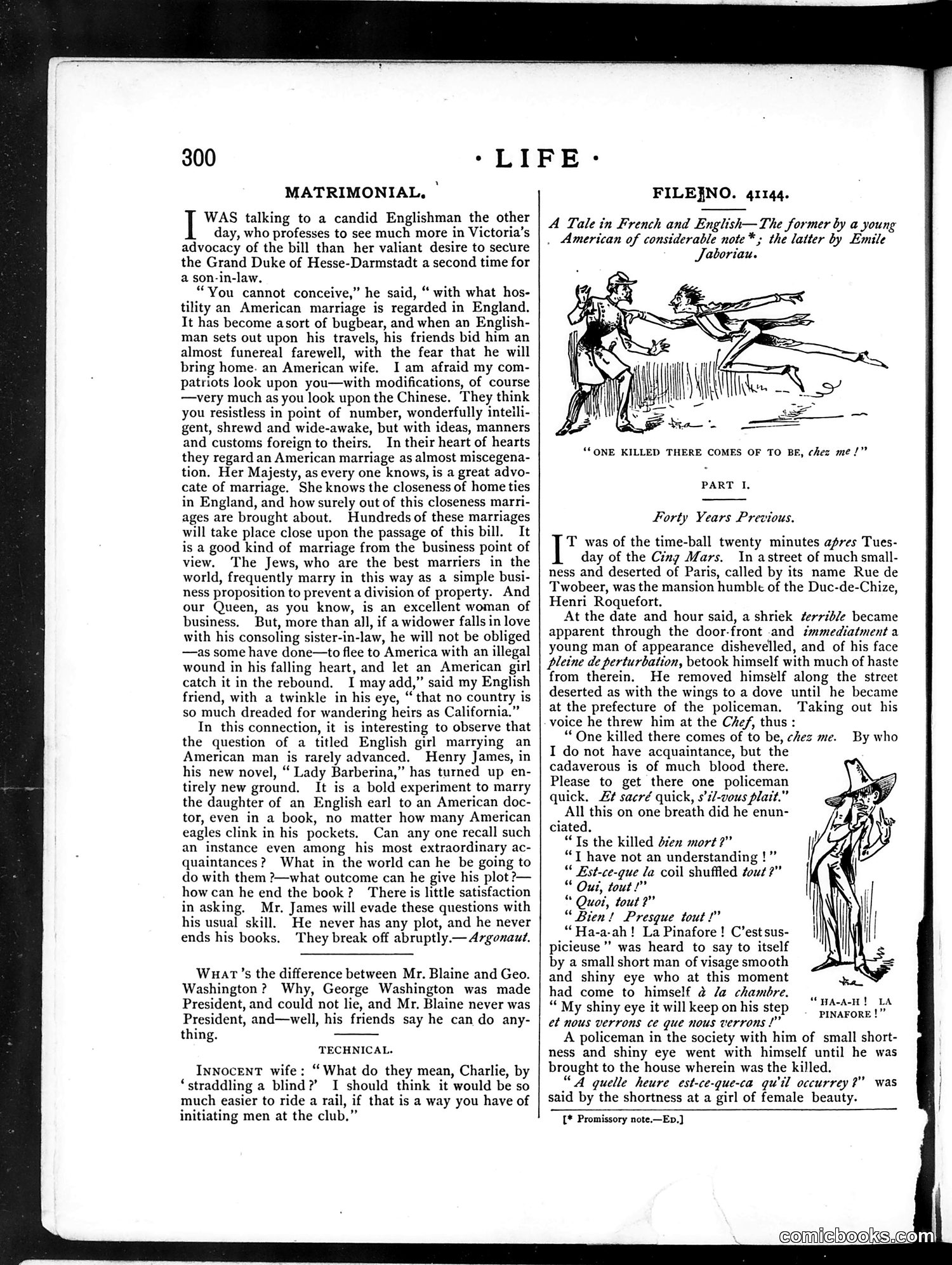
This page contains two distinct sections: **Left column ("Matrimonial")**: Social commentary criticizing American marriages, particularly involving English husbands marrying American women. The writer expresses concern that such unions are viewed negatively in England, where Americans are stereotyped as lacking refinement. The piece references Henry James's novel "Lady Barbarina" as an example exploring this cross-cultural marriage theme. The satire mocks both English snobbery and American pretension. **Right column ("Fileño 41144")**: A French-English tale titled "Forty Years Previous," featuring what appears to be a dramatic urban murder mystery. A disheveled young man announces a killing, creating confusion among Parisians and a policeman. The French phrases and theatrical tone suggest satirical fiction rather than serious crime reporting. Both sections reflect late-19th-century anxieties about class, nationality, and cultural differences.
📄 Transcribed text from this page (OCR, searchable)
Machine-transcribed from the original scan — historical spelling and the odd misread are preserved.
300 MATRIMONIAL, - WAS talking to a candid Englishman the other day, who professes to see much more in Victoria’s advocacy of the bill than her valiant desire to secure the Grand Duke of Hesse-Darmstadt a second time for a son-in-law. “You cannot conceive,” he said, “ with what hos- tility an American marriage is regarded in England. It has become asort of bugbear, and when an English- man sets out upon his travels, his friends bid him an almost funereal farewell, with the fear that he will bring home. an American wife. I am afraid my com- patriots look upon you—with modifications, of course —very much as you look upon the Chinese. They think you resistless in point of number, wonderfully inteili- gent, shrewd and wide-awake, but with ideas, manners and customs foreign to theirs. In their heart of hearts they regard an American marriage as almost miscegena- tion. Her Majesty, as every one knows, is a great advo- cate of marriage. She knows the closeness of home ties in England, and how surely out of this closeness marri- ages are brought about. Hundreds of these marriages will take place close upon the passage of this bill. It is a good kind of marriage from the business point of view. The Jews, who are the best marriers in the world, frequently marry in this way as a simple busi- ness proposition to prevent a division of property. And our Queen, as you know, is an excellent woman of business. But, more than all, if a widower falls in love with his consoling sister-in-law, he will not be obliged —as some have done—to flee to America with an illegal wound in his falling heart, and let an American girl catch it in the rebound. I may add,” said my English friend, with a twinkle in his eye, “that no country is so much dreaded for wandering heirs as California.” In this connection, it is interesting to observe that the question of a titled English girl marrying an American man is rarely advanced. Henry James, in his new novel, “ Lady Barberina,” has turned up en- tirely new ground. It is a bold experiment to marry the daughter of an English earl to an American doc- tor, even in a book, no matter how many American eagles clink in his pockets. Can any one recall such an instance even among his most extraordinary ac- quaintances? What in the world can he be going to do with them ?—what outcome can he give his plot ?— how can he end the book? There is little satisfaction in asking. Mr. James will evade these questions with his usual skill. He never has any plot, and he never ends his books. They break off abruptly.— Argonaut. Wuat’s the difference between Mr. Blaine and Geo. Washington? Why, George Washington was made President, and could not lie, and Mr. Blaine never was President, and—well, his friends say he can do any- thing. TECHNICAL. Innocent wife: “What do they mean, Charlie, by “straddling a blind?’ I should think it would be so much easier to ride a rail, if that is a way you have of initiating men at the club.” FILEJNO. 41144. A Tale in French and English—The former by a young . American of considerable note*; the latter by Emile Jaboriau. gue “ONE KILLED THERE COMES OF TO BE, chez me!” PART I. Forty Years Previous. T was of the time-ball twenty minutes afres Tues- day of the Cing Mars. In astreet of much small- ness and deserted of Paris, called by its name Rue de Twobeer, was the mansion humble of the Duc-de-Chize, Henri Roquefort. At the date and hour said, a shriek ¢errib/e became apparent through the door-front and émmediatment a young man of appearance dishevelled, and of his face pleine de perturbation, betook himself with much of haste from therein. He removed himself along the street deserted as with the wings to a dove until he became at the prefecture of the policeman. Taking out his voice he threw him at the Chef, thus : “One killed there comes of to be, chez me. I do not have acquaintance, but the cadaverous is of much blood there. Please to get there one policeman quick. Et sacré quick, s’#l-vous plait.” All this on one breath did he enun- ciated. “Ts the killed d¢en mort ?” “T have not an understanding !” “ Est-ce-que la coil shuffled tout?” “ Oui, tout!” “ Quoi, tout?” “Bien! Presque tout!” “Ha-a-ah! La Pinafore! C’estsus- picieuse ” was heard to say to itself by a small short man of visage smooth and shiny eye who at this moment had come to himself @ /a chambre. “My shiny eye it will keep on his step et nous verrons ce que nous verrons !” A policeman in the society with him of small short- ness and shiny eye went with himself until he was brought to the house wherein was the killed. “A quelle heure est-ce-que-ca gu'il occurrey ?” was said by the shortness at a girl of female beauty. By who “HA-A-H! LA PINAFORE !” [* Promissory note—Ep,]