
Life, 1884-05-29 · page 7 of 16
Life — May 29, 1884 — page 7: what you’re looking at
What you’re looking at
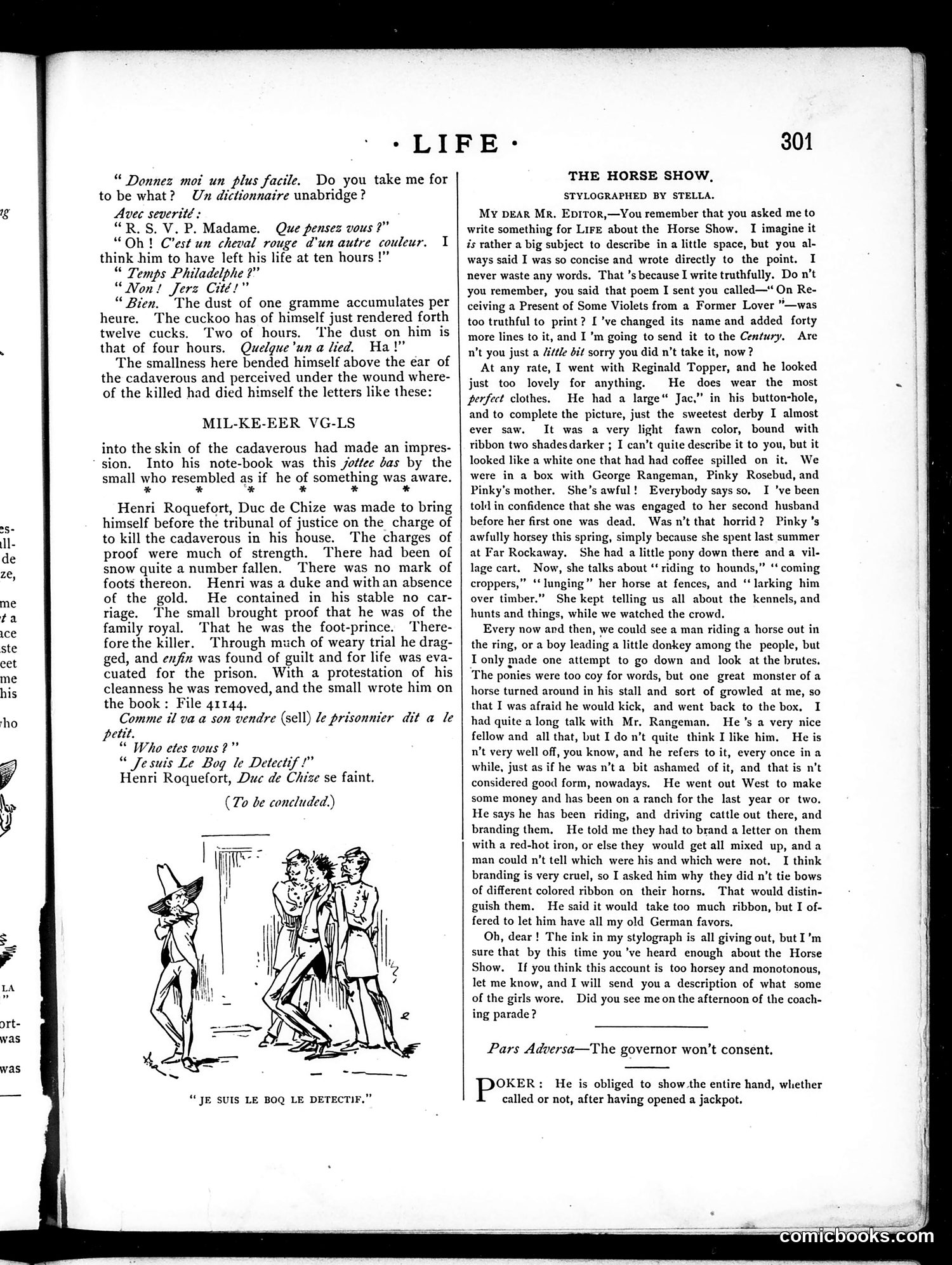
The main content is "The Horse Show," a humorous letter from a reader describing her experience at what appears to be a prominent social event. The accompanying illustration labeled "Je suis le Boq le Detectif" shows three figures in period dress, likely referencing a French detective character. The illustration's caption and context suggest satire of pretentious social situations—the writer describes encounters with horses, fashionable attendees, and aristocratic affectations (German favors, ribbon-decorated horses). The "detective" reference appears to mock those who take themselves overly seriously at such events. This represents Life's typical satirical approach: puncturing the pretensions of high society through humorous personal narratives and accompanying caricatures.
📄 Transcribed text from this page (OCR, searchable)
Machine-transcribed from the original scan — historical spelling and the odd misread are preserved.
*LIFE- “ Donnez moi un plus facile. Do you take me for to be what? Un dictionnatre wnabridge ? Avec severité : “R.S.V.P. Madame. Que pensez vous ?” “Oh! C'est un cheval rouge d'un autre couleur, 1 think him to have left his life at ten hours !” “ Temps Philadelphe ?” “ Non! Jerz Cité!” “ Bien. The dust of one gramme accumulates per heure. The cuckoo has of himself just rendered forth twelve cucks. Two of hours. ‘The dust on him is that of four hours. Quelgue’un a lied, Ha!” The smallness here bended himself above the ear of the cadaverous and perceived under the wound where- of the killed had died himself the letters like these: MIL-KE-EER VG-LS into the skin of the cadaverous had made an impres- sion. Into his note-book was this joftee bas by the small who resembled as if he of something was aware. * * * * * * Henri Roquefort, Duc de Chize was made to bring himself before the tribunal of justice on the charge of to kill the cadaverous in his house. The charges of proof were much of strength. There had been of snow quite a number fallen. There was no mark of foots thereon. Henri was a duke and withan absence of the gold. He contained in his stable no car- riage. The small brought proof that he was of the family royal. That he was the foot-prince. ‘There- fore the killer. Through much of weary trial he drag- ged, and enfin was found of guilt and for life was eva- cuated for the prison. With a protestation of his cleanness he was removed, and the small wrote him on the book: File 41144. Comme il va a son vendre (sell) le prisonnier dit a le petit. “ Who etes vous ?” “ Jesuis Le Bog le Detectif !” Henri Roquefort, Duc de Chize se faint. (To be concluded.) “JE SUIS LE BOQ LE DETECTIF.” 301 THE HORSE SHOW, STYLOGRAPHED BY STELLA. My bEar Mr. Eprror,—You remember that you asked me to write something for Lire about the Horse Show. I imagine it is rather a big subject to describe in a little space, but you al- ways said I was so concise and wrote directly to the point. I never waste any words. That ’s because I write truthfully. Do n't you remember, you said that poem I sent you called—“ On Re- ceiving a Present of Some Violets from a Former Lover ’—was too truthful to print? [ ’ve changed its name and added forty more lines to it, and I’m going to send it to the Century. Are n't you just a iftle bit sorry you did n’t take it, now? At any rate, I went with Reginald Topper, and he looked just too lovely for anything. He does wear the most perfect clothes. He had a large“ Jac,” in his button-hole, and to complete the picture, just the sweetest derby I almost ever saw. It was a very light fawn color, bound with ribbon two shades darker ; I can’t quite describe it to you, but it looked like a white one that had had coffee spilled on it. We were in a box with George Rangeman, Pinky Rosebud, and Pinky's mother. She’s awful! Everybody says so. I ’ve been told in confidence that she was engaged to her second husband before her first one was dead. Wasn't that horrid? Pinky ’s awfully horsey this spring, simply because she spent last summer at Far Rockaway. She had a little pony down there and a vil- lage cart. Now, she talks about ‘‘ riding to hounds,” ‘ coming croppers,” “lunging” her horse at fences, and “larking him over timber.” She kept telling us all about the kennels, and hunts and things, while we watched the crowd. Every now and then, we could see a man riding a horse out in the ring, or a boy leading a little donkey among the people, but I only made one attempt to go down and look at the brutes. The ponies were too coy for words, but one great monster of a horse turned around in his stall and sort of growled at me, so that I was afraid he would kick, and went back to the box. I had quite a long talk with Mr. Rangeman. He ’s a very nice fellow and all that, but I don’t quite think I like him. He is n't very well off, you know, and he refers to it, every once ina while, just as if he was n’t a bit ashamed of it, and that is n’t considered good form, nowadays. He went out West to make some money and has been on a ranch for the last year or two. He says he has been riding, and driving cattle out there, and branding them, He told me they had to brand a letter on them with a red-hot iron, or else they would get all mixed up, anda man could n’t tell which were his and which were not. I think branding is very cruel, so I asked him why they did n’t tie bows of different colored ribbon on their horns. That would distin- guish them. He said it would take too much ribbon, but I of- fered to let him have all my old German favors. Oh, dear! The ink in my stylograph is all giving out, but I’m sure that by this time you ’ve heard enough about the Horse Show. If you think this account is too horsey and monotonous, let me know, and I will send youa description of what some of the girls wore, Did you see me on the afternoon of the coach- ing parade? Pars Adversa—The governor won’t consent. OKER: He is obliged to show the entire hand, whether called or not, after having opened a jackpot.