
A complete issue · 16 pages · 1884
Life — May 22, 1884
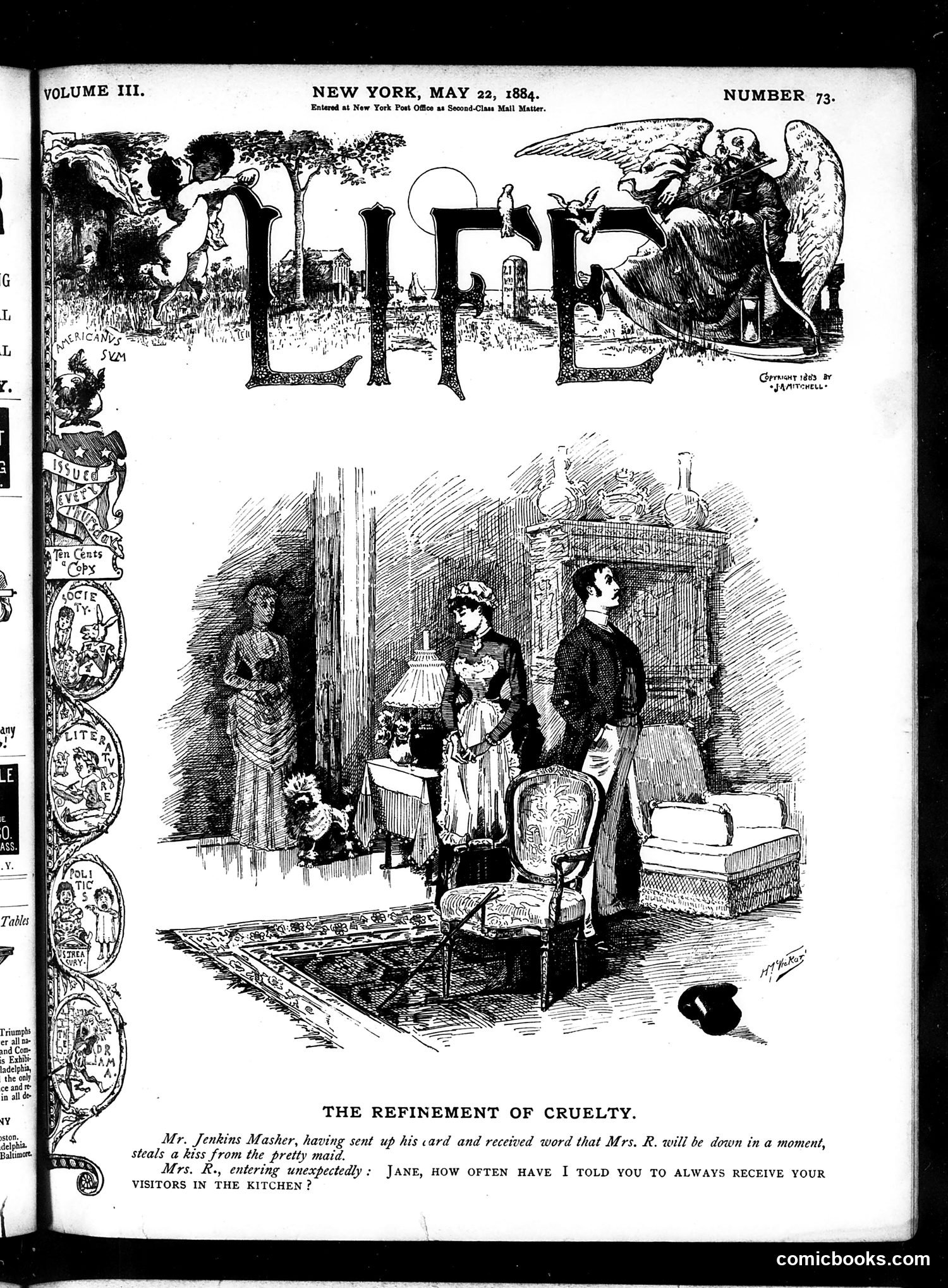
This satirical cartoon illustrates Victorian-era social hypocrisy regarding servants. The scene shows a household interior where Mr. Jenkins Masher has sent his card upstairs, stealing a kiss from a "pretty maid" while the mistress, Mrs. R., is momentarily absent. The caption's irony is sharp: Mrs. R. scolds the maid Jane for receiving "visitors in the kitchen," implying moral impropriety—yet the cartoon reveals the actual "cruelty" is the employer's own inappropriate behavior toward his servant, whom he exploits precisely because of her vulnerable position in the household hierarchy. The title mocks how the wealthy class enforced strict moral codes on servants while engaging in far worse conduct themselves.
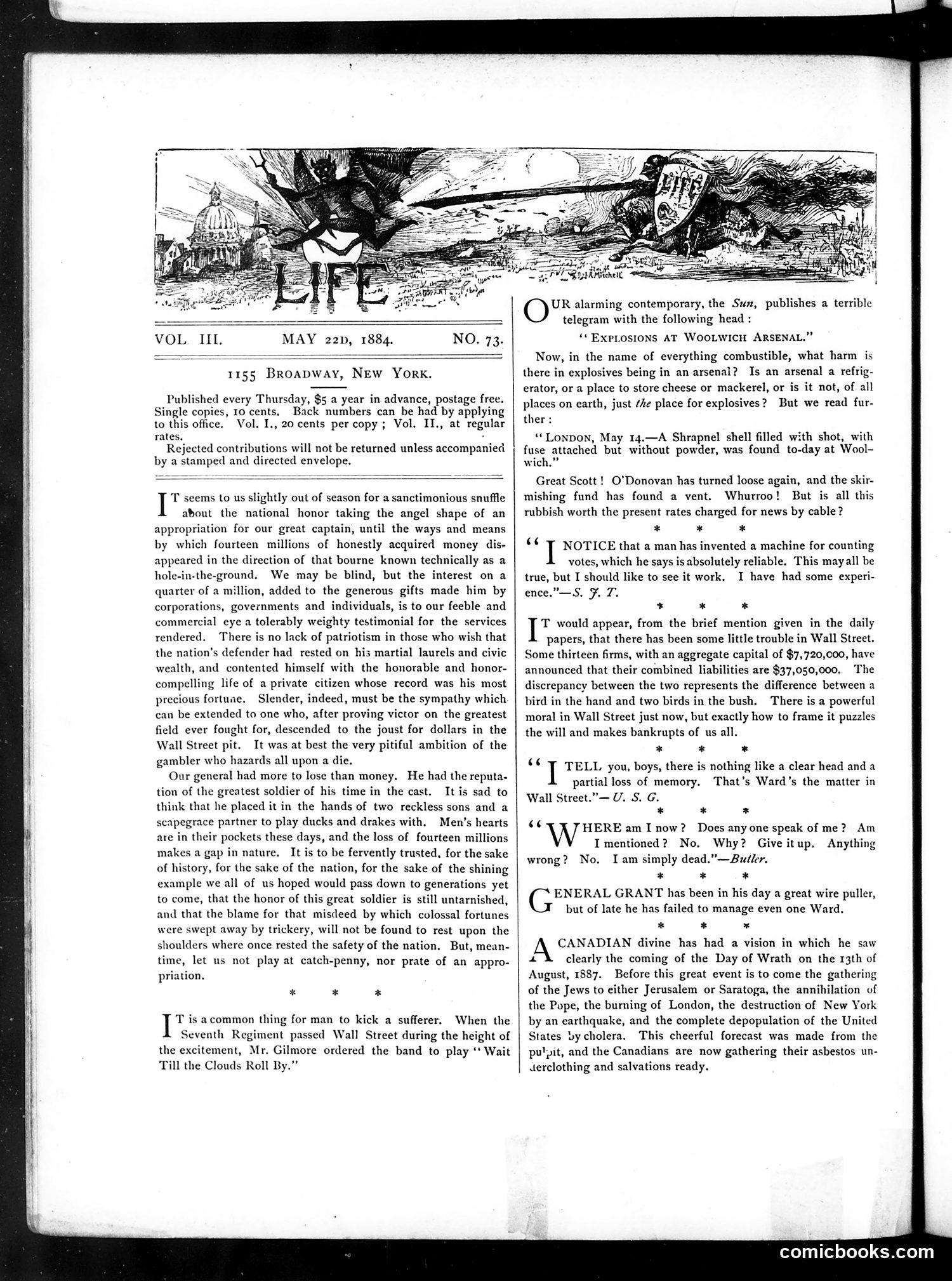
The page contains editorial commentary rather than political cartoons. The masthead illustration shows "LIFE" with classical imagery. The editorial criticizes the appropriation of General Grant's name for financial gain—describing how his name was used to raise millions for supposedly honest business purposes. The piece sarcastically attacks the "nation's defender" being reduced to lending his reputation to commercial ventures while living as a private citizen. Additional items mock Wall Street financial scandals (mentioning thirteen firms with $27.7 million in capital but $27 million in liabilities), satirize a voting-machine invention, and include cryptic gossip items about Ward and General Grant. The tone is sharply critical of financial corruption and the exploitation of Civil War heroism for profit during the Gilded Age.
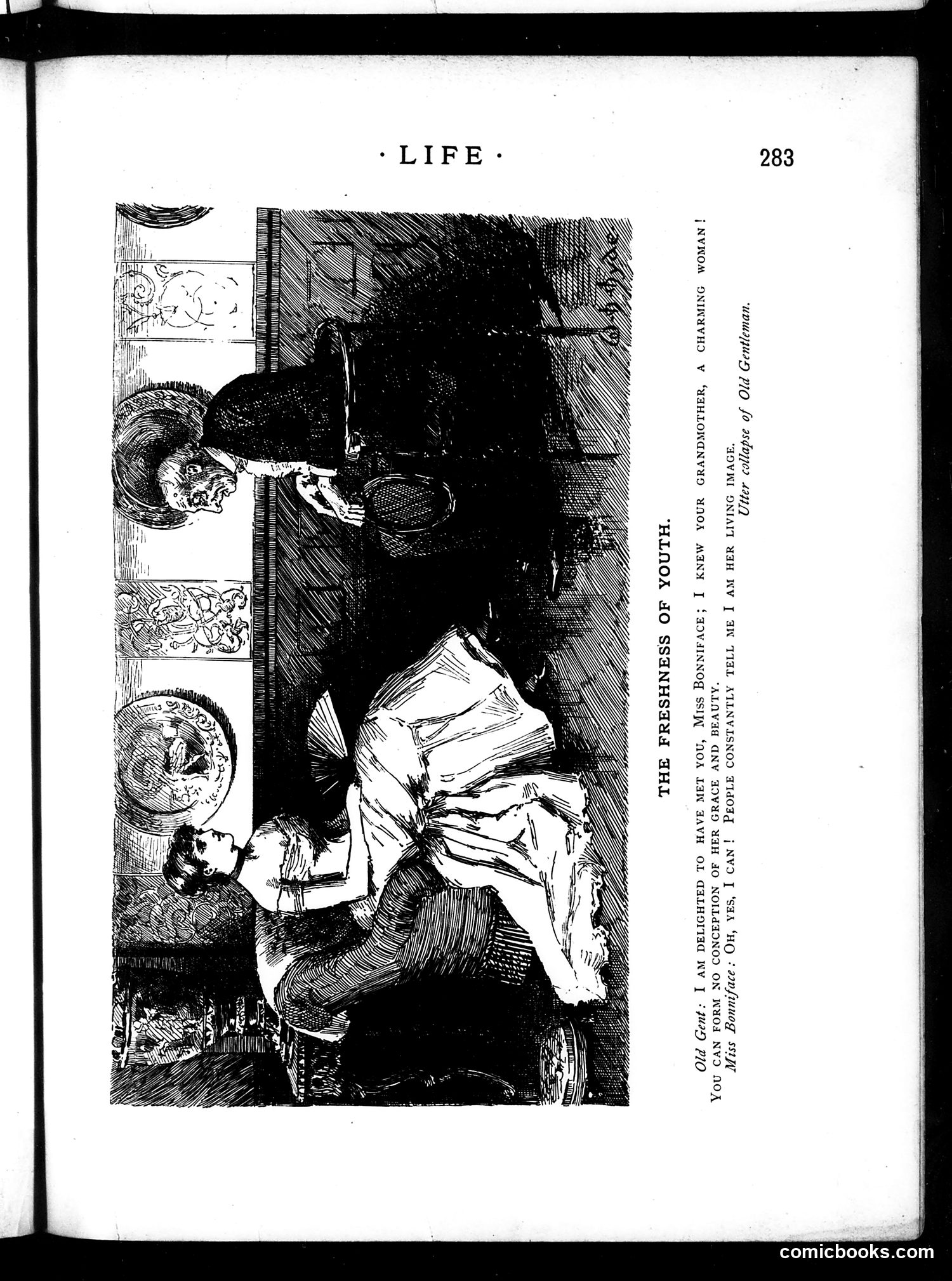
This satirical cartoon depicts a young woman reclining on a couch in a domestic interior. The title and accompanying verse mock the pretense of youthful appearance and innocence, particularly among women concerned with beauty and social standing. The poem's sarcastic tone—"Oh Girl! I am tempted to have you Miss Somewhere, I keep your grandmother, a charming woman!"—suggests the cartoon critiques artificial youth presentation or perhaps critiques how older women are discarded from society while younger women are celebrated. The detailed domestic setting with various framed pictures on the wall suggests commentary on middle-class domestic life and the social pressures women faced regarding aging and appearance in early 20th-century America. The satire targets the anxiety around maintaining youthful looks and social relevance.
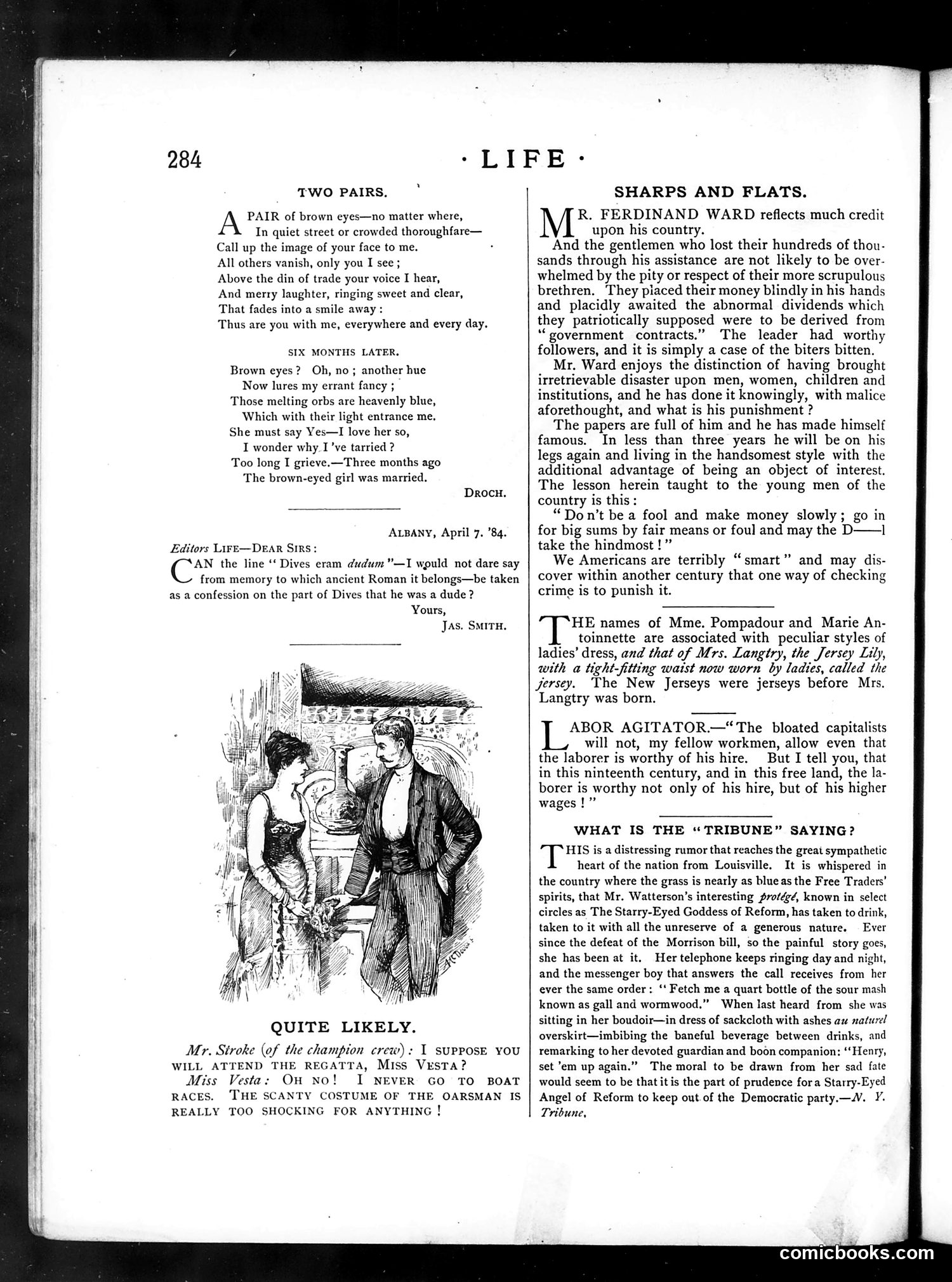
The bottom cartoon depicts a social interaction between two figures—apparently a man ("Mr. Stroke of the champion crew") and a woman ("Miss Vesta"). The dialogue reveals satirical commentary on Victorian social conventions and class anxieties. Mr. Stroke invites Miss Vesta to attend a regatta (rowing race), but she declines, citing that "the scanty costume of the oarsman is really too shocking for anything." The satire targets both masculine athletic display and feminine prudishness—suggesting women's exaggerated modesty about men's athletic wear serves as social cover, while revealing underlying class consciousness about spectacle and propriety during the Gilded Age.
This page contains two distinct sections: **"Who's Who?"** section discusses Dr. Hylande-MacGrath's proposed "Who's Who" publication, listing prominent individuals by their societal positions (government officials, military officers, philanthropists, etc.). The satire targets the absurdity of creating exhaustive biographical directories of the wealthy and influential—suggesting such projects are pretentious exercises in cataloging society's elite while adding little real value. **"Uncle Si's Musings"** presents humorous verse about ham and eggs, offering whimsical observations on breakfast foods with no apparent political content. **"The Presidency"** section reprints letters responding to a Herald circular asking prominent governors and officers whom they'd nominate for President and their views on tariffs. The first response from Boston (May 15, 1884) from Gov. Robinson humorously avoids committing to specific answers, deflecting with vague platitudes—satirizing politicians' reluctance to take clear positions on contentious issues.
This page contains no cartoon or satirical illustration. Instead, it features letters to the editor and an article titled "The Facts About This New Scheme." The article discusses a proposal to solve Irish emigration and American unemployment by having American railroad corporations purchase unoccupied Irish land. The scheme would gradually absorb Ireland's soil while relocating its population to America. The satire is textual rather than visual: the author presents this land-acquisition plan with mock seriousness, highlighting its absurdity through detailed financial calculations (cost per acre, profit margins) and the implicit colonization it represents. The piece critiques both American business interests and suggests skepticism about solving social problems through corporate expansion into foreign territories.
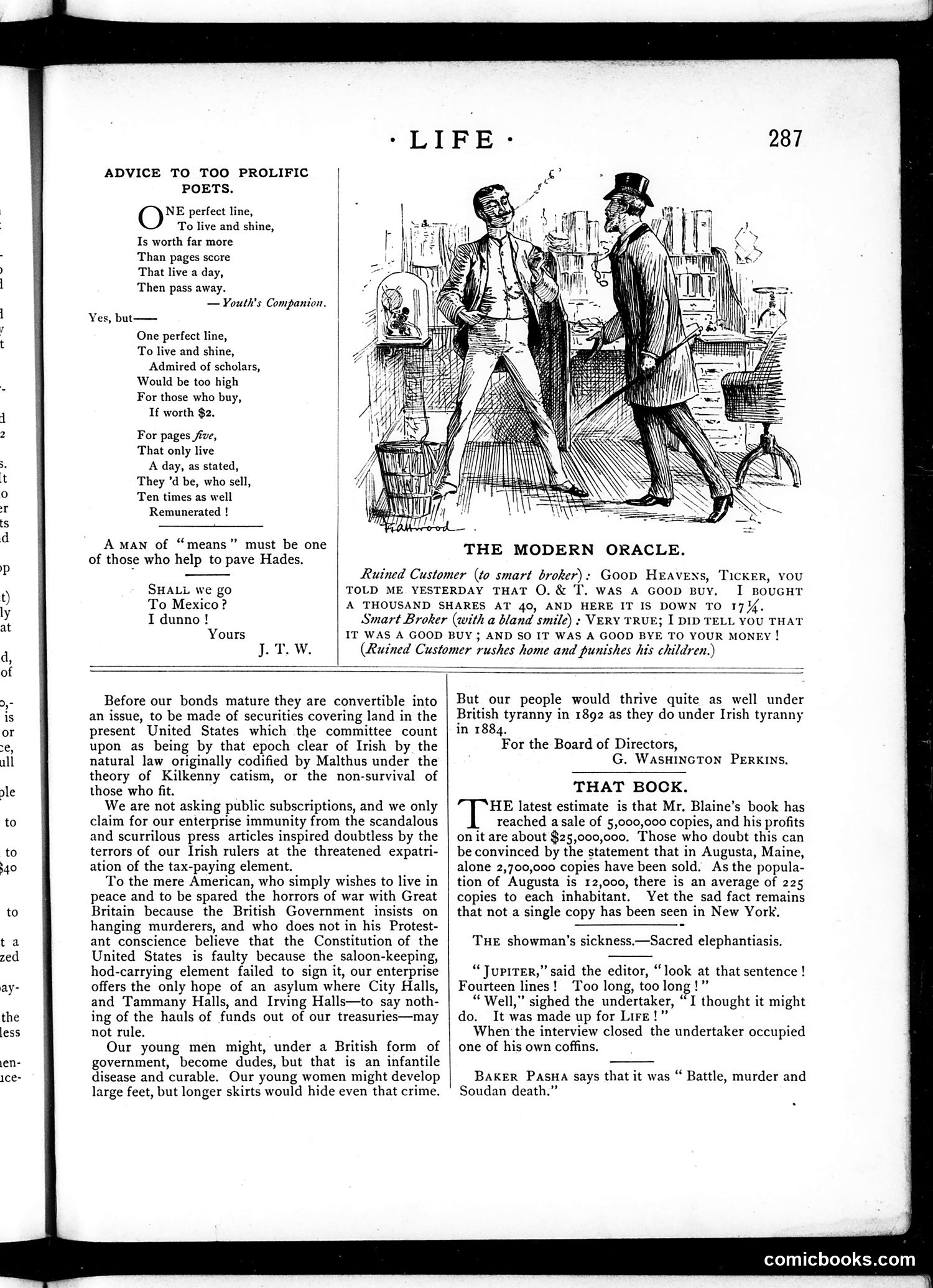
This cartoon depicts a stock market scam. A "Smart Broker" (top hat, confident smile) has convinced a "Ruined Customer" to buy O. & T. stock at 49 cents, claiming it was "a good buy." The stock has since collapsed to 12½ cents, devastating the investor who "bought a thousand shares." The satire targets fraudulent stock brokers who exploit ordinary investors with false promises of profit. The broker's bland smile emphasizes his callous dishonesty—he knew the stock was worthless but sold it anyway. The caption notes the ruined man "punishes his children," showing how financial fraud cascades through families. This reflects turn-of-century concerns about unregulated stock market manipulation and predatory brokers preying on middle-class savers.
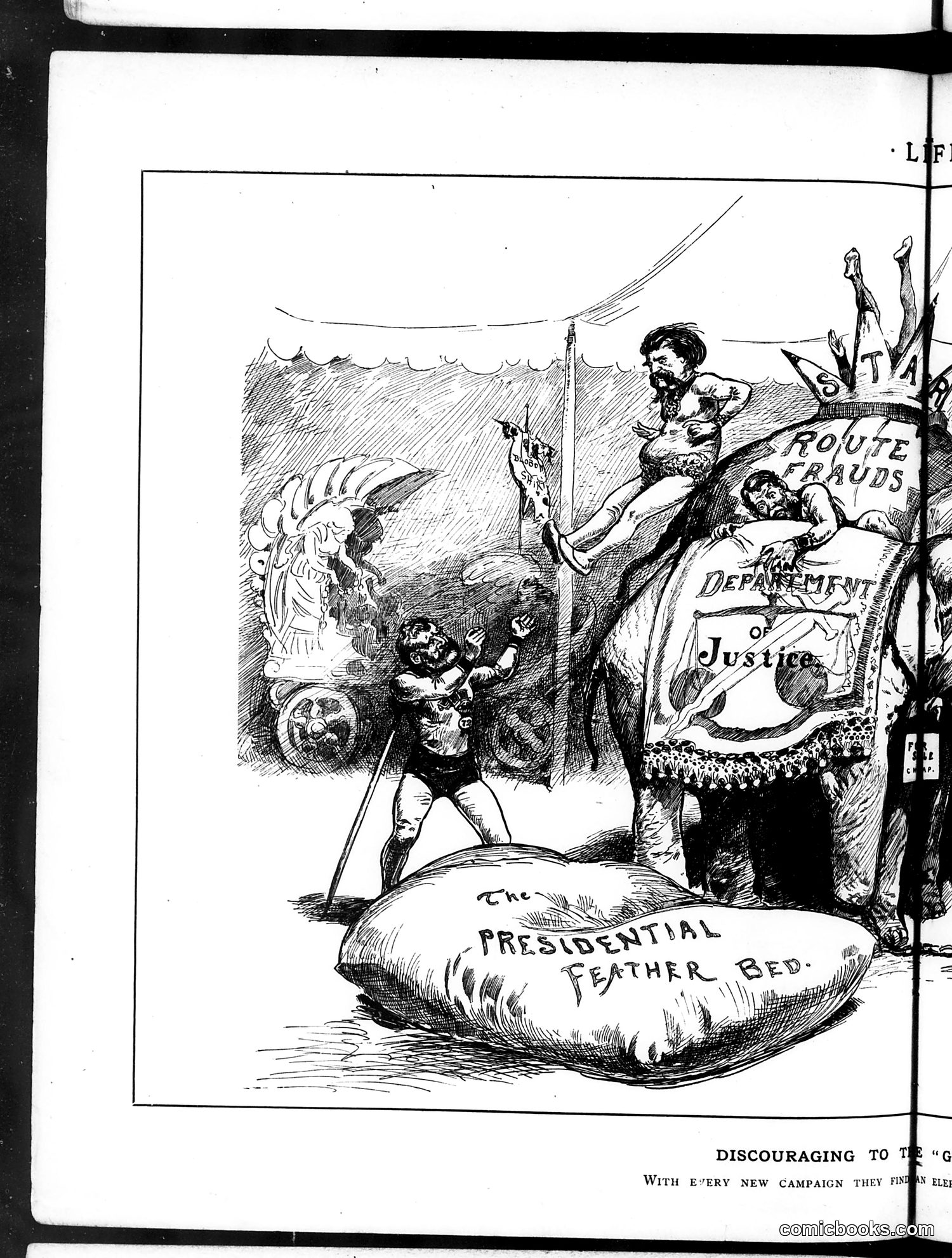
This satirical cartoon depicts a military figure standing on "The Presidential Feather Bed," defending it with a sword against attack. On the right, figures labeled "Route Frauds" and "Department of Justice" are portrayed as threats approaching the bed — visualized as an elegantly cushioned, comfortable position. The satire suggests that presidential power is being defended against investigations or legal challenges from the Department of Justice regarding alleged "route frauds" (likely related to government contracts or patronage). The military defender represents protection of executive privilege or obstruction of justice inquiries. The cartoon criticizes how presidential authority is being used to shield wrongdoing from legitimate oversight, portraying justice investigations as unwelcome intrusions into executive comfort and power.
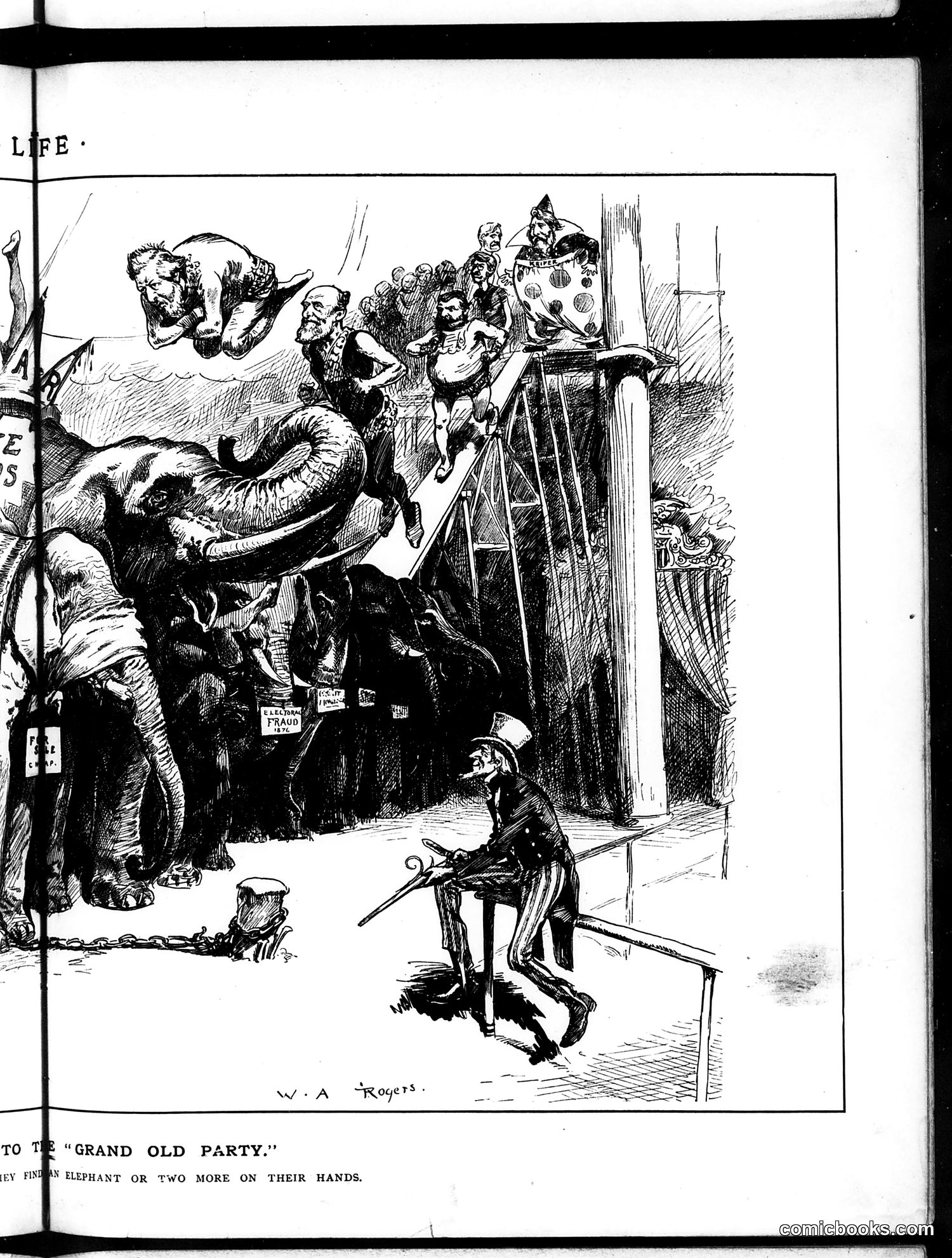
This W.A. Rogers cartoon, titled "To the 'Grand Old Party,'" depicts an elephant (the Republican Party symbol) struggling under the weight of numerous figures climbing on its back and sitting atop it. A skeletal Death figure sits in the foreground, appearing to conduct or direct the chaos with a baton. The satire critiques the Republican Party as overburdened by various political figures and interests competing for power and control. The "Grand Old Party" reference is ironic—suggesting the party is collapsing under internal discord rather than standing strong. The presence of Death suggests the cartoon warns that this internal chaos threatens the party's viability. The specific identities of the figures remain unclear without additional context about the publication date.
This page contains three distinct sections: a sentimental poem ("A Contrast"), household humor tips, and a musical critique. **"A Contrast"** presents a morality tale comparing two sisters raised similarly—one becomes beautiful and virtuous, the other hard, cold, and vice-ridden. The satire lies in the "Household Hints" section below, which mockingly inverts practical advice. Jokes like making jam by slamming your finger in a door, or cooking codfish by a fireplace instead of water, are absurdist humor satirizing incompetent or overly-complicated housekeeping. **"Concerning Wagner"** attacks the composer's disciples. The piece argues that Wagnerians dismiss all previous classical music as worthless while praising Wagner's continuous, abstract "dark and solemn sea" of sound. The critic champions melody—accessible, singable tunes understood by ordinary people—against the elitism of the new Wagner-dominated musical movement. The page reflects late 19th-century debates: domestic ideology, practical humor for homemakers, and the clash between classical tradition and modernist Wagner aesthetics.
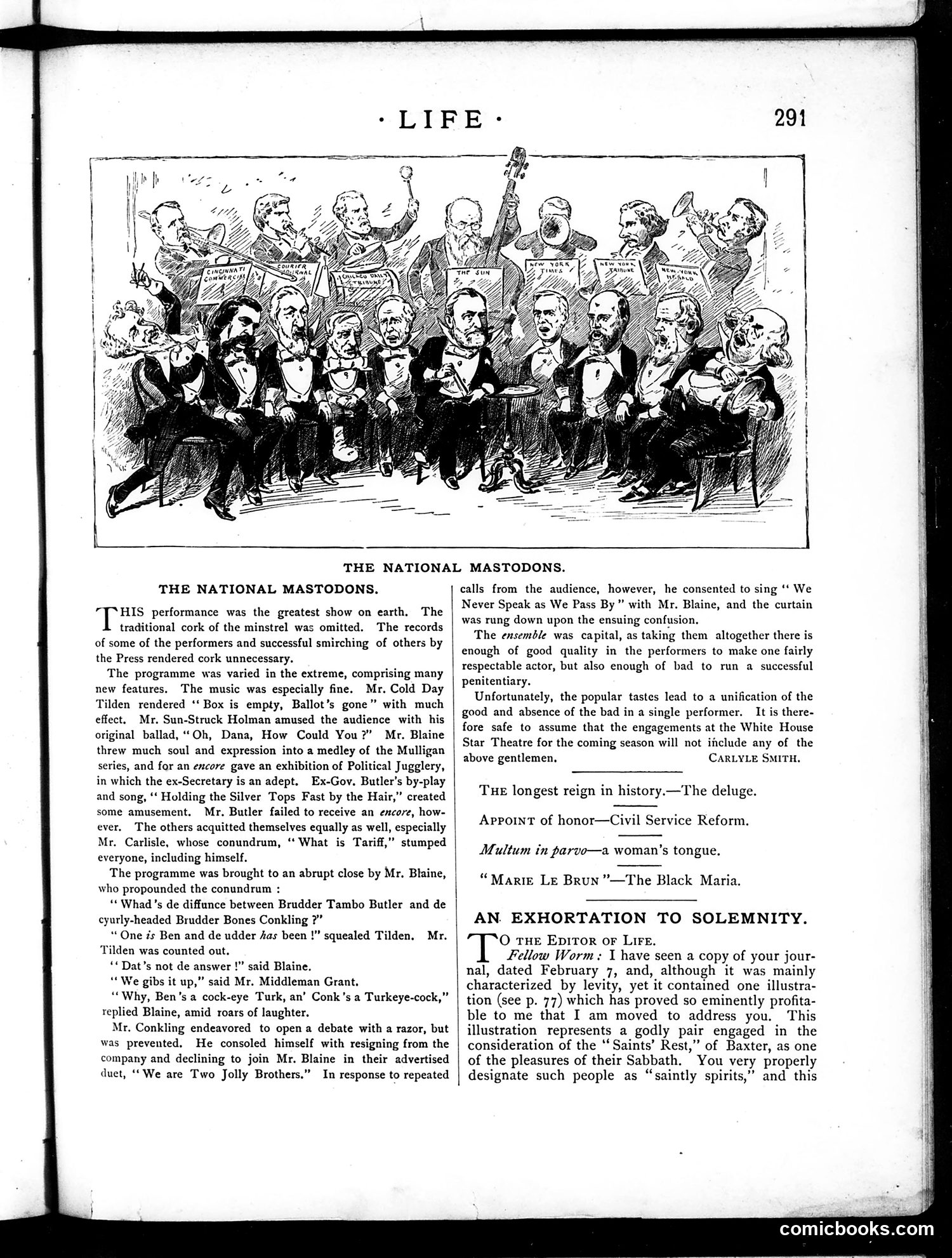
This cartoon satirizes prominent American politicians of the Gilded Age, depicted as performers in a minstrel show — a deliberate mockery comparing them to low entertainment. The figures referenced include: - **Tilden** (likely Samuel J. Tilden) - **Blaine** (James G. Blaine) - **Conkling** (Roscoe Conkling) - **Butler** (Benjamin Butler) - **Grant** (Ulysses S. Grant) - **Carlisle** (unclear which) - **Dana** (likely Charles Dana) The "mastodons" label suggests these are outdated, extinct political figures. The satire mocks their public quarrels, inconsistencies, and unsuitability for office — the text notes there's "enough of good quality...to make one fairly respectable actor, but also enough of bad to run a successful penitentiary." The conclusion jokes they'd never be invited to the White House, suggesting Life magazine views them as unfit for serious governance.
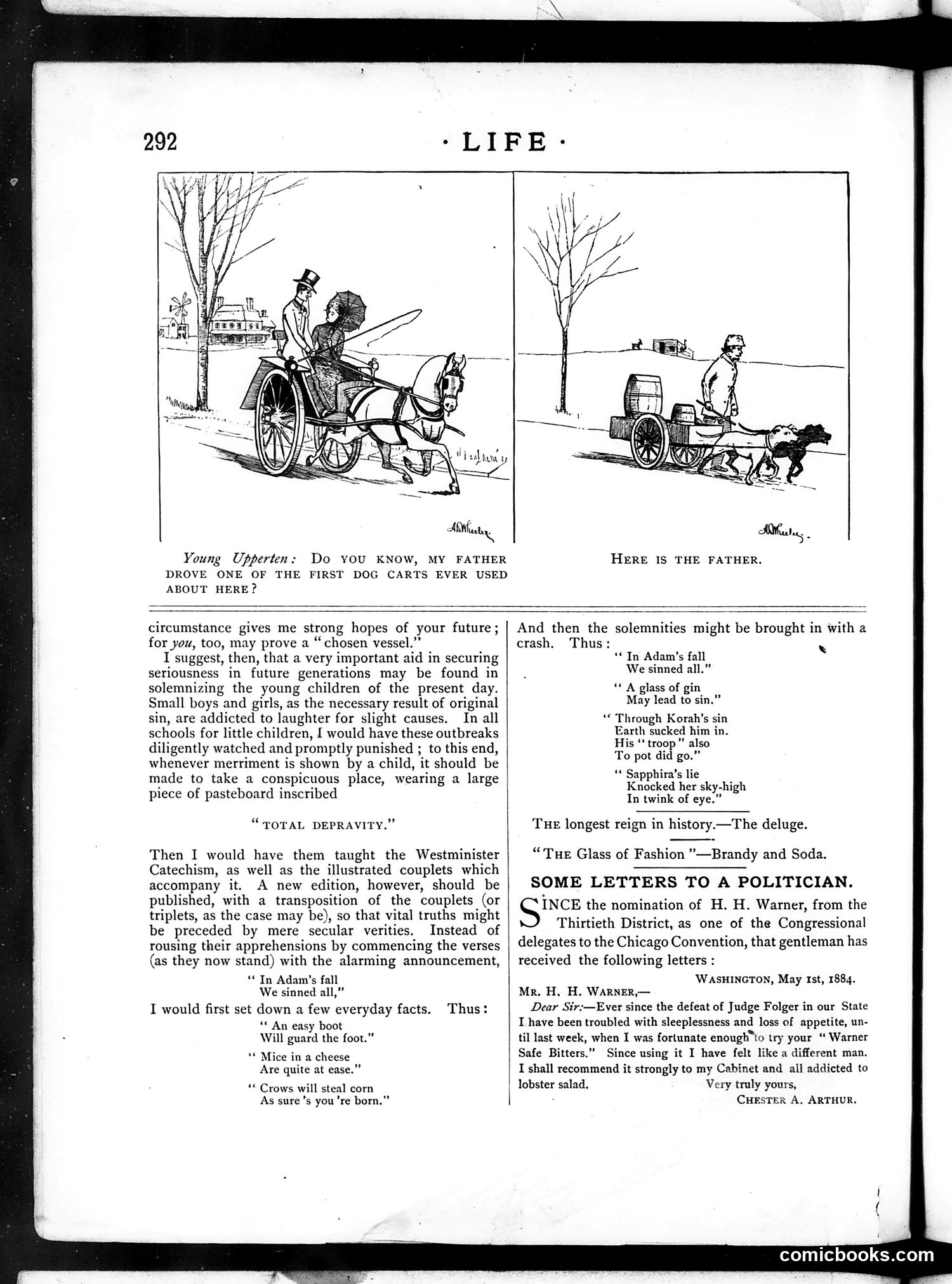
The top cartoon mocks social pretension through a visual joke: a young man brags that his father drove "one of the first dog carts"—implying aristocratic heritage—but the second panel reveals his father actually *pulls* a cart himself like a beast of burden, driven by another man. The satire targets class-climbing and false gentility. The lengthy middle text parodies Puritanical child-rearing ideology, sarcastically proposing that children wear "TOTAL DEPRAVITY" placards and learn grim religious doctrine. The humor lies in exaggerating already-stern Victorian educational practices to absurdity. The bottom section satirizes patent medicine endorsements and political corruption. A letter supposedly from President Chester A. Arthur (nominated 1884, per the text) claims "Warner Safe Bitters" cured his insomnia—an obvious advertisement masquerading as a testimonial. The joke targets both the fake medical claims and politicians' willingness to lend their names to commercial products for profit.
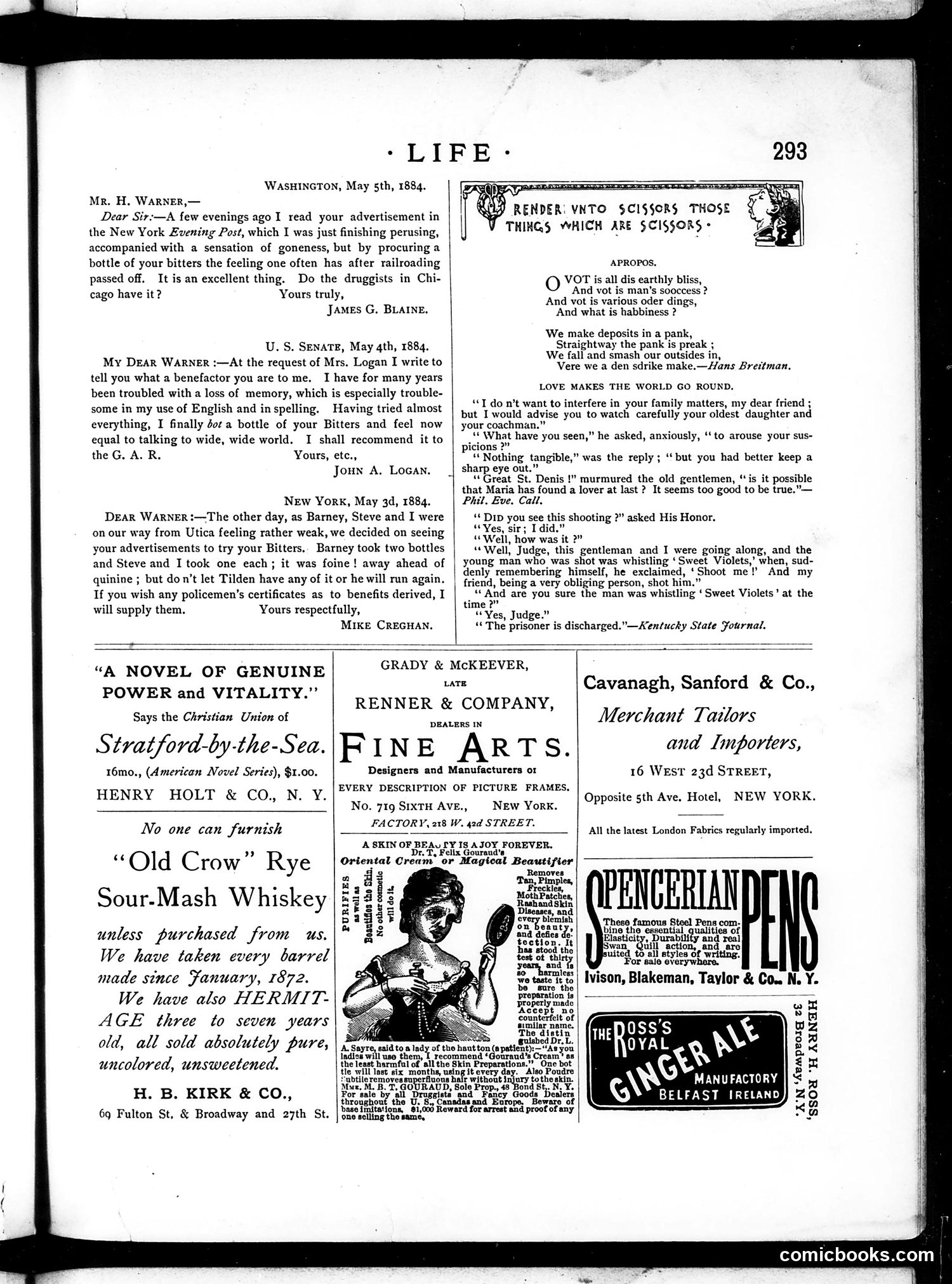
This page is primarily **testimonial advertisements** for H. Warner's Bitters, a patent medicine. The "letters" praising the product are satirical — they feature recognizable 1884 political figures endorsing the bitters with absurd claims. **The figures referenced:** - **James G. Blaine**: 1884 Republican presidential candidate, humorously claiming the bitters cured railway-induced malaise - **Mrs. Logan** (via Senator John A. Logan): wife of the Civil War general, jokingly attributing memory improvement to the tonic - **Mike Creghan**: appears to be a Democratic operative; his letter mocks Republican James Tilden, joking Tilden shouldn't use the bitters or "he will run again" **The satire:** Life ridicules patent medicine advertising by having prominent politicians endorse quack tonics for implausible ailments (memory loss, general weakness). This mocks both the credulous testimonial culture and the politicians themselves. The page also contains unrelated humorous anecdotes and period advertisements for fine arts, tailoring, and whiskey.
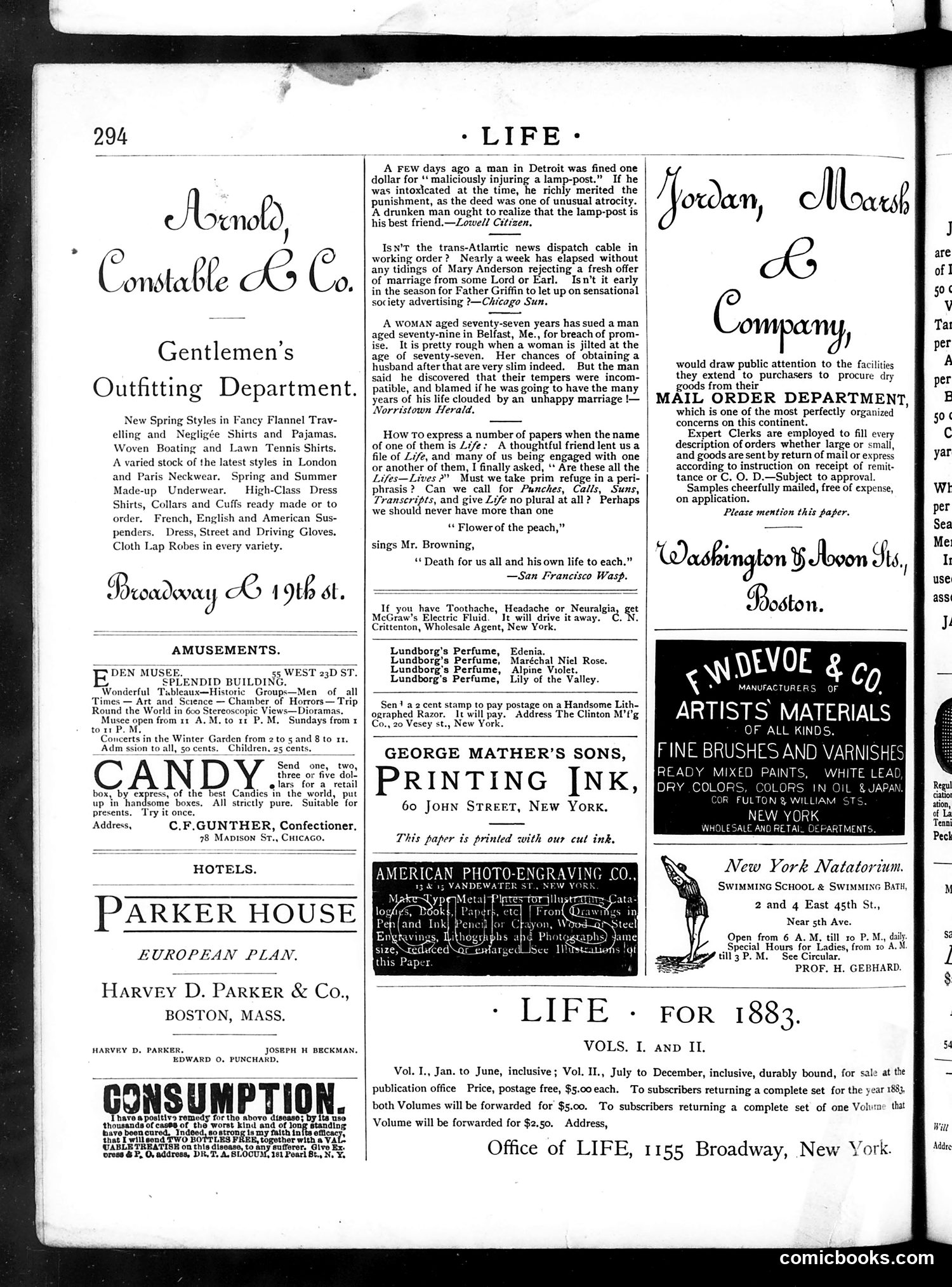
This page is primarily **advertising and notices**, not political cartoons. The small editorial content includes brief satirical **social commentary** typical of Life magazine's style: - A joke about a Detroit man fined for damaging a lamp-post, suggesting the lamp-post is a "best friend" to drunks - Mock outrage that Mary Anderson (likely the actress) hasn't rejected a marriage proposal recently—suggesting endless coverage of her romantic rejections - Sympathy for a 77-year-old woman jilted by a 79-year-old man in Belfast, Maine, with dark humor about her slim prospects - Wordplay about the plural of "Life" (the magazine itself) The rest is commercial: gentlemen's clothing, hotels, candy, perfumes, printing ink, and other Victorian-era products. There are **no political cartoons visible** on this page—it's a typical magazine back page mixing light social satire with paid advertisements.
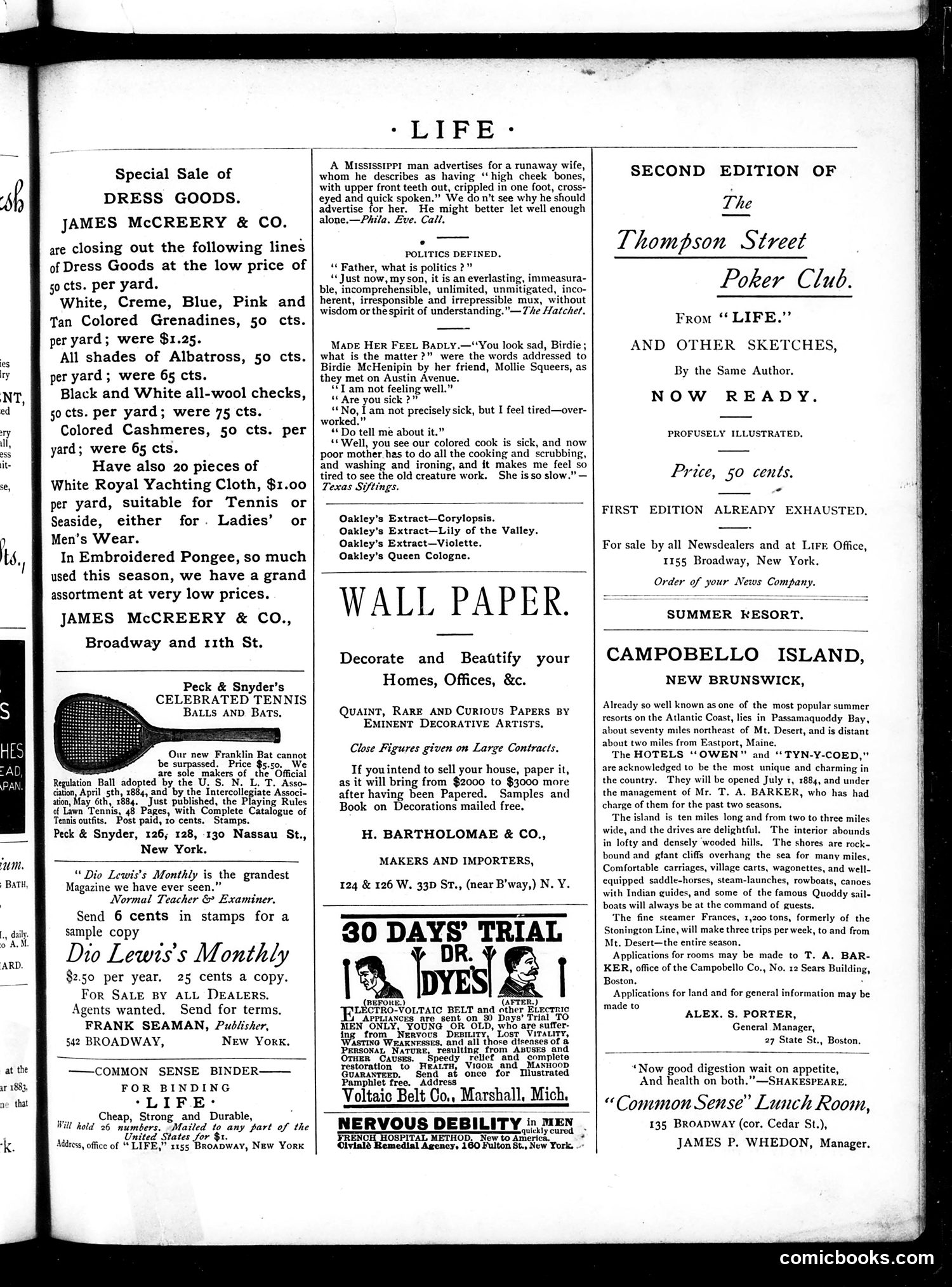
**This is primarily an **advertising page**, not satirical content**. The image shows numerous commercial advertisements typical of 1880s-era magazines. However, there are **three short humorous text items** embedded among the ads: 1. **"A Mississippi man advertises..."** — A joke mocking a man seeking his runaway wife by describing her as having missing teeth, being crippled, and cross-eyed. The satire suggests these unflattering details make the advertisement absurd—why would he want her back? 2. **"Politics Defined"** — A father-son dialogue where the father describes politics as "an everlasting, immeasurable, incomprehensible, unlimited...mux, without wisdom." This reflects late-19th-century cynicism about American politics during the Gilded Age. 3. **"Made Her Feel Badly"** — A woman complains about her servant/cook being ill, saying it exhausts *her* watching the old woman work. The satire targets wealthy privilege and obliviousness about servants' hardship. These are lightweight social commentary typical of Life magazine's regular satirical short-form humor.
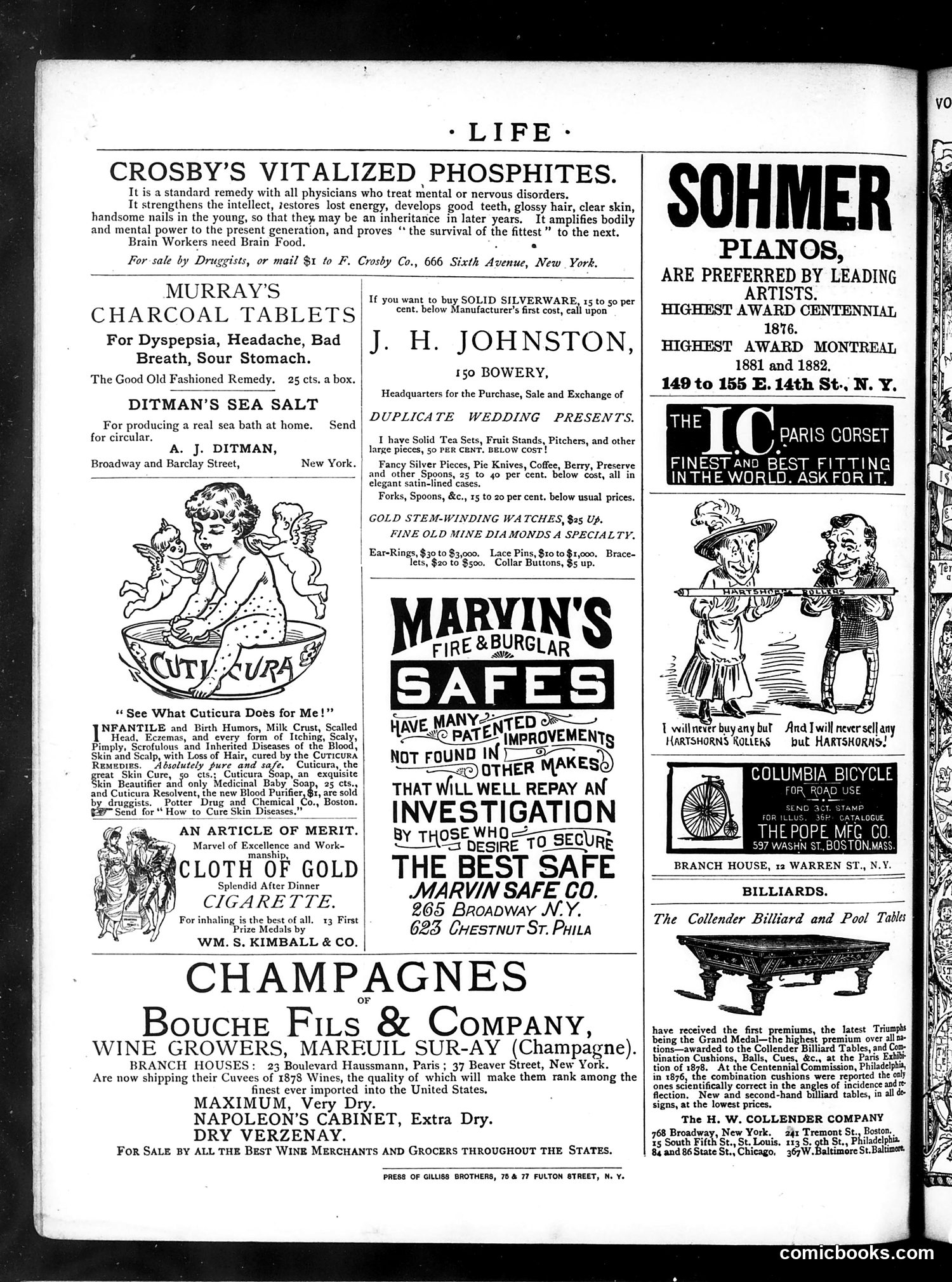
This is a **Life magazine advertisements page** from the 1870s-1880s, featuring patent medicines and consumer goods typical of the era. The notable satirical element appears in the **Cuticura advertisement**, which uses exaggerated testimonials claiming the product cures "every form of Itching, Scaly, Pimply, Scrofulous" diseases—a common advertising tactic mocked by Life. The magazine itself was known for ridiculing such dubious health claims. The **Hartshorns Rollers cartoon** (lower right) shows two figures in conversation about never buying or selling competing roller skates—a humorous advertisement playing on exclusivity. Most content here represents **aggressive patent medicine marketing** that Life satirized: Crosby's "Vitalized Phosphites" promises to strengthen intellect and prove "survival of the fittest," Murray's Charcoal Tablets claim to cure dyspepsia, and Cuticura promises miraculous cures. These exaggerated health claims were prime targets for Life's satire about fraudulent 19th-century consumer culture.