
Life, 1884-05-22 · page 6 of 16
Life — May 22, 1884 — page 6: what you’re looking at
What you’re looking at
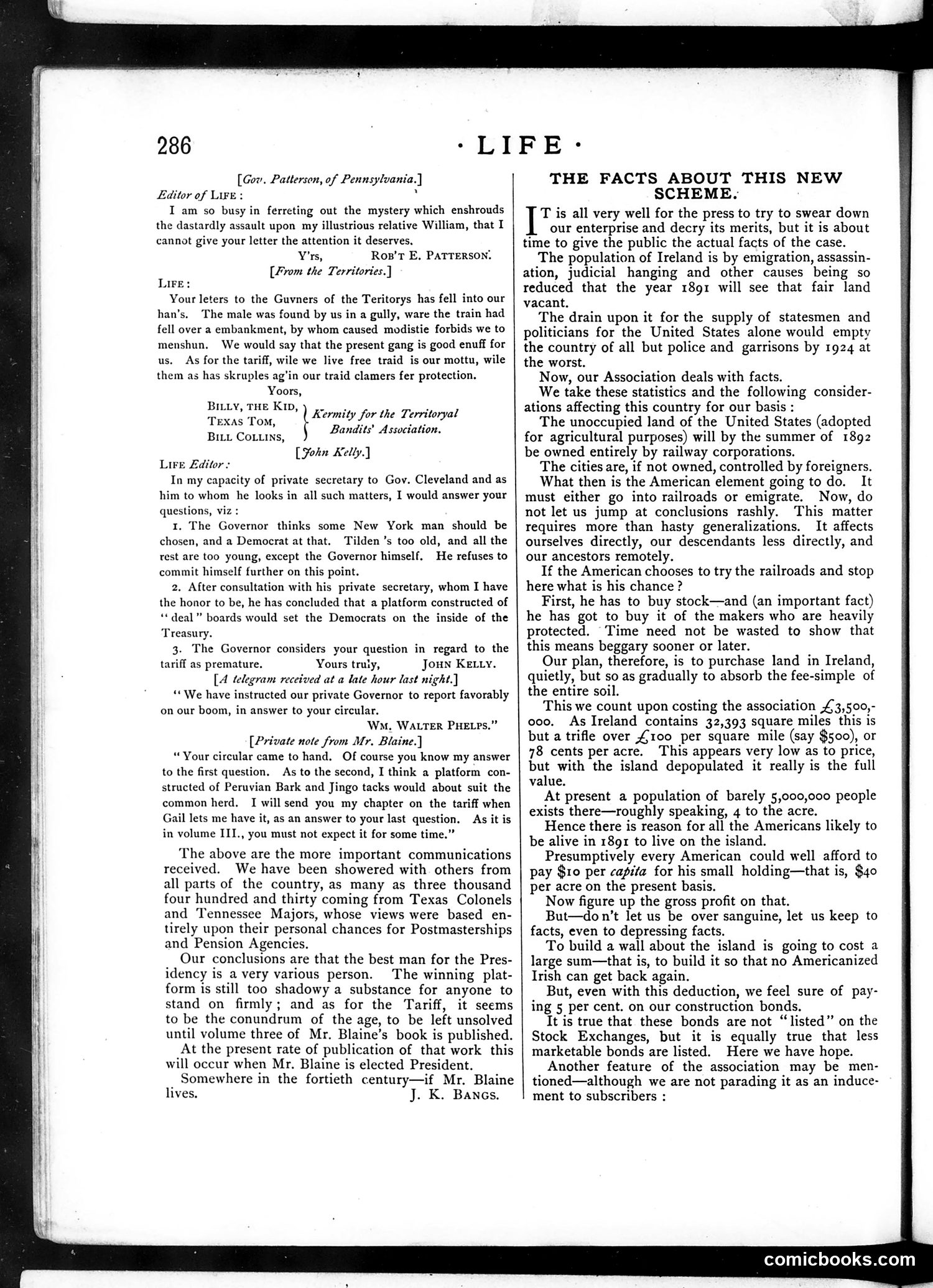
This page contains no cartoon or satirical illustration. Instead, it features letters to the editor and an article titled "The Facts About This New Scheme." The article discusses a proposal to solve Irish emigration and American unemployment by having American railroad corporations purchase unoccupied Irish land. The scheme would gradually absorb Ireland's soil while relocating its population to America. The satire is textual rather than visual: the author presents this land-acquisition plan with mock seriousness, highlighting its absurdity through detailed financial calculations (cost per acre, profit margins) and the implicit colonization it represents. The piece critiques both American business interests and suggests skepticism about solving social problems through corporate expansion into foreign territories.
📄 Transcribed text from this page (OCR, searchable)
Machine-transcribed from the original scan — historical spelling and the odd misread are preserved.
286 [Gor Patterson, of Pennsylvania,] Editor of LiFe : . I am so busy in ferreting out the mystery which enshrouds the dastardly assault upon my illustrious relative William, that I cannot give your letter the attention it deserves, Y'rs, Ros’t E, PATTERSON. [From the Territories.) Lire: Your leters to the Guvners of the Teritorys has fell into our han’s. The male was found by us in a gully, ware the train had fell over a embankment, by whom caused modistie forbids we to menshun. We would say that the present gang is good enuff for us. As for the tariff, wile we live free traid is our mottu, wile them as has skruples ag'in our traid clamers fer protection. Yoors, BILLy, Kip, - . . nape andamaa ae for the Territoryal Texas Tom, ane a Bandits’ Association, Bit Coutins, [Youn Kelly] Lire Editor : In my capacity of private secretary to Gov. Cleveland and as him to whom he looks in all such matters, I would answer your questions, viz : 1. The Governor thinks some New York man should be chosen, and a Democrat at that. Tilden’s too old, and all the rest are too young, except the Governor himself. commit himself further on this point. 2, After consultation with his private secretary, whom I have the honor to be, he has concluded that a platform constructed of “deal” boards would set the Democrats on the inside of the Treasury. 3. The Governor considers your question in regard to the tariff as premature. Yours truly, Joun KELLy. [4 telegram received at a late hour last night.] “We have instructed our private Governor to report favorably on our boom, in answer to your circular. W. WALTER PHELPS.” [Private note from Mr. Blaine.] “Your circular came to hand. Of course you know my answer to the first question. As to the second, I think a platform con- structed of Peruvian Bark and Jingo tacks would about suit the common herd. I will send you my chapter on the tariff when Gail lets me have it, as an answer to your last question. As it is in volume III., you must not expect it for some time.” He refuses to The above are the more important communications received. We have been showered with others from all parts of the country, as many as three thousand four hundred and thirty coming from Texas Colonels and Tennessee Majors, whose views were based en- tirely upon their personal chances for Postmasterships and Pension Agencies. Our conclusions are that the best man for the Pres- idency is a very various person. The winning plat- form is still too shadowy a substance for anyone to stand on firmly; and as for the Tariff, it seems to be the conundrum of the age, to be left unsolved until volume three of Mr. Blaine’s book is published. At the present rate of publication of that work this will occur when Mr. Blaine is elected President. Somewhere in the fortieth century—if Mr. Blaine lives. J. K. Banos. -LIFE: THE FACTS ABOUT THIS NEW SCHEME. T is all very well for the press to try to swear down our enterprise and decry its merits, but it is about time to give the public the actual facts of the case. The population of Ireland is by emigration, assassin- ation, judicial hanging and other causes being so reduced that the year 1891 will see that fair land vacant. The drain upon it for the supply of statesmen and politicians for the United States alone would empty the country of all but police and garrisons by 1924 at the worst. Now, our Association deals with facts. We take these statistics and the following consider- ations affecting this country for our basis : The unoccupied land of the United States (adopted for agricultural purposes) will by the summer of 1892 be owned entirely by railway corporations. The cities are, if not owned, controlled by foreigners. What then is the American element going to do. It must either go into railroads or emigrate. Now, do not let us jump at conclusions rashly. This matter requires more than hasty generalizations. It affects ourselves directly, our descendants less directly, and our ancestors remotely. If the American chooses to try the railroads and stop here what is his chance? First, he has to buy stock—and (an important fact) he has got to buy it of the makers who are heavily protected. Time need not be wasted to show that this means beggary sooner or later. Our plan, therefore, is to purchase land in Ireland, quietly, but so as gradually to absorb the fee-simple of the entire soil. This we count upon costing the association £3,500,- ooo. As Ireland contains 32,393 square miles this is but a trifle over £100 per square mile (say $500), or 78 cents per acre. This appears very low as to price, but with the island depopulated it really is the full value. At present a population of barely 5,000,000 people exists there—roughly speaking, 4 to the acre. Hence there is reason for all the Americans likely to be alive in 1891 to live on the island. Presumptively every American could well afford to pay $10 per capita for his small holding—that is, $40 per acre on the present basis. Now figure up the gross profit on that. But—do n’t let us be over sanguine, let us keep to facts, even to depressing facts. To build a wall about the island is going to cost a large sum—that is, to build it so that no Americanized Irish can get back again. But, even with this deduction, we feel sure of pay- ing 5 per cent. on our construction bonds. It is true that these bonds are not “listed” on the Stock Exchanges, but it is equally true that less marketable bonds are listed. Here we have hope. Another feature of the association may be men- tioned—although we are not parading it as an induce- ment to subscribers : comicbooks.com