
Life, 1884-05-22 · page 10 of 16
Life — May 22, 1884 — page 10: what you’re looking at
What you’re looking at
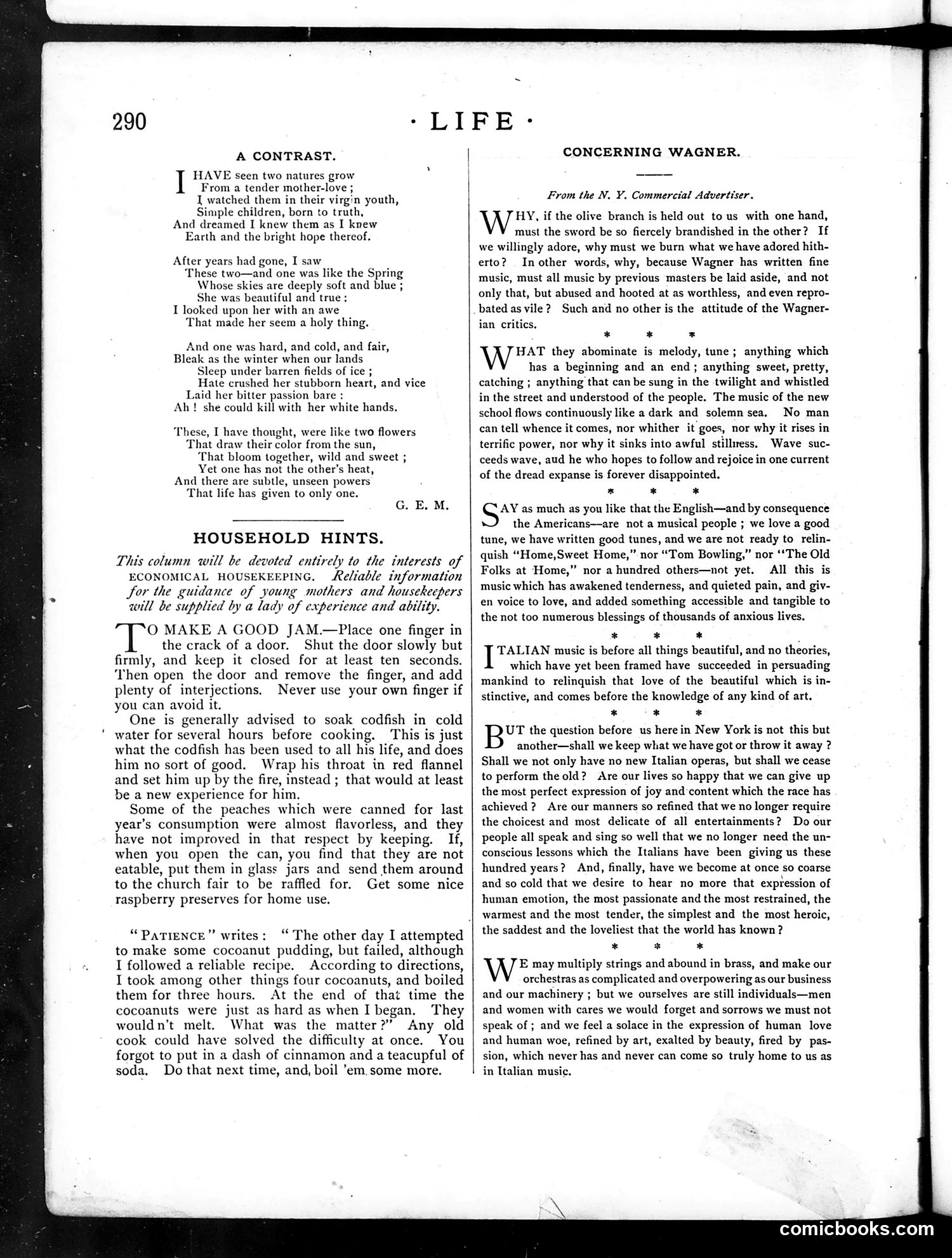
This page contains three distinct sections: a sentimental poem ("A Contrast"), household humor tips, and a musical critique. **"A Contrast"** presents a morality tale comparing two sisters raised similarly—one becomes beautiful and virtuous, the other hard, cold, and vice-ridden. The satire lies in the "Household Hints" section below, which mockingly inverts practical advice. Jokes like making jam by slamming your finger in a door, or cooking codfish by a fireplace instead of water, are absurdist humor satirizing incompetent or overly-complicated housekeeping. **"Concerning Wagner"** attacks the composer's disciples. The piece argues that Wagnerians dismiss all previous classical music as worthless while praising Wagner's continuous, abstract "dark and solemn sea" of sound. The critic champions melody—accessible, singable tunes understood by ordinary people—against the elitism of the new Wagner-dominated musical movement. The page reflects late 19th-century debates: domestic ideology, practical humor for homemakers, and the clash between classical tradition and modernist Wagner aesthetics.
📄 Transcribed text from this page (OCR, searchable)
Machine-transcribed from the original scan — historical spelling and the odd misread are preserved.
A CONTRAST. HAVE seen two natures grow From a tender mother-love ; I watched them in their virgin youth, Simple children, born to truth, And dreamed I knew them as I knew Earth and the bright hope thereof. After years had gone, I saw These two—and one was like the Spring Whose skies are deeply soft and blue ; She was beautiful and true: I looked upon her with an awe That made her seem a holy thing. And one was hard, and cold, and fair, Bleak as the winter when our lands Sleep under barren fields of ice ; Hate crushed her stubborn heart, and vice Laid her bitter passion bare : Ah! she could kill with her white hands. These, I have thought, were like two flowers That draw their color from the sun, ‘That bloom together, wild and sweet ; Yet one has not the other's heat, And there are subtle, unseen powers ‘That life has given to only one. HOUSEHOLD HINTS. This column will be devoted entirely to the interests of ECONOMICAL HOUSEKEEPING. Reliable information for the guidance of young mothers and housekeepers will be supplied by a lady of experience and ability. O MAKE A GOOD JAM.—Place one finger in the crack of a door. Shut the door slowly but firmly, and keep it closed for at least ten seconds. ‘Then open the door and remove the finger, and add plenty of interjections. Never use your own finger if you can avoid it. One is generally advised to soak codfish in cold water for several hours before cooking. This is just what the codfish has been used to all his life, and does him no sort of good. Wrap his throat in red flannel and set him up by the fire, instead ; that would at least be a new experience for him. Some of the peaches which were canned for last year’s consumption were almost flavorless, and they have not improved in that respect by keeping. If, when you open the can, you find that they are not eatable, put them in glass jars and send them around to the church fair to be raffled for. Get some nice raspberry preserves for home use. “ PATIENCE” writes : I followed a reliable recipe. According to directions, I took among other things four cocoanuts, and boiled them for three hours. At the end of that time the cocoanuts were just as hard as when I began. They wouldn't melt. What was the matter?” Any old cook could have solved the difficulty at once. You forgot to put in a dash of cinnamon and a teacupful of soda. Do that next time, and, boil ’em.some more. “ The other day I attempted to make some cocoanut pudding, but failed, although CONCERNING WAGNER. From the N. Y. Commercial Advertiser. HY, if the olive branch is held out to us with one hand, must the sword be so fiercely brandished in the other? If we willingly adore, why must we burn what we have adored hith- erto? In other words, why, because Wagner has written fine music, must all music by previous masters be laid aside, and not only that, but abused and hooted at as worthless, and even repro- bated as vile? Such and no other is the attitude of the Wagner- ian critics. * * * HAT they abominate is melody, tune ; anything which has a beginning and an end ; anything sweet, pretty, catching ; anything that can be sung in the twilight and whistled in the street and understood of the people. The music of the new school flows continuously like a dark and solemn sea, No man can tell whence it comes, nor whither it goes, nor why it rises in terrific power, nor why it sinks into awful stillress, Wave suc- ceeds wave, aud he who hopes to follow and rejoice in one current of the dread expanse is forever disappointed. = * * Ss‘ as much as you like that the English—and by consequence the Americans—are not a musical people ; we love a good tune, we have written good tunes, and we are not ready to relin- quish ‘“‘Home,Sweet Home,” nor “Tom Bowling,” nor ‘‘The Old Folks at Home,” nor a hundred others—not yet. All this is music which has awakened tenderness, and quieted pain, and giv- en voice to love, and added something accessible and tangible to the not too numerous blessings of thousands of anxious lives. * * * TALIAN music is before all things beautiful, and no theories, which have yet been framed have succeeded in persuading mankind to relinquish that love of the beautiful which is in- stinctive, and comes before the knowledge of any kind of art. * * * UT the question before us herein New York is not this but another—shall we keep what we have got or throw it away ? Shall we not only have no new Italian operas, but shall we cease to perform the old? Are our lives so happy that we can give up the most perfect expression of joy and:content which the race has achieved? Are our manners so refined that we no longer require the choicest and most delicate of all entertainments? Do our people all speak and sing so well that we no longer need the un- conscious lessons which the Italians have been giving us these hundred years? And, finally, have we become at once so coarse and so cold that we desire to hear no more that expression of human emotion, the most passionate and the most restrained, the warmest and the most tender, the simplest and the most heroic, the saddest and the loveliest that the world has known? * * * E may multiply strings and abound in brass, and make our orchestras as complicated and overpowering as our business and our machinery ; but we ourselves are still individuals—men and women with cares we would forget and sorrows we must not speak of ; and we feel a solace in the expression of human love and human woe, refined by art, exalted by beauty, fired by pas- sion, which never has and never can come so truly home to us as in Italian music. comicbooks.com