
Life, 1884-05-22 · page 4 of 16
Life — May 22, 1884 — page 4: what you’re looking at
What you’re looking at
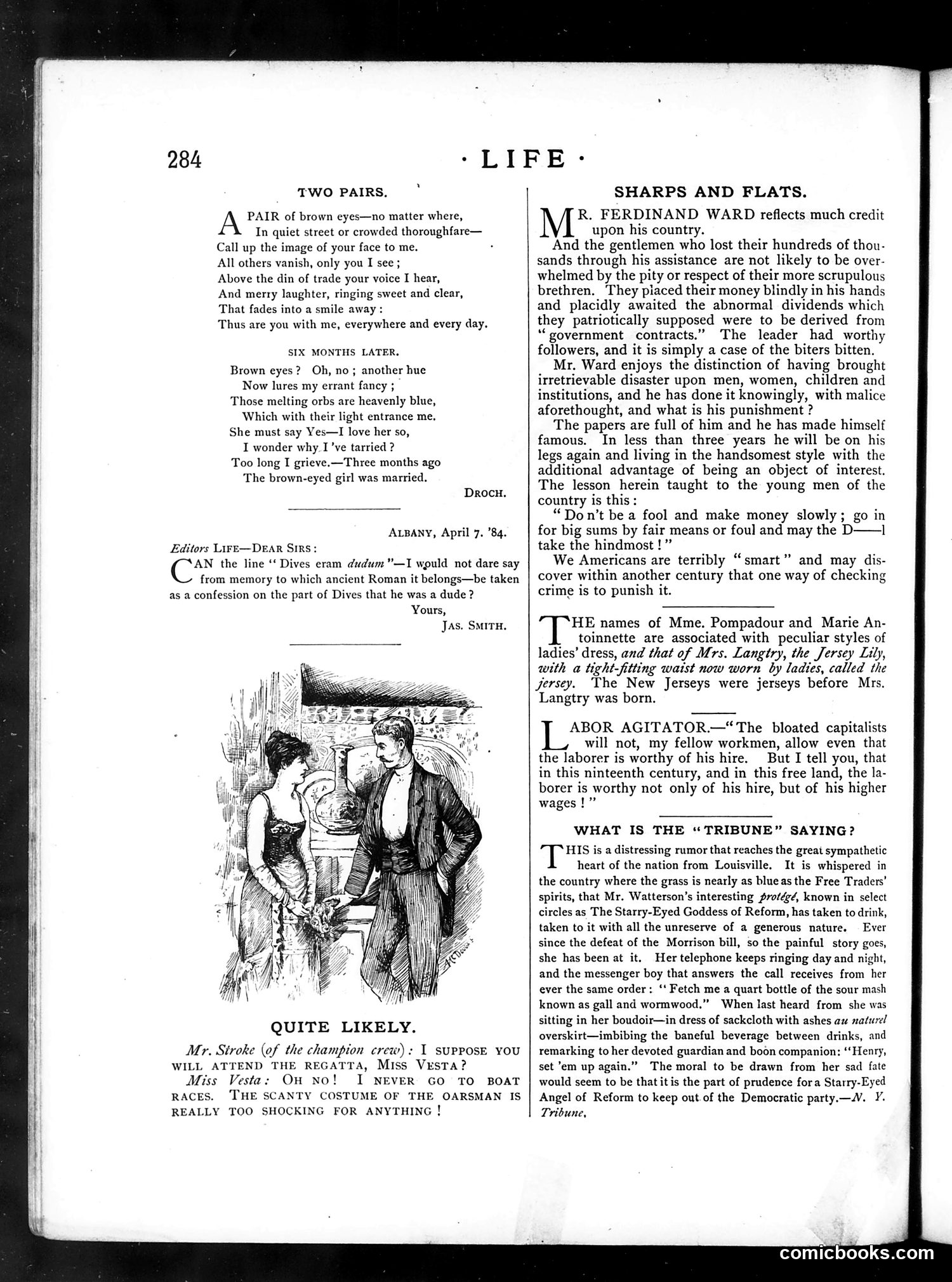
The bottom cartoon depicts a social interaction between two figures—apparently a man ("Mr. Stroke of the champion crew") and a woman ("Miss Vesta"). The dialogue reveals satirical commentary on Victorian social conventions and class anxieties. Mr. Stroke invites Miss Vesta to attend a regatta (rowing race), but she declines, citing that "the scanty costume of the oarsman is really too shocking for anything." The satire targets both masculine athletic display and feminine prudishness—suggesting women's exaggerated modesty about men's athletic wear serves as social cover, while revealing underlying class consciousness about spectacle and propriety during the Gilded Age.
📄 Transcribed text from this page (OCR, searchable)
Machine-transcribed from the original scan — historical spelling and the odd misread are preserved.
*LIFE: TWO PAIRS. PAIR of brown eyes—no matter where, In quiet street or crowded thoroughfare— Call up the image of your face to me. : All others vanish, only you I see; Above the din of trade your voice I hear, And merry laughter, ringing sweet and clear, That fades into a smile away : Thus are you with me, everywhere and every day. SIX MONTHS LATER. Brown eyes? Oh, no; another hue Now lures my errant fancy ; Those melting orbs are heavenly blue, Which with their light entrance me, She must say Yes—I love her so, I wonder why I’ve tarried ? Too long I grieve.—Three months ago The brown-eyed girl was married. Drocu. ALBANY, April 7. ’84. Editors L1FE—DEAR Sirs: AN the line ‘‘ Dives eram dudum”—I would not dare say from memory to which ancient Roman it belongs—be taken as a confession on the part of Dives that he was a dude? Yours, Jas. SMITH. i ne QUITE LIKELY. Mr. Stroke (of the champion crew): 1 suppose you WILL ATTEND THE REGATTA, Miss Vesta? Miss Vesta: Ow No! I NEVER GO TO BOAT RACES. THE SCANTY COSTUME OF THE OARSMAN IS REALLY TOO SHOCKING FOR ANYTHING ! SHARPS AND FLATS. R. FERDINAND WARD reflects much credit upon his country. And the gentlemen who lost their hundreds of thou- sands through his assistance are not likely to be over- whelmed by the pity or respect of their more scrupulous brethren. They piaced their money blindly in his hands and placidly awaited the abnormal dividends which they patriotically supposed were to be derived from ‘government contracts.” The leader had worthy followers, and it is simply a case of the biters bitten. Mr. Ward enjoys the distinction of having brought irretrievable disaster upon men, women, children and institutions, and he has done it knowingly, with malice aforethought, and what is his punishment ? The papers are full of him and he has made himself famous. In less than three years he will be on his legs again and living in the handsomest style with the additional advantage of being an object of interest. The lesson herein taught to the young men of the country is this : “Don’t be a fool and make money slowly; go in for big sums by fair means or foul and may the D——1 take the hindmost !” We Americans are terribly “smart” and may dis- cover within another century that one way of checking crime is to punish it. HE names of Mme. Pompadour and Marie An- toinnette are associated with peculiar styles of ladies’ dress, and that of Mrs. Langtry, the Jersey Lily, with a tight-fitting waist now worn by ladies, called the Jersey. The New Jerseys were jerseys before Mrs. Langtry was born. ABOR AGITATOR.—* The bloated capitalists will not, my fellow workmen, allow even that the laborer is worthy of his hire. But I tell you, that in this ninteenth century, and in this free land, the la- borer is worthy not only of his hire, but of his higher wages!” WHAT IS THE “TRIBUNE” SAYING? HIS is a distressing rumor that reaches the great sympathetic heart of the nation from Louisville. It is whispered in the country where the grass is nearly as blueas the Free Traders’ spirits, that Mr. Watterson’s interesting protégé, known in select circles as The Starry-Eyed Goddess of Reform, has taken to drink, taken to it with all the unreserve of a generous nature. Ever since the defeat of the Morrison bill, so the painful story goes, she has been at it. Her telephone keeps ringing day and night, and the messenger boy that answers the call receives from her ever the same order: ‘‘ Fetch me a quart bottle of the sour mash known as gall and wormwood,” When last heard from she was sitting in her boudoir—in dress of sackcloth with ashes au naturel overskirt—imbibing the baneful beverage between drinks, and remarking to her devoted guardian and boon companion: ‘Henry, set ’em up again.” The moral to be drawn from her sad fate would seem to be that it is the part of prudence fora Starry-Eyed Angel of Reform to keep out of the Democratic party... Tribune, comicbooks.com