
A complete issue · 16 pages · 1884
Life — May 1, 1884
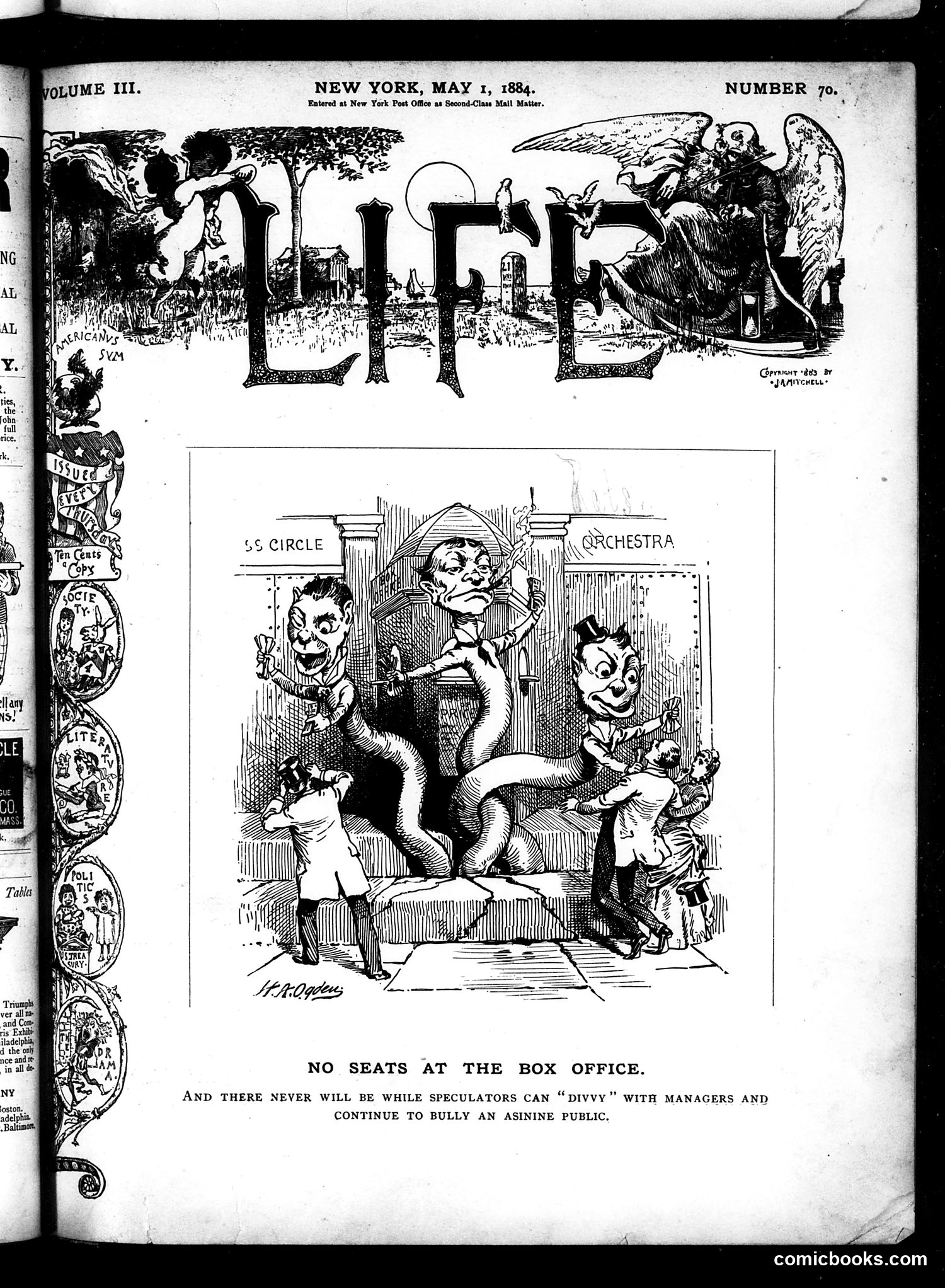
This *Life* magazine page from May 1, 1884 contains a satirical cartoon titled "No Seats at the Box Office." The illustration shows three caricatured figures at what appears to be a theater box office, with two well-dressed men flanking a central figure in an exaggerated pose. The caption's second line references "speculators" who "divvy" (divide profits) with managers while continuing to "bully an asinine public." This critiques ticket scalping and collusion between theater box-office staff and speculators who purchased tickets to resell at inflated prices—a practice that squeezed ordinary theatergoers out of available seating. The cartoon satirizes corruption in entertainment venues where insider dealings prevented legitimate public access to performances.
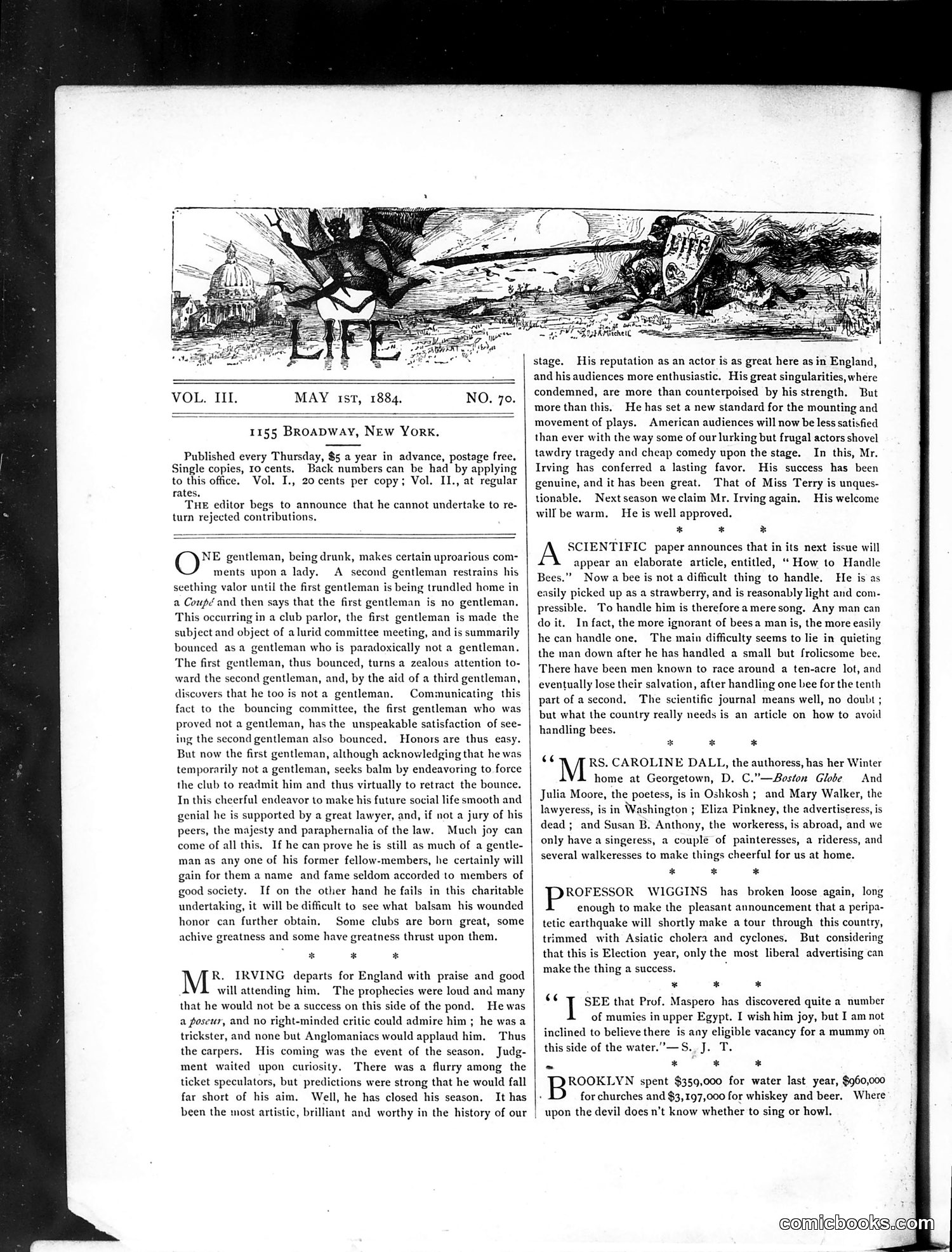
This page contains social commentary and brief satirical items rather than a single political cartoon. The visible header illustration depicts allegorical figures (likely representing Life itself and other concepts), but the specific meaning is unclear without additional context. The text includes anecdotes mocking Victorian social pretension—particularly a story about gentlemen in a club debating whether someone is a "gentleman," satirizing the obsession with class status and honor among the upper classes. Additional items mock Professor Wiggins (an apparent charlatan claiming to predict earthquakes) and note Brooklyn's municipal spending priorities, sardonically questioning why the city spends vastly more on water than whiskey, suggesting misplaced values. The page reflects 1880s concerns with social climbing, scientific fraud, and urban governance.
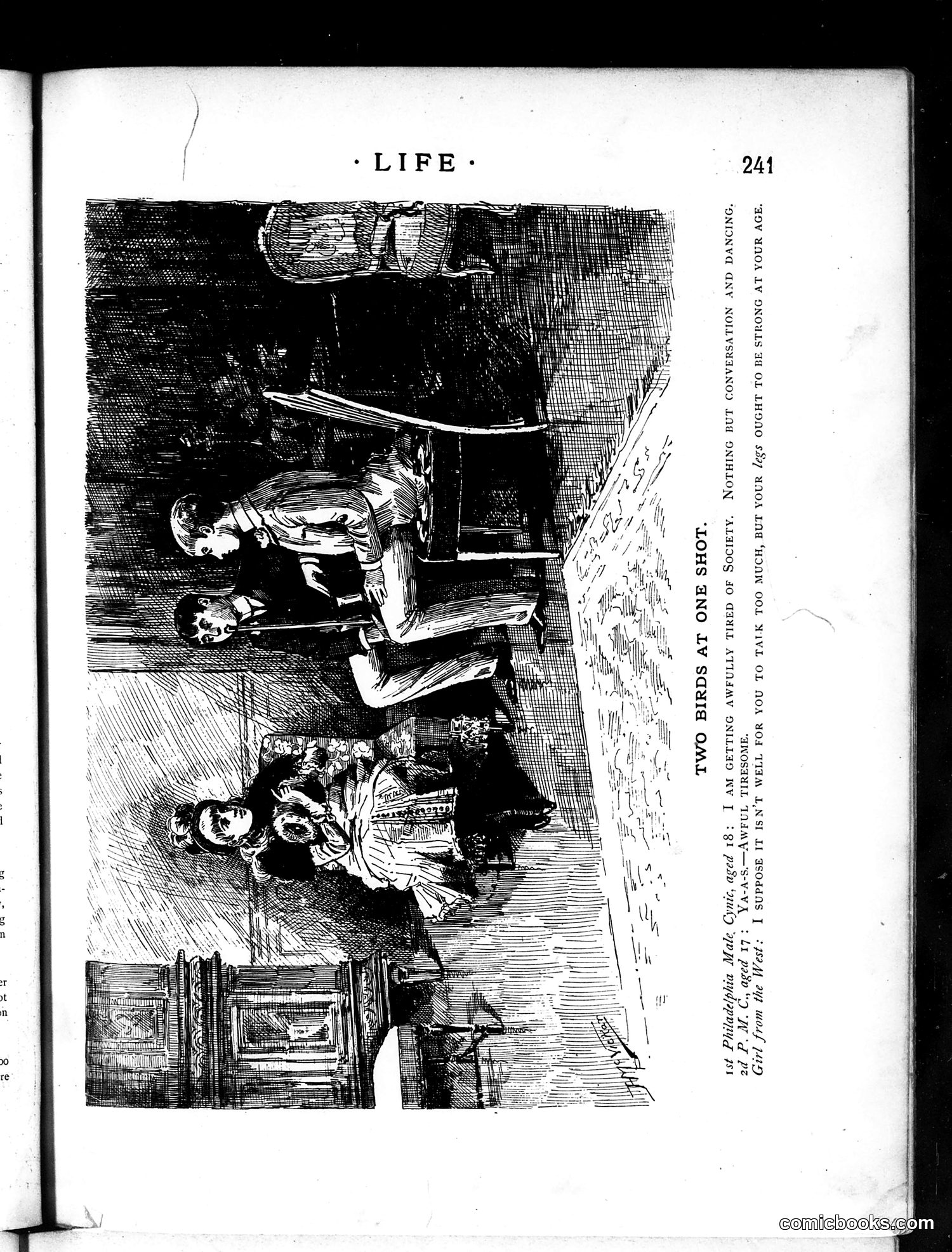
This is an engraving titled "TWO BIRDS AT ONE SHOT," credited to Penrhyn Stanlaws, showing a domestic interior scene rotated 90 degrees. The caption references "a certainty: a plurality of Sweett, Spiritus, and Dancing" and mentions something about a "trick" that "will for two trifle but our age covet in Stones at your age." The satirical point appears obscure without additional context. The domestic scene—featuring what seems to be well-dressed figures in an interior—likely contains social commentary about courtship, marriage, or gender relations typical of Life magazine's humor. However, the specific references in the caption are unclear to modern readers, and without knowing the exact publication date or contemporary events, the precise target of satire cannot be confidently identified. The ornate, late-19th or early-20th century style suggests this period's social conventions are at issue.
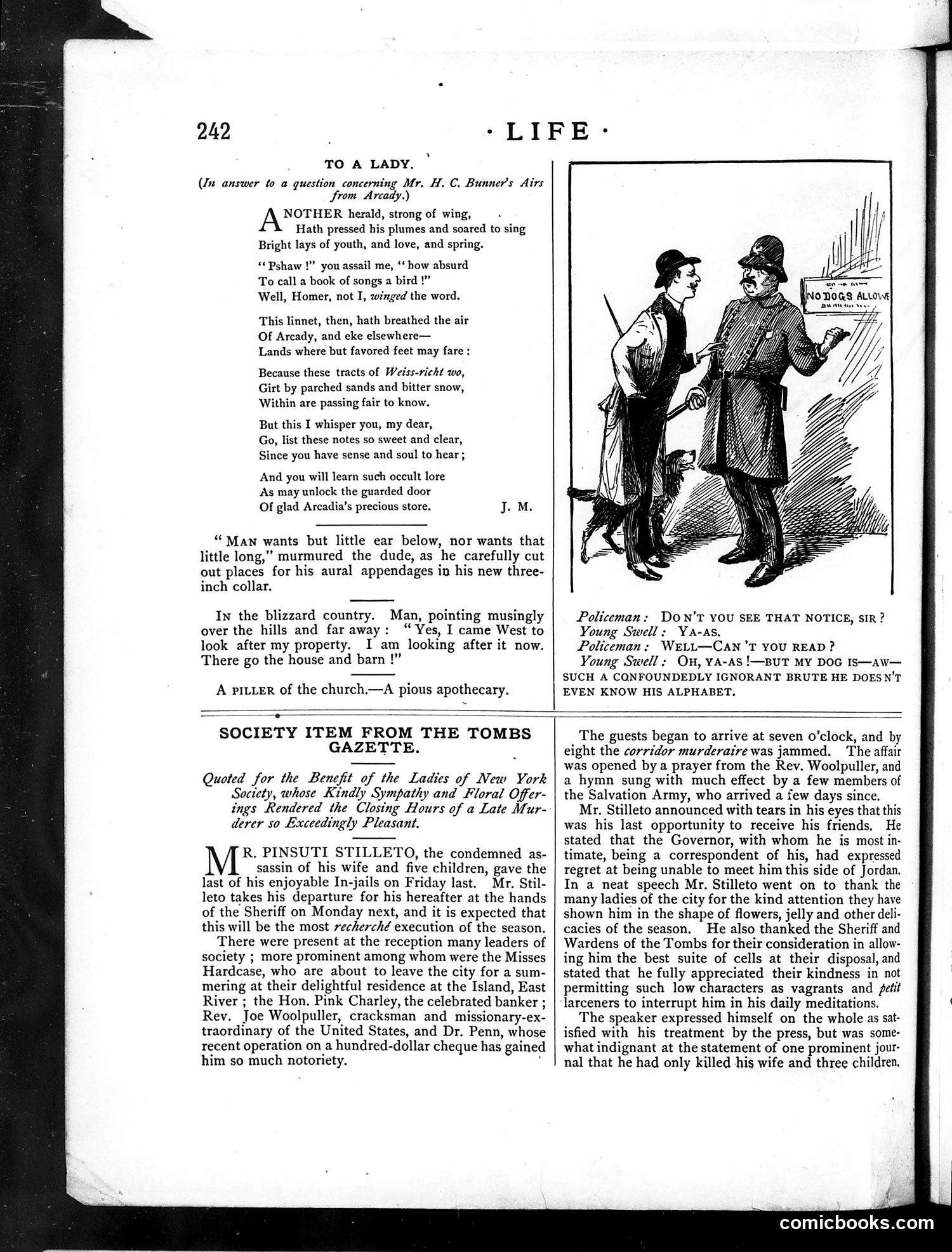
The cartoon depicts a "Young Swell" (a fashionable but foolish young man) confronted by a policeman about a sign reading "NO DOGS ALLOW'D." The humor lies in the swell's deliberately obtuse response: when the policeman points out he can't read, the young man insultingly suggests the officer is "such a confoundedly ignorant brute" he doesn't know his alphabet. The joke satirizes the pretentious arrogance of wealthy young dandies who use condescension and verbal sparring to evade accountability, turning the tables on authority figures. It's a class-based satire mocking how privileged youth weaponize rudeness and feigned superiority against working-class officials trying to enforce basic rules.
This page contains **book reviews and literary criticism**, not political cartoons. The header illustration shows a small figure reading, introducing three review sections: 1. **"Bookshelf"** - Reviews an anonymous novel "Stratford-by-the-Sea," praising its artistic depiction of provincial English life and character development. 2. **"An Explanation"** - A humorous poem addressing someone's tardiness or emotional evasion, likely satirizing social pretense. 3. **"Mr. Barnum's Latest Acquisitions"** - Critiques P.T. Barnum as a charlatan, satirizing his reputation for collecting curiosities and exaggeration. Lists absurd "acquisitions" (a Novoocka, Englishman, Bostonian, Philadelphian) as mockery. 4. Brief notices of other notable books being published. The page is primarily **literary content with gentle social satire** rather than political commentary.
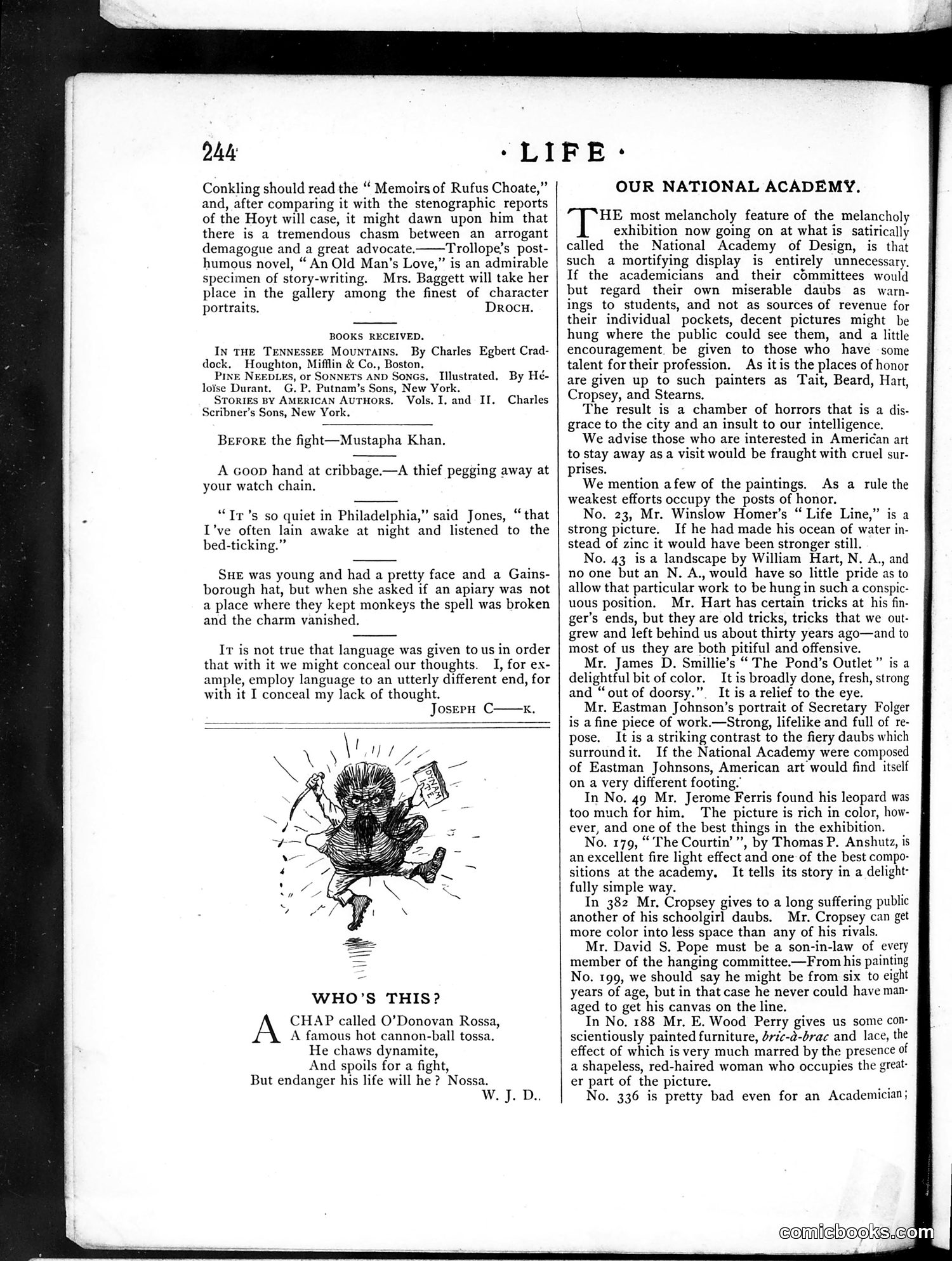
This untitled cartoon depicts a figure in chaotic motion, surrounded by radiating lines suggesting explosive energy or impact. The accompanying poem identifies him as "O'Donovan Rossa," described as "a famous hot cannon-ball tossa" who "chaws dynamite" and causes trouble. O'Donovan Rossa (1831-1915) was an Irish republican activist and Fenian leader known for advocating violent resistance against British rule. The cartoon satirizes him as a dangerous, volatile revolutionary—literally portrayed as a human cannon-ball or explosive device. The joke plays on both his reputation for radical action and his name's phonetic resemblance to "toss," mocking Irish nationalist militancy through crude caricature and violent imagery typical of 19th-century American satirical magazines.
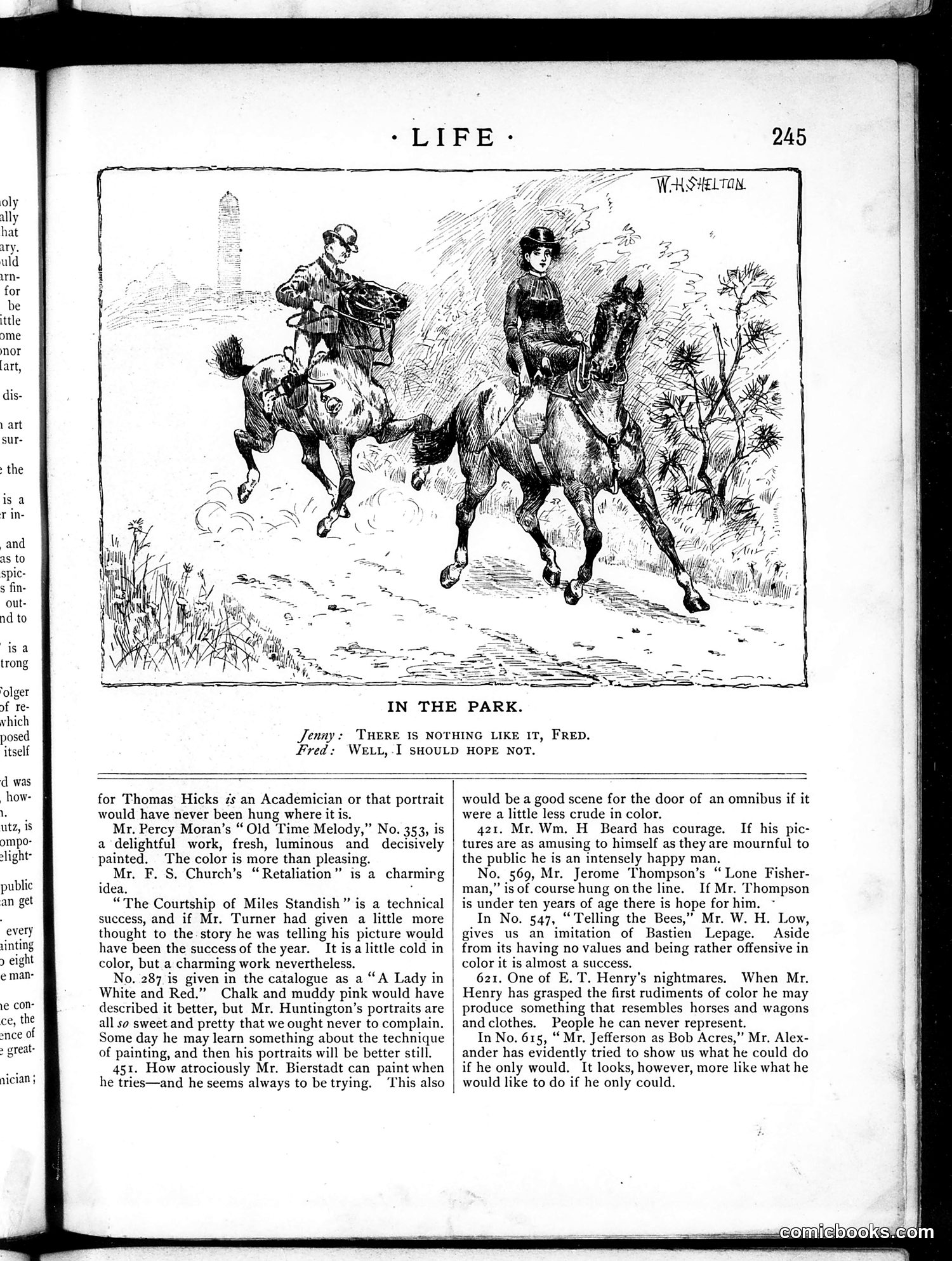
This is a humorous sketch by W.H. Shelton depicting two riders on horseback encountering each other on a country path. The dialogue reads: **Jenny:** "There is nothing like it, Fred." **Fred:** "Well, I should hope not." The joke appears to be a mild innuendo about courtship or romance—the female rider (Jenny) is enthusiastically praising the experience of riding together, while the male rider's response suggests he hopes such intimate moments remain exclusive to them. The accompanying text below discusses various portrait painters and their techniques, unrelated to the cartoon. This represents typical turn-of-the-century *Life* magazine humor: genteel, mildly suggestive comedy aimed at educated urban readers, relying on social situations and restrained double entendre rather than crude jokes.
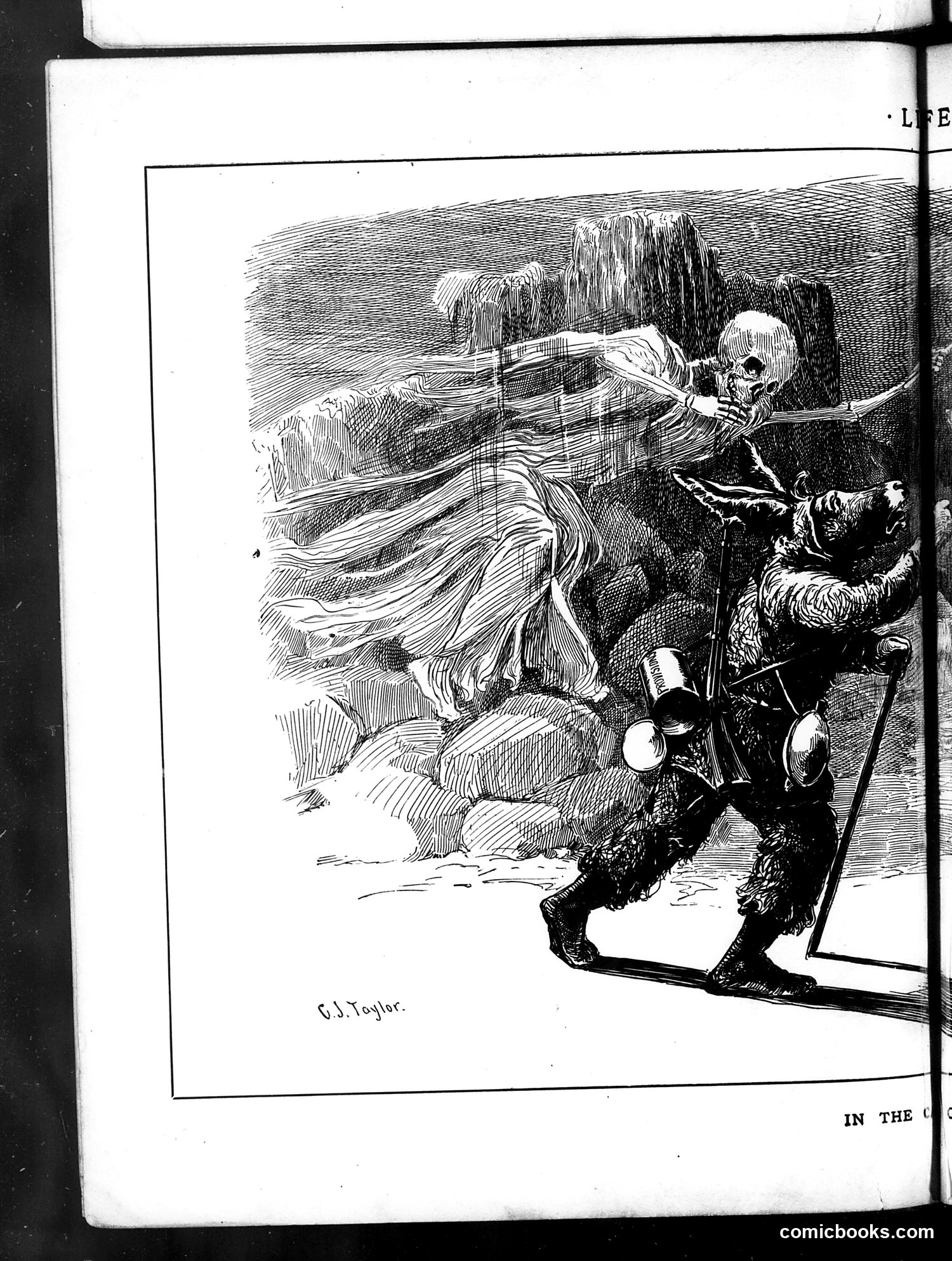
This is a skeleton figure playing a violin while standing on what appears to be a cliff or precipice overlooking a landscape. The skeleton is dressed in tattered clothing and appears emaciated or death-like. The artist's signature reads "G.J. Taylor." The caption at the bottom reads "IN THE U[...]" (text cut off). This appears to be a memento mori or "death and music" themed satirical illustration, likely commentary on the futility of artistic pursuits or possibly social commentary about poverty and hardship. The skeleton musician could represent either the death of artistic culture, the struggles of impoverished artists, or more broadly, humanity's mortality rendered absurd through the juxtaposition of violin-playing with skeletal death imagery. Without the complete caption, the specific political or social target remains unclear.
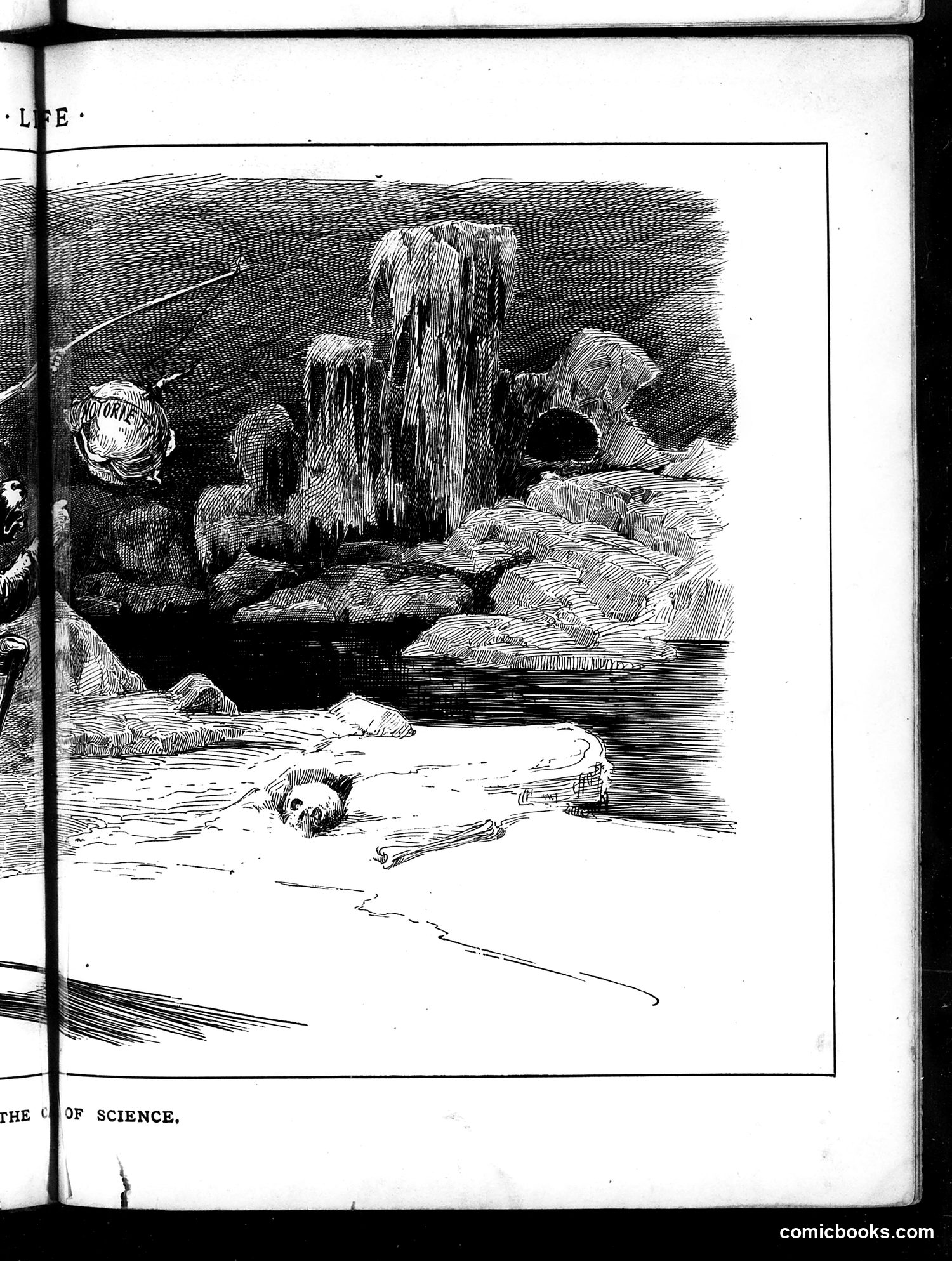
This appears to be an illustration from *Life* magazine's "The Cult of Science" section (visible at bottom). The engraving depicts what seems to be a geyser or natural hot spring erupting, with several figures observing it from nearby rocks. The style is characteristic of 19th-century satirical woodcut illustrations. Without clearer OCR text or additional context on the page, I cannot definitively identify which specific scientific phenomenon or public figures are being satirized here. The cartoon likely mocks either: contemporary scientific fascination with natural wonders, tourist behavior around geological attractions, or possibly scientific pretension. The exact satirical target remains unclear from the image alone.
This page contains three distinct satirical pieces: **"Seasodable"** (left): A humorous poem mocking tourists who visit popular destinations at the "wrong" season, suggesting one should avoid Bay's until June despite poets' claims otherwise. **"A Touch of Puritanism"** (bottom left): Life ridicules the Society for the Prevention of Crime for complaining about *flower sellers* on Fifth Avenue and Broadway—particularly pretty female vendors—claiming flowers are "vice-provoking." The satire targets excessive Puritan moralism: the magazine mocks the idea that flowers pose a genuine moral threat to public virtue, suggesting the society confuses minor propriety issues with actual crime. **"Two-For-Myself-and-One-For-You's Vacation Excursions"** (right): A mock advertisement for luxury train travel with absurdly specific amenities (private berths, clergy with corkscrews), satirizing over-elaborate tourist packages and their pretentious marketing language. The page ridicules American prudishness, tourist culture, and sanctimonious reformers of the period.
This page satirizes a transcontinental train journey through the American West, mocking both the tour itself and Eastern attitudes toward frontier regions. The text presents a mock travel guide describing stops in Kansas, Colorado, New Mexico, and Arizona. The satire works on multiple levels: it stereotypes Native Americans and Mexicans as specimens to observe (with "coupons detached" suggesting they're collectible curiosities), mocks the romanticization of the "Wild West," and ridicules wealthy Easterners seeking exotic experiences. References to "Lydia Thompson and Oscar Wilde" in the Arizona section appear to mock fashionable aesthetic pretensions. The smaller pieces—a definition of "Life Insurance" as "a game at which you can only win with death for a partner," and notes on candidate Rutherford B. Hayes—represent typical magazine content. The overall effect satirizes both the colonial-tourist mentality of wealthy Americans and the exoticization of indigenous peoples and frontier life as entertainment commodities.
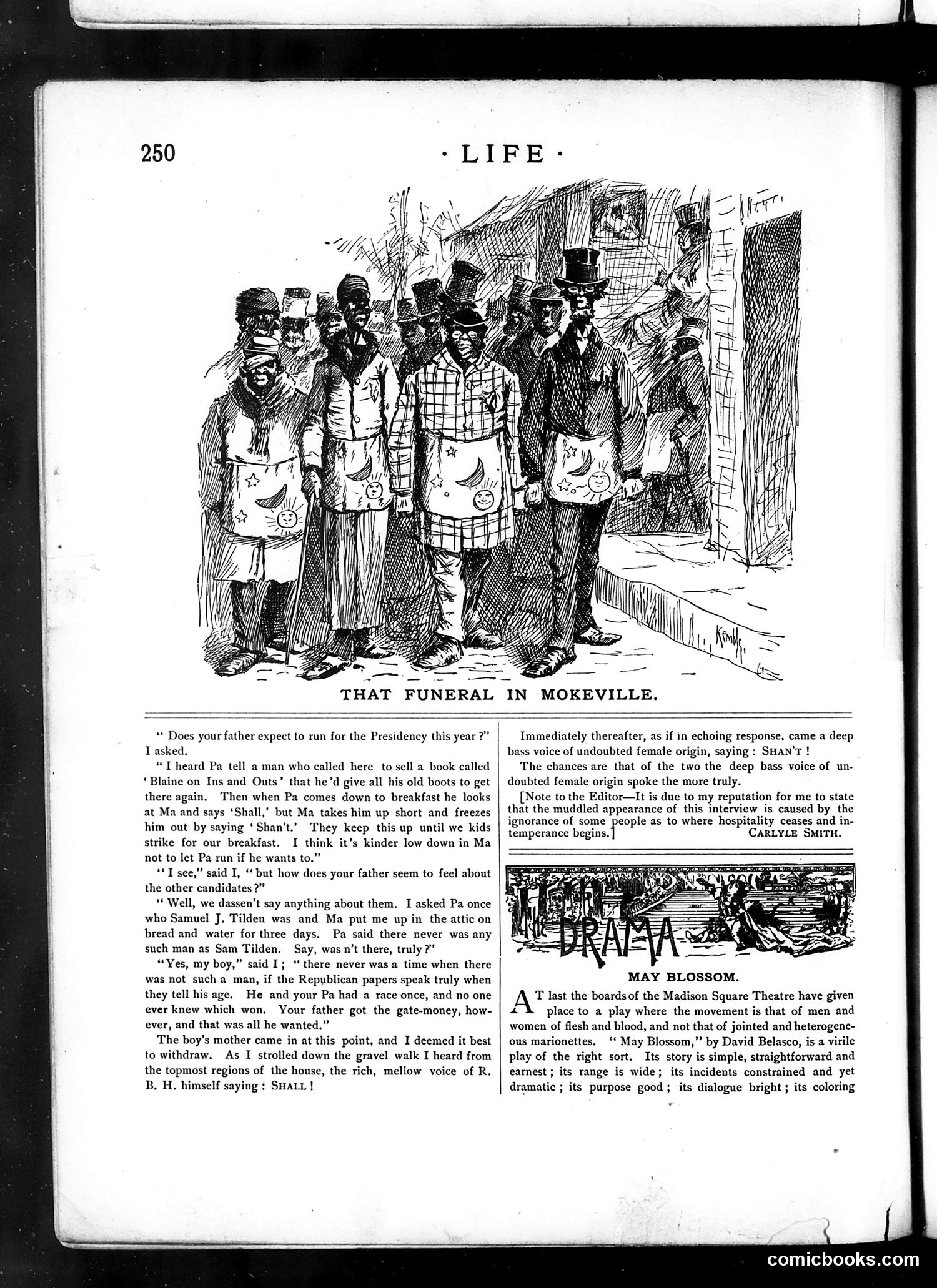
This satirical story mocks a political figure (identified only as "R. B. H.") who aspires to the Presidency. The humor centers on domestic discord: his wife repeatedly vetoes his political ambitions, responding "Shan't!" whenever he says "Shall!" about running for office. The narrative references real 19th-century political rivals—Samuel J. Tilden (Democratic candidate) and James G. Blaine (whose book "Blaine on Ins and Outs" is mentioned). The story suggests the protagonist previously lost a close election to one of these figures but kept the "gate-money" (admission fees), implying he profited regardless of losing. The joke's point: this would-be politician is dominated by his wife at home and cares more about money than genuine political competition. The closing note about "muddled appearance" caused by "ignorance" and "intemperance" adds a layer suggesting the narrator may be unreliable or intoxicated—further satirizing the era's political culture.
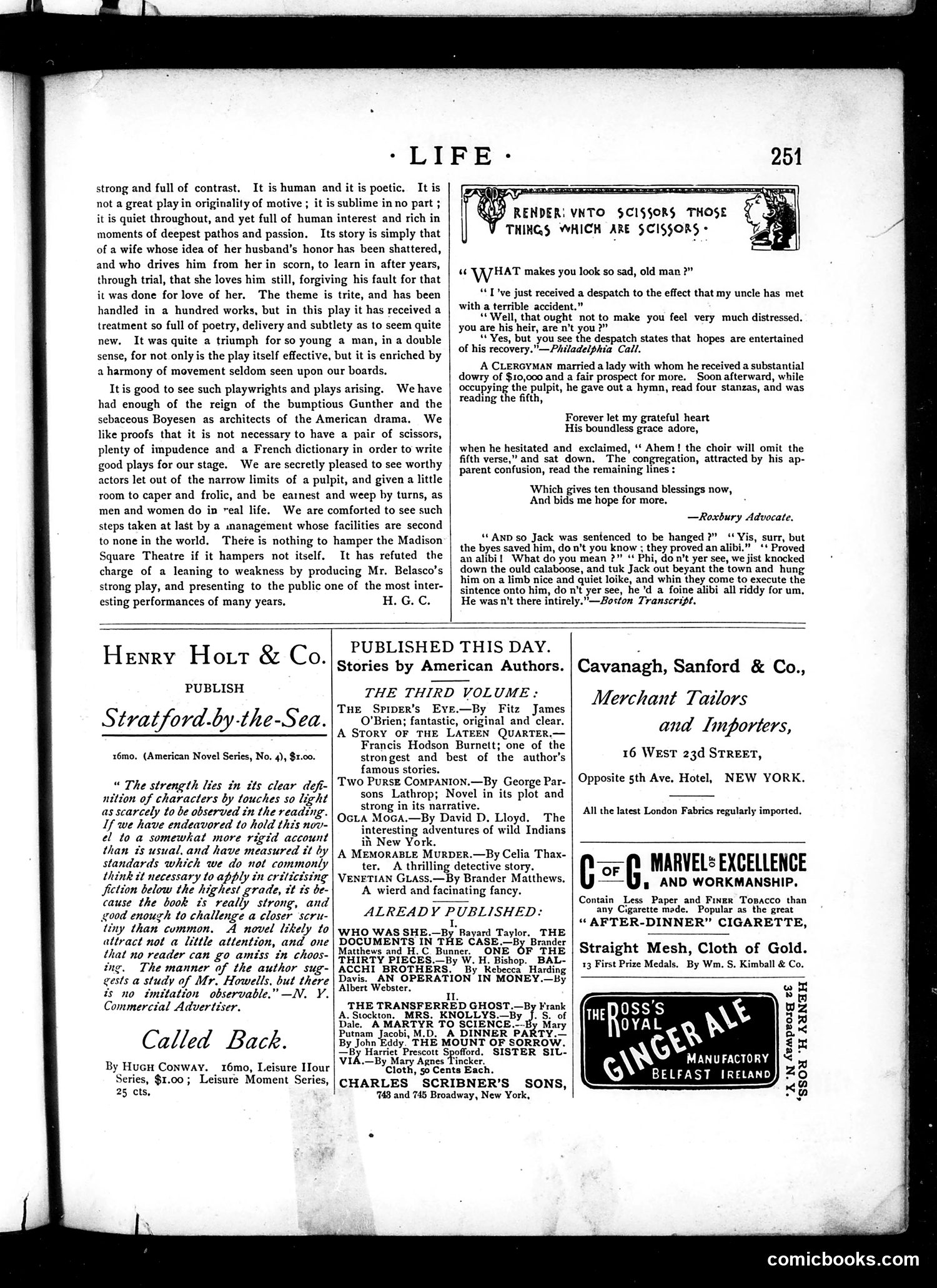
This page is primarily **advertising and literary notices** rather than political satire. The main content consists of book advertisements and theater reviews from Henry Holt & Co. publishers. The small cartoon at top—"Render unto scissors those things which are scissors"—appears to be a visual pun on the biblical phrase "render unto Caesar," applying it absurdly to scissors. Its satirical point is unclear from the image alone. The three humorous anecdotes below the cartoon use common joke formats of the era: - A dark joke about an heir hoping his uncle dies - A clergyman's awkward hymn moment when verse five mentions the dowry he just received - An Irish-dialect joke about criminals creating an alibi by moving an execution location These reflect period humor styles but contain no specific political references. The page serves primarily as a vehicle for book promotion and light entertainment rather than social commentary.
This page is primarily **advertisements and brief humorous anecdotes** rather than political cartoons. The text includes several short jokes mocking contemporary social types: an item from *Punch* ridiculing Mrs. Floppington's tedious at-home gatherings; a *Commercial Advertiser* piece sarcastically noting female chorus singers' supposedly long lifespans (implying they don't start careers until late in life); and a *Moonshine* anecdote about a parson's grim wordplay on a son lacking "decided bent" (direction/money). A *Wall Street News* item satirizes railroad bureaucracy—executives request bids for massive supplies, then immediately cut worker wages and ration oil by the spoonful, illustrating corporate hypocrisy. The page is dominated by period advertisements for clothing, candy, corsets, hotels, printing ink, and medical remedies. The *Harvard Club* notice recommends Charlemagne Tower as "Overseer," though the significance is unclear without broader context. No major political figures or events are caricatured here.
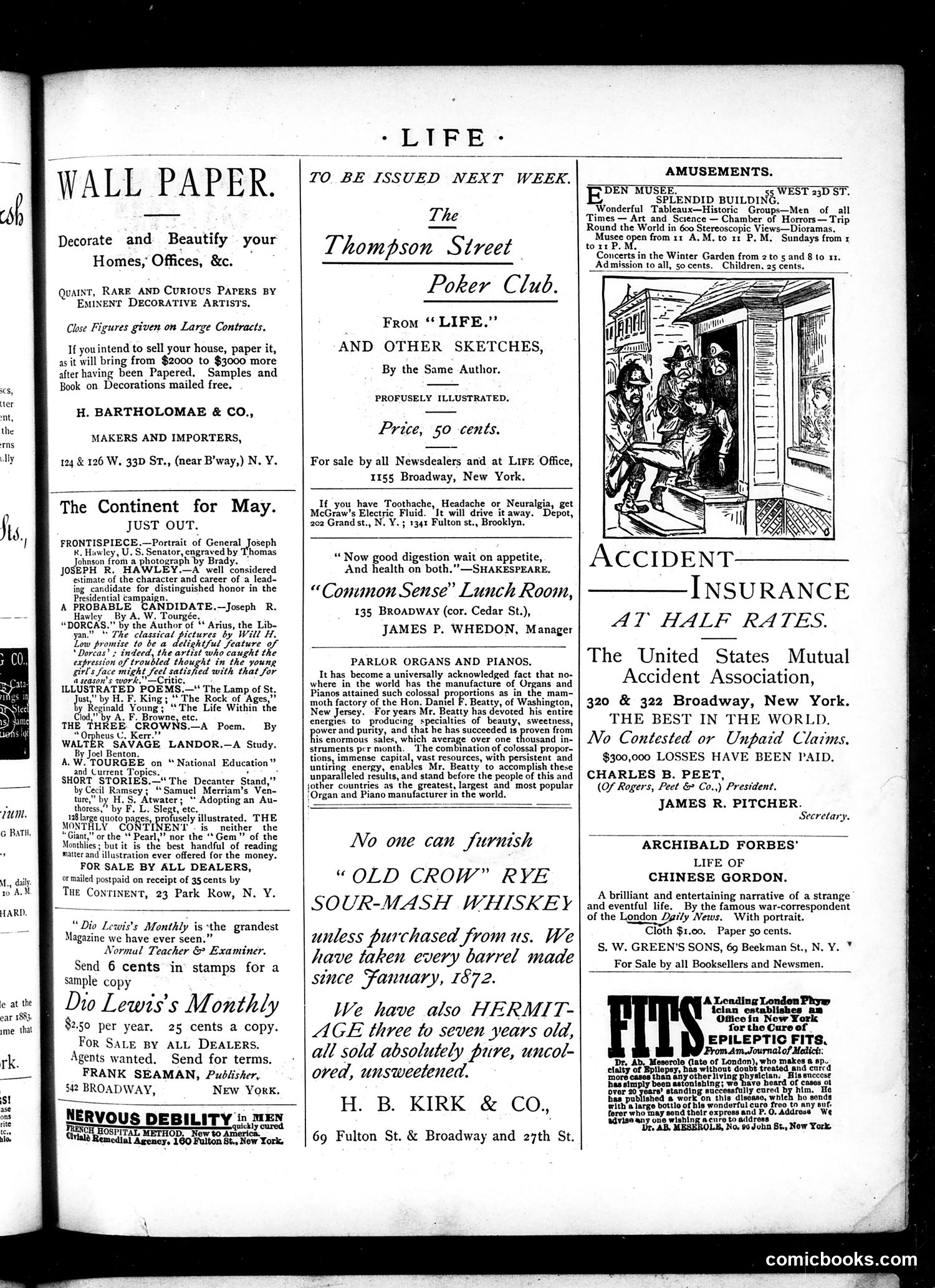
This page is primarily **advertisements and announcements** for an 1880s Life magazine issue. The one visible cartoon image depicts what appears to be an informal gathering of men in a modest interior space—likely illustrating "The Thompson Street Poker Club," a sketch to be published next week. The main content includes ads for wallpaper, organs and pianos (manufactured by Daniel F. Beatty), whiskey, and various magazines and remedies. There's a small illustration promoting an upcoming book, showing men around a table in casual setting, typical of Life's humorous social commentary illustrations of the era. Without clearer details or identified caricatures in the cartoons, I cannot specify particular political or social satire. The page appears to be a typical magazine back page focused on commercial advertising rather than editorial content.
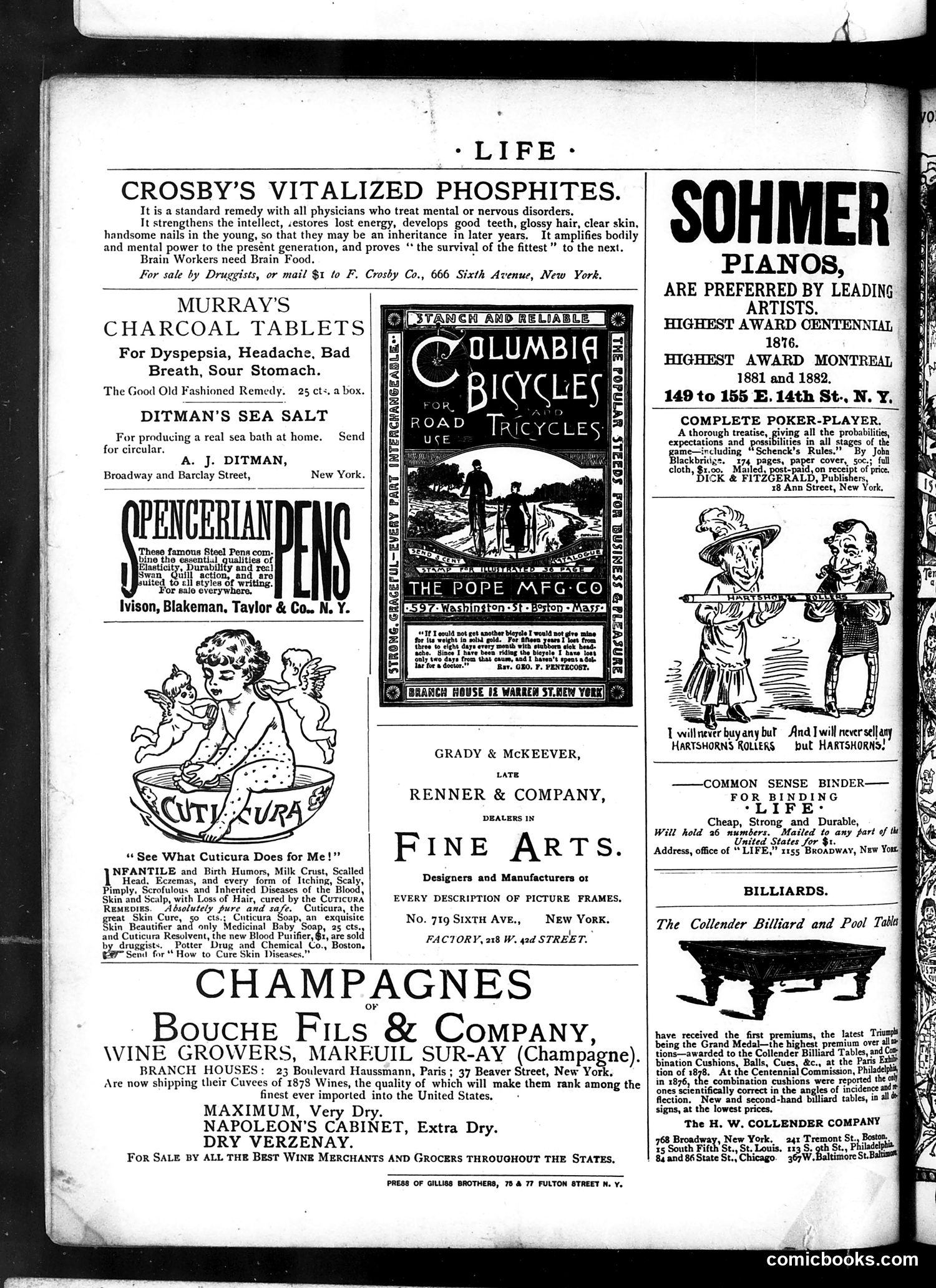
This page is primarily **advertisements** with one small **political cartoon**. The cartoon appears in the upper right, showing two caricatured figures (likely representing political or social figures of the era) arguing about roller skates or similar products, with speech bubbles declaring "I will never buy any but HARTSHORNS ROLLERS" and "And I will never sell any but HARTSHORNS!" The joke is a **mock argument over brand loyalty**—a satire on aggressive marketing and consumer tribalism. Without additional historical context, the specific identities of these caricatures remain unclear, though they appear to represent competing commercial interests or personalities locked in petty dispute. The rest of the page consists of patent medicine advertisements (Crosby's Phosphites, Cuticura), musical instruments (Sohmer Pianos), imported champagne, and other consumer goods typical of 1870s-80s American Life magazine advertising. The page reflects the magazine's business model: satirical editorial content paired with lucrative advertisements.