
Life, 1884-05-01 · page 7 of 16
Life — May 1, 1884 — page 7: what you’re looking at
What you’re looking at
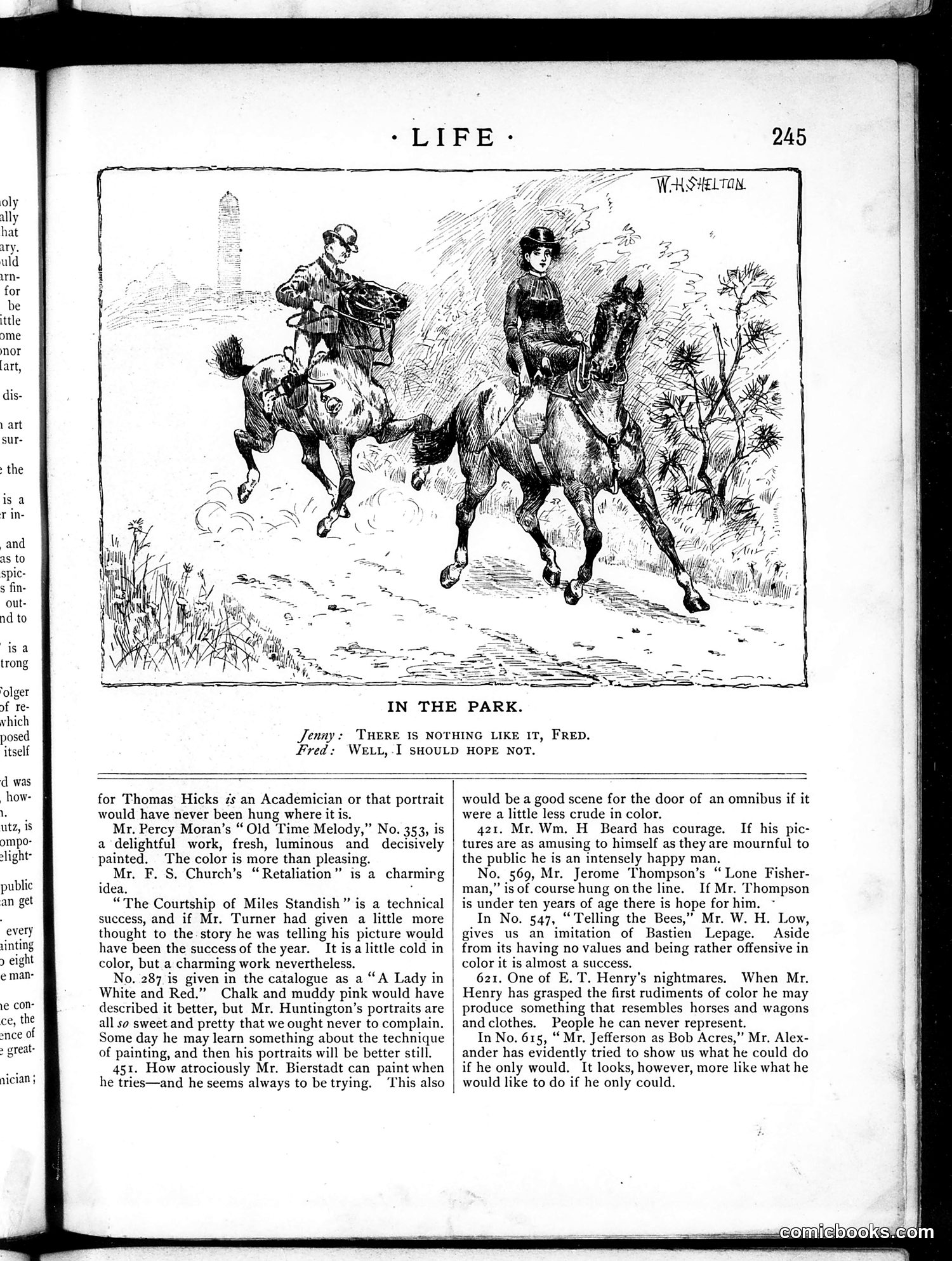
This is a humorous sketch by W.H. Shelton depicting two riders on horseback encountering each other on a country path. The dialogue reads: **Jenny:** "There is nothing like it, Fred." **Fred:** "Well, I should hope not." The joke appears to be a mild innuendo about courtship or romance—the female rider (Jenny) is enthusiastically praising the experience of riding together, while the male rider's response suggests he hopes such intimate moments remain exclusive to them. The accompanying text below discusses various portrait painters and their techniques, unrelated to the cartoon. This represents typical turn-of-the-century *Life* magazine humor: genteel, mildly suggestive comedy aimed at educated urban readers, relying on social situations and restrained double entendre rather than crude jokes.
📄 Transcribed text from this page (OCR, searchable)
Machine-transcribed from the original scan — historical spelling and the odd misread are preserved.
oly lly hat ry. uld im- for be ittle ome nor fart, dis- art sur- : the is a rin and as to spic- s fin- out- nd to isa trong ‘olger of re- vhich posed itself d was _how- l. utz, is ompo- slight public an get every inting > eight e man- e con- ce, the nce of > great: nician ; IN THE PARK. Jenny: THERE IS NOTHING LIKE IT, FRED. Fred: WELL,-I SHOULD HOPE NOT. for Thomas Hicks ¢s an Academician or that portrait would have never been hung where it is. Mr. Percy Moran’s “Old Time Melody,” No. 353, is a delightful work, fresh, luminous and decisively painted. The color is more than pleasing. Mr. F. S. Church’s “Retaliation” is a charmirg idea. . “The Courtship of Miles Standish” is a technical | success, and if Mr. Turner had given a little more thought to the. story he was telling his picture would have been the success of the year. It isa little cold in color, but a charming work nevertheless. No. 287 is given in the catalogue as a “A Lady in White and Red.” Chalk and muddy pink would have described it better, but Mr. Huntington’s portraits are all so sweet and pretty that we ought never to complain. Some day he may learn something about the technique of painting, and then his portraits will be better still. 451. How atrociously Mr. Bierstadt can paint when he tries—and he seems always to be trying. his also would be a good scene for the door of an omnibus if it were a little less crude in color. 421. Mr. Wm. H Beard has courage. If his pic- tures are as amusing to himself as they are mournful to the public he is an intensely happy man. No. 569, Mr. Jerome Thompson’s “Lone Fisher- man,” is of course hung on the line. If Mr. Thompson is under ten years of age there is hope for him. In No. 547, “Telling the Bees,” Mr. W. H. Low, gives us an imitation of Bastien Lepage. Aside from its having no values and being rather offensive in color it is almost a success. 621. One of E. T. Henry's nightmares. When Mr. Henry has grasped the first rudiments of color he may | produce something that resembles horses and wagons and clothes. People he can never represent. In No. 615, “ Mr. Jefferson as Bob Acres,” Mr. Alex- ander has evidently tried to show us what he could do if he only would. It looks, however, more like what he would like to do if he only could.