
Life, 1884-05-01 · page 5 of 16
Life — May 1, 1884 — page 5: what you’re looking at
What you’re looking at
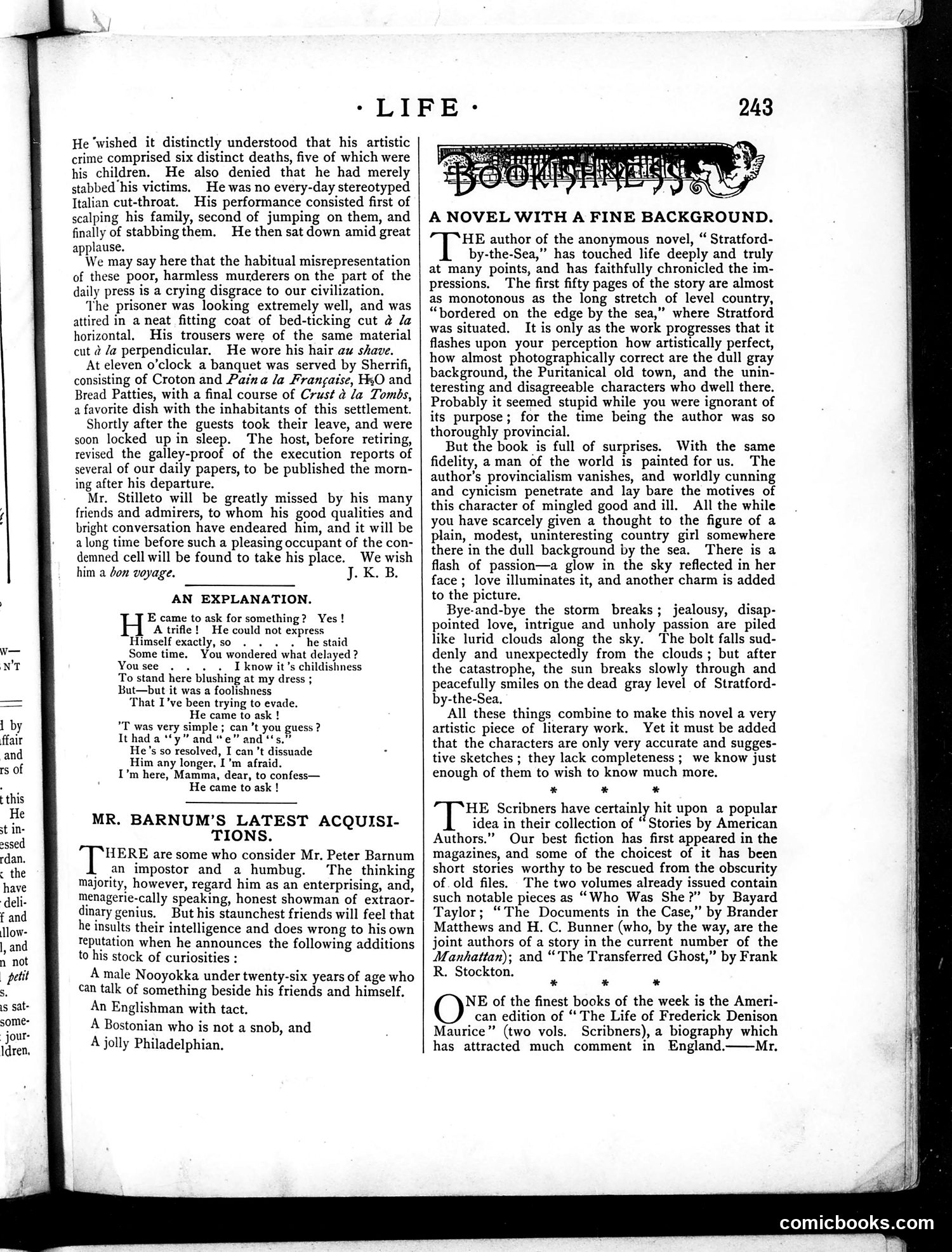
This page contains **book reviews and literary criticism**, not political cartoons. The header illustration shows a small figure reading, introducing three review sections: 1. **"Bookshelf"** - Reviews an anonymous novel "Stratford-by-the-Sea," praising its artistic depiction of provincial English life and character development. 2. **"An Explanation"** - A humorous poem addressing someone's tardiness or emotional evasion, likely satirizing social pretense. 3. **"Mr. Barnum's Latest Acquisitions"** - Critiques P.T. Barnum as a charlatan, satirizing his reputation for collecting curiosities and exaggeration. Lists absurd "acquisitions" (a Novoocka, Englishman, Bostonian, Philadelphian) as mockery. 4. Brief notices of other notable books being published. The page is primarily **literary content with gentle social satire** rather than political commentary.
📄 Transcribed text from this page (OCR, searchable)
Machine-transcribed from the original scan — historical spelling and the odd misread are preserved.
rs Of t this st in- essed rdan. < the have ‘deli- f and ow- |, and n not petit is sat some- jour- Idren. - LIFE: 243 He ‘wished it distinctly understood that his artistic crime comprised six distinct deaths, five of which were his children. He also denied that he had merely stabbed ‘his victims. He was no every-day stereotyped Italian cut-throat. His performance consisted first of scalping his family, second of jumping on them, and finally of stabbing them. He then sat down amid great applause. We may say here that the habitual misrepresentation of these poor, harmless murderers on the part of the daily press is a crying disgrace to our civilization. The prisoner was looking extremely well, and was attired in a neat fitting coat of bed-ticking cut @ /@ horizontal. His trousers were of the same material cut @ Za perpendicular. He wore his hair au shave. At eleven o’clock a banquet was served by Sherrifi, consisting of Croton and Paina la Frangaise, HxO and Bread Patties, with a final course of Crust a la Tombs, a favorite dish with the inhabitants of this settlement. Shortly after the guests took their leave, and were soon locked up in sleep. The host, before retiring, revised the galley-proof of the execution reports of several of our daily papers, to be published the morn- ing after his departure. Mr. Stilleto will be greatly missed by his many friends and admirers, to whom his good qualities and bright conversation have endeared him, and it will be along time before such a pleasing occupant of the con- demned cell will be found to take his place. We wish him a bon voyage. . K. BL AN EXPLANATION. E came to ask for something? Yes! A trifle! He could not express Himself exactly,so . . . . hestaid Some time. You wondered what delayed? You see . ._ I know it’s childishness To stand here blushing at my dress ; But—but it was a foolishness That I’ve been trying to evade. He came to ask ! "T was very simple ; can ’t you guess ? It had a ty” and “e” and ‘‘s.” He's so resolved, I can ’t dissuade Him any longer, I’m afraid. I’m here, Mamma, dear, to confess— He came to ask ! MR. BARNUM’S LATEST ACQUISI- TIONS. HERE are some who consider Mr. Peter Barnum | an impostor and a humbug. ‘The thinking Majority, however, regard him as an enterprising, and, menagerie-cally speaking, honest showman of extraor- dinary genius. But his staunchest friends will feel that he insults their intelligence and does wrong to his own Teputation when he announces the following additions to his stock of curiosities : A male Nooyokka under twenty-six years of age who can talk of something beside his friends and himself. An Englishman with tact. A Bostonian who is not a snob, and A jolly Philadelphian. A NOVEL WITH A FINE BACKGROUND. HE author of the anonymous novel, “ Stratford- by-the-Sea,” has touched life deeply and truly at many points, and has faithfully chronicled the im- pressions. The first fifty pages of the story are almost as monotonous as the long stretch of level country, “bordered on the edge by the sea,” where Stratford was situated. It is only as the work progresses that it flashes upon your perception how artistically perfect, how almost photographically correct are the dull gray background, the Puritanical old town, and the unin- teresting and disagreeable characters who dwell there. Probably it seemed stupid while you were ignorant of its purpose; for the time being the author was so thoroughly provincial. But the book is full of surprises. With the same fidelity, a man of the world is painted for us. The author’s provincialism vanishes, and worldly cunning and cynicism penetrate and lay bare the motives of this character of mingled good and ill. All the while you have scarcely given a thought to the figure of a plain, modest, uninteresting country girl somewhere there in the dull background by the sea. There is a flash of passion—a glow in the sky reflected in her face ; love illuminates it, and another charm is added to the picture. Bye-and-bye the storm breaks; jealousy, disap- pointed love, intrigue and unholy passion are piled like lurid clouds along the sky. The bolt falls sud- denly and unexpectedly from the clouds ; but after the catastrophe, the sun breaks slowly through and peacefully smiles on the dead gray level of Stratford- by-the-Sea. All these things combine to make this novel a very artistic piece of literary work. Yet it must be added that the characters are only very accurate and sugges- tive sketches ; they lack completeness ; we know just enough of them to wish to know much more. * * * HE Scribners have certainly hit upon a popular idea in their collection of “Stories by American Authors.” Our best fiction has first appeared in the magazines, and some of the choicest of it has been short stories worthy to be rescued from the obscurity of. old files. The two volumes already issued contain such notable pieces as “Who Was She?” by Bayard Taylor; “The Documents in the Case,” by Brander Matthews and H. C. Bunner (who, by the way, are the joint authors of a story in the current number of the Manhattan); and “The Transferred Ghost,” by Frank R. Stockton. * * NE of the finest books of the week is the Ameri- can edition of “ The Life of Frederick Denison Maurice” (two vols. Scribners), a biography which has attracted much comment in England.—Mr. comicbooks.com