
Life, 1884-05-01 · page 6 of 16
Life — May 1, 1884 — page 6: what you’re looking at
What you’re looking at
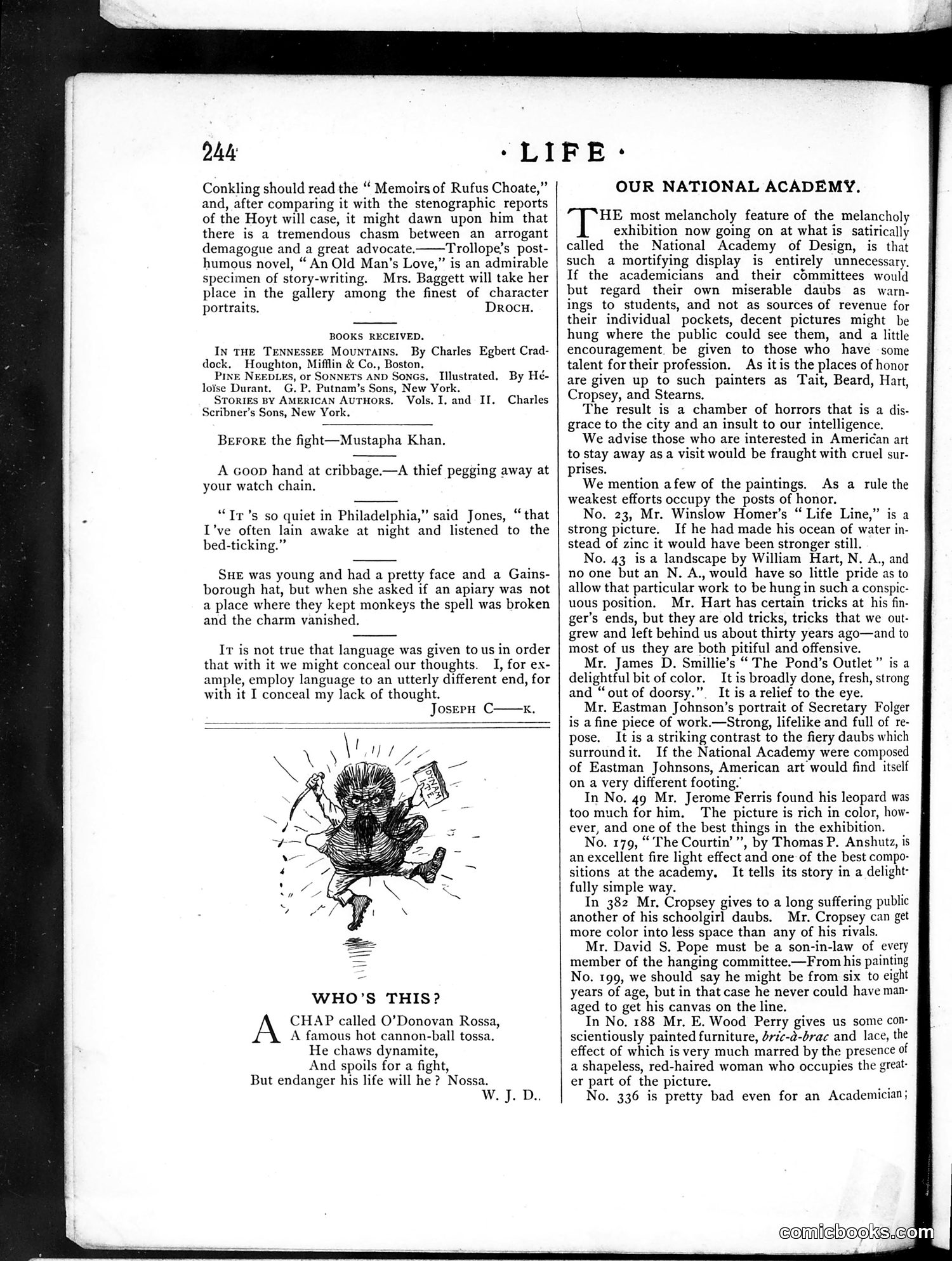
This untitled cartoon depicts a figure in chaotic motion, surrounded by radiating lines suggesting explosive energy or impact. The accompanying poem identifies him as "O'Donovan Rossa," described as "a famous hot cannon-ball tossa" who "chaws dynamite" and causes trouble. O'Donovan Rossa (1831-1915) was an Irish republican activist and Fenian leader known for advocating violent resistance against British rule. The cartoon satirizes him as a dangerous, volatile revolutionary—literally portrayed as a human cannon-ball or explosive device. The joke plays on both his reputation for radical action and his name's phonetic resemblance to "toss," mocking Irish nationalist militancy through crude caricature and violent imagery typical of 19th-century American satirical magazines.
📄 Transcribed text from this page (OCR, searchable)
Machine-transcribed from the original scan — historical spelling and the odd misread are preserved.
244 Conkling should read the “ Memoirs of Rufus Choate,” and, after comparing it with the stenographic reports of the Hoyt will case, it might dawn upon him that there is a tremendous chasm between an arrogant demagogue and a great advocate. Trollope’s post- humous novel, “ An Old Man's Love,” is an admirable specimen of story-writing. Mrs. Baggett will take her place in the gallery among the finest of character portraits. Drocu. BOOKS RECEIVED. In THE TENNESSEE Mountains. By Charles Egbert Crad- dock. Houghton, Mifflin & Co., Boston. Pine NEEDLES, or SONNETS AND Soncs. Illustrated. By Hé- loise Durant. G. P. Putnam’s Sons, New York. STorIgs BY AMERICAN AuTHoRs. Vols. I, and II. Scribner’s Sons, New York, Charles Berore the fight—Mustapha Khan. A coop hand at cribbage.—A thief pegging away at your watch chain. “Tr’s so quiet in Philadelphia,” said Jones, “that I've often lain awake at night and listened to the bed-ticking.” SHE was young and had a pretty face and a Gains- borough hat, but when she asked if an apiary was not a place where they kept monkeys the spell was broken and the charm vanished. Ir is not true that language was given tous in order that with it we might conceal our thoughts. I, for ex- ample, employ language to an utterly different end, for with it I conceal my lack of thought. JosrpH C——x. WHO’S THIS? CHAP called O’Donovan Rossa, A famous hot cannon-ball tossa. He chaws dynamite, And spoils for a fight, But endanger his life will he ? Nossa. W. J. D.. “LIFE: OUR NATIONAL ACADEMY. Te most melancholy feature of the melancholy exhibition now going on at what is satirically called the National Academy of Design, is that such a mortifying display is entirely unnecessary, If the academicians and their cdmmittees would but regard their own miserable daubs as warn- ings to students, and not as sources of revenue for their individual pockets, decent pictures might be hung where the public could see them, and a little encouragement. be given to those who have some talent for their profession. As itis the places of honor are given up to such painters as Tait, Beard, Hart, Cropsey, and Stearns. The result is a chamber of horrors that is a dis- grace to the city and an insult to our intelligence. We advise those who are interested in American art to stay away asa visit would be fraught with cruel sur- prises. We mention afew of the paintings. As a rule the weakest efforts occupy the posts of honor. No. 23, Mr. Winslow Homer’s “ Life Line,” is a strong picture. If he had made his ocean of water in- stead of zinc it would have been stronger still. No. 43 is a landscape by William Hart, N. A., and no one but an N. A., would have so little pride as to allow that particular work to be hung in such a conspic- uous position. Mr. Hart has certain tricks at his fin- ger’s ends, but they are old tricks, tricks that we out- grew and left behind us about thirty years ago—and to most of us they are both pitiful and offensive. Mr. James D. Smillie’s “The Pond’s Outlet” is a delightful bit of color. It is broadly done, fresh, strong and “out of doorsy.”. It is a relief to the eye. Mr. Eastman Johnson’s portrait of Secretary Folger is a fine piece of work.—Strong, lifelike and full of re- pose. It is a striking contrast to the fiery daubs which surround it. If the National Academy were composed of Eastman Johnsons, American art would find itself on a very different footing.” In No. 49 Mr. Jerome Ferris found his leopard was too much for him, The picture is rich in color, how- ever, and one of the best things in the exhibition. _ No. 179, “ The Courtin’”’, by Thomas P. Anshutz, is an excellent fire light effect and one of the best compo- sitions at the academy. It tells its story in a delight: fully simple way. : In 382 Mr. Cropsey gives to a long suffering public another of his schoolgirl daubs. Mr. Cropsey can get more color into less space than any of his rivals. Mr. David S. Pope must be a son-in-law of every member of the hanging committee—From his painting No. 199, we should say he might be from six to eight years of age, but in that case he never could have man- aged to get his canvas on the line. In No. 188 Mr. E. Wood Perry gives us some con- scientiously painted furniture, bric-d-brac and lace, the effect of which is very much marred by the presence of a shapeless, red-haired woman who occupies the great- er part of the picture. . No. 336 is pretty bad even for an Academician; comichooks.