
A complete issue · 16 pages · 1884
Life — April 10, 1884
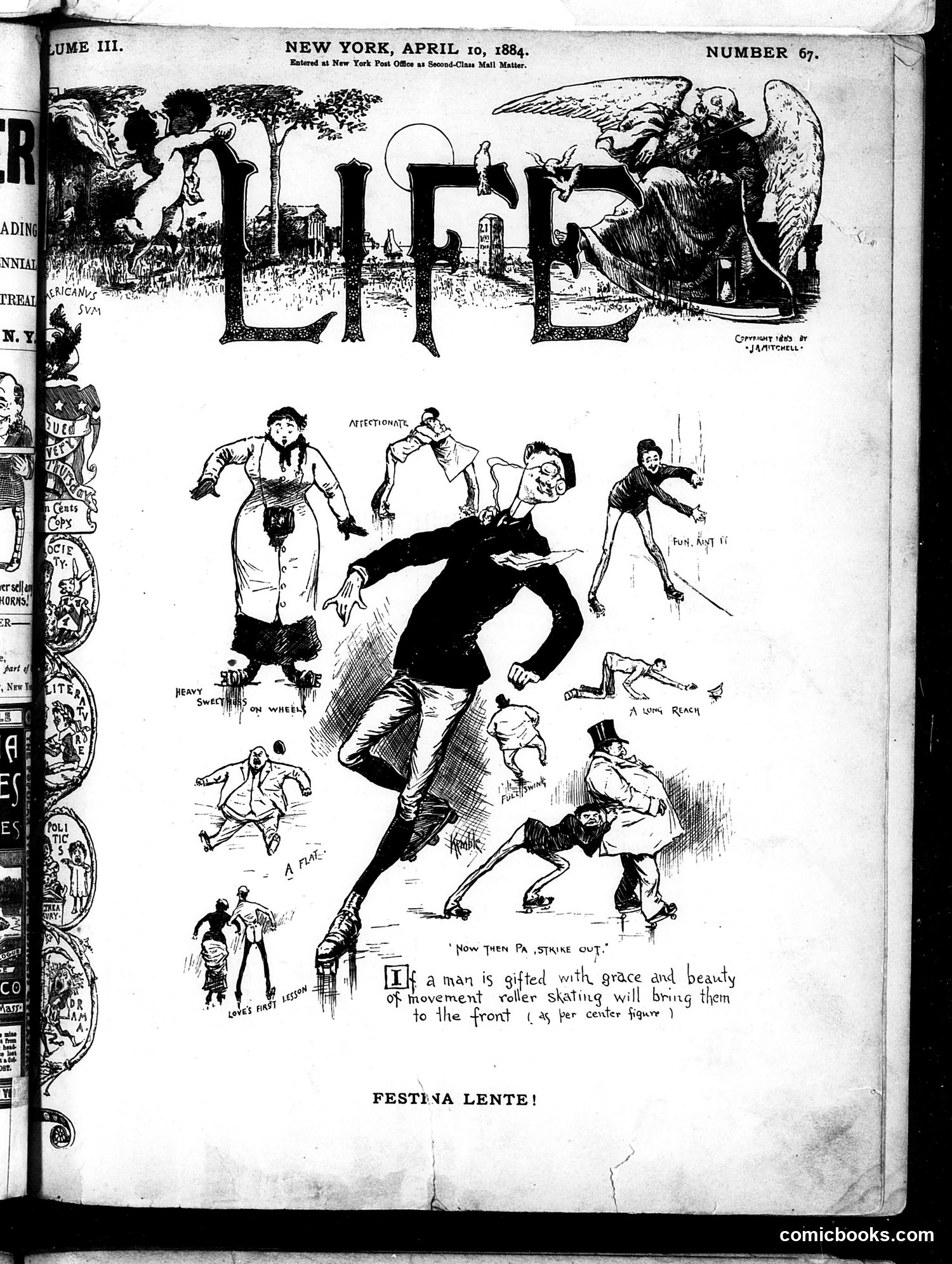
This page satirizes the roller skating craze of the 1880s. The central illustration shows various people attempting roller skating with comical results—falling, flailing, and losing control. The accompanying text reads: "If a man is gifted with grace and beauty of movement roller skating will bring them to the front (as center figure)." The joke mocks the pretension that roller skating demonstrates elegance or skill. Instead, the cartoon depicts it as an undignified, accident-prone activity where most participants end up sprawling on the ground. The "center figure" (shown horizontally mid-fall) is presented as the supposed ideal—suggesting the satire is that roller skating makes everyone look ridiculous regardless of claimed grace or ability. This reflects contemporary anxiety about this new recreational fad.
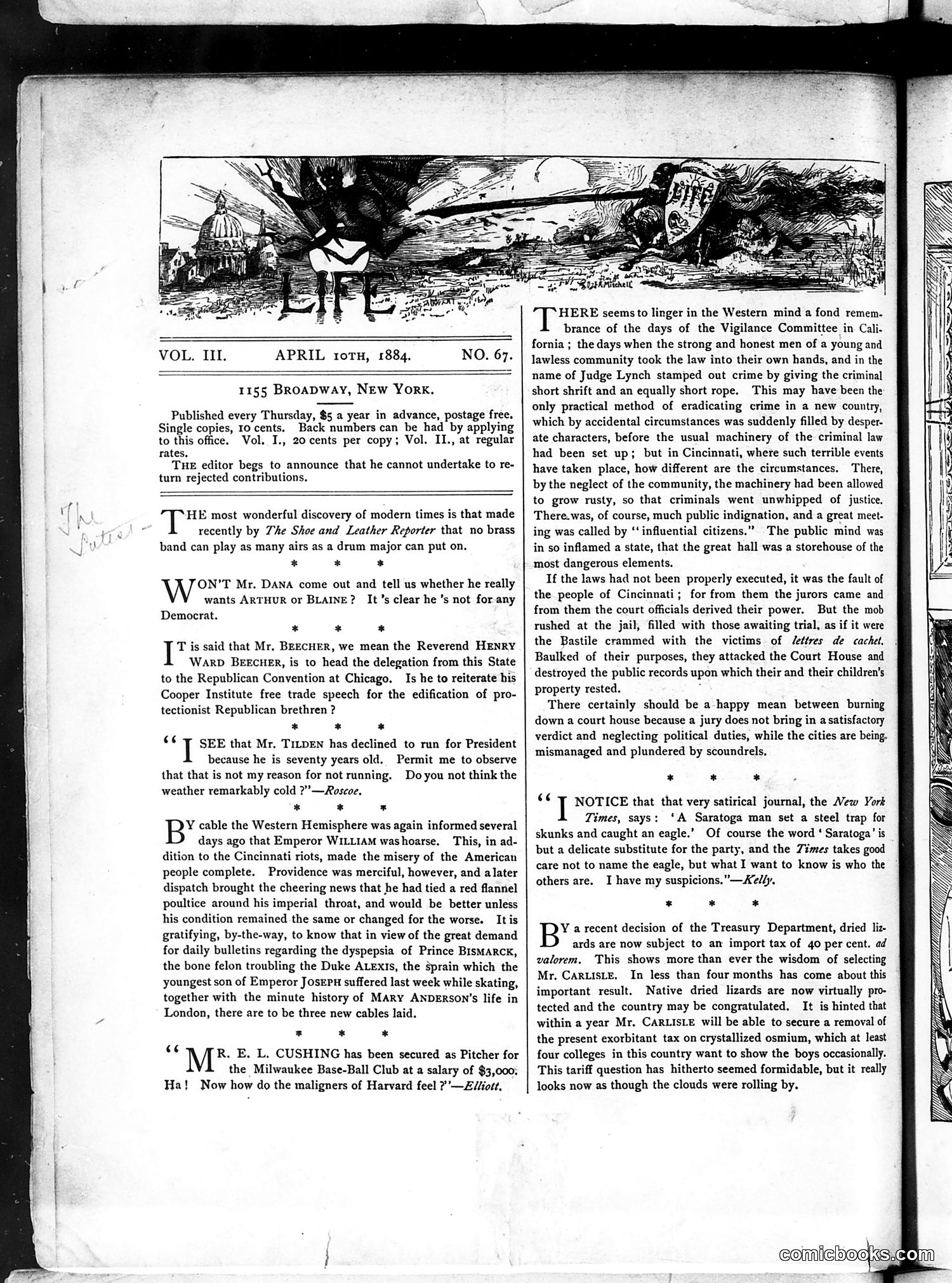
The page consists of brief satirical paragraphs rather than illustrated cartoons. The headpiece shows a classical figure, but the content focuses on written jabs at contemporary politics and personalities. Key targets include: - **Arthur or Blaine**: A jab questioning whether someone truly wants either as a Democratic candidate, implying both are objectionable. - **Rev. Henry Ward Beecher**: Criticized for allegedly supporting Republican protective tariffs despite claims of moral principle. - **Tilden**: Mocked for declining a presidential run at age seventy, with a weather-related pun. The pieces mock political hypocrisy, inconsistency, and aging politicians. The tone is light but pointed—typical of *Life*'s role as a satirical commentary on American politics during the Gilded Age.
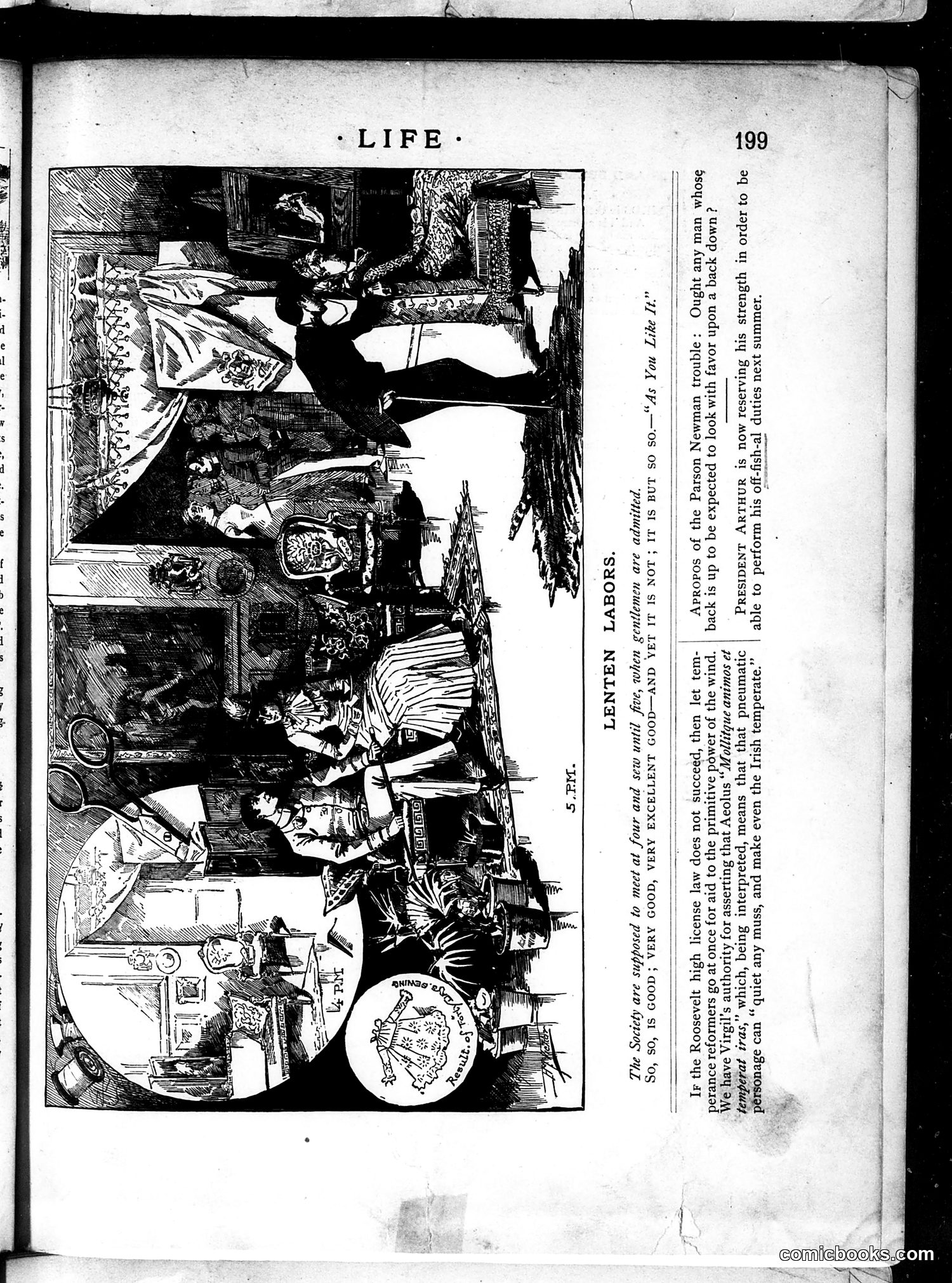
This political cartoon satirizes someone's arduous work or struggle (the title "Leyten Labors" appears to reference classical mythology's Herculean tasks). The image depicts a figure engaged in strenuous activity within an interior domestic scene, surrounded by various household objects and furnishings rendered in detailed cross-hatching style typical of early-to-mid 20th century satirical illustration. The accompanying text mentions "The Society or supplied in a nest where it is very eagerly consumed" and references "a Rooseveltian horse" and "primordial" concerns, suggesting this critiques either labor practices, domestic burden, or political figures of that era. Without clearer OCR of the full caption, the specific political target remains somewhat unclear, though the domestic setting and labor emphasis suggest commentary on either women's work or class-based labor struggles.
This page contains literary commentary rather than political cartoons. The left column features "Watts and Select Hymns," Victorian-era poems about nature and morality. The right column critiques the London *Standard* newspaper's dismissive comments about English art, arguing that English artists lack international reputation compared to German, French, and Danish counterparts. The writer sarcastically suggests that public dinners or "Artists' Balls" might improve the Academy's standing, and jokes that wealthy Britons visiting Rome would boost English prestige more effectively than French rivals. The "Bookman's Corner" section reviews "Bethesda," a high-pressure romance novel by Barbara Elbon, mocking its overwrought emotional language and melodramatic French diplomat protagonist.
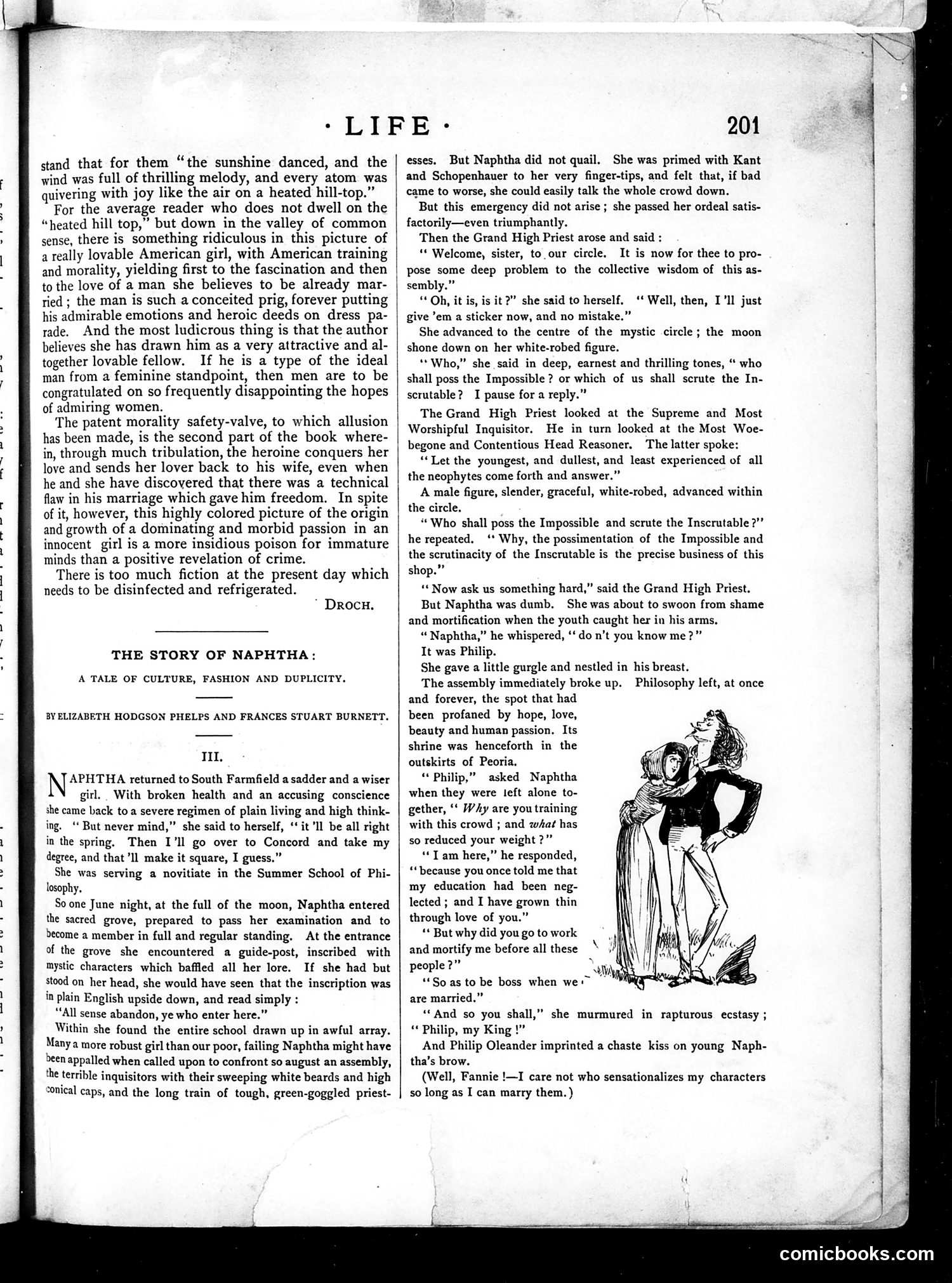
This page contains a serialized short story by Elizabeth Hodson Phelps and Frances Stuart Burnett titled "The Story of Naphtha: A Tale of Culture, Fashion and Duplicity." The illustration shows a young woman in classical dress being embraced by a man, accompanying narrative about a character named Naphtha who has returned to South Farmfield "sadder and wiser" and now works as a novitiate in a Summer School of Philosophy. The story appears to satirize intellectual pretensions and romantic entanglements among educated women of the era. Rather than political satire, this represents *Life* magazine's literary fiction content—the publication combined social commentary with serialized stories targeting educated middle-class readers interested in culture and romance narratives.
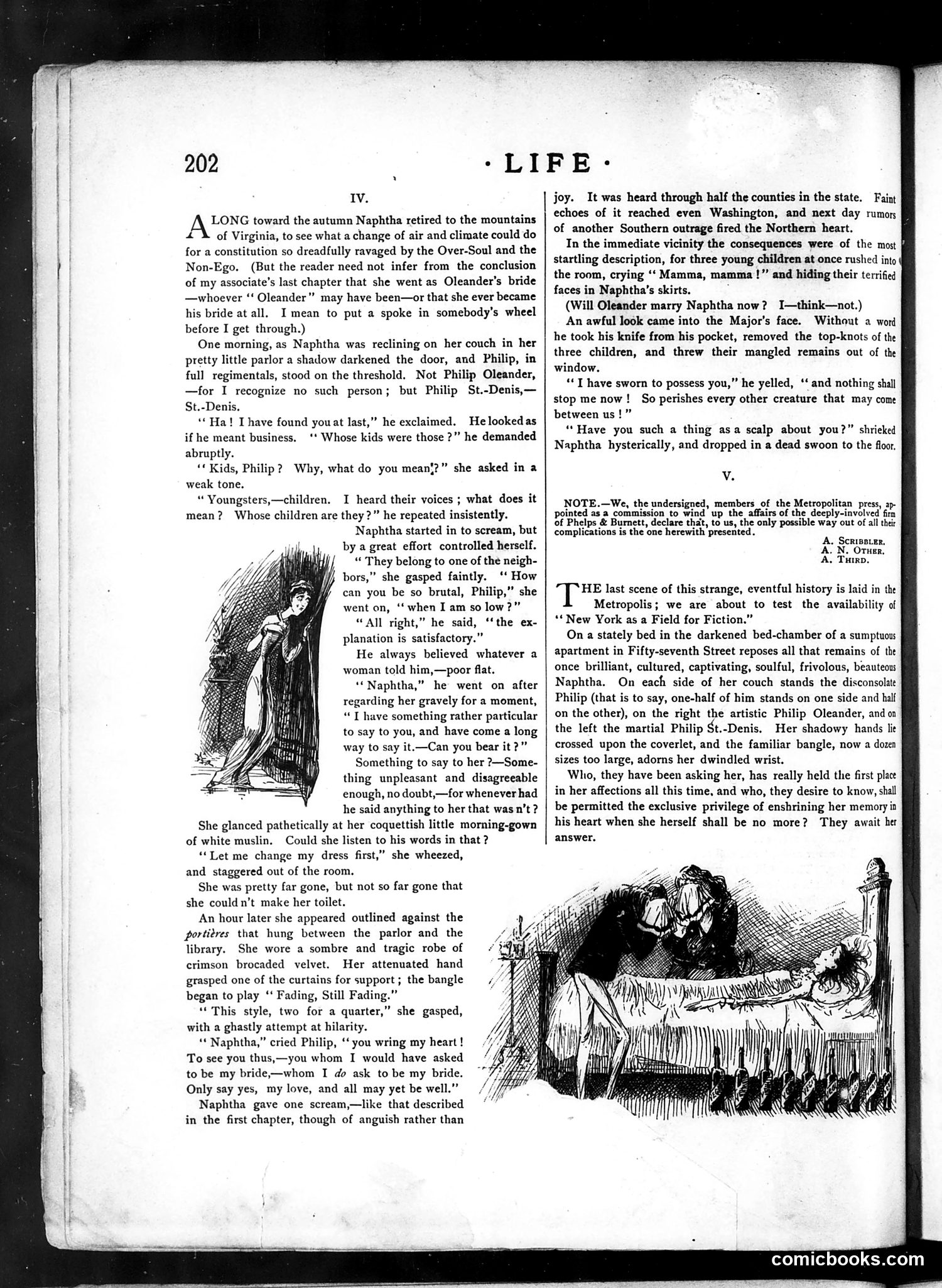
This page contains serialized fiction rather than political satire or comics. The narrative concerns characters named Naphtha, Philip, and Philip St.-Denis in what appears to be a domestic drama set in New York. The two illustrations are literary scene-setting: the upper sketch shows a woman in period dress at a doorway or threshold, while the lower illustration depicts figures on a bed, illustrating emotional moments from the narrative. The text focuses on romantic tension and conflict between characters, with dialogue about marriage proposals and jealousy. There is no apparent political commentary, social satire, or caricature work on this page—it is straightforward serialized fiction typical of Life magazine's literary content from this era.
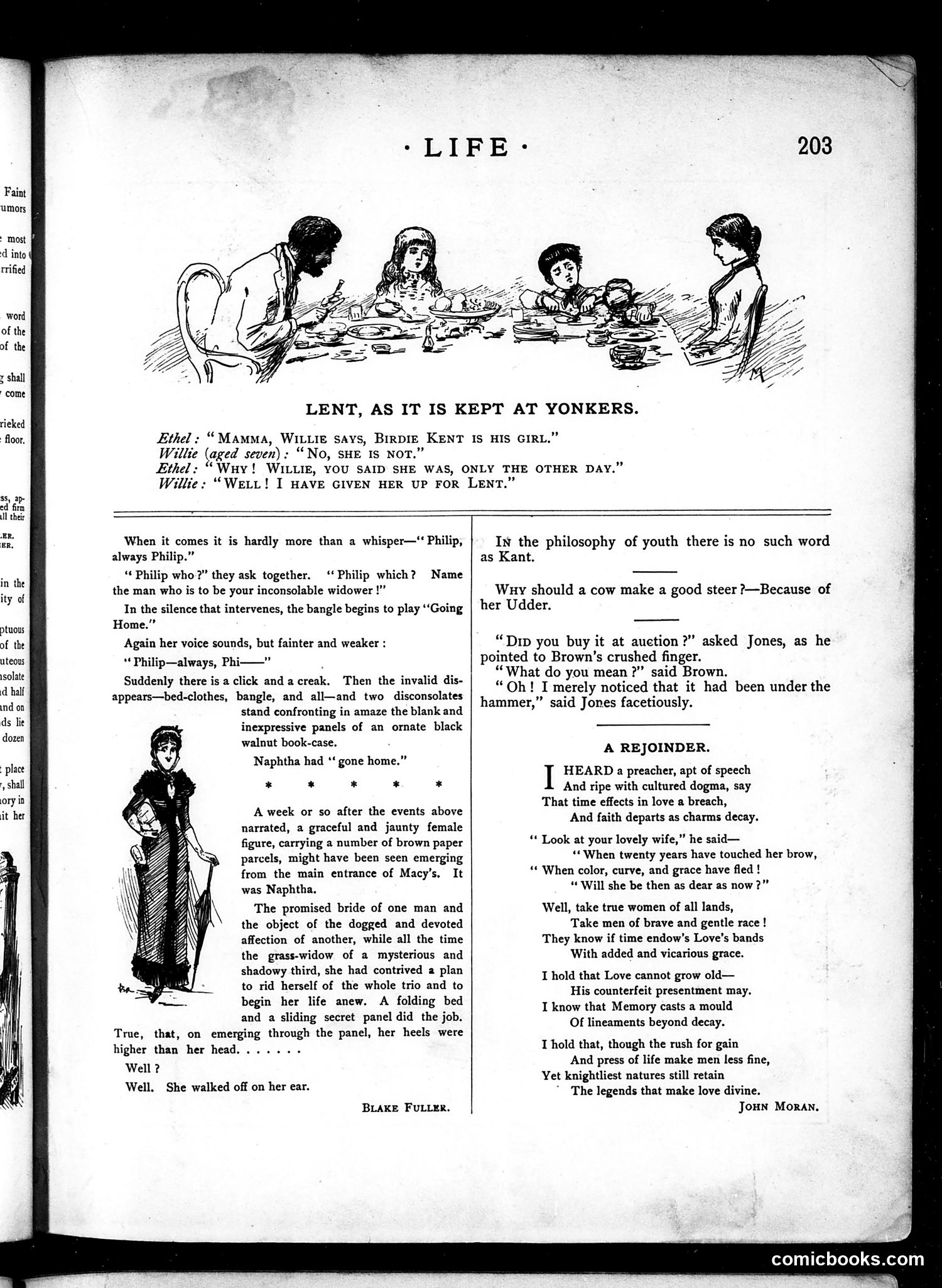
This satirical cartoon depicts a family dinner scene during Lent, the Christian period of fasting and abstinence. The humor turns on a domestic dispute about observing Lenten rules: a mother tells her son Willie that Birdie Kent is Willie's girlfriend, but Willie denies it. Ethel counters that Willie claimed this "only the other day," and Willie responds he's "given her up for Lent." The satire mocks casual religious observance—using Lenten sacrifice as a flippant excuse to abandon a relationship rather than genuinely practicing spiritual discipline. The title "As It Is Kept at Yonkers" (a New York suburb) suggests this represents typical middle-class American hypocrisy regarding religious practice, treating sacred obligations as convenient social cover for personal convenience.
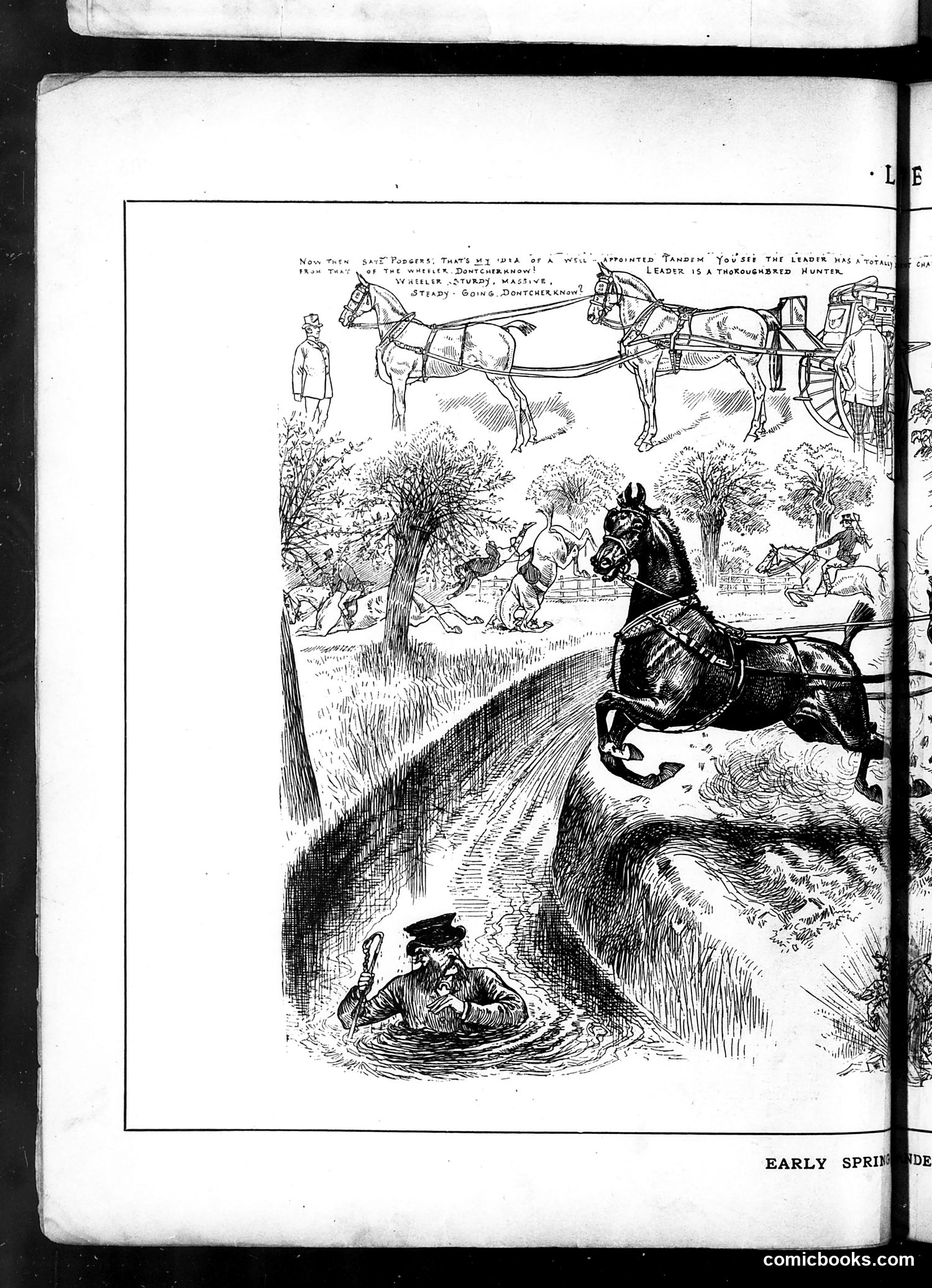
This appears to be a satirical illustration about early spring activities and social rituals. The text at the top (partially legible) references "a well-appointed tandem" and mentions "the leader has a thorough-bred horse" and "a thoroughbred hunter," suggesting commentary on wealthy leisure activities. The cartoon depicts contrasting social classes: well-dressed riders on horseback in the park above, representing the affluent engaged in fashionable spring recreation, while below a man sits in a stream or pond, appearing to be a working-class figure. The juxtaposition likely satirizes class divisions and how different social groups experience springtime—the wealthy enjoying refined pursuits like riding, while the poor have more basic entertainment or are literally in the water.
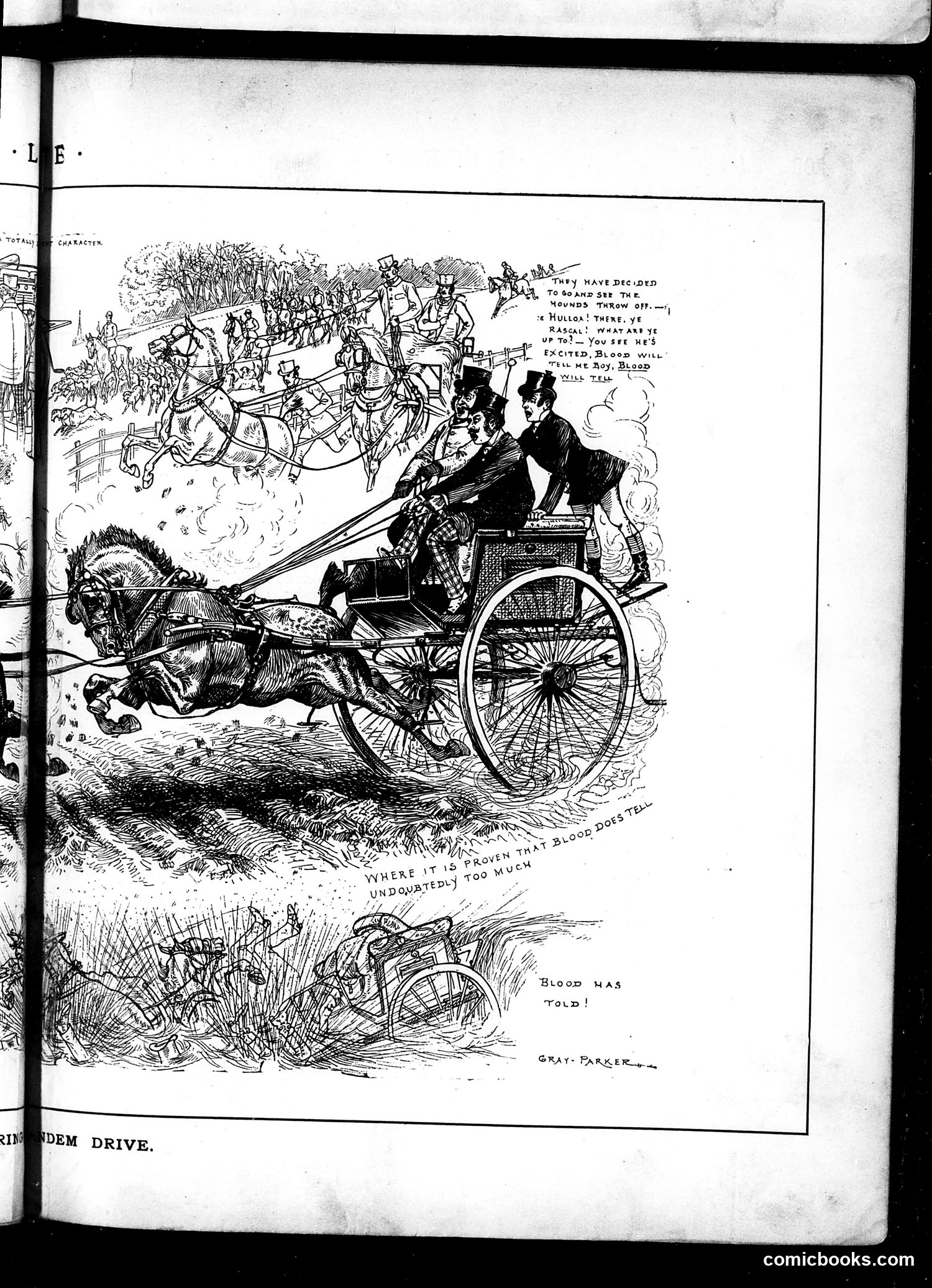
This appears to be a satirical drawing showing two well-dressed men in top hats riding in a horse-drawn carriage, with one saying "Blood will tell" as they observe a chaotic scene of many horses and people ahead. The caption reads "Where it is proven that blood does tell (undoubtedly) too much blood!" The joke plays on the expression "blood will tell"—meaning one's true nature or breeding shows through. The cartoon suggests these aristocratic gentlemen are discussing bloodlines or pedigree, while ironically a violent or chaotic equestrian scene unfolds, literally showing "too much blood." The satire likely critiques upper-class pretension about inherited superiority while depicting the messy, brutal reality beneath their refined assumptions. The artist is signed "Gray-Parker."
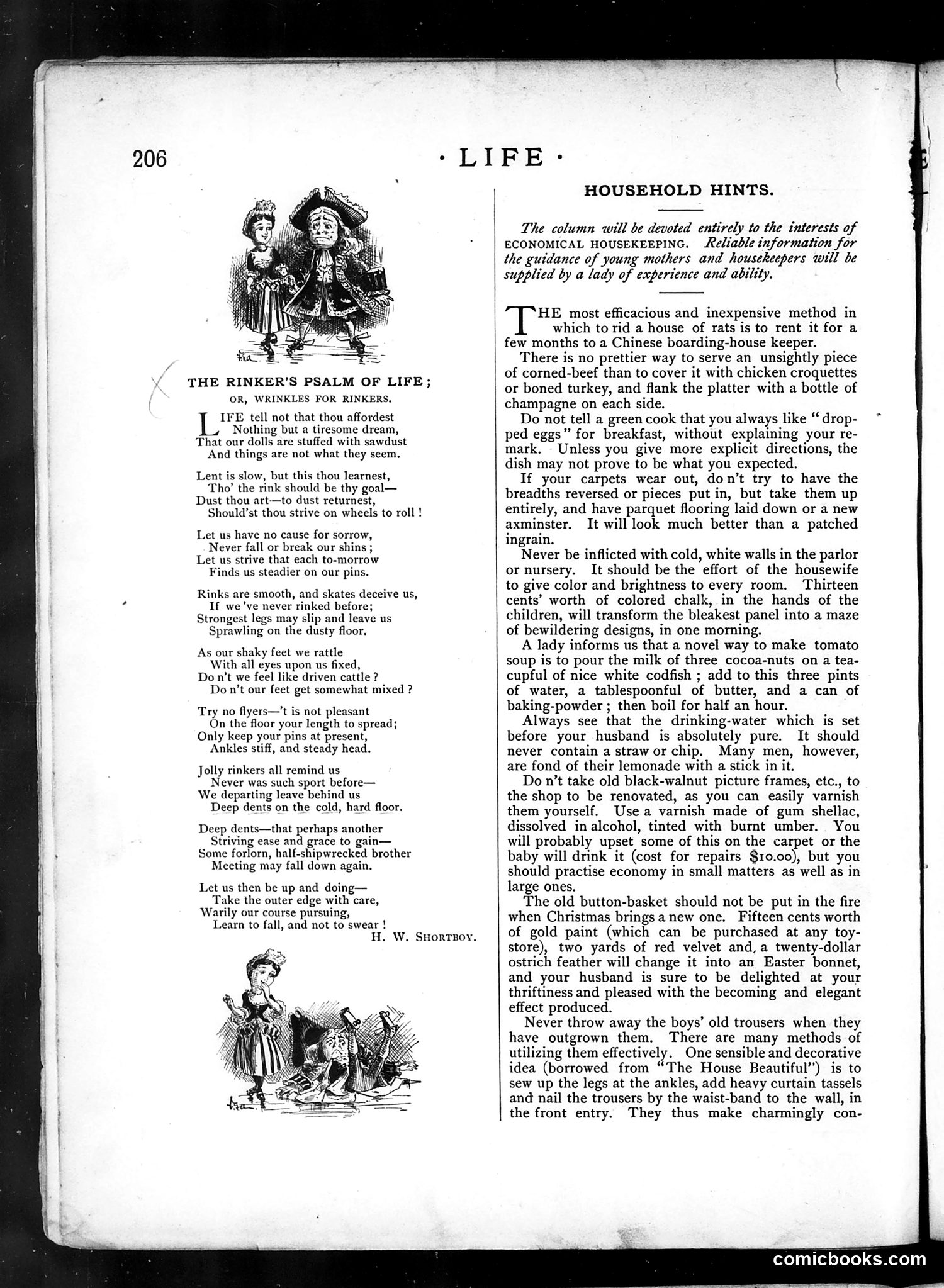
This page contains two distinct pieces of satire. **"The Rinker's Psalm of Life"** (left) mocks ice-skating culture, particularly among young people. The poem parodies serious religious or moral verse ("dust thou art—to dust returnest") to humorously warn against skating rinks, where people constantly fall on hard floors. The joke lies in treating this trivial recreational activity with mock-solemnity, and the repeated references to falling, bruised ankles, and "deep dents" in the floor create physical comedy. **"Household Hints"** (right) satirizes domestic advice columns through deliberately absurd suggestions: renting your house to a Chinese keeper to eliminate rats, serving spoiled corned-beef disguised under fancy preparations, letting children draw on walls with chalk, or making soup from coconut milk and codfish. The humor exposes the gap between pretentious "economical housekeeping" advice and practical reality—the hints are either useless, dangerous, or comically impractical. Both pieces mock Victorian-era earnestness and the proliferation of advice literature.
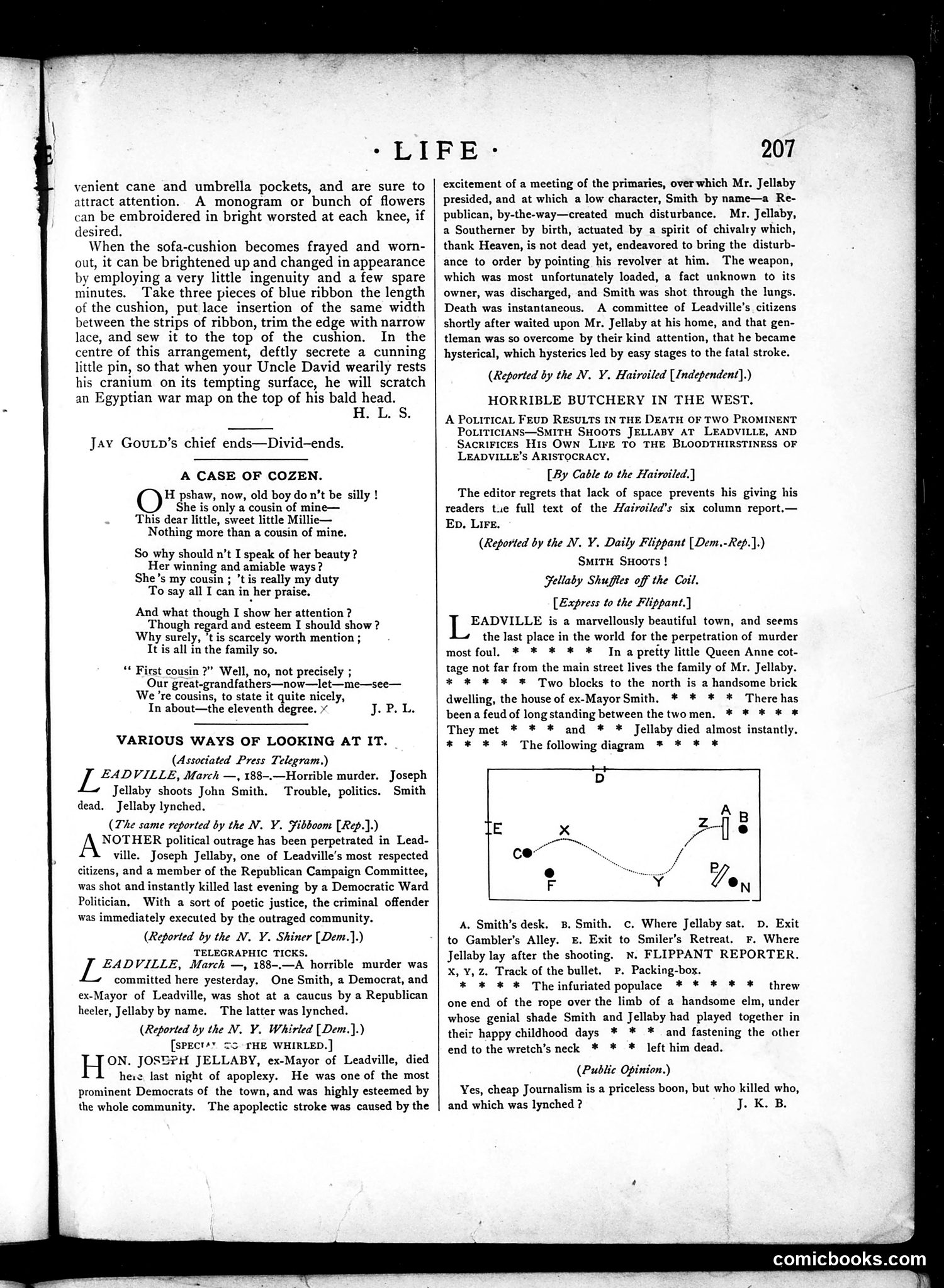
This page satirizes how partisan newspapers distort the same event to serve their political agendas. The scenario: Joseph Jellaby shoots John Smith in Leadville. Each news source spins the identical incident completely differently: - **Associated Press** (neutral): Simple facts—murder, shooting, lynching - **Republican paper** (Fibboom): Jellaby becomes a "respected citizen" and Republican Committee member; Smith becomes a "Democratic Ward Politician" - **Democratic paper** (Shiner): Smith becomes a "Democrat" ex-Mayor; Jellaby becomes a Republican operative - **Another Democratic outlet** (Whirled): Jellaby dies of apoplexy; the shooting is reframed as self-defense against disturbance The final report absurdly claims Jellaby died from emotional distress after the shooting. **The satire's point**: Newspapers of opposing parties will completely reverse facts, identities, and moral culpability depending on which party benefits. Truth becomes irrelevant—only partisan advantage matters. This mockery of partisan journalism reflects Gilded Age newspaper practices, where party loyalty often trumped accuracy.
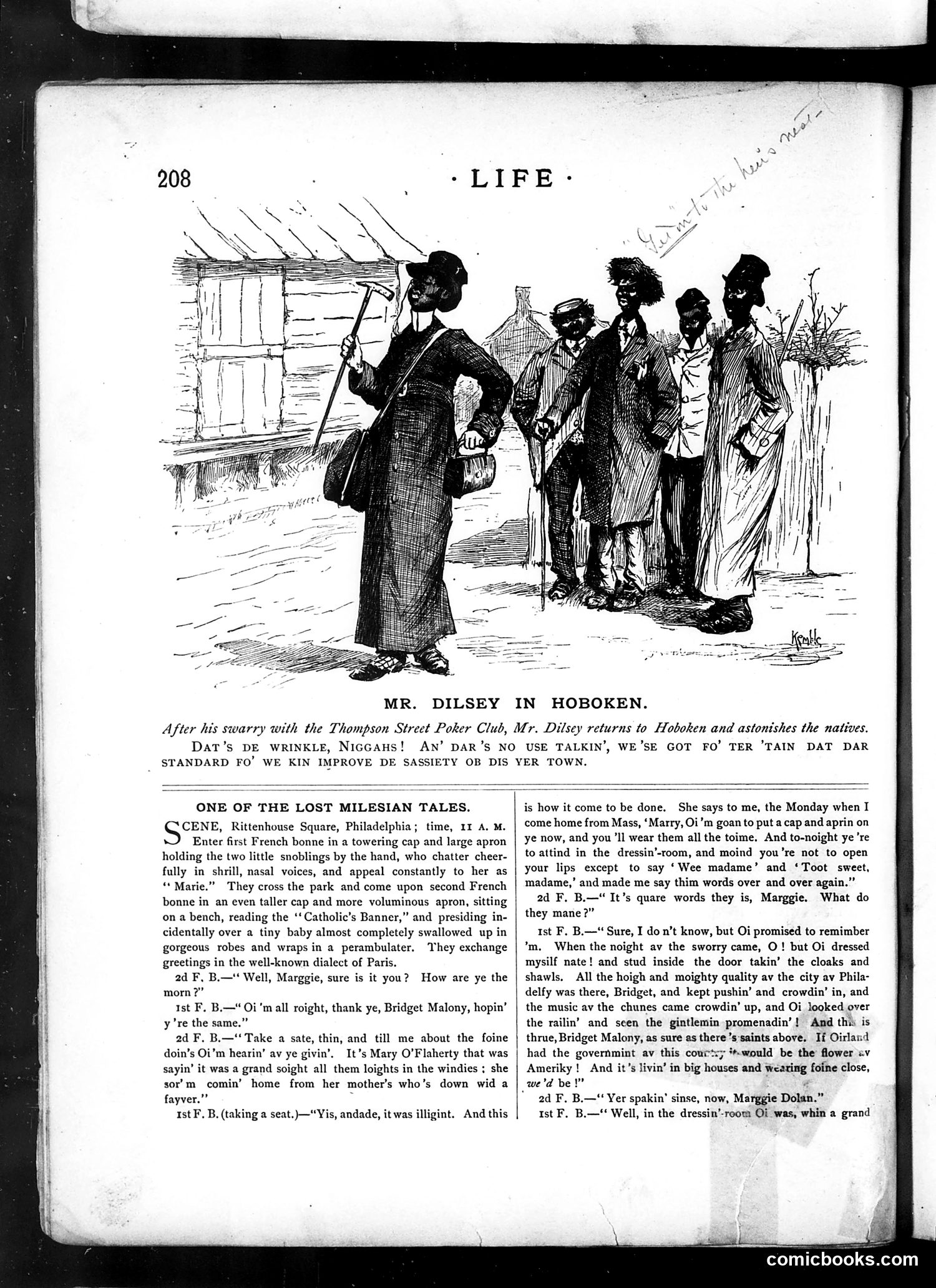
This page contains two separate satirical pieces from *Life* magazine: **Top cartoon**: "Mr. Dilsey in Hoboken" mocks African American dialect and aspirations. Mr. Dilsey returns from a poker game in New York to his hometown, announcing he'll "improve" local society by setting a "standard." The satire targets both his pretensions and the stereotyped dialect used to portray him and onlookers. **Bottom story**: "One of the Lost Milesian Tales" satirizes Irish immigrant domestic servants in Philadelphia. Two French governesses converse—but in exaggerated Irish-accented English rather than French. The humor derives from the contradiction: they're supposed to be French but speak in thick Irish brogue, and one describes attending a fancy Philadelphia event where she repeated French phrases ("Wee madame," "Toot sweet") she didn't understand. The satire mocks both Irish immigrants' social climbing and their linguistic/cultural outsider status in American high society. Both pieces use ethnic caricature and dialect humor—common in period *Life* magazine—to ridicule working-class and immigrant aspirations toward respectability.
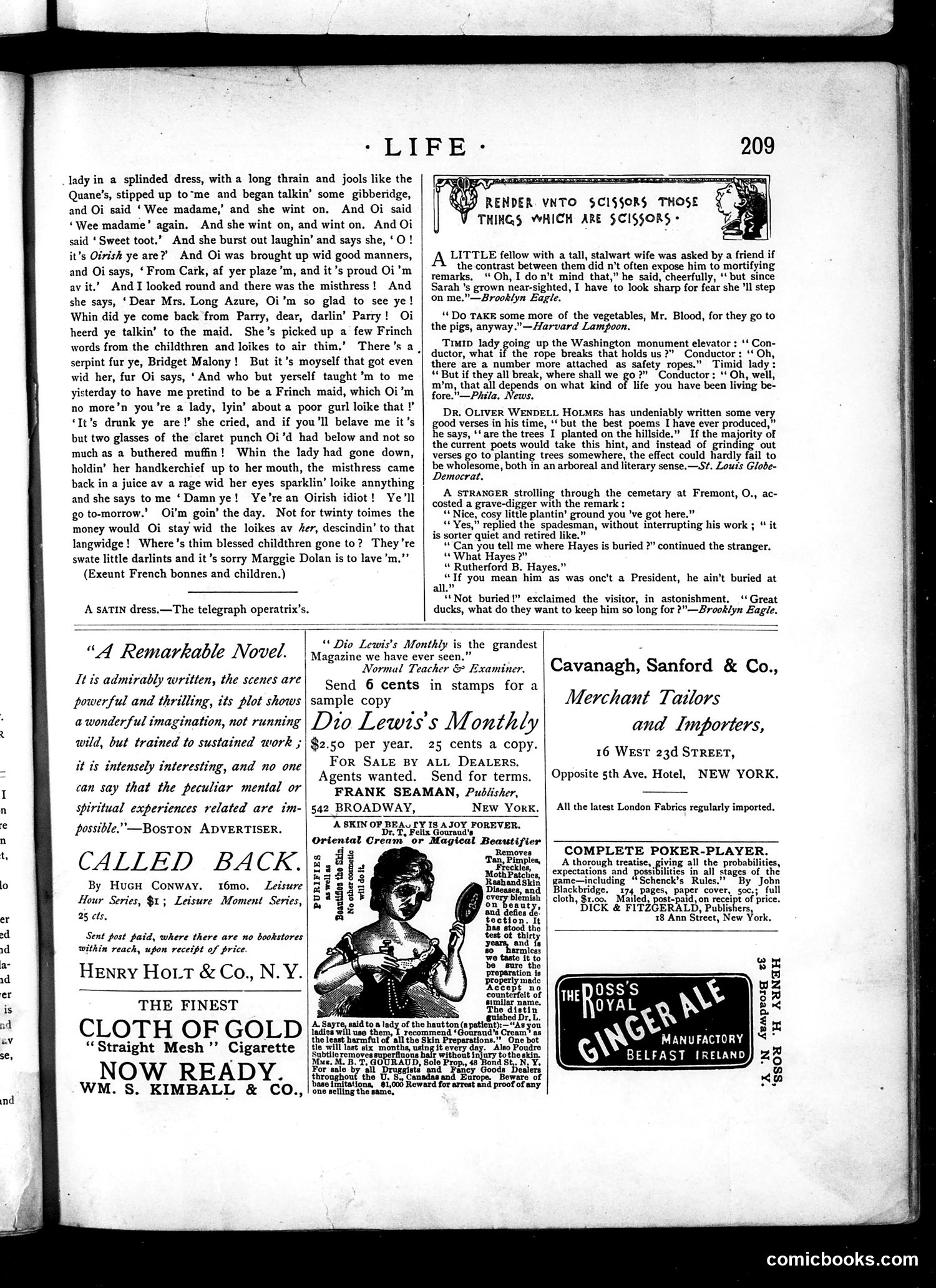
This page is primarily **advertising and literary excerpts** with minimal editorial cartooning. The main content consists of **humorous anecdotes** in dialect, chiefly a long Irish-accented monologue by a servant named Bridget Malony about being mistaken for a French maid by her employer. The satire targets **class pretension**: the wealthy employer mimics Irish servants' attempts at French affectation, then punishes the servant for exposing this hypocrisy. A secondary joke references **Rutherford B. Hayes**, the 19th-century U.S. President, in a cemetery scene where a gravedigger expresses surprise Hayes isn't buried—implying Hayes was politically dead or irrelevant by this publication date. The page's top features a small decorative cartoon captioned "RENDER UNTO SCISSORS THOSE THINGS WHICH ARE SCISSORS"—likely an advertisement pun. The bulk consists of **advertisements** for magazines (*Dio Lewis's Monthly*, *Called Back*), clothing, and beverages, typical of period Life magazine pages.
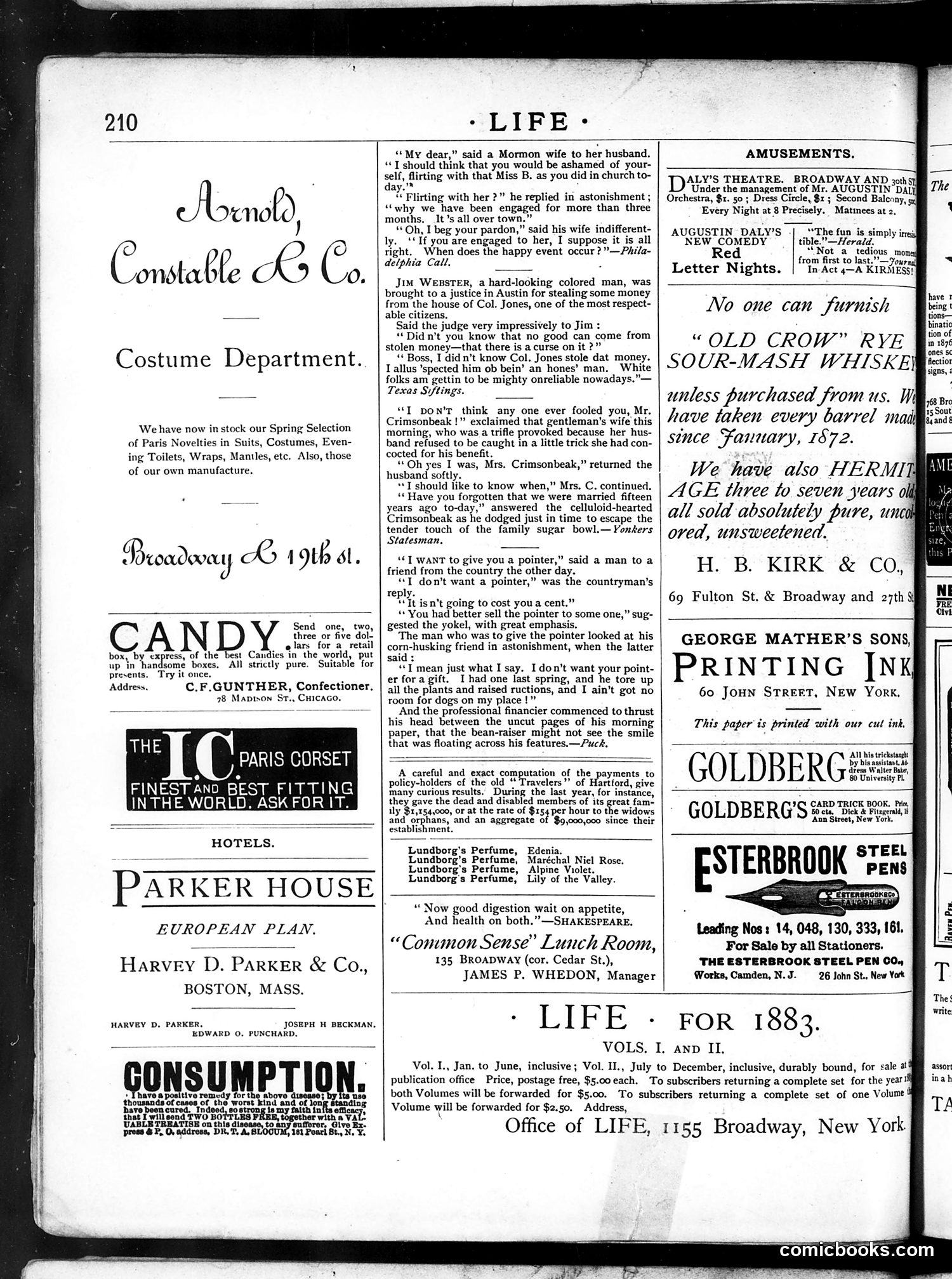
This page is primarily **advertisements and humor anecdotes**, not political cartoons. The content consists of: **Humor Pieces**: Short jokes about marital infidelity, racism, and rural/urban social differences—typical 1880s satirical fare. Notable is a racist anecdote about "Jim Webster," a Black man arrested for theft, making a joke about white people being unreliable. Another involves a "countryman" (rural person) rejecting city advice, playing on period stereotypes of rural simplicity versus urban sophistication. **Advertisements**: The page features ads for corsets, candy, hotels, printing ink, and — significantly — a **"Consumption" remedy** (tuberculosis was a major killer; such "cures" were common quackery). The Mormon joke references polygamy, a contemporary social controversy. **Context**: This reflects 1883 attitudes: casual racism, gender stereotypes, and predatory medical advertising were unremarkable. The humor targets perceived social inferiors (Black people, rural folks) or marital situations.
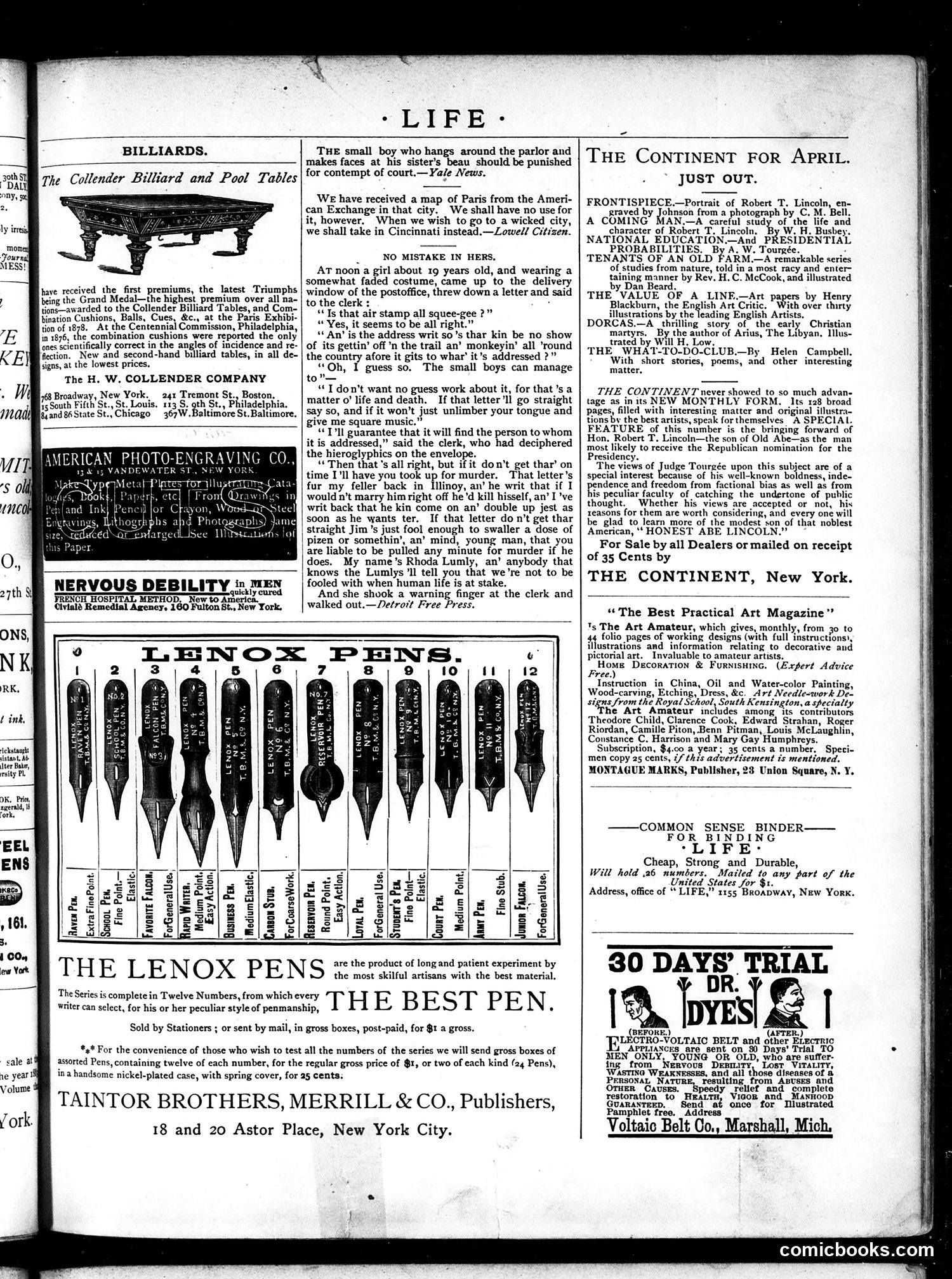
This page is primarily **advertisements and humorous short pieces** rather than political cartoons. The main content includes: **"No Mistake in Hers"** — A comedic anecdote about a rural girl named Rhoda Lumly mailing a letter to her boyfriend in Illinois. She threatens the postal clerk with legal liability if the letter doesn't arrive promptly, because her suitor has threatened suicide if she doesn't marry him. The humor derives from her exaggerated rural dialect ("air stamp all squee-gee," "thar"), her illogical threat to prosecute the clerk for "murder" if her boyfriend kills himself, and the absurdity of her priorities. The remaining content consists of product advertisements for **Collender Billiard Tables**, **Lenox Pens** (shown with 12 different nib styles), a medical remedy for "Nervous Debility in Men," and other period goods. Two brief jokes appear in the margins about a mischievous boy and comparing Cincinnati unfavorably to Paris.
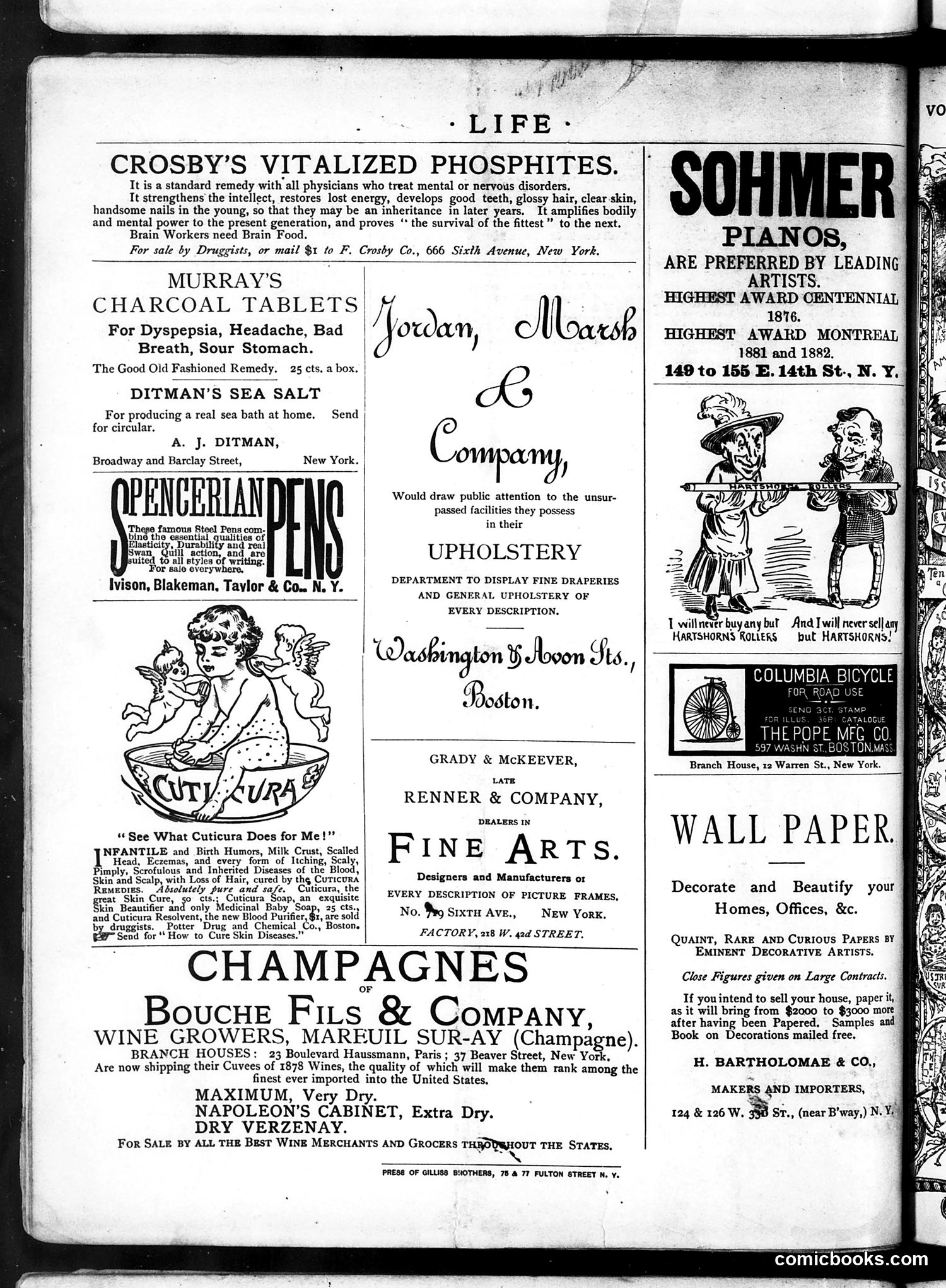
This is primarily an **advertising page** with one small cartoon. The main satire appears in the illustration accompanying the Sohmer Pianos advertisement (top right), which shows two caricatured figures—one appearing to be a woman in a dress and one a man—with dialogue: "I will never buy any but HARTSHORNS ROLLERS" and "And I will never sell but HARTSHORNS!" The joke plays on **window shade roller hardware**—a mundane domestic product—by depicting it as so desirable that both buyer and seller are obsessively devoted to the brand. This is typical 19th-century absurdist advertising humor, exaggerating consumer preference to comic effect. The remainder of the page consists of patent medicine and luxury product advertisements (phosphites, champagne, wallpaper, fine arts supplies), reflecting Gilded Age consumer culture and the pseudo-scientific health claims common to the era.