
Life, 1884-04-10 · page 5 of 16
Life — April 10, 1884 — page 5: what you’re looking at
What you’re looking at
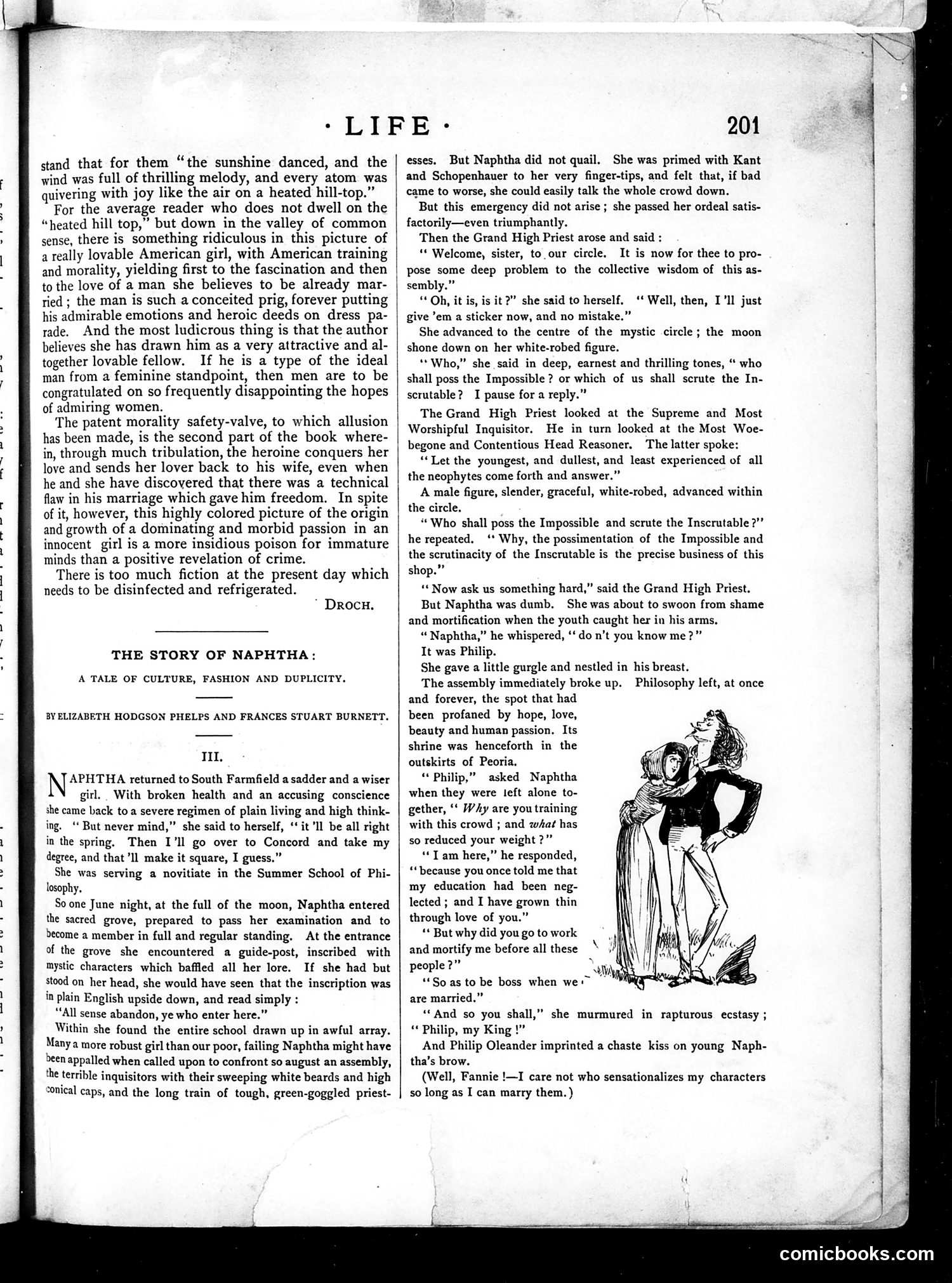
This page contains a serialized short story by Elizabeth Hodson Phelps and Frances Stuart Burnett titled "The Story of Naphtha: A Tale of Culture, Fashion and Duplicity." The illustration shows a young woman in classical dress being embraced by a man, accompanying narrative about a character named Naphtha who has returned to South Farmfield "sadder and wiser" and now works as a novitiate in a Summer School of Philosophy. The story appears to satirize intellectual pretensions and romantic entanglements among educated women of the era. Rather than political satire, this represents *Life* magazine's literary fiction content—the publication combined social commentary with serialized stories targeting educated middle-class readers interested in culture and romance narratives.
📄 Transcribed text from this page (OCR, searchable)
Machine-transcribed from the original scan — historical spelling and the odd misread are preserved.
‘LIFE: stand that for them “the sunshine danced, and the wind was full of thrilling melody, and every atom was quivering with joy like the air on a heated hill-top.” For the average reader who does not dwell on the “heated hill top,” but down in the valley of common sense, there is something ridiculous in this picture of a really lovable American girl, with American training and morality, yielding first to the fascination and then to the love of a man she believes to be already mar- ried ; the man is such a conceited prig, forever putting his admirable emotions and heroic deeds on dress pa- rade. And the most ludicrous thing is that the author believes she has drawn him as a very attractive and al- together lovable fellow. If he is a type of the ideal man from a feminine standpoint, then men are to be congratulated on so frequently disappointing the hopes of admiring women. The patent morality safety-valve, to which allusion | has been made, is the second part of the book where- in, through much tribulation, the heroine conquers her love and sends her lover back to his wife, even when he and she have discovered that there was a technical flaw in his marriage which gave him freedom. In spite of it, however, this highly colored picture of the origin and growth of a dominating and morbid passion in an innocent girl is a more insidious poison for immature minds than a positive revelation of crime. There is too much fiction at the present day which needs to be disinfected and refrigerated. * Drocn. THE STORY OF NAPHTHA: A TALE OF CULTURE, FASHION AND DUPLICITY. BYELIZABETH HODGSON PHELPS AND FRANCES STUART BURNETT, TIL. APHTHA returned to South Farmfield a sadder and a wiser girl. With broken health and an accusing conscience she came back to a severe regimen of plain living and high think- ing. ‘“ But never mind,” she said to herself, ‘‘it’ll be all right in the spring. Then I'll go over to Concord and take my degree, and that ’ll make it square, I guess.” She was serving a novitiate in the Summer School of Phi- losophy. So one June night, at the full of the moon, Naphtha entered the sacred grove, prepared to pass her examination and to become a member in full and regular standing. At the entrance of the grove she encountered a guide-post, inscribed with mystic characters which baffled all her lore. If she had but stood on her head, she would have seen that the inscription was in plain English upside down, and read simply : “All sense abandon, ye who enter here.” Within she found the entire school drawn up in awful array. Many 4 more robust girl than our poor, failing Naphtha might have deen appalled when called upon to confront so august an assembly, the terrible inquisitors with their sweeping white beards and high *onical caps, and the long train of tough, green-goggled priest- 201 esses, But Naphtha did not quail. She was primed with Kant and Schopenhauer to her very finger-tips, and felt that, if bad came to worse, she could easily talk the whole crowd down. But this emergency did not arise ; she passed her ordeal satis- factorily—even triumphantly. Then the Grand High Priest arose and said : ‘* Welcome, sister, to.our circle. It is now for thee to pro- pose some deep problem to the collective wisdom of this as- sembly.” “Oh, it is, is it?” she said to herself. ‘* Well, then, I'll just give ’em a sticker now, and no mistake.” She advanced to the centre of the mystic circle; the moon shone down on her white-robed figure. “Who,” she said in deep, earnest and thrilling tones, “ who shall poss the Impossible ? or which of us shall scrute the In- scrutable? I pause for a reply.” The Grand High Priest looked at the Supreme and Most Worshipful Inquisitor. He in turn looked at the Most Woe- begone and Contentious Head Reasoner. The latter spoke: “Let the youngest, and dullest, and least experienced of all the neophytes come forth and answer.” A male figure, slender, graceful, white-robed, advanced within the circle, “Who shall poss the Impossible and scrute the Inscrutable ?”” he repeated. ‘* Why, the possimentation of the Impossible and the scrutinacity of the Inscrutable is the precise business of this shop.” ‘‘ Now ask us something hard,” said the Grand High Priest. But Naphtha was dumb. She was about to swoon from shame and mortification when the youth caught her in his arms, “ Naphtha,” he whispered, ‘‘ do n’t you know me?” It was Philip. She gave a little gurgle and nestled in his breast. The assembly immediately broke up. Philosophy left, at once and forever, the spot that had been profaned by hope, love, beauty and human passion. Its shrine was henceforth in the outskirts of Peoria. “ Philip,” asked Naphtha when they were left alone to- gether, ‘‘ Why are you training with this crowd ; and what has so reduced your weight ?”” ‘Tam here,” he responded, “because you once told me that my education had been neg- lected ; and I have grown thin through love of you.” “ But why did you go to work and mortify me before all these people?” “So as to be boss when wes are married,” “And so you shall,” she murmured in rapturous ecstasy ; “ Philip, my King !” And Philip Oleander imprinted a chaste kiss on young Naph- tha’s brow. (Well, Fannie !—I care not who sensationalizes my characters so long as I can marry them. ) comicbooks.com