
Life, 1884-04-10 · page 7 of 16
Life — April 10, 1884 — page 7: what you’re looking at
What you’re looking at
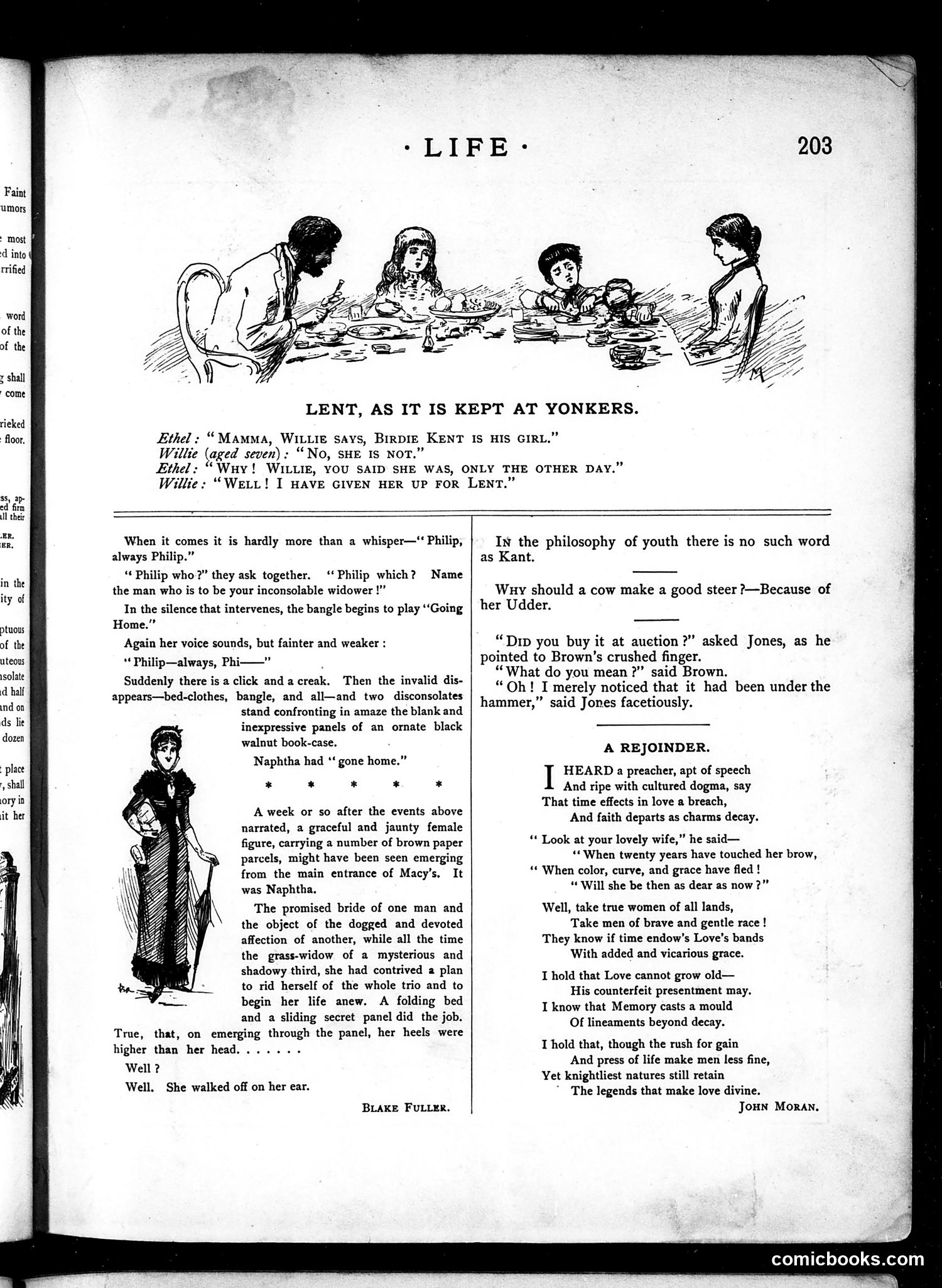
This satirical cartoon depicts a family dinner scene during Lent, the Christian period of fasting and abstinence. The humor turns on a domestic dispute about observing Lenten rules: a mother tells her son Willie that Birdie Kent is Willie's girlfriend, but Willie denies it. Ethel counters that Willie claimed this "only the other day," and Willie responds he's "given her up for Lent." The satire mocks casual religious observance—using Lenten sacrifice as a flippant excuse to abandon a relationship rather than genuinely practicing spiritual discipline. The title "As It Is Kept at Yonkers" (a New York suburb) suggests this represents typical middle-class American hypocrisy regarding religious practice, treating sacred obligations as convenient social cover for personal convenience.
📄 Transcribed text from this page (OCR, searchable)
Machine-transcribed from the original scan — historical spelling and the odd misread are preserved.
$8, ap- ed firm their ER, ER, in the ity of ptuous of the uteous isolate d half ind on ds lie dozen - place Shall ory in it her LENT, AS IT IS KEPT AT YONKERS. Ethel: “Mamma, WILLIE says, BirDIE KENT Is HIS GIRL.” Willie (aged seven): “No, SHE IS NOT.” Ethel: “ Wuy! WILLIE, YOU SAID SHE WAS, ONLY THE OTHER DAY.” Willie: ““Weii! I HAVE GIVEN HER UP FOR LENT.” When it comes it is hardly more than a whisper—‘ Philip, always Philip.” “Philip who?” they ask together. ‘Philip which? Name the man who is to be your inconsolable widower !”” In the silence that intervenes, the bangle begins to play “Going Home.” Again her voice sounds, but fainter and weaker : “Philip—always, Phim—” . Suddenly there is a click and acreak. Then the invalid dis- appears—bed-clothes, bangle, and all—and two disconsolates stand confronting in amaze the blank and inexpressive panels of an ornate black walnut book-case. Naphtha had “ gone home.” * * * * * A week or so after the events above narrated, a graceful and jaunty female figure, carrying a number of brown paper parcels, might have been seen emerging from the main entrance of Macy's. It was Naphtha, The promised bride of one man and the object of the dogged and devoted affection of another, while all the time the grass-widow of a mysterious and shadowy third, she had contrived a plan to rid herself of the whole trio and to begin her life anew. A folding bed and a sliding secret panel did the job. True, that, on emerging through the panel, her heels were higher than her head Well? Well. She walked off on her ear. we WO QYVAGS BLAKE FULLER. In the philosophy of youth there is no such word as Kant. Wuy should a cow make a good steer ?—Because of her Udder. “Dip you buy it at auction?” asked Jones, as he pointed to Brown’s crushed finger. “What do you mean ?” said Brown. “Oh! I merely noticed that it had been under the hammer,” said Jones facetiously. A REJOINDER. HEARD a preacher, apt of speech And ripe with cultured dogma, say That time effects in love a breach, And faith departs as charms decay. “* Look at your lovely wife,” he said— “When twenty years have touched her brow, “« When color, curve, and grace have fled ! “ Will she be then as dear as now?” Well, take true women of all lands, Take men of brave and gentle race ! They know if time endow’s Love’s bands With added and vicarious grace. I hold that Love cannot grow old— His counterfeit presentment may. I know that Memory casts a mould Of lineaments beyond decay. T hold that, though the rush for gain And press of life make men less fine, Yet knightliest natures still retain The legends that make love divine. Joun Moran. comicbooks.com