
Life, 1884-04-10 · page 4 of 16
Life — April 10, 1884 — page 4: what you’re looking at
What you’re looking at
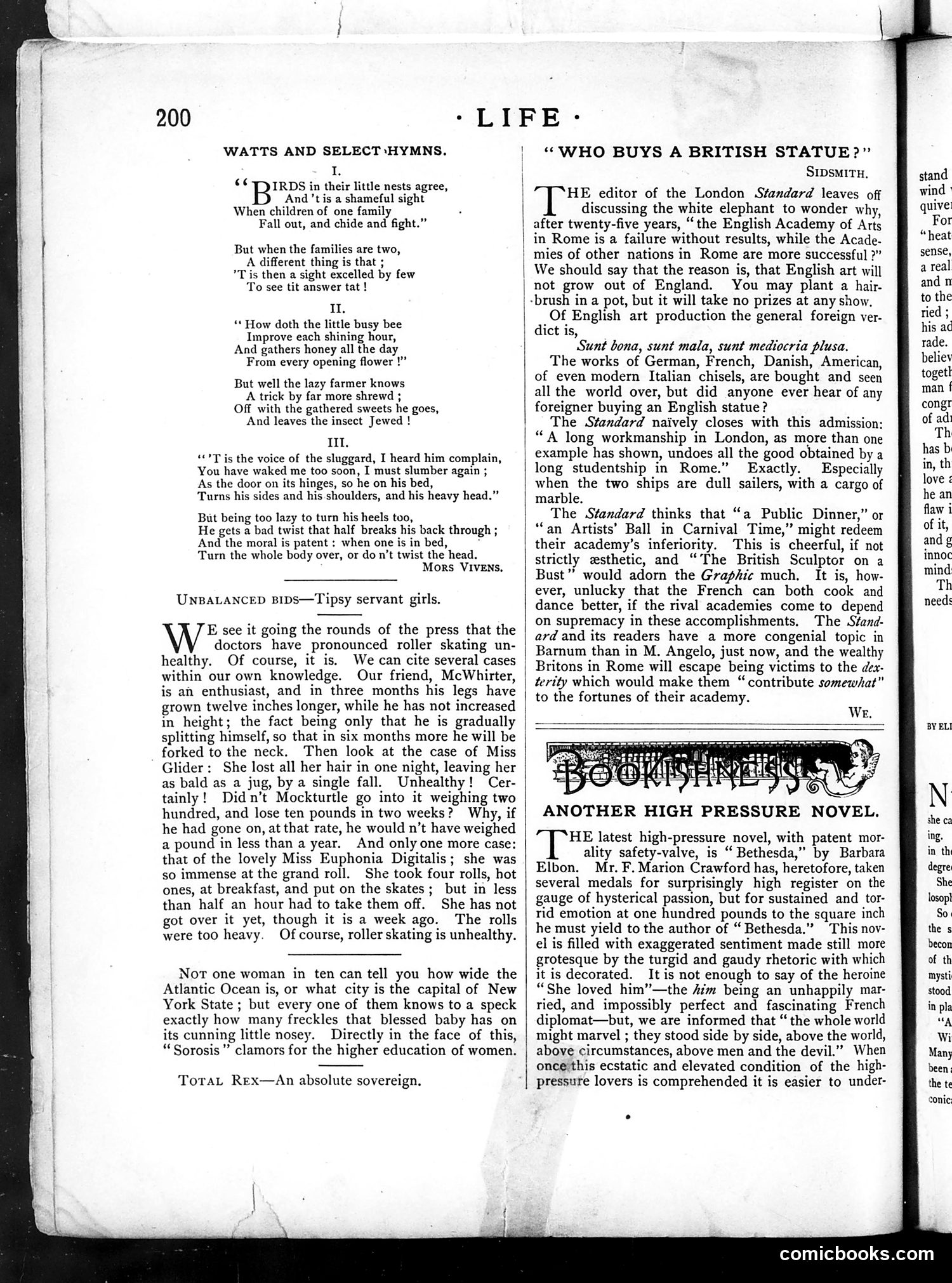
This page contains literary commentary rather than political cartoons. The left column features "Watts and Select Hymns," Victorian-era poems about nature and morality. The right column critiques the London *Standard* newspaper's dismissive comments about English art, arguing that English artists lack international reputation compared to German, French, and Danish counterparts. The writer sarcastically suggests that public dinners or "Artists' Balls" might improve the Academy's standing, and jokes that wealthy Britons visiting Rome would boost English prestige more effectively than French rivals. The "Bookman's Corner" section reviews "Bethesda," a high-pressure romance novel by Barbara Elbon, mocking its overwrought emotional language and melodramatic French diplomat protagonist.
📄 Transcribed text from this page (OCR, searchable)
Machine-transcribed from the original scan — historical spelling and the odd misread are preserved.
200 ‘LIFE - WATTS AND SELECT:-HYMNS. I. 6¢ 7 IRDS in their little nests agree, And’tis a shameful sight When children of one family Fall out, and chide and fight.” But when the families are two, A different thing is that ; ’T is then a sight excelled by few To see tit answer tat ! Il. ‘* How doth the little busy bee Improve each shining hour, And gathers honey all the day From every opening flower !”” But well the lazy farmer knows A trick by far more shrewd ; Off with the gathered sweets he goes, And leaves the insect Jewed ! Il. “OT is the voice of the sluggard, I heard him complain, You have waked me too soon, I must slumber again ; As the door on its hinges, so he on his bed, Turns his sides and his shoulders, and his heavy head.” But being too lazy to turn his heels too, He gets a bad twist that half breaks his back through ; And the moral is patent : when one is in bed, . Turn the whole body over, or do n’t twist the head. Mors VIVENs, UNBALANCED BIDS—Tipsy servant girls. E see it going the rounds of the press that the doctors have pronounced roller skating un- healthy. Of course, it is. We can cite several cases within our own knowledge. Our friend, McWhirter, is an enthusiast, and in three months his legs have grown twelve inches longer, while he has not increased in height; the fact being only that he is gradually splitting himself, so that in six months more he will be forked to the neck. Then look at the case of Miss Glider: She lost all her hair in one night, leaving her as bald as a jug, by a single fall. Unhealthy! Cer- tainly! Didn’t Mockturtle go into it weighing two hundred, and lose ten pounds in two weeks? Why, if he had gone on, at that rate, he would n’t have weighed a pound in less than a year. And only one more case: that of the lovely Miss Euphonia Digitalis; she was so immense at the grand roll. She took four rolls, hot ones, at breakfast, and put on the skates ; but in less than half an hour had to take them off. She has not got over it yet, though it is a week ago. The rolls were too heavy. Ofcourse, roller skating is unhealthy. Not one woman in ten can tell you how wide the Atlantic Ocean is, or what city is the capital of New York State ; but every one of them knows to a speck exactly how many freckles that blessed baby has on its cunning little nosey. Directly in the face of this, “Sorosis ” clamors for the higher education of women. ToraL Rex—An absolute sovereign. ' *““WHO BUYS A BRITISH STATUE?” SipsMItH. HE editor of the London Standard leaves off discussing the white elephant to wonder why, after twenty-five years, “the English Academy of Arts in Rome is a failure without results, while the Acade- mies of other nations in Rome are more successful ?” We should say that the reason is, that English art will not grow out of England. You may plant a hair- -brush in a pot, but it will take no prizes at any show, ei Of English art production the general foreign ver- ‘ict 1s, Sunt bona, sunt mala, sunt mediocria plusa. The works of German, French, Danish, American, of even modern Italian chisels, are bought and seen all the world over, but did anyone ever hear of any foreigner buying an English statue? The Standard naively closes with this admission: “A long workmanship in London, as more than one example has shown, undoes all the good obtained by a long studentship in Rome.” Exactly. Especially when the two ships are dull sailers, with a cargo of marble. The Standard thinks that “a Public Dinner,” or “‘an Artists’ Ball in Carnival Time,” might redeem their academy’s inferiority. This is cheerful, if not strictly esthetic, and “The British Sculptor on a Bust” would adorn the Graphic much. It is, how- ever, unlucky that the French can both cook and dance better, if the rival academies come to depend on supremacy in these accomplishments. The Stand- ard and its readers have a more congenial topic in Barnum than in M. Angelo, just now, and the wealthy Britons in Rome will escape being victims to the dex- terity which would make them “contribute somewhat” to the fortunes of their academy. We, HE latest high-pressure novel, with patent mor- ality safety-valve, is “ Bethesda,” by Barbara Elbon. Mr. F. Marion Crawford has, heretofore, taken several medals for surprisingly high register on the gauge of hysterical passion, but for sustained and tor- rid emotion at one hundred pounds to the square inch he must yield to the author of “ Bethesda.” This nov- el is filled with exaggerated sentiment made still more grotesque by the turgid and gaudy rhetoric with which it is decorated. It is not enough to say of the heroine “She loved him”’—the Aim being an unhappily mar- ried, and impossibly perfect and fascinating French diplomat—but, we are informed that “the whole world might marvel ; they stood side by side, above the world, above circumstances, above men and the devil.” When once this ecstatic and elevated condition of the high- pressure lovers is comprehended it is easier to under- stand wind | quive! For “heat sense, a real and n to the ried ; his ac rade. belies toget! man f congr of adi Th has b in, th love « he an flaw i of it, and g innoc mind BYELI she ca ing, in th degre She losopl So the s decon of th mysti stood in pla “A Wi Many deen: the te conic comicbooks.com