
Life, 1884-04-10 · page 6 of 16
Life — April 10, 1884 — page 6: what you’re looking at
What you’re looking at
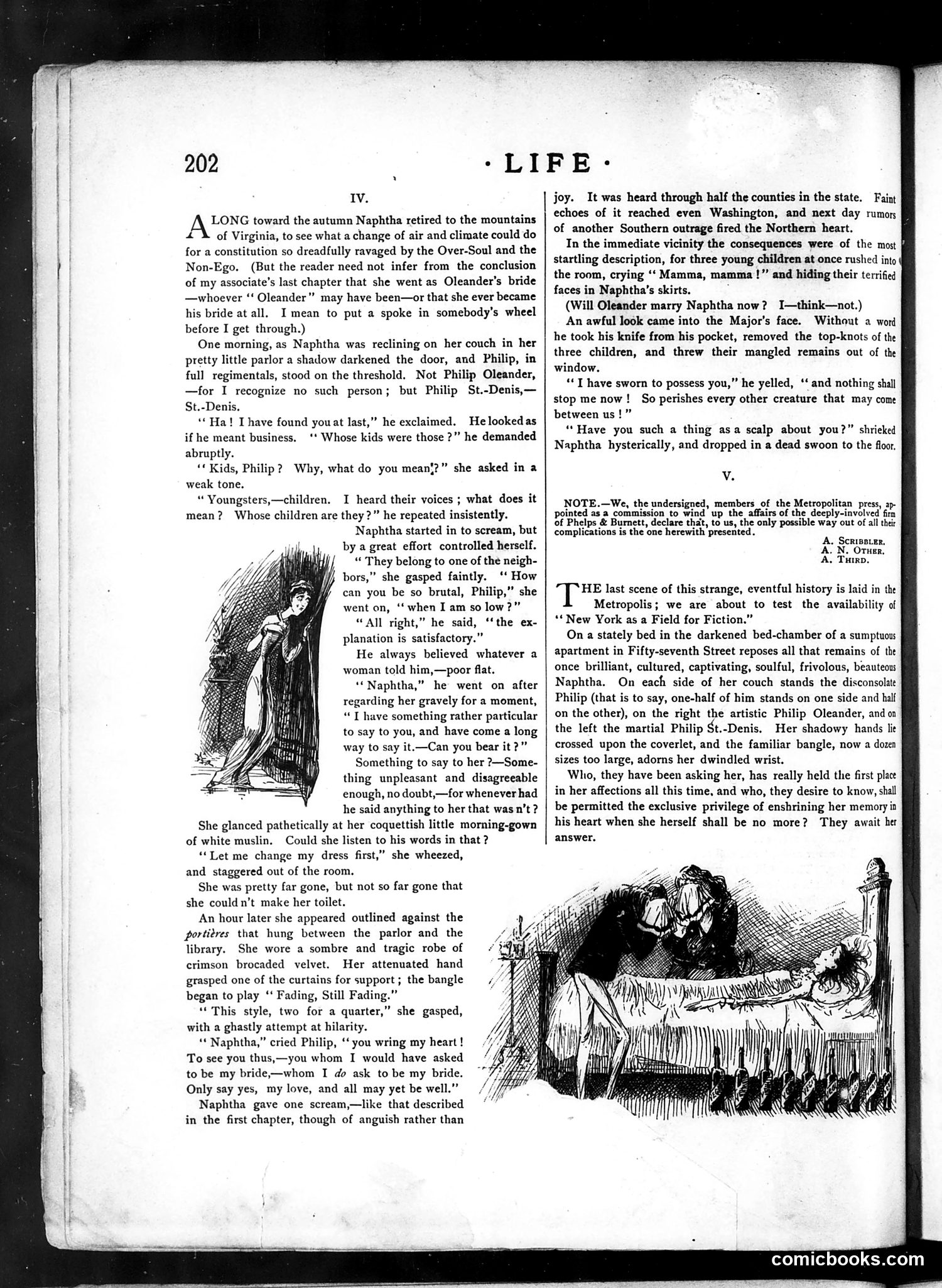
This page contains serialized fiction rather than political satire or comics. The narrative concerns characters named Naphtha, Philip, and Philip St.-Denis in what appears to be a domestic drama set in New York. The two illustrations are literary scene-setting: the upper sketch shows a woman in period dress at a doorway or threshold, while the lower illustration depicts figures on a bed, illustrating emotional moments from the narrative. The text focuses on romantic tension and conflict between characters, with dialogue about marriage proposals and jealousy. There is no apparent political commentary, social satire, or caricature work on this page—it is straightforward serialized fiction typical of Life magazine's literary content from this era.
📄 Transcribed text from this page (OCR, searchable)
Machine-transcribed from the original scan — historical spelling and the odd misread are preserved.
202 Iv. LONG toward the autumn Naphtha retired to the mountains 4 of Virginia, to see what a change of air and climate could do for a constitution so dreadfully ravaged by the Over-Soul and the Non-Ego. (But the reader need not infer from the conclusion of my associate's last chapter that she went as Oleander's bride —whoever ‘‘ Oleander” may have been—or that she ever became his bride at all. I mean to put a spoke in somebody's wheel before I get through.) One morning, as Naphtha was reclining on her couch in her pretty little parlor a shadow darkened the door, and Philip, in full regimentals, stood on the threshold. Not Philip Oleander, —for I recognize no such person; but Philip St.-Denis,— St.-Denis, ‘‘Ha! [have found youat last,” he exclaimed. Helookedas if he meant business. ‘t Whose kids were those ?” he demanded abruptly. “* Kids, Philip? Why, what do you mean’ weak tone. “Youngsters,—children. I heard their voices ; what does it mean? Whose children are they?” he repeated insistently. Naphtha started in to scream, but by a great effort controlled herself. “ They belong to one of the neigh- bors,” she gasped faintly. ‘‘ How can you be so brutal, Philip,” she went on, ‘‘ when I am so low?” “All right,” he said, ‘‘the ex- planation is satisfactory.” He always believed whatever a woman told him,—poor flat. ‘*Naphtha,” he went on after regarding her gravely for a moment, “[ have something rather particular to say to you, and have come a long way to say it.—Can you bear it?” Something to say to her ?—Some- thing unpleasant and disagreeable enough, no doubt,—for whenever had he said anything to her that wasn’t? She glanced pathetically at her coquettish little morning-gown of white muslin. Could she listen to his words in that ? ‘Let me change my dress first,” she wheezed, and staggered out of the room. She was pretty far gone, but not so far gone that she couldn’t make her toilet. An hour later she appeared outlined against the portitres that hung between the parlor and the library. She wore a sombre and tragic robe of crimson brocaded velvet. Her attenuated hand grasped one of the curtains for support ; the bangle began to play ‘ Fading, Still Fading.” “This style, two for a quarter,” she gasped, with a ghastly attempt at hilarity. ““ Naphtha,” cried Philip, ‘you wring my heart! To see you thus,—you whom I would have asked to be my bride,—whom I do ask to be my bride. Only say yes, my love, and all may yet be well.” Naphtha gave one scream,—like that described in the first chapter, though of anguish rather than she asked in a -LIFE-: joy. It was heard through half the counties in the state. Faint echoes of it reached even Washington, and next day rumor of another Southern outrage fired the Northern heart. In the immediate vicinity the consequences were of the most startling description, for three young children at once rushed into the room, crying ‘‘ Mamma, mamma !” and hiding their terrified faces in Naphtha’s skirts. (Will Oleander marry Naphtha now? I—think—not.) An awful look came into the Major’s face. Without a word he took his knife from his pocket, removed the top-knots of the three children, and threw their mangled remains out of the window. “«T have sworn to possess you,” he yelled, ‘‘ and nothing shall stop me now! So perishes every other creature that may come between us!” “Have you such a thing asa scalp about you?” shrieked Naphtha hysterically, and dropped in a dead swoon to the floor Vv. NOTE.—We, the undersigned, members _of the Metropolitan press, ap- pointed as a commission to wind’ up the affairs of the deeply-involved fra of Phelps & Burnett, declare that, to us, the only possible way out of all their complications is the one herewith presented. A. Scrioauer, ALN. Otuer. A. Tino. HE last scene of this strange, eventful history is laid in the Metropolis; we are about to test the availability of ‘*New York as a Field for Fiction.” On a stately bed in the darkened bed-chamber of a sumptuous apartment in Fifty-seventh Street reposes all that remains of the once brilliant, cultured, captivating, soulful, frivolous, beauteous Naphtha. On each side of her couch stands the disconsolate Philip (that is to say, one-half of him stands on one side and half on the other), on the right the artistic Philip Oleander, and on the left the martial Philip St.-Denis. Her shadowy hands lie crossed upon the coverlet, and the familiar bangle, now a dozen sizes too large, adorns her dwindled wrist. Who, they have been asking her, has really held the first place in her affections all this time, and who, they desire to know, shall be permitted the exclusive privilege of enshrining her memory in his heart when she herself shall be no more? They await her answer. comicbooks.com