
A complete issue · 16 pages · 1884
Life — April 3, 1884
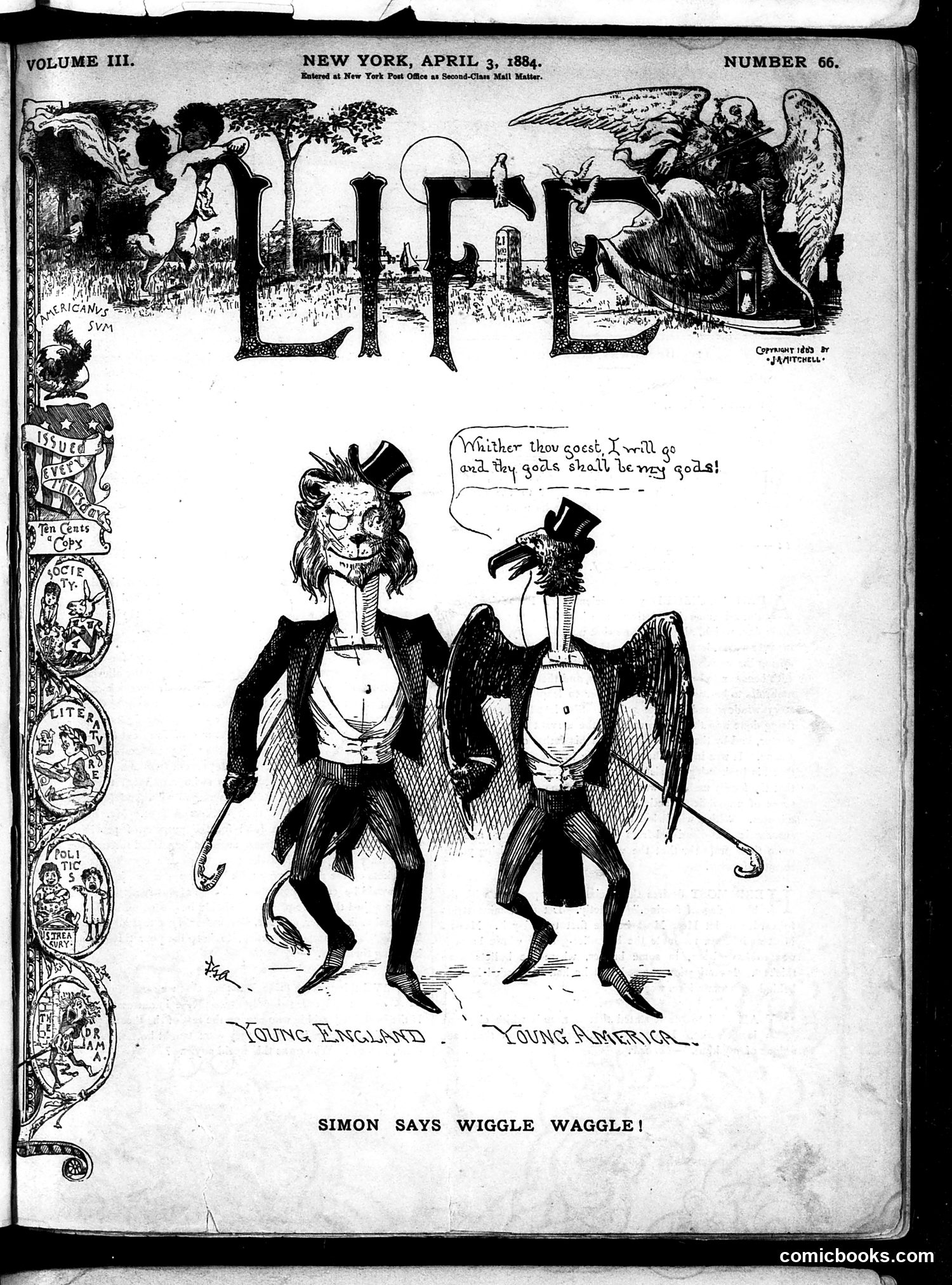
This cartoon satirizes the relationship between Britain and America through personified animal figures. "Young England" (depicted as a lion in formal dress) and "Young America" (depicted as an eagle similarly attired) are shown as anthropomorphic rivals. England says to America: "Whither thou goest I will go and thy gods shall be my gods!"—a biblical reference suggesting England mockingly claims to follow America's lead. The satire likely comments on Anglo-American relations during the 1880s, possibly referencing trade policies, colonial competition, or cultural influence. The "wiggle waggle" caption suggests the figures perform identically, implying America is following Britain's example rather than the reverse. The formal attire and top hats emphasize their status as "civilized" nations engaged in diplomatic posturing.
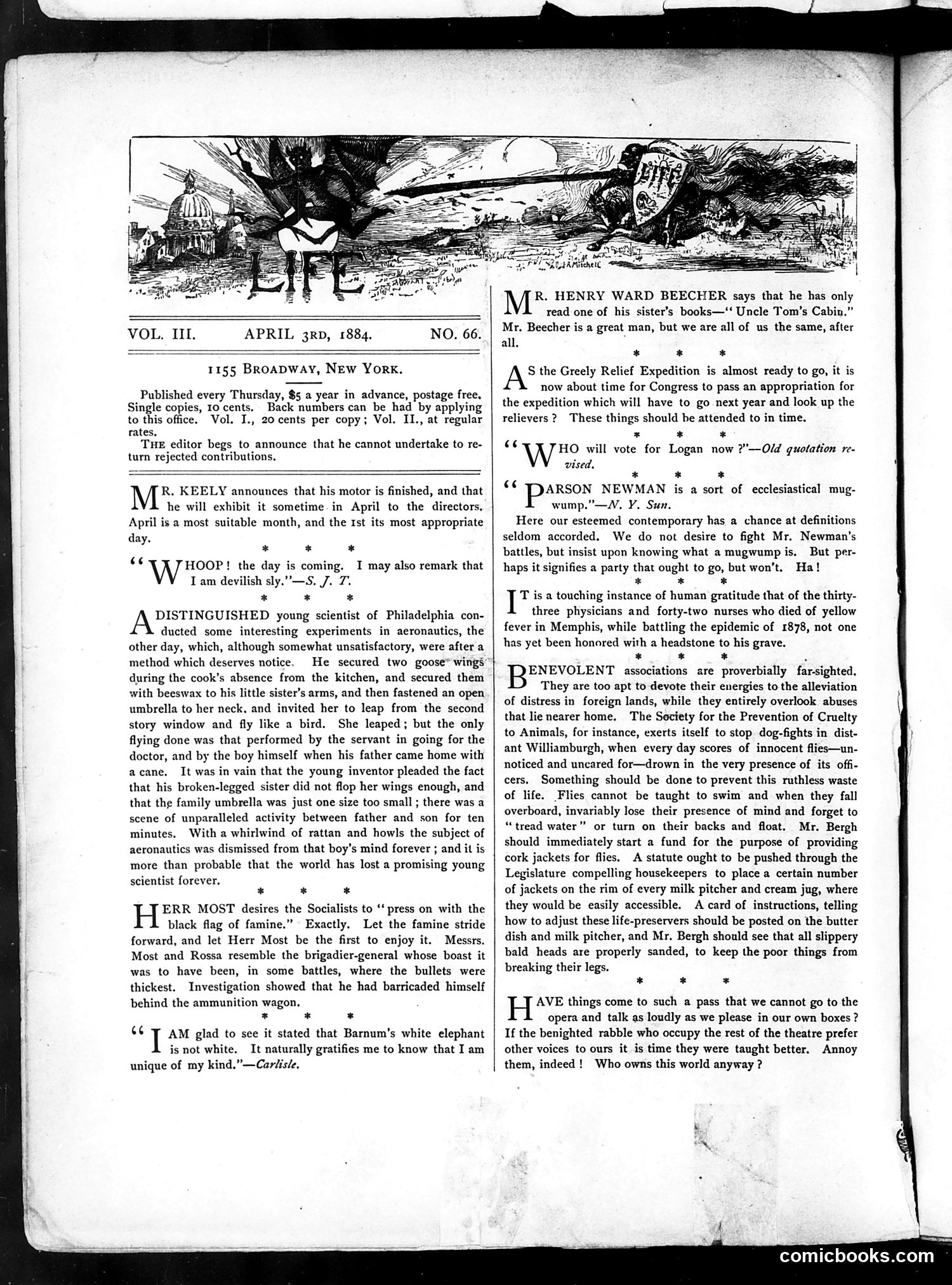
The masthead cartoon depicts "LIFE" as a figure emerging from or battling against dark, chaotic forces—likely representing death or societal disorder. The imagery is allegorical rather than topical. The page contains editorial snippets and social commentary rather than coherent political cartoons. Notable items include: - A jab at **Parson Newman**, called an "ecclesiastical mugwump" (a term for political independents), suggesting he represents wavering moral authority - Criticism of **benevolent associations** that ignore domestic suffering while focusing on foreign relief - Satire about theater etiquette and opera-goers disturbing fellow patrons - Commentary on **Barnum's white elephant**, suggesting skepticism about its authenticity The tone is typical of *Life's* sharp social satire—mocking hypocrisy, pretension, and moral inconsistency among prominent figures and institutions.
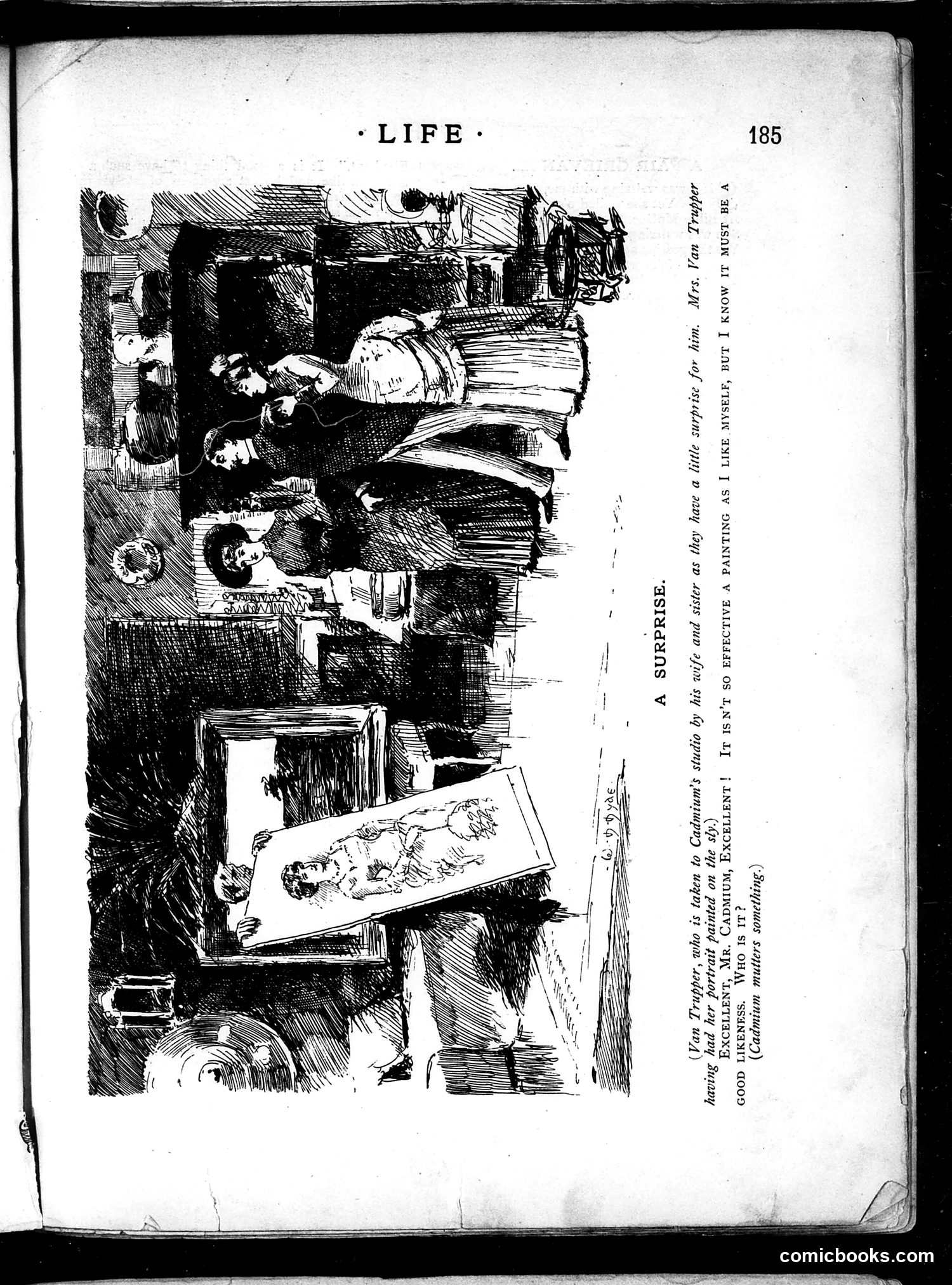
This satirical illustration depicts a domestic scene where a man appears to have been caught in an embarrassing or compromising situation. The sketch shows figures in what seems to be a bedroom or private room, with one person holding what appears to be a revealing drawing or photograph. The caption "A Surprise" suggests the humor derives from an unexpected discovery—likely a spouse or family member finding something they shouldn't. The text references "Ten Tripery" and mentions "Cabbarett stabs" and a "Cabinet" (possibly political), though the OCR text is unclear. Without clearer context about the specific historical event or individuals being satirized, the cartoon appears to mock infidelity, hypocrisy, or the gap between public propriety and private behavior—common targets of Life magazine's satire during the early 20th century.
This page contains literary reviews and social commentary rather than political cartoons. The main content includes: **"A Fair Grievance"** — a poem by Eleanor Putnam about a woman who gossiped about the author while walking together at Billie McGee's. **"An Unsatisfactory Interview"** — a humorous dialogue where an elderly woman rudely dismisses a young girl's name as "not polite," suggesting it's either Jane or Maria. The exchange satirizes rigid Victorian social conventions about proper female names. **Book reviews** discussing Charles Reade's "The White Elephant and Dynamite in Fiction," praising its realistic storytelling, and announcements about the *Commercial Advertiser* newspaper under new management and a Theodore Winthrop poetry collection. The page primarily offers social satire about manners and literary criticism rather than political content.
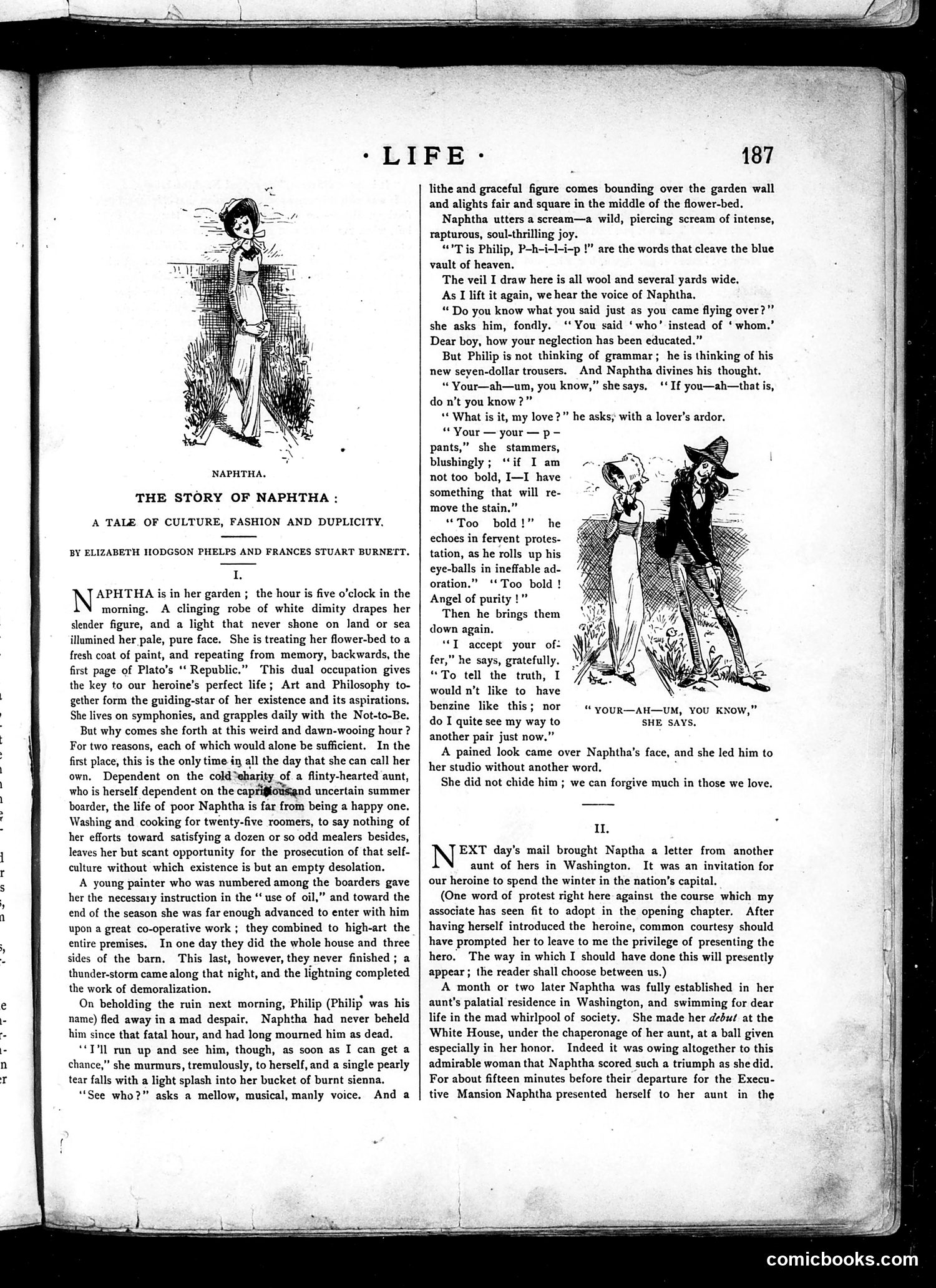
This page presents a serialized story titled "The Story of Naphtha: A Tale of Culture, Fashion and Duplicity" by Elizabeth Hodgson Phelps and Frances Stuart Burnett. The narrative follows Naphtha, a woman in her garden treating her flower-bed with a fresh coat of paint while rereading Plato's "Republic." The illustrations show Naphtha interacting with a young man named Philip. The story appears to satirize upper-class pretension—specifically how wealthy, educated women performed intellectual cultivation while managing domestic life. The juxtaposition of Naphtha's philosophical interests against the mundane reality of her existence (treating flowers with paint, domestic concerns) suggests the satire targets the gap between aspirational self-image and actual circumstances among the cultured elite.
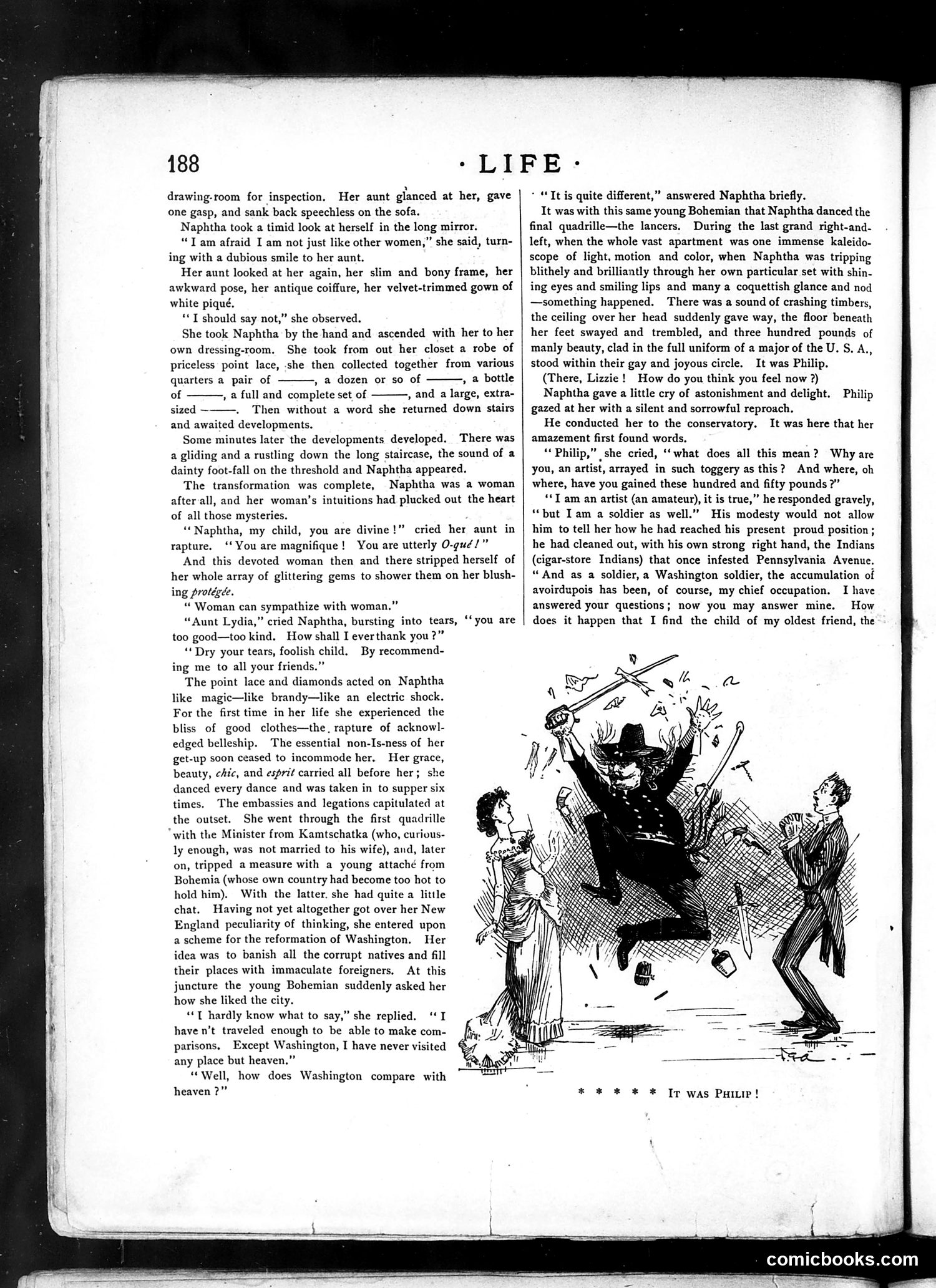
This page contains narrative fiction rather than political satire. The text describes a woman named Naphtha meeting a U.S. Army soldier named Philip at a social gathering in Washington, D.C. The accompanying illustration shows a man in military uniform dancing energetically with a woman in a dress, depicted in an exuberant, dynamic style typical of early 20th-century magazine illustration. The content satirizes Washington society and romantic encounters during what appears to be the World War I era, when soldiers were prominent in the capital. The humor derives from social situations rather than direct political commentary—the irony of a soldier claiming he's "cleaned out" Indians and Pennsylvania Avenue while now being a refined gentleman in civilized society. This is primarily entertainment fiction, not political cartooning.
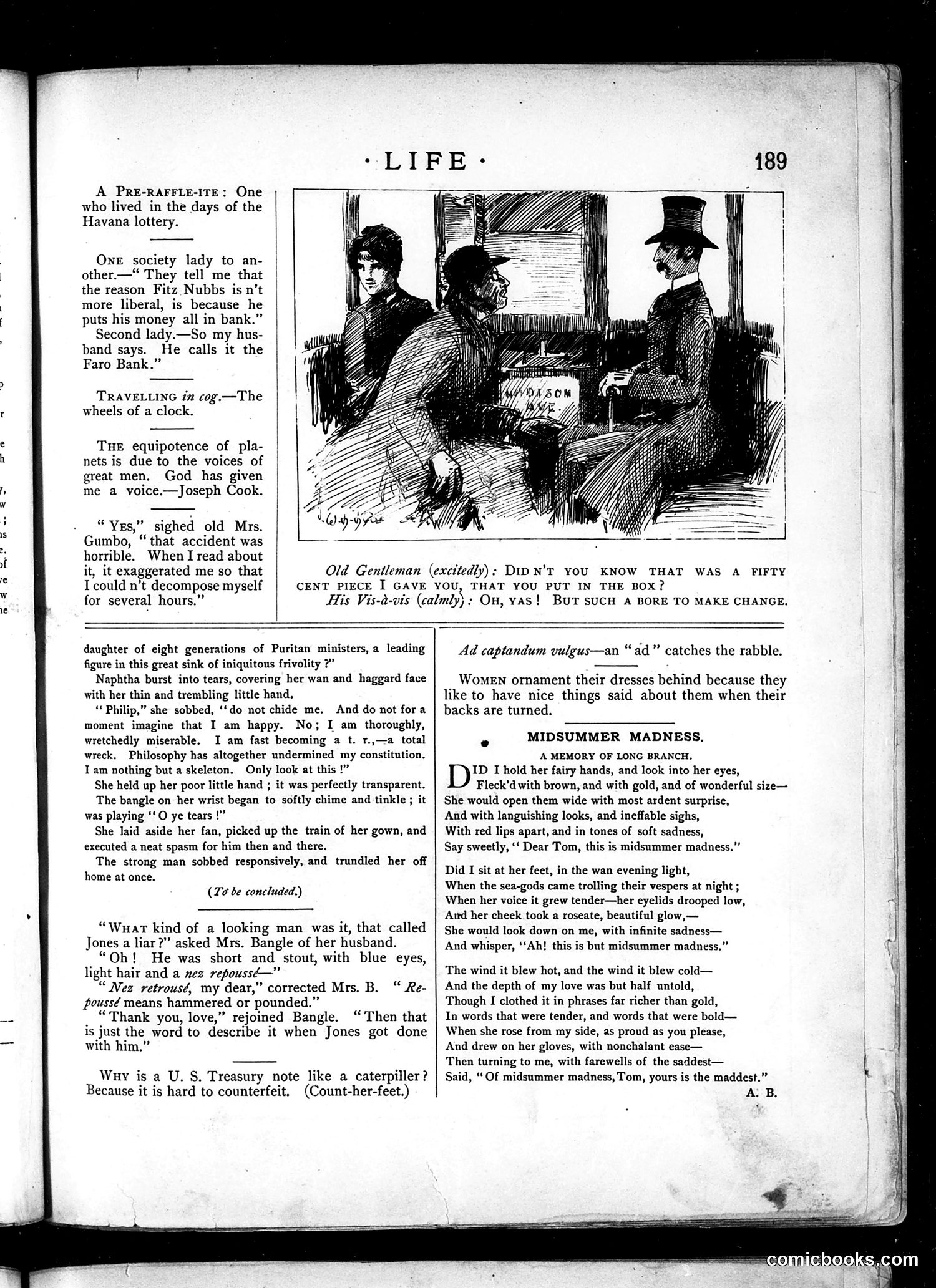
The main cartoon depicts three well-dressed men in what appears to be a bank or financial establishment. An elderly gentleman complains to a younger man that he gave him a fifty-cent piece to put in a box, which the younger man (labeled "Vis-à-vis") claims was so boring he had to make change from it. **The satire:** This is a commentary on financial irresponsibility and the casual attitude toward money among banking or business professionals. The joke suggests that even small deposits are treated carelessly by those managing funds—the elderly man's modest contribution was deemed so uninteresting that it warranted immediate conversion, likely implying mismanagement or indifference to clients' modest savings. The page also contains unrelated humorous anecdotes and a poem titled "Midsummer Madness."
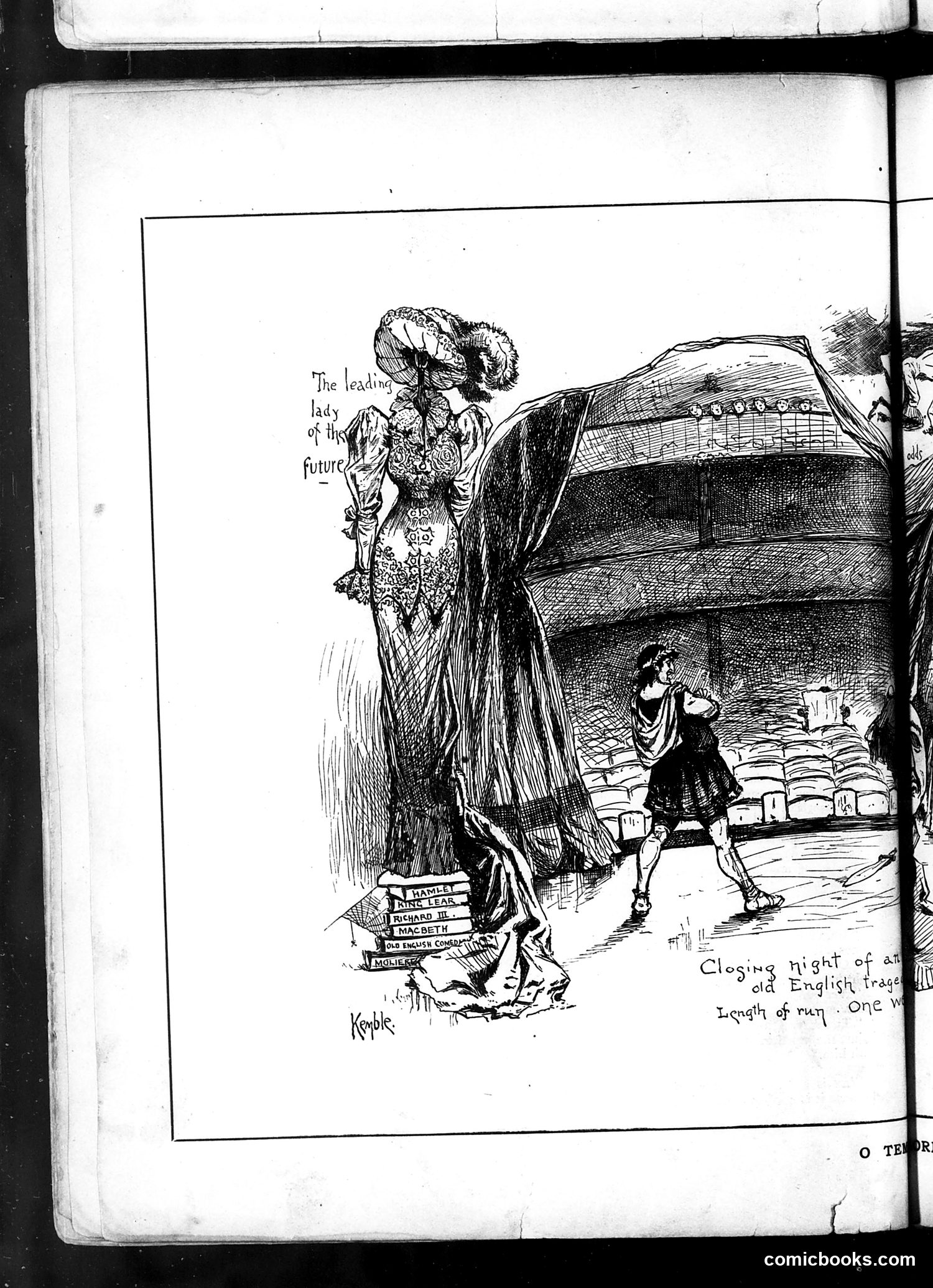
This illustration by Kemble depicts "The leading lady of the future" as an allegorical female figure standing over a stack of Shakespeare plays (*King Lear*, *Richard III*, *Macbeth*, *A Midsummer Night's Dream*, *Othello*). She's rendered as an elegant, elaborately dressed woman with a dramatic cloak, positioned above a theatrical scene with actors on stage. The satire likely critiques early 20th-century debates about women's roles in theater and society. The woman stands triumphantly over classic literature—suggesting women's growing influence in dramatic arts or perhaps ironically commenting on changing theatrical traditions. The caption references "closing night of an old English tragedy," implying these classical works are becoming obsolete, possibly replaced by modern sensibilities or women-centered entertainment. The exact political target remains somewhat unclear without additional context.
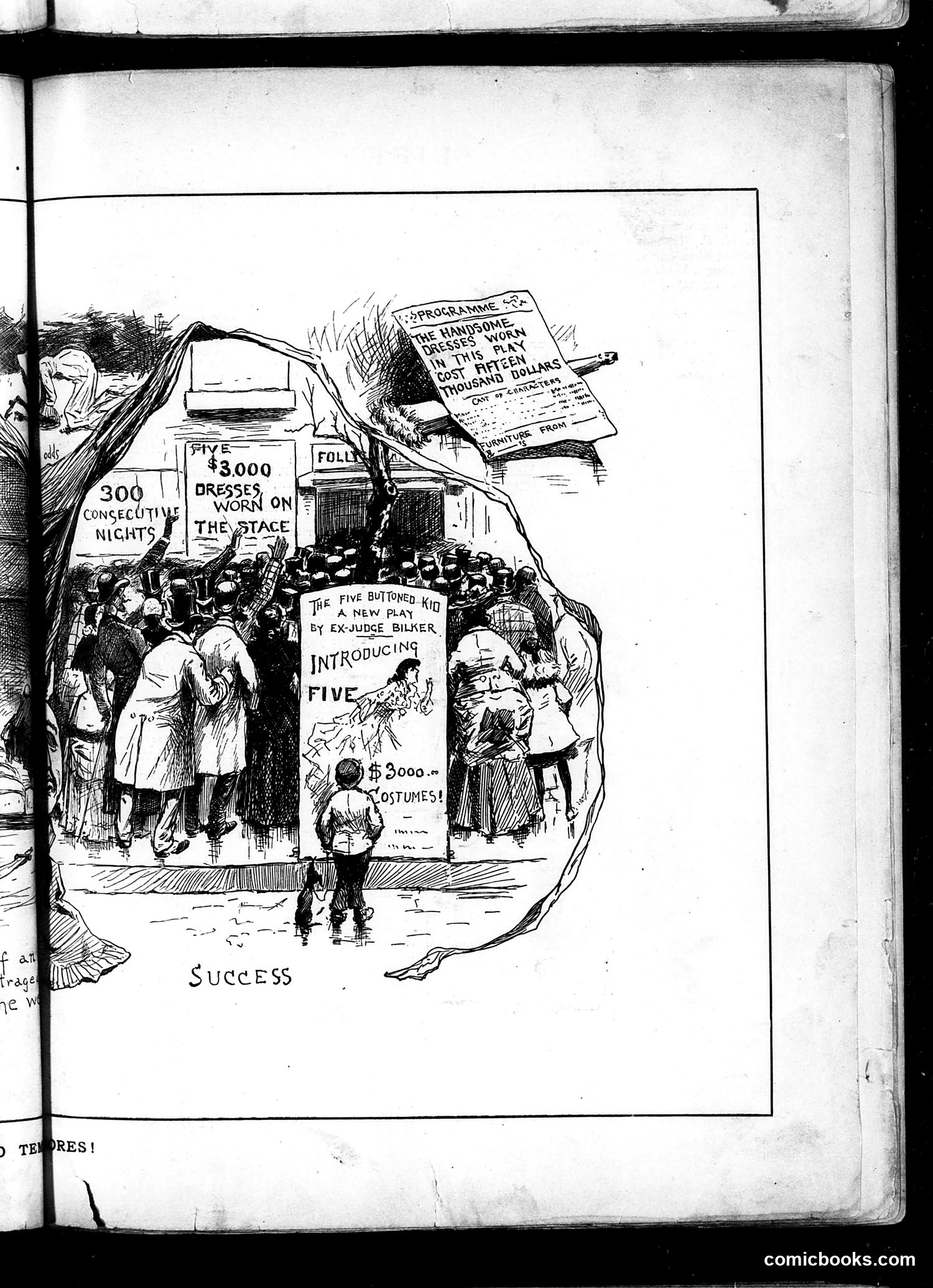
This is a satirical cartoon about theatrical success, labeled "SUCCESS." The image depicts a crowd of people gathered around theater playbills and advertisements. Key visible text includes: - "300 CONSECUTIVE NIGHTS" - "$3000 DRESSES WORN ON THE STAGE" - "THE HANDSOME HUSBAND" (a play title) - "THE FIVE BUTTONED KID - A NEW PLAY by EX-JUDGE BILKER" featuring "$3000 COSTUMES" - A "PROGRAMME" document The cartoon satirizes the theatrical industry's obsession with expensive production values—elaborate costumes, lengthy runs, and star-studded casts—as markers of commercial success. The crowded, enthusiastic audience suggests that audiences were drawn to spectacle and extravagance rather than artistic merit. The reference to "EX-JUDGE BILKER" may be a satirical jab at someone involved in theater production or investment during this era.
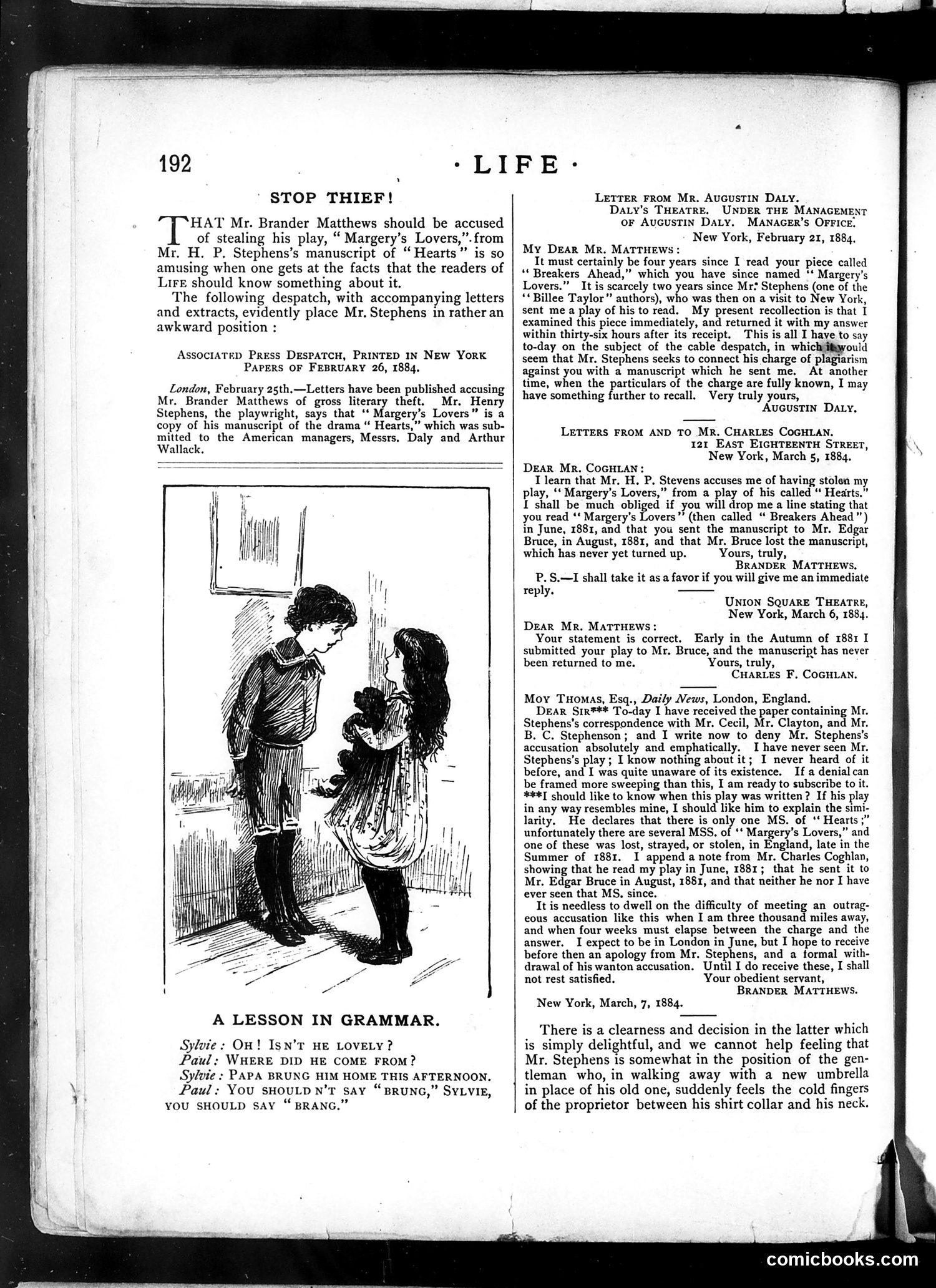
This page documents a real theatrical controversy: playwright Henry P. Stephens accused Brander Matthews of stealing his play "Hearts" and passing it off as "Margery's Lovers." The central cartoon (titled "A Lesson in Grammar") appears unrelated—it's a humorous sketch about a child mispronouncing "brought" as "brung," teaching proper English grammar. The bulk of the page comprises letters and a press dispatch settling the plagiarism claim. Augustin Daly (a major theater manager) states he received Stephens's manuscript but returned it within 36 hours. Matthews counters that he wrote "Breakers Ahead" (later renamed "Margery's Lovers") in 1881—before Stephens's version—and submitted it to Edgar Bruce, who lost the manuscript. A theater associate (Coghlan) corroborates Matthews's timeline. The satire's point: despite Stephens's accusation, the evidence suggests Matthews's play predates Stephens's, undermining the theft claim. The page presents this as absurdly overwrought theatrical drama.
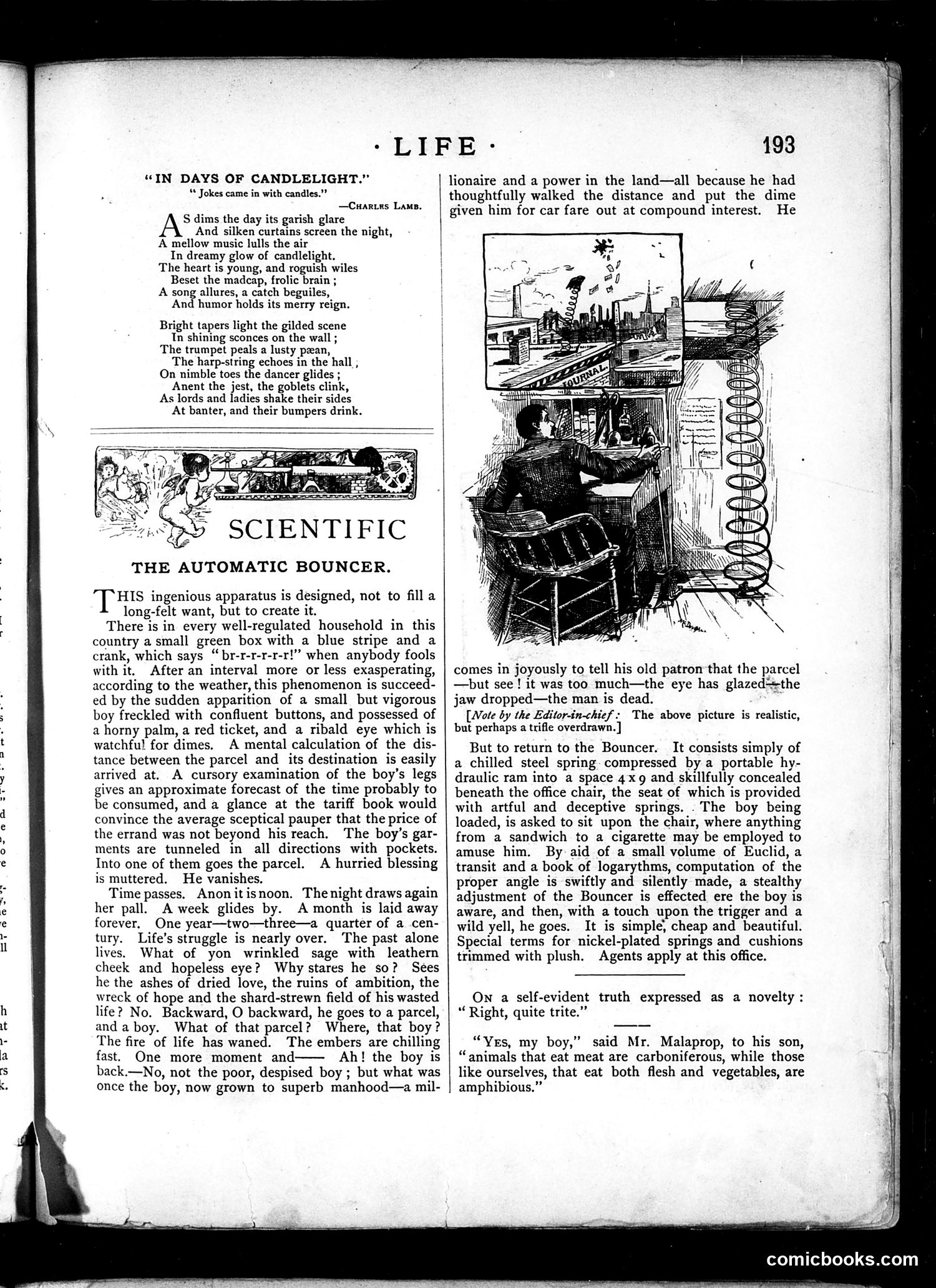
This page satirizes the unreliability of messenger boys delivering parcels in early 20th-century America. The "Automatic Bouncer" is a fictional spring-loaded chair device designed to literally launch delivery boys into action—a joke about their notorious slowness and unreliability. The accompanying narrative mocks this absurdity by exaggerating the wait time: a man sends a parcel via messenger boy and ages decades waiting for delivery. The boy eventually returns as a wealthy adult who invested the carfare money at compound interest—satirizing both the boy's original irresponsibility and the man's faith in an impossible system. The satire targets the inefficiency of messenger services and the absurd lengths one might go to force compliance. The editor's note ("perhaps a trifle overdrawn") adds self-aware humor, acknowledging the ridiculous exaggeration while implying the underlying complaint about slow service is valid.
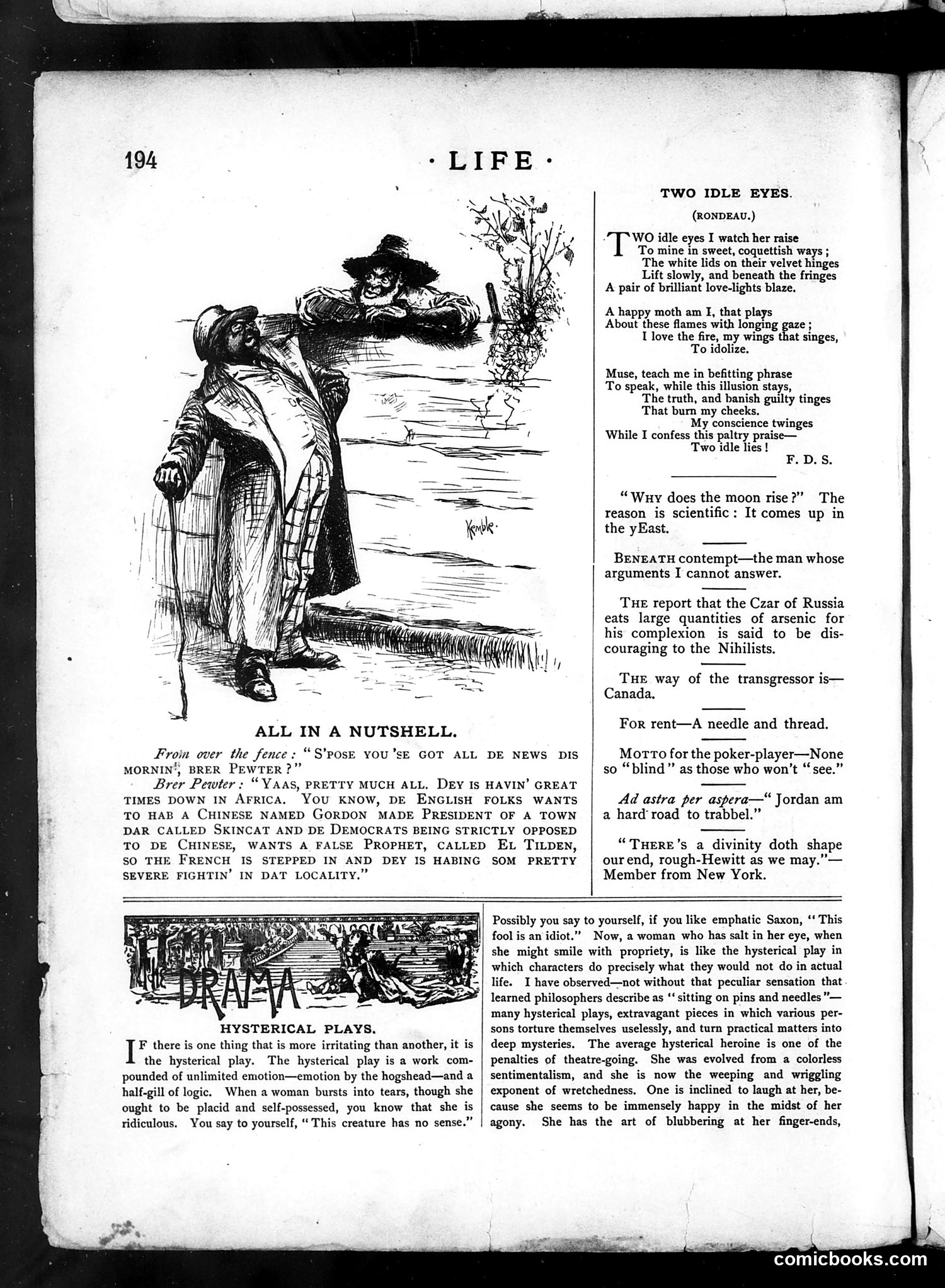
This cartoon depicts two African American men in conversation (rendered in period dialect), discussing international news. The main satirical target appears to be confusion and chaos surrounding **Gordon, a Chinese man made president of a town called "Skincat"** in Africa. The joke hinges on absurdist conflict: English support for Gordon versus Democratic opposition to Chinese leadership, with the French allegedly intervening militarily. The satire mocks **American political ignorance about foreign affairs**—the characters treat a fabricated, implausible scenario as real news. The casual, joking tone about conflict suggests contemporary skepticism toward sensational overseas reporting or concern-mongering. The page also contains an unrelated poem about romantic temptation ("Two Idle Eyes") and brief satirical quips targeting political figures and social pretension—typical Life magazine fare mixing humor about romance, politics, and theatrical melodrama.
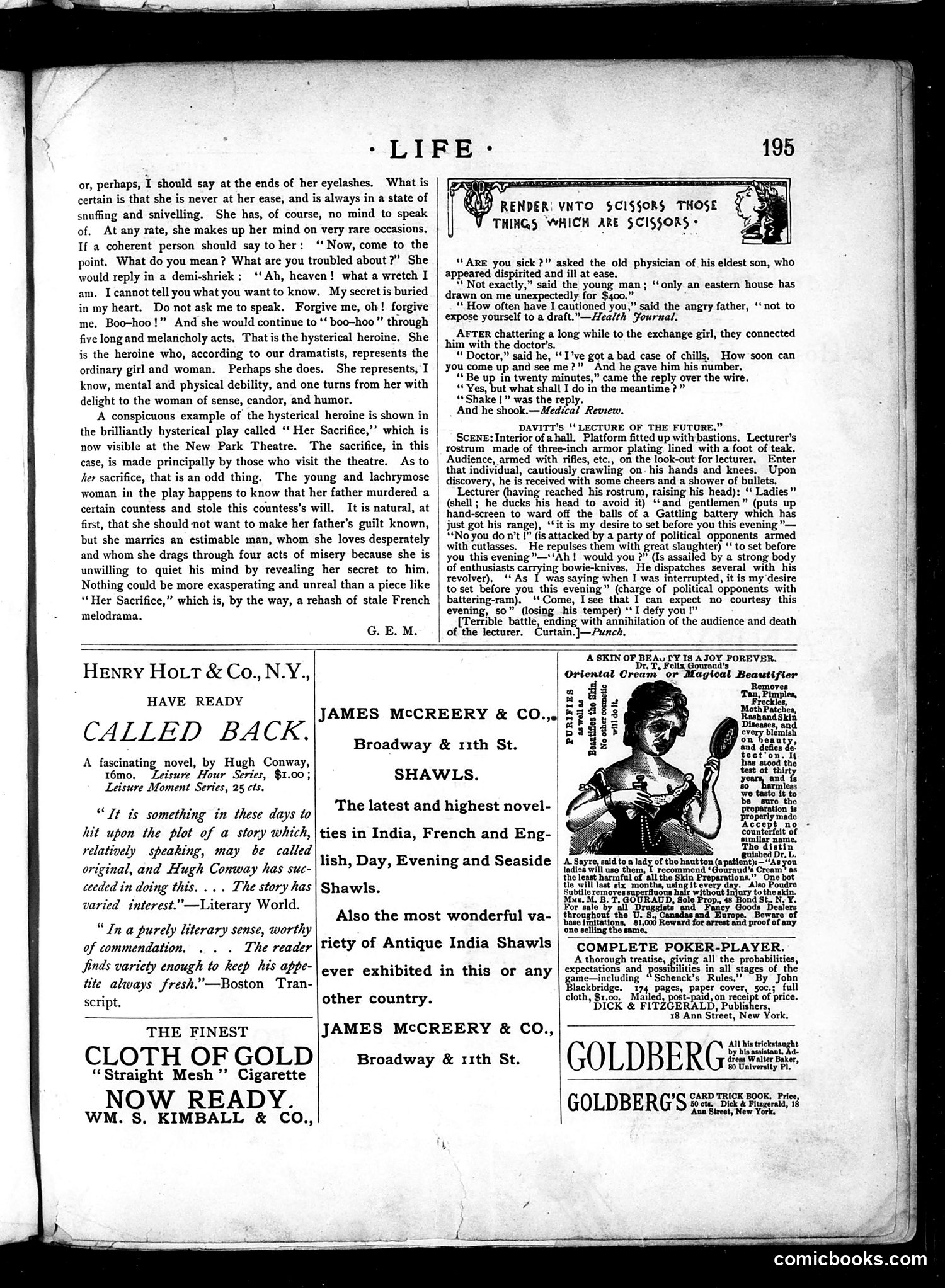
This page contains primarily **literary criticism and advertisements** rather than political cartoons. The main content is a theater review criticizing the play "Her Sacrifice" at the New Park Theatre. The critic attacks the "hysterical heroine" archetype—a stock character in melodrama who is emotionally unstable, indecisive, and drags others through suffering. The play's plot exemplifies this: a woman knows her father committed murder but torments her devoted husband for four acts rather than simply telling him the truth. The review dismisses this as an "exasperating and unreal" rehash of stale French melodrama that represents "mental and physical debility" rather than authentic womanhood. **The humorous sidebar pieces** ("Are you sick?", "After chattering," "Davitt's Lecture") are brief joke columns typical of Life's satirical format—wordplay and absurdist scenarios with punchlines. **Advertisements** for books and products occupy the lower portion, including "Called Back" by Hugh Conway and shawls from James McCreery & Co.
This is primarily an **advertising and announcements page** rather than a satirical cartoon page. The content consists mostly of period advertisements and theater notices. The only satirical content appears in the **brief humor items** scattered throughout: 1. **Tennyson/Barkeeper joke**: Plays on "ode" (poem) vs. "owed" (debt), comparing the poet's refined slate-writing to a bartender's crude IOUs. 2. **Stage driver anecdote**: A young woman absent-mindedly compliments the driver's mustache instead of properly thanking him for the ride—satirizing female absent-mindedness or romantic distraction. 3. **Jumbo elephant jokes**: References the famous circus elephant "Jumbo," using his massive size for humorous comparisons about measurements and female vanity. These are light, genteel Victorian-era humor pieces. The page primarily showcases **1880s consumer culture**: hosiery, candy, corsets, hotels, perfumes, whiskey, and fountain pens—reflecting Life's function as both satirical publication and advertising vehicle.
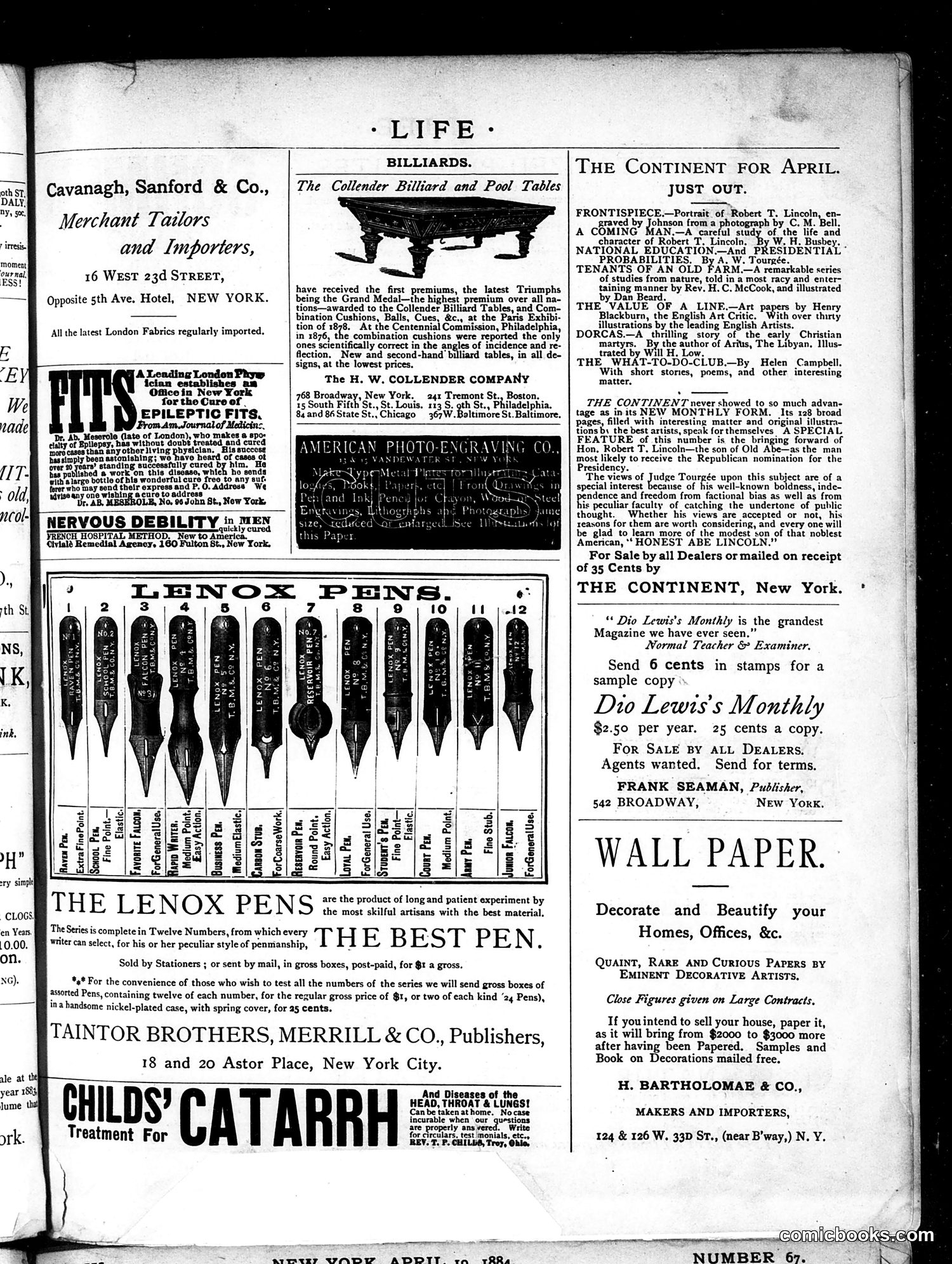
This page is primarily **advertising and table of contents** for *Life* magazine's April issue, with minimal editorial cartooning. The significant political content is the **frontispiece portrait of Robert T. Lincoln** and accompanying article titled "A Coming Man." Robert T. Lincoln (son of Abraham Lincoln) is being presented as a potential Republican presidential candidate. The text emphasizes his character and fitness for high office, calling him "the modest son of that noblest American, HONEST ABE LINCOLN." Judge Tourgée's accompanying analysis suggests Lincoln is "most likely to receive the Republican nomination for the Presidency"—this reflects real 1884 pre-election speculation about Lincoln as a successor candidate. The remainder of the page consists of **product advertisements** (billiard tables, Lenox pens, wallpaper, medical remedies) and magazine subscription promotions typical of 19th-century periodicals. No satirical cartoon is visible—the page functions primarily as promotional and editorial material.
This page is primarily **advertising**, typical of 19th-century magazine layouts. The left side features patent medicines and remedies—Crosby's Phosphites, Murray's Charcoal Tablets, Cuticura products—targeting ailments like dyspepsia, skin conditions, and "nervous disorders." The prominent illustrated ad shows a woman's profile with text praising Cuticura remedies, a common marketing approach of the era. Another notable ad features Spiegelshall natural bitter-water, endorsed by period medical authorities. The right side advertises consumer goods: Sohmer pianos (award-winning), Hartshorns window rollers, and Pope bicycles/tricycles. The bicycle ad includes an illustration of riders, reflecting the late-19th-century cycling craze. **There is no political cartoon visible on this page.** The small illustrations are product advertisements, not satirical commentary. This appears to be a standard commercial page from Life magazine's early period, when advertising revenue dominated its content.