
Life, 1884-04-03 · page 6 of 16
Life — April 3, 1884 — page 6: what you’re looking at
What you’re looking at
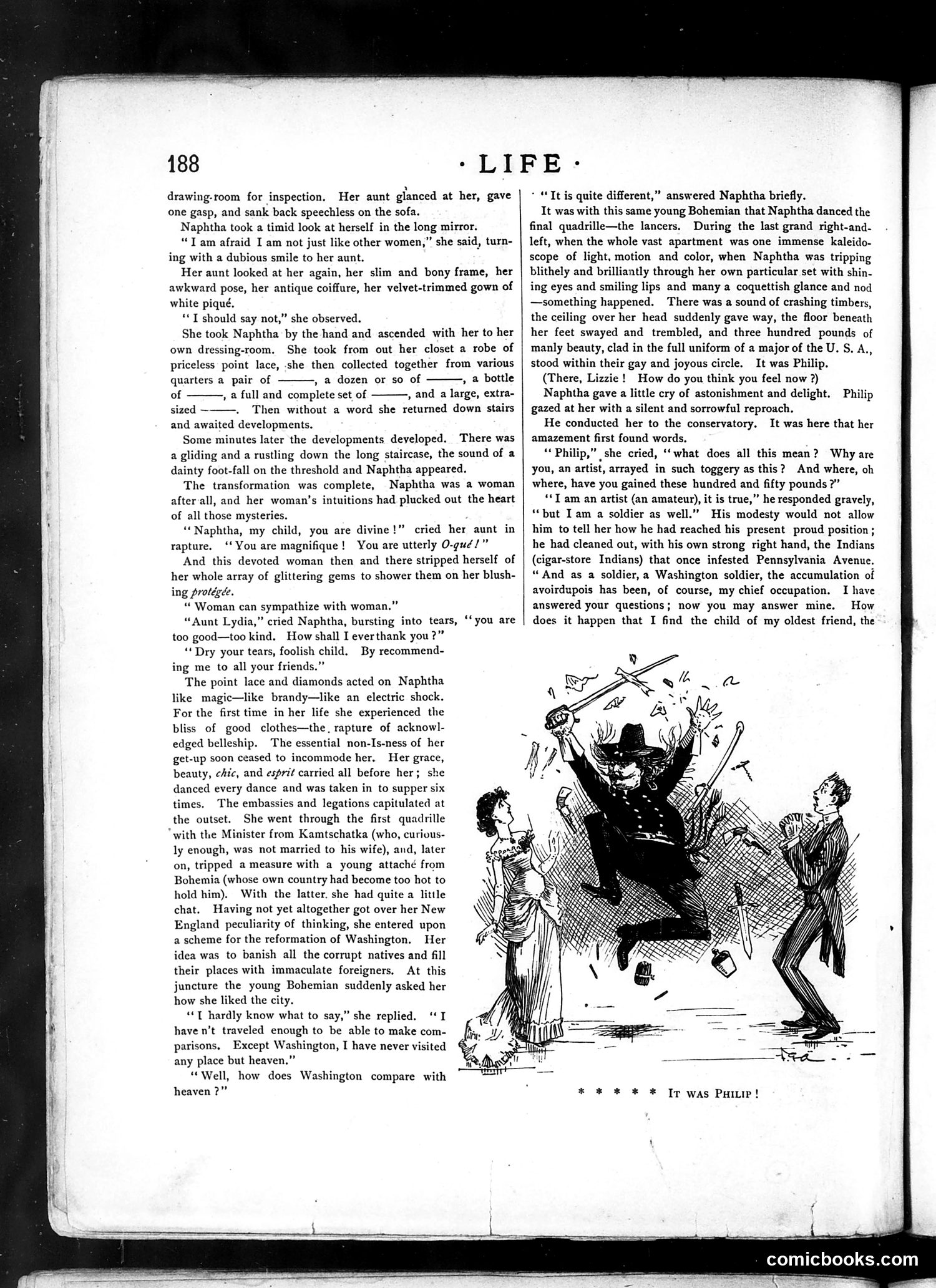
This page contains narrative fiction rather than political satire. The text describes a woman named Naphtha meeting a U.S. Army soldier named Philip at a social gathering in Washington, D.C. The accompanying illustration shows a man in military uniform dancing energetically with a woman in a dress, depicted in an exuberant, dynamic style typical of early 20th-century magazine illustration. The content satirizes Washington society and romantic encounters during what appears to be the World War I era, when soldiers were prominent in the capital. The humor derives from social situations rather than direct political commentary—the irony of a soldier claiming he's "cleaned out" Indians and Pennsylvania Avenue while now being a refined gentleman in civilized society. This is primarily entertainment fiction, not political cartooning.
📄 Transcribed text from this page (OCR, searchable)
Machine-transcribed from the original scan — historical spelling and the odd misread are preserved.
188 drawing-room for inspection. Her aunt glanced at her, gave one gasp, and sank back speechless on the sofa. Naphtha took a timid look at herself in the long mirror. “Tam afraid I am not just like other women,” she said, turn- ing with a dubious smile to her aunt. Her aunt looked at her again, her slim and bony frame, her awkward pose, her antique coiffure, her velvet-trimmed gown of white piqué, “«T should say not,” she observed. She took Naphtha by the hand and ascended with her to her own dressing-room. She took from out her closet a robe of priceless point lace, she then collected together from various quarters a pair of , a dozen or so of , a bottle of , a full and complete set of , and a large, extra- sized — Then without a word she returned down stairs and awaited developments. Some minutes later the developments developed. There was a gliding and a rustling down the long staircase, the sound of a dainty foot-fall on the threshold and Naphtha appeared. The transformation was complete, Naphtha was a woman after all, and her woman’s intuitions had plucked out the heart of all those mysteries. “‘Naphtha, my child, you are divine!” cried her aunt in rapture. ‘You are magnifique! You are utterly O-gu¢é/” ‘And this devoted woman then and there stripped herself of her whole array of glittering gems to shower them on her blush- ing protégde. “ Woman can sympathize with woman.” “Aunt Lydia,” cried Naphtha, bursting into tears, ‘‘ you are too good—too kind. How shall I everthank you?” “Dry your tears, foolish child. By recommend- ing me to all your friends.” The point lace and diamonds acted on Naphtha like magic—like brandy—like an electric shock. For the first time in her life she experienced the bliss of good clothes—the, rapture of acknowl- edged belleship. The essential non-Is-ness of her get-up soon ceased to incommode her. Her grace, beauty, chic, and esprit carried all before her; she danced every dance and was taken in to supper six times. The embassies and legations capitulated at the outset. She went through the first quadrille “with the Minister from Kamtschatka (who, curious- ly enough, was not married to his wife), and, later on, tripped a measure with a young attaché from Bohemia (whose own country had become too hot to hold him). With the latter. she had quite a little chat. Having not yet altogether got over her New England peculiarity of thinking, she entered upon a scheme for the reformation of Washington. Her idea was to banish all the corrupt natives and fill their places with immaculate foreigners. At this juncture the young Bohemian suddenly asked her how she liked the city. “*T hardly know what to say,” she replied. ‘I have n’t traveled enough to be able to make com- parisons, Except Washington, I have never visited any place but heaven.” “Well, how does Washington compare with heaven ?” - LIFE: * “Tt is quite different,” answered Naphtha briefly. It was with this same young Bohemian that Naphtha danced the final quadrille—the lancers. During the last grand right-and- left, when the whole vast apartment was one immense kaleido- scope of light, motion and color, when Naphtha was tripping blithely and brilliantly through her own particular set with shin- ing eyes and smiling lips and many a coquettish glance and nod —something happened. There was a sound of crashing timbers, the ceiling over her head suddenly gave way, the floor beneath her feet swayed and trembled, and three hundred pounds of manly beauty, clad in the full uniform of a major of the U. S. A., stood within their gay and joyous circle. It was Philip. (There, Lizzie! How do you think you feel now ?) Naphtha gave a little cry of astonishment and delight. gazed at her with a silent and sorrowful reproach. He conducted her to the conservatory. It was here that her amazement first found words, “Philip,” she cried, “‘what does all this mean? Why are you, an artist, arrayed in such toggery as this? And where, oh where, have you gained these hundred and fifty pounds ?” “*T am an artist (an amateur), it is true,” he responded gravely, “but Iam a soldier as well.” His modesty would not allow him to tell her how he had reached his present proud position ; he had cleaned out, with his own strong right hand, the Indians (cigar-store Indians) that once infested Pennsylvania Avenue. “And as a soldier, a Washington soldier, the accumulation of avoirdupois has been, of course, my chief occupation. answered your questions; now you may answer mine. Philip T have How does it happen that I find the child of my oldest friend, the * * * * * Tr was PHILIP!