
Life, 1884-04-03 · page 4 of 16
Life — April 3, 1884 — page 4: what you’re looking at
What you’re looking at
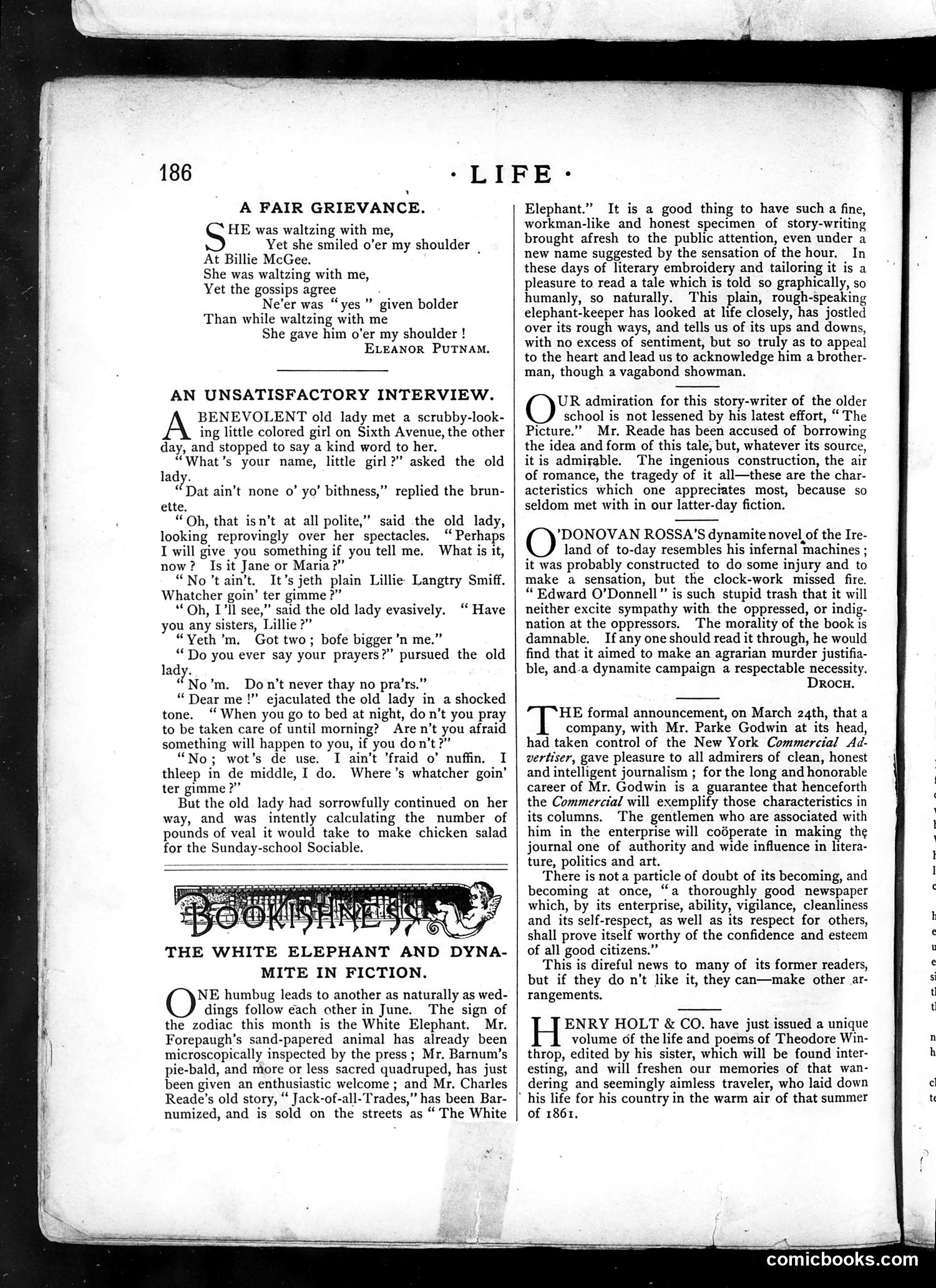
This page contains literary reviews and social commentary rather than political cartoons. The main content includes: **"A Fair Grievance"** — a poem by Eleanor Putnam about a woman who gossiped about the author while walking together at Billie McGee's. **"An Unsatisfactory Interview"** — a humorous dialogue where an elderly woman rudely dismisses a young girl's name as "not polite," suggesting it's either Jane or Maria. The exchange satirizes rigid Victorian social conventions about proper female names. **Book reviews** discussing Charles Reade's "The White Elephant and Dynamite in Fiction," praising its realistic storytelling, and announcements about the *Commercial Advertiser* newspaper under new management and a Theodore Winthrop poetry collection. The page primarily offers social satire about manners and literary criticism rather than political content.
📄 Transcribed text from this page (OCR, searchable)
Machine-transcribed from the original scan — historical spelling and the odd misread are preserved.
186 A FAIR GRIEVANCE. HE was waltzing with me, Yet she smiled o’er my shoulder | At Billie McGee. She was waltzing with me, Yet the gossips agree Ne’er was “yes ” given bolder Than while waltzing with me She gave him o’er my shoulder ! ELEANOR PuTNaM. AN UNSATISFACTORY INTERVIEW. BENEVOLENT old lady met a scrubby-look- ing little colored girl on Sixth Avenue, the other day, and stopped to say a kind word to her. “What’s your name, little girl?” asked the old lady. “Dat ain’t none o’ yo’ bithness,” replied the brun- ette. “Oh, that isn’t at all polite,” said the old lady, looking reprovingly over her spectacles. “ Perhaps I will give you something if you tell me. What is it, now? Is it Jane or Maria?” “No 't ain’t. It’s jeth plain Lillie Langtry Smiff. Whatcher goin’ ter gimme ?” “Oh, I'll see,” said the old lady evasively. you any sisters, Lillie?” “Yeth ’m. Got two; bofe bigger ’n me.” “Do you ever say your prayers?” pursued the old lady. “No’m. Don’t never thay no pra’rs.” “Dear me!” ejaculated the old lady in a shocked tone. ‘“ When you go to bed at night, don’t you pray to be taken care of until morning? Are n’t you afraid something will happen to you, if you don’t?” “No; wot’s de use. I ain’t ’fraid o’ nuffin. I thleep in de middle, I do. Where’s whatcher goin’ ter gimme ?” But the old lady had sorrowfully continued on her way, and was intently calculating the number of pounds of veal it would take to make chicken salad for the Sunday-school Sociable. “ Have THE WHITE ELEPHANT AND DYNA- MITE IN FICTION. NE humbug leads to another as naturally as wed- dings follow each other in June. The sign of the zodiac this month is the White Elephant. Mr. Forepaugh’s sand-papered animal has already been microscopically inspected by the press ; Mr. Barnum’s pie-bald, and more or less sacred quadruped, has just been given an enthusiastic welcome ; and Mr. Charles Reade’s old story, “ Jack-of-all-Trades,” has been Bar- numized, and is sold on the streets as “ The White - LIFE: Elephant.” It is a good thing to have such a fine, workman-like and honest specimen of story-writing brought afresh to the public attention, even under a new name suggested by the sensation of the hour. In these days of literary embroidery and tailoring it is a pleasure to read a tale which is told so graphically, so humanly, so naturally. This plain, rough-speaking elephant-keeper has looked at life closely, has jostled over its rough ways, and tells us of its ups and downs, with no excess of sentiment, but so truly as to appeal to the heart and lead us to acknowledge him a brother- man, though a vagabond showman. UR admiration for this story-writer of the older school is not lessened by his latest effort, “ The Picture.” Mr. Reade has been accused of borrowing the idea and form of this tale, but, whatever its source, it is admirable. The ingenious construction, the air of romance, the tragedy of it all—these are the char- acteristics which one appreciates most, because so seldom met with in our latter-day fiction. Oe ROSSA’S dynamite novel of the Ire- land of to-day resembles his infernal machines ; it was probably constructed to do some injury and to make a sensation, but the clock-work missed fire. “ Edward O’Donnell” is such stupid trash that it will neither excite sympathy with the oppressed, or indig- nation at the oppressors. The morality of the book is damnable. If any one should read it through, he would find that it aimed to make an agrarian murder justifia- ble, and.a dynamite campaign a respectable necessity. Drocu. HE formal announcement, on March 24th, that a company, with Mr. Parke Godwin at its head, had taken control of the New York Commercial Ad- vertiser, gave pleasure to all admirers of clean, honest and intelligent journalism ; for the long and honorable career of Mr. Godwin is a guarantee that henceforth the Commercial will exemplify those characteristics in its columns. The gentlemen who are associated with him in the enterprise will codperate in making the journal one of authority and wide influence in litera- ture, politics and art. There is not a particle of doubt of its becoming, and becoming at once, “a thoroughly good newspaper which, by its enterprise, ability, vigilance, cleanliness and its self-respect, as well as its respect for others, shall prove itself worthy of the confidence and esteem of all good citizens.” This is direful news to many of its former readers, but if they do n’t like it, they can—make other ar- rangements. ENRY HOLT & CO. have just issued a unique volume of the life and poems of Theodore Win- throp, edited by his sister, which will be found inter- esting, and will freshen our memories of that wan- dering and seemingly aimless traveler, who laid down ' his life for his country in the warm air of that summer of 1861. A comicbooks.com