
Life, 1884-04-03 · page 7 of 16
Life — April 3, 1884 — page 7: what you’re looking at
What you’re looking at
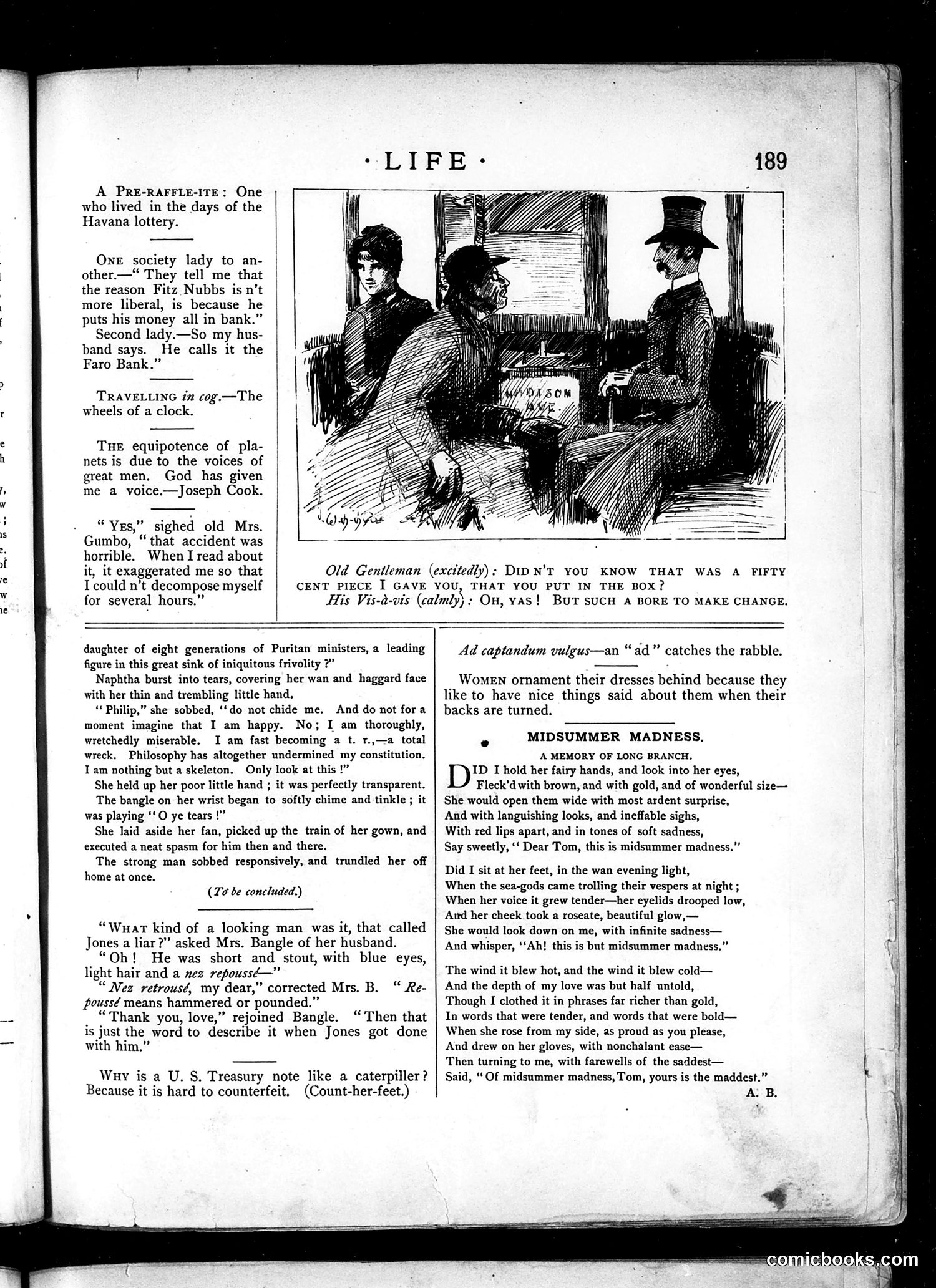
The main cartoon depicts three well-dressed men in what appears to be a bank or financial establishment. An elderly gentleman complains to a younger man that he gave him a fifty-cent piece to put in a box, which the younger man (labeled "Vis-à-vis") claims was so boring he had to make change from it. **The satire:** This is a commentary on financial irresponsibility and the casual attitude toward money among banking or business professionals. The joke suggests that even small deposits are treated carelessly by those managing funds—the elderly man's modest contribution was deemed so uninteresting that it warranted immediate conversion, likely implying mismanagement or indifference to clients' modest savings. The page also contains unrelated humorous anecdotes and a poem titled "Midsummer Madness."
📄 Transcribed text from this page (OCR, searchable)
Machine-transcribed from the original scan — historical spelling and the odd misread are preserved.
A PRE-RAFFLE-ITE: One who lived in the days of the Havana lottery. One society lady to an- other.—“ They tell me that the reason Fitz Nubbs is n’t more liberal, is because he puts his money all in bank.” Second lady.—So my hus- band says. He calls it the Faro Bank.” TRAVELLING i” cog.—The wheels of a clock. THE equipotence of pla- nets is due to the voices of great men. God has given me a voice.—Joseph Cook. “ Yes,” sighed old Mrs. Gumbo, “that accident was horrible. When I read about it, it exaggerated me so that Icould n’t decompose myself for several hours.” Old Gentleman (excitedly): Dip N’r YoU KNOW THAT WAS A FIFTY CENT PIECE I GAVE YOU, THAT YOU PUT IN THE BOX? His Vis-a-vis (calmly): Ou, yAS! Bur SUCH A BORE TO MAKE CHANGE. daughter of eight generations of Puritan ministers, a leading figure in this great sink of iniquitous frivolity ?” Naphtha burst into tears, covering her wan and haggard face with her thin and trembling little hand. “Philip,” she sobbed, ‘‘do not chide me. And do not fora moment imagine that I am happy. No; I am thoroughly, wretchedly miserable. I am fast becoming a t. r.,—a total wreck. Philosophy has altogether undermined my constitution. lam nothing but a skeleton. Only look at this !” She held up her poor little hand ; it was perfectly transparent. The bangle on her wrist began to softly chime and tinkle ; it was playing ‘‘O ye tears !”” She laid aside her fan, picked up the train of her gown, and executed a neat spasm for him then and there. The strong man sobbed responsively, and trundled her off home at once. (To be concluded.) “Wuart kind of a looking man was it, that called Jones a liar?” asked Mrs. Bangle of her husband. “Oh! He was short and stout, with blue eyes, light hair and a mez repoussé—" “Nez retrousé, my dear,” corrected Mrs. B. poussé means hammered or pounded.” “Thank you, love,” rejoined Bangle. “Then that is just the word to describe it when Jones got done with him.” “© Ren Why is a U. S. Treasury note like a caterpiller? Because it is hard to counterfeit. (Count-her-feet.) Ad captandum vulgus—an “ad” catches the rabble. WomeEN ornament their dresses behind because they like to have nice things said about them when their backs are turned. MIDSUMMER MADNESS. A MEMORY OF LONG BRANCH. ID I hold her fairy hands, and look into her eyes, Fleck’d with brown, and with gold, and of wonderful size— She would open them wide with most ardent surprise, And with languishing looks, and ineffable sighs, With red lips apart, and in tones of soft sadness, Say sweetly, ‘‘ Dear Tom, this is midsummer madness.” Did I sit at her feet, in the wan evening light, When the sea-gods came trolling their vespers at night ; When her voice it grew tender—her eyelids drooped low, And her cheek took a roseate, beautiful glow,— She would look down on me, with infinite sadness— And whisper, ‘‘Ah! this is but midsummer madness.” The wind it blew hot, and the wind it blew cold— And the depth of my love was but half untold, Though I clothed it in phrases far richer than gold, In words that were tender, and words that were bold— When she rose from my side, as proud as you please, And drew on her gloves, with nonchalant ease— Then turning to me, with farewells of the saddest— Said, “Of midsummer madness, Tom, yours is the maddest.” A. B.