
Life, 1884-04-03 · page 5 of 16
Life — April 3, 1884 — page 5: what you’re looking at
What you’re looking at
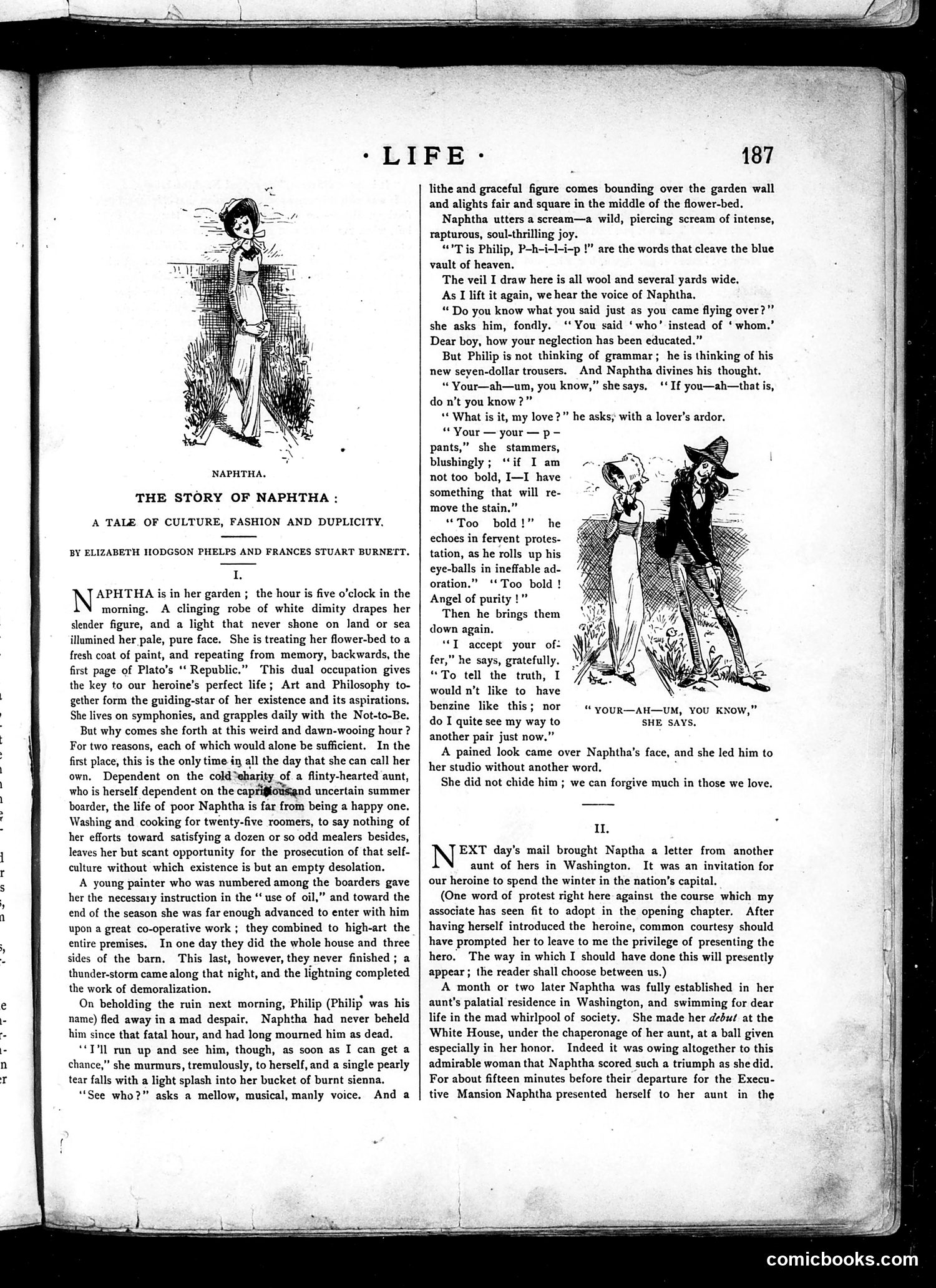
This page presents a serialized story titled "The Story of Naphtha: A Tale of Culture, Fashion and Duplicity" by Elizabeth Hodgson Phelps and Frances Stuart Burnett. The narrative follows Naphtha, a woman in her garden treating her flower-bed with a fresh coat of paint while rereading Plato's "Republic." The illustrations show Naphtha interacting with a young man named Philip. The story appears to satirize upper-class pretension—specifically how wealthy, educated women performed intellectual cultivation while managing domestic life. The juxtaposition of Naphtha's philosophical interests against the mundane reality of her existence (treating flowers with paint, domestic concerns) suggests the satire targets the gap between aspirational self-image and actual circumstances among the cultured elite.
📄 Transcribed text from this page (OCR, searchable)
Machine-transcribed from the original scan — historical spelling and the odd misread are preserved.
* LIFE - NAPHTHA. THE STORY OF NAPHTHA: A TALE OF CULTURE, FASHION AND DUPLICITY, BY ELIZABETH HODGSON PHELPS AND FRANCES STUART BURNETT. I APHTHA is in her garden ;_ the hour is five o’clock in the morning. A clinging robe of white dimity drapes her slender figure, and a light that never shone on land or sea illumined her pale, pure face. She is treating her flower-bed to a fresh coat of paint, and repeating from memory, backwards, the first page of Plato’s ‘‘ Republic.” ‘This dual occupation gives the key to our heroine’s perfect life; Art and Philosophy to- gether form the guiding-star of her existence and its aspirations. She lives on symphonies, and grapples daily with the Not-to-Be. But why comes she forth at this weird and dawn-wooing hour ? For two reasons, each of which would alone be sufficient. In the first place, this is the only time in all the day that she can call her own. Dependent on the cold°eharity of a flinty-hearted aunt, who is herself dependent on the caprigiougnd uncertain summer boarder, the life of poor Naphtha is far from being a happy one. Washing and cooking for twenty-five roomers, to say nothing of her efforts toward satisfying a dozen or so odd mealers besides, leaves her but scant opportunity for the prosecution of that self- culture without which existence is but an empty desolation. A young painter who was numbered among the boarders gave her the necessary instruction in the “‘ use of oil,” and toward the end of the season she was far enough advanced to enter with him upon a great co-operative work ; they combined to high-art the entire premises. In one day they did the whole house and three sides of the barn. This last, however, they never finished ; a thunder-storm came along that night, and the lightning completed the work of demoralization. On beholding the ruin next morning, Philip (Philip was his name) fled away in a mad despair, Naphtha had never beheld him since that fatal hour, and had long mourned him as dead. “T'll run up and see him, though, as soon as I can get a chance,” she murmurs, tremulously, to herself, and a single pearly tear falls with a light splash into her bucket of burnt sienna. “See who?” asks a mellow, musical, manly voice. And a 187 lithe and graceful figure comes bounding over the garden wall and alights fair and square in the middle of the flower-bed. Naphtha utters a scream—a wild, piercing scream of intense, rapturous, soul-thrilling joy. “’'T is Philip, P-h-i-l-i-p !” are the words that cleave the blue vault of heaven. The veil I draw here is all wool and several yards wide. As I lift it again, we hear the voice of Naphtha. “Do you know what you said just as you came flying over?” she asks him, fondly. ‘‘ You said ‘who’ instead of ‘ whom.’ Dear boy, how your neglection has been educated.” But Philip is not thinking of grammar; he is thinking of his ‘And Naphtha divines his thought. ‘If you—ah—that is, new seyen-dollar trousers. “ Your—ah—um, you know,” she says, do n’t you know?” ‘« What is it, my love?” he asks, with a lover’s ardor. “Your — your — p- pants,” she stammers, blushingly ; “if I am not too bold, I—I have something that will re- move the stain,” “Too bold!” he echoes in fervent protes- tation, as he rolls up his eye-balls in ineffable ad- oration.” ‘*Too bold ! Angel of purity !” Then he brings them down again. “I accept your of: fer,” he says, gratefully. “To tell the truth, I would n’t like to have benzine like this; nor do I quite see my way to another pair just now.” A pained look came over Naphtha’s face, and she led him to her studio without another word. : She did not chide him ; we can forgive much in those we love. “ YOUR—AH—UM, YOU KNOW,” SHE SAYS, IL. EXT day's mail brought Naptha a letter from another aunt of hers in Washington. It was an invitation for our heroine to spend the winter in the nation’s capital. (One word of protest right here against the course which my associate has seen fit to adopt in the opening chapter. After having herself introduced the heroine, common courtesy should have prompted her to leave to me the privilege of presenting the hero. The way in which I should have done this will presently appear; the reader shall choose between us.) A month or two later Naphtha was fully established in her aunt's palatial residence in Washington, and swimming for dear life in the mad whirlpool of society. She made her debut at the White House, under the chaperonage of her aunt, at a ball given especially in her honor. Indeed it was owing altogether to this admirable woman that Naphtha scored such a triumph as she did. For about fifteen minutes before their departure for the Execu- tive Mansion Naphtha presented herself to her aunt in the comicbooks.com