
A complete issue · 16 pages · 1884
Life — March 6, 1884
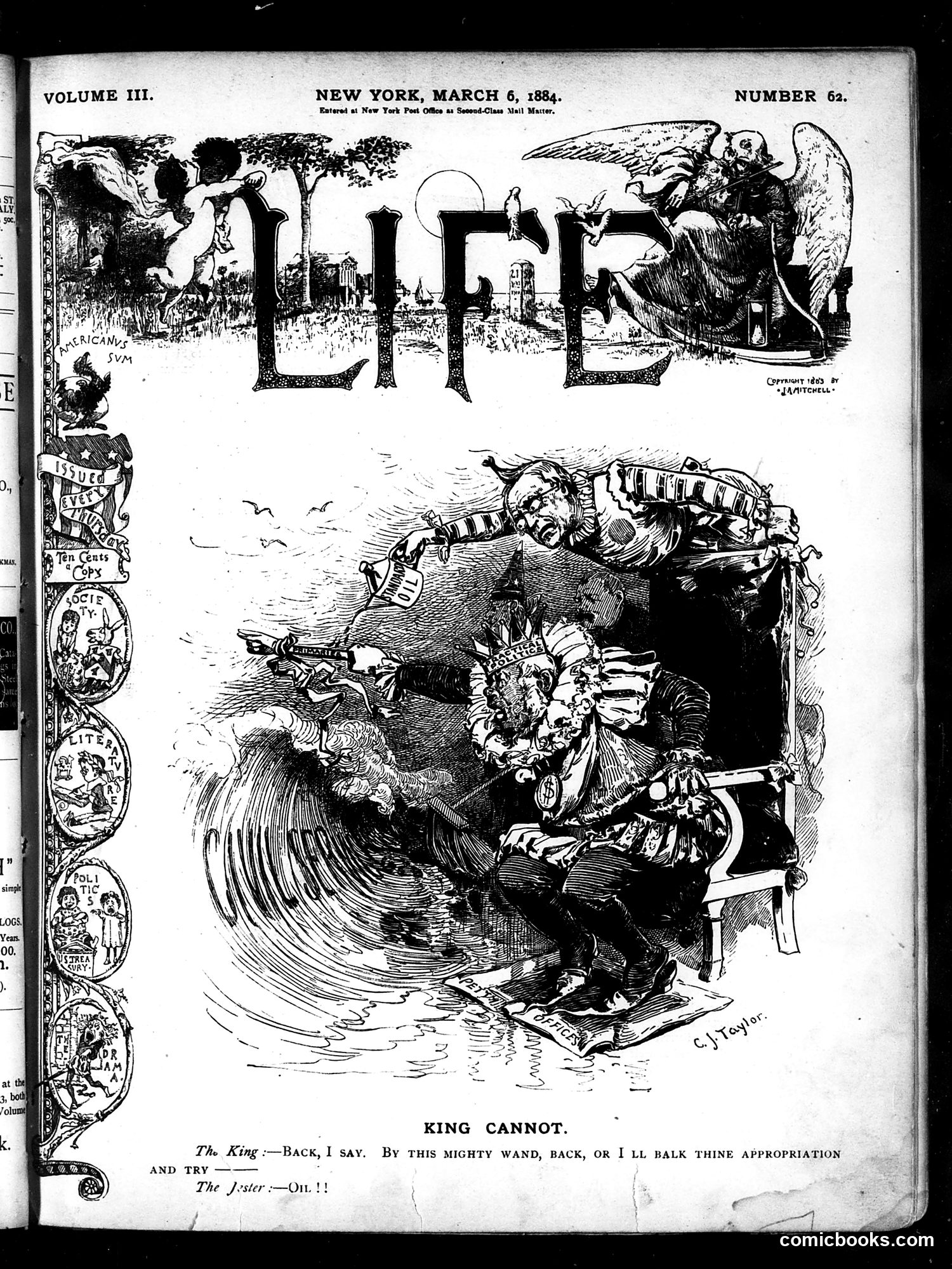
This political cartoon satirizes a powerful figure (likely a monarch or authoritarian ruler) being confronted by a jester or court fool. The central image shows an ornately-dressed, imperious character seated on a throne, confronted by a smaller figure with a magical wand or staff. The dialogue reads: "Back, I say. By this mighty wand, back, or I'll balk thine appropriation" / "Oh!!" The satire appears to criticize the limits on royal or executive power—specifically, that even a king cannot control all resources or authority when opposed by those holding financial power (suggested by "appropriation"). The jester's magical wand represents civil or parliamentary authority that can check the monarch's will. This likely reflects 1884 American political debates over executive versus legislative power.
The page contains a satirical story about a card game at the Thompson Street Poker Club involving characters named Mr. Williams and Rev. Mr. Smith. The narrative describes Mr. Williams cheating at poker—secretly counting money and hiding cards—then getting caught and physically assaulted by the reverend, who repeatedly "butts his head" against the floor. The cartoon's satire targets hypocrisy: a supposedly righteous clergyman abandons Christian values during a gambling dispute, becoming violent over a card game. The story mocks both characters—the cheating layman and the hypocritical reverend—reflecting 1880s concerns about urban vice, gambling, and the gap between religious profession and actual behavior. The humor relies on the incongruity of clergy engaging in rough street-level altercations.
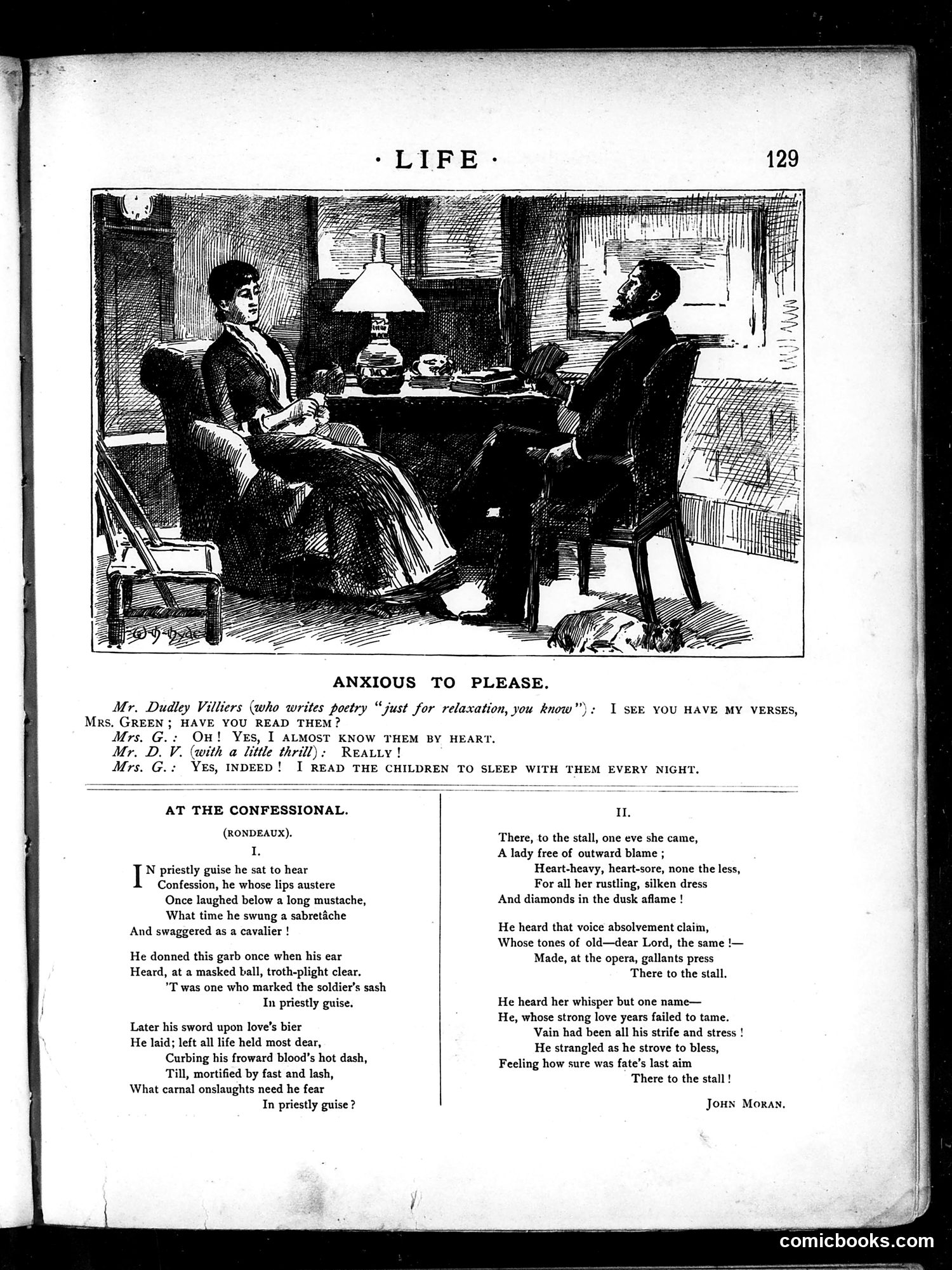
The cartoon depicts a social comedy about literary pretension. Mr. Dudley Villiers, identified as a poet who writes "just for relaxation," shows his verses to Mrs. Green. She claims to know them by heart and reads them to her children at bedtime—flattery clearly designed to please the amateur poet. The satire targets both parties: Villiers' vanity in seeking validation for his casual verse-writing, and Mrs. Green's transparent social maneuvering through exaggerated praise. The humor lies in the mutual performance—neither party is genuine. The accompanying poem "At the Confessional" by John Moran provides thematic reinforcement about hidden truths beneath polite social interaction, suggesting that such drawing-room conversations mask deeper, more complicated realities.
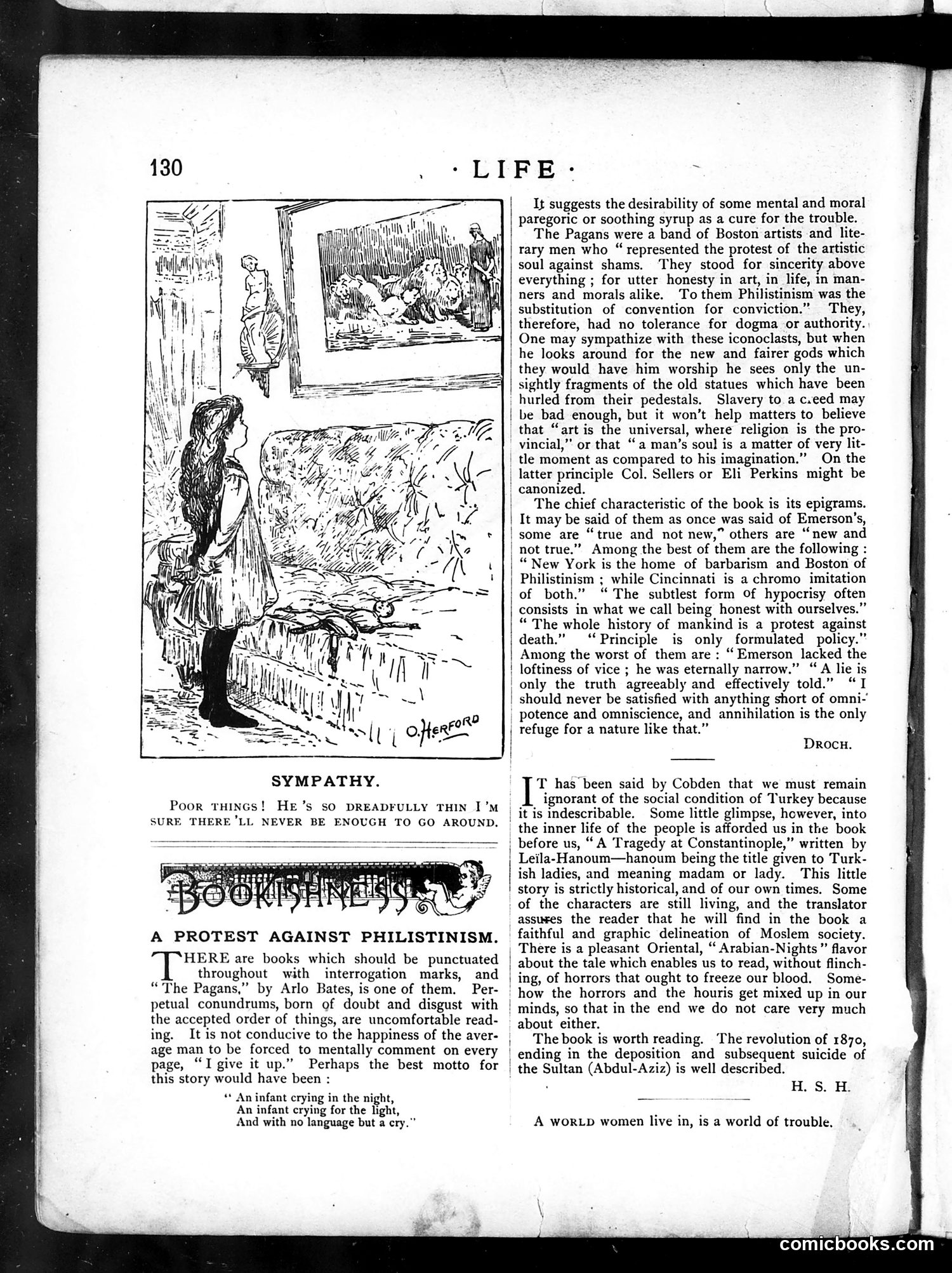
The page contains a sketch titled "SYMPATHY" depicting a poor woman or child in tattered clothing, with accompanying text lamenting poverty: "Poor things! He is so dreadfully thin I'm sure there'll never be enough to go around." Below is a book review of "The Pagans" by Afro Hates, critiquing a novel about Boston artists and intellectuals protesting against social convention. The review criticizes both the artistic "Pagans" and religious "Philistines," suggesting neither group possesses genuine virtue or honesty. The illustration and text together satirize both poverty and the self-righteous posturing of intellectual elites—those claiming moral superiority while actual human suffering persists. The juxtaposition suggests the magazine's skepticism toward bohemian artistic movements that ignored material social problems.
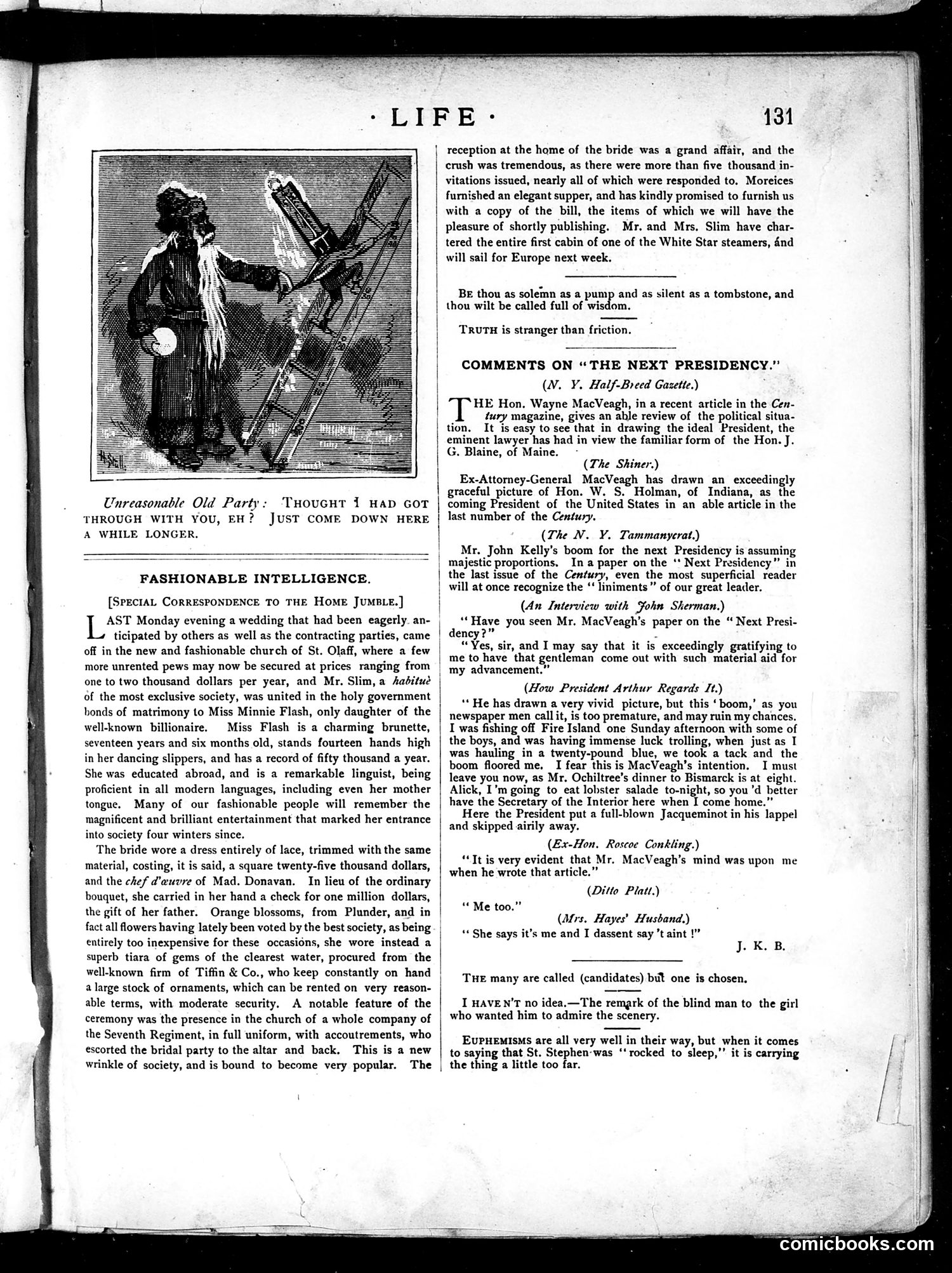
The main cartoon, titled "Unreasonable Old Party," depicts an elderly figure descending a ladder, with the caption suggesting he's leaving the Republican Party ("just come down here a while longer"). This appears to be political commentary on party defections or shifting allegiances during the late 19th or early 20th century. The page's primary content addresses "The Next Presidency," featuring commentary from various political figures discussing Hon. Wayne MacVeagh's article about the ideal presidential candidate. The references to J.G. Blaine of Maine and discussions of presidential succession indicate this relates to a specific electoral moment, though the exact election year is unclear from this page alone. The satire mocks politicians' self-promotion and inflated rhetoric about presidential qualities.
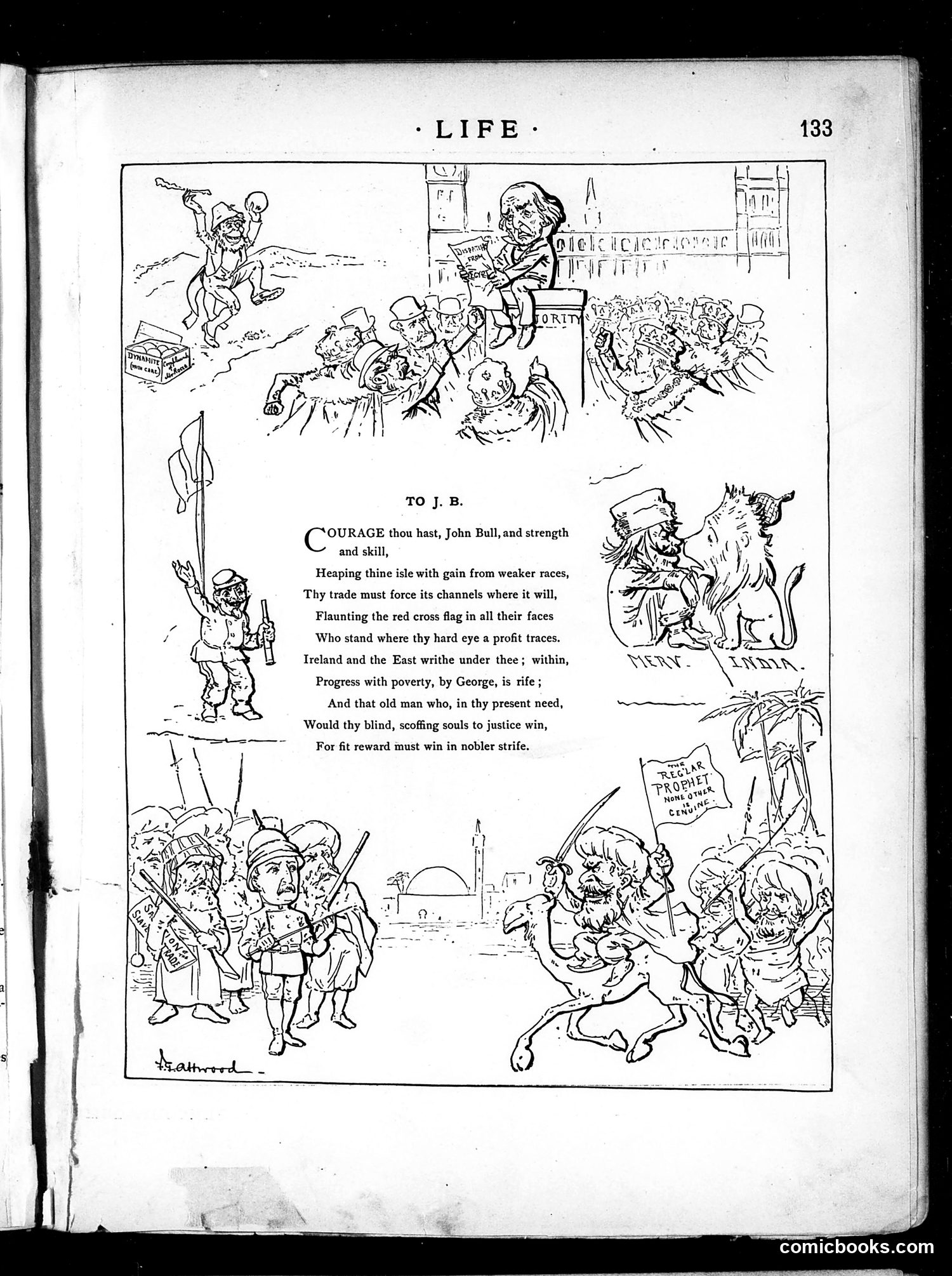
This page addresses John Bull—the personification of Britain—encouraging British courage and strength to maintain imperial dominance. The poem celebrates Britain's ability to extract wealth ("gain") from "weaker races" and force trade through military power ("channels"). References to "the red cross flag," Ireland, and "the East" indicate Britain's colonial ambitions. The satirical cartoons surrounding the verse mock various aspects of imperialism: military campaigns, colonial subjugation, and the exploitation of populations. The imagery depicts caricatured figures representing colonized peoples and British imperial forces in exaggerated, dehumanizing styles typical of period satire. The overall message critiques British imperial ideology while appearing to celebrate it—a common satirical technique in *Life* magazine's commentary on contemporary geopolitical power dynamics.
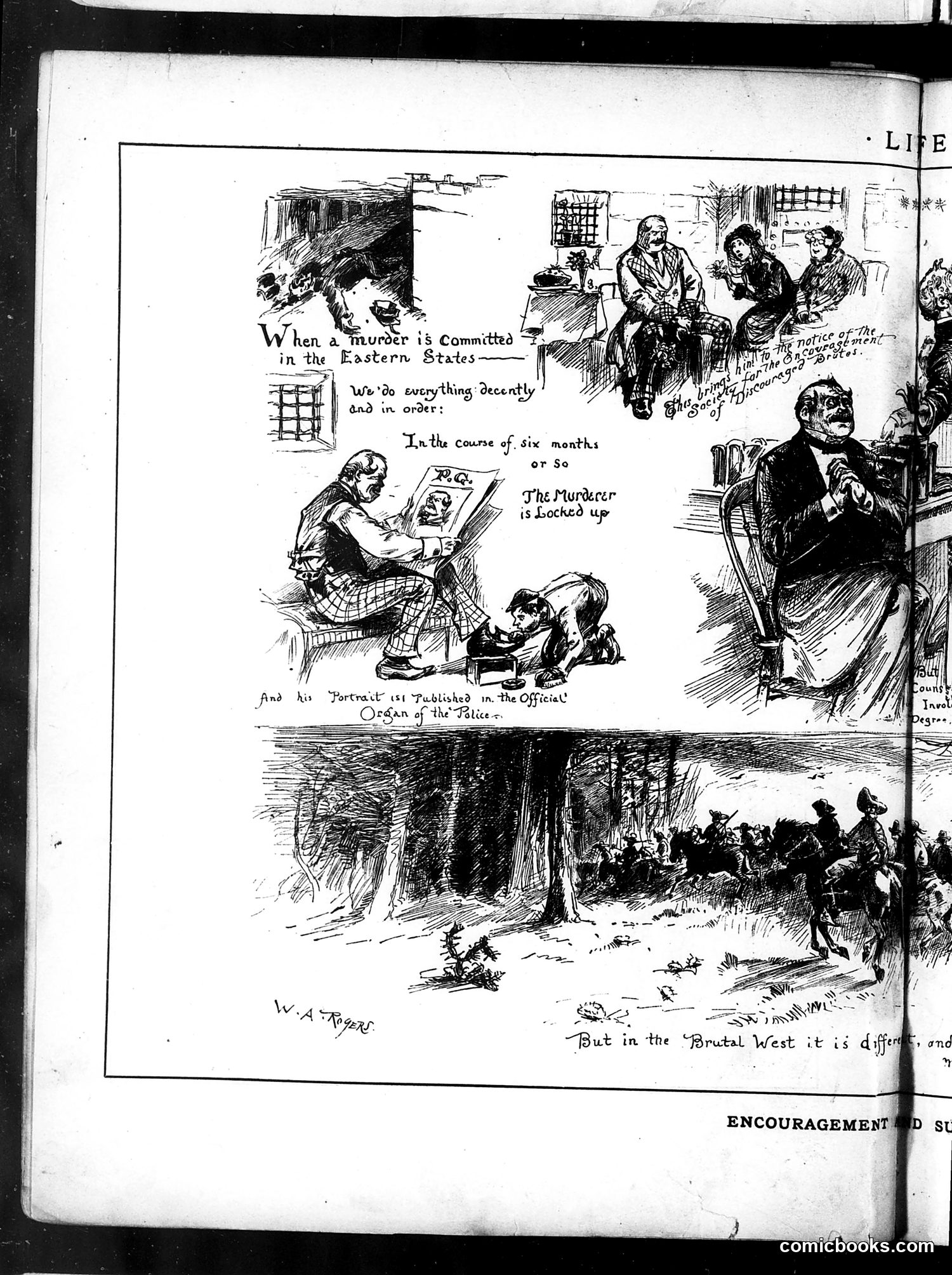
This cartoon by W.A. Twain contrasts criminal justice procedures between regions. In the Eastern States, the process is orderly: "We do everything decently and in order." Within six months, "The Murderer is locked up" and his portrait appears in official police publications. However, the bottom panel shows the "Brutal West" operates differently—depicting what appears to be a lynching scene with a crowd gathered around a tree, suggesting extrajudicial execution rather than legal process. The satire critiques Western vigilantism and mob justice as primitive compared to Eastern legal procedures. This reflects early 20th-century anxieties about lawlessness in frontier regions versus established Eastern legal systems.
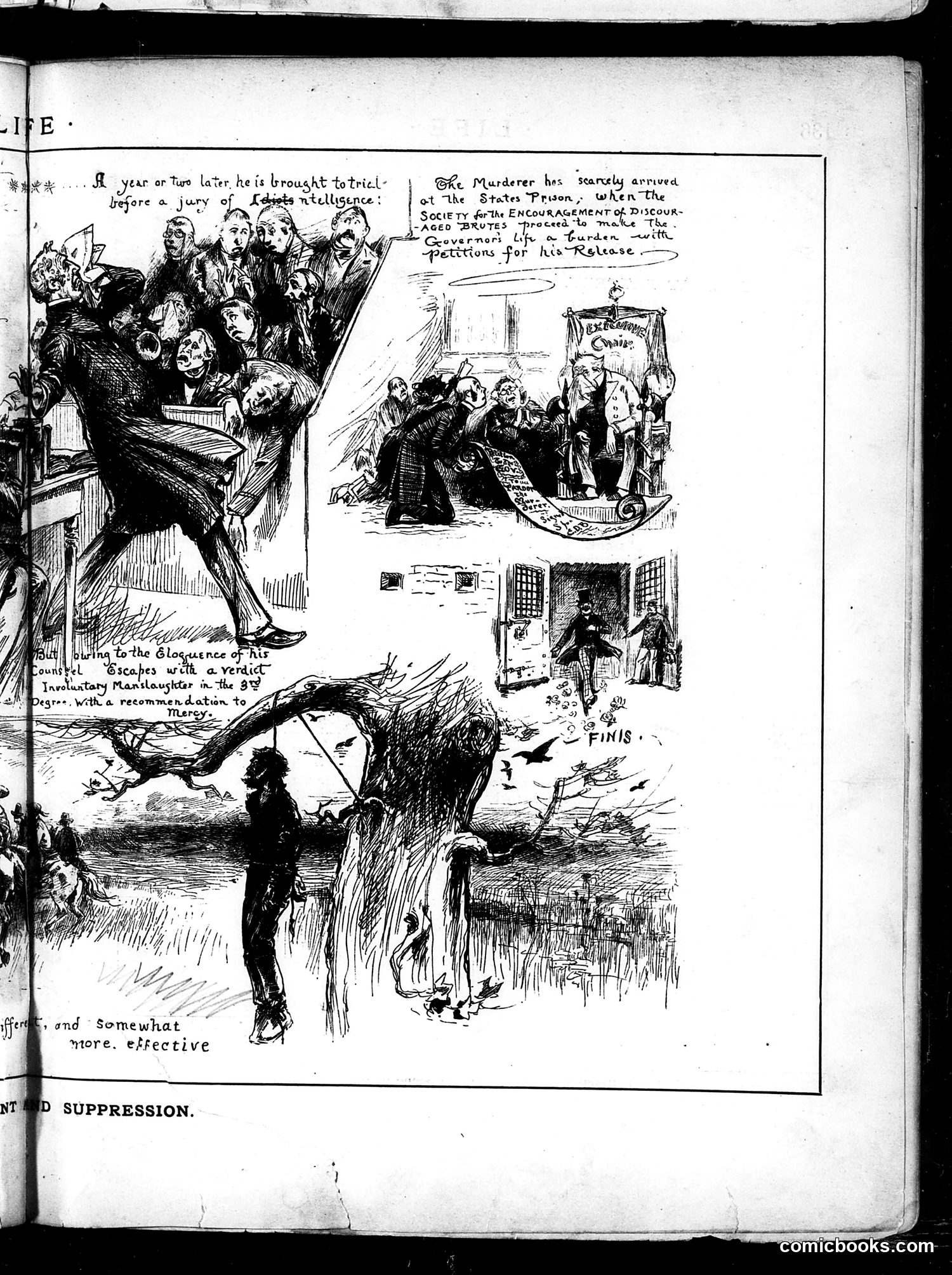
This page depicts a criminal case progressing through the American justice system. The top panels show: 1. A jury trial where the accused murderer faces "a jury of [his] peers" 2. The murderer arriving at State's Prison after conviction, with the Society for the Encouragement of Discouraged Brutes petitioning the governor for his release 3. A courtroom scene where the defendant "escapes with a verdict [of acquittal], thereby invalidating the 3rd degree" 4. The final panel shows the murderer free, walking away The satire critiques the tension between harsh police tactics ("3rd degree" interrogation) and legal protections for the accused. It suggests that while the justice system convicts criminals, humanitarian reform efforts and legal technicalities enable their release—making the entire process ineffective. The bottom text references "CRIME AND SUPPRESSION," indicating concern about rising criminality and inadequate legal remedies.
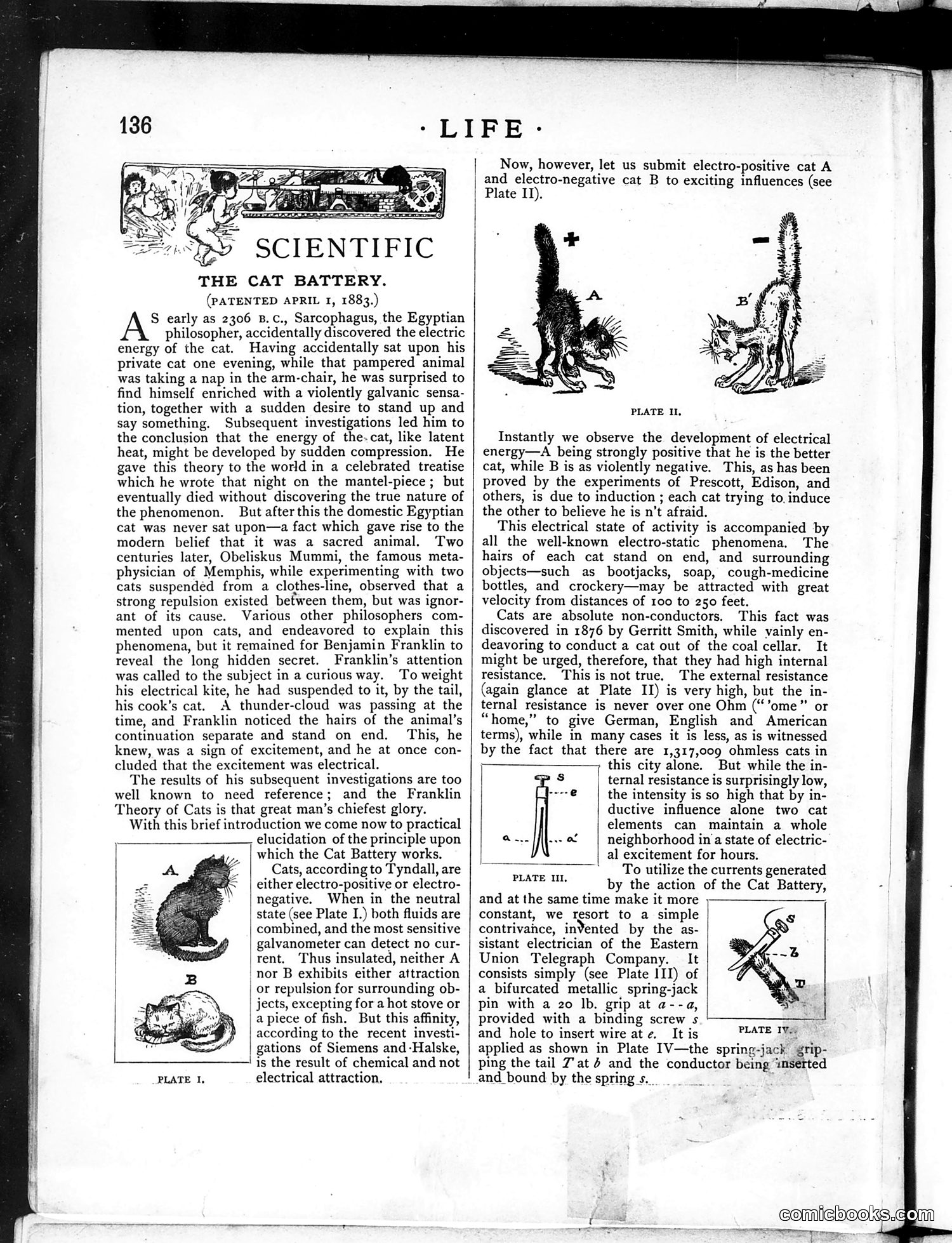
This is a mock-scientific article satirizing pseudo-scientific theories by presenting cats as electrical devices. The humor works on multiple levels: **The Setup:** It presents a fabricated history claiming ancient philosophers and Benjamin Franklin discovered cats generate electricity—a absurd premise presented with faux-academic authority, complete with invented authorities like "Sarcophagus" and fake experimental evidence. **The Joke:** The article describes two cats (A and B) as "electro-positive" and "electro-negative," then uses scientific language to describe ordinary cat behavior: standing fur, attraction to objects, and aggressive posturing. Phrases like "each cat trying to induce the other to believe he is n't afraid" translates scientific terminology into the mundane reality of cats being territorial and frightened. **The Target:** This mocks Victorian-era enthusiasm for electricity as a scientific cure-all and the tendency to apply new scientific concepts to everything, no matter how absurdly. The patent date (April 1, 1883) and ridiculous citations of real scientists (Edison, Franklin) enhance the satire by mimicking genuine scientific publication style.
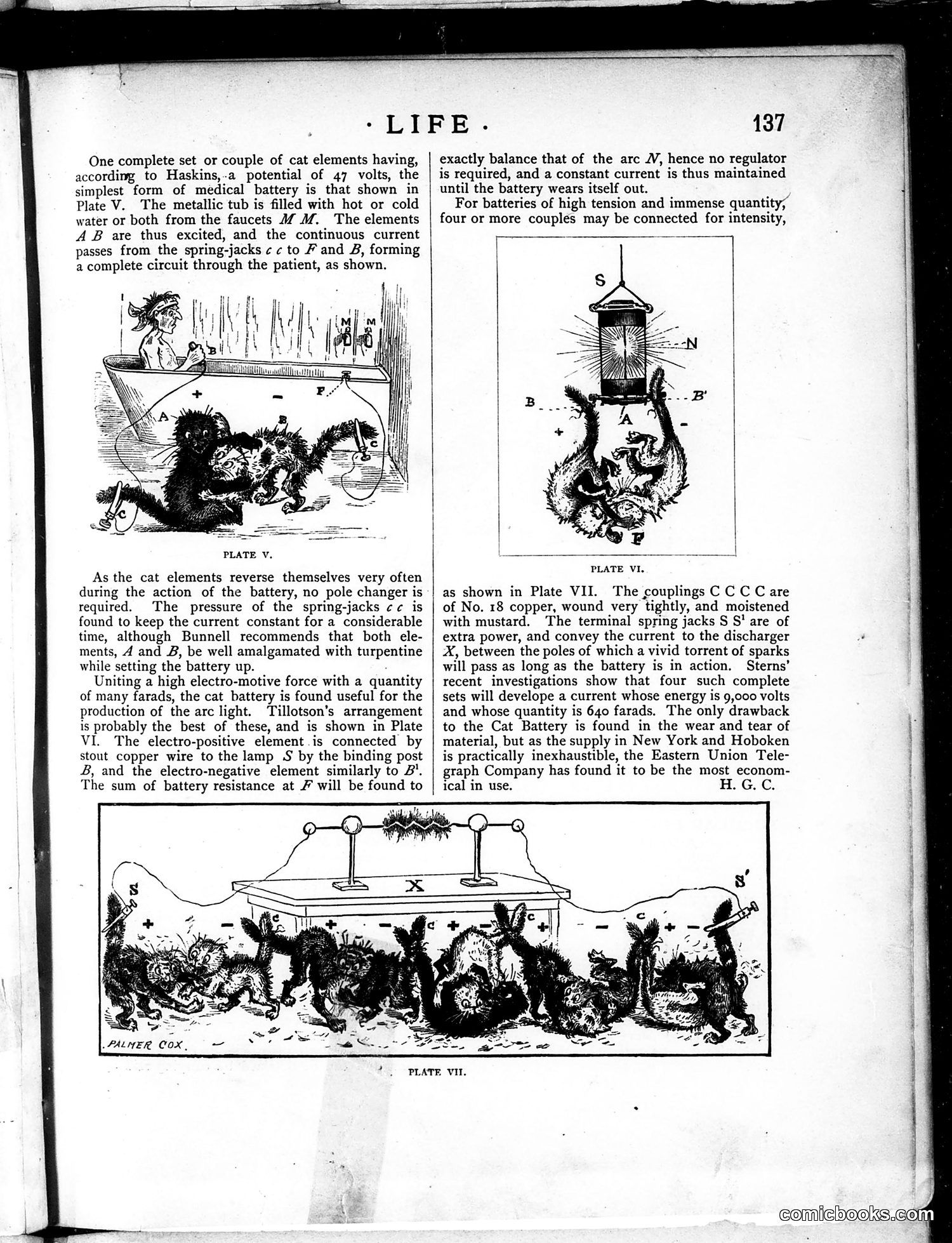
This is a mock-scientific article satirizing both pseudoscientific medical devices and the era's obsession with electrical "cures." The humor works on multiple levels: **The Setup:** The text presents absurd "scientific" instructions for using *cats as electrical batteries*—complete with technical jargon (volts, farads, electro-motive force) that sounds legitimate but describes pure nonsense. **The Joke:** The illustrations show cats wired into electrical circuits, with Plate VII depicting multiple cats harnessed together as a power source. The final detail—that the "Eastern Union Telegraph Company" uses them because New York and Hoboken have an "inexhaustible" cat supply—makes the satire explicit. **Context:** This mocks 19th-century quack medical electricity devices ("electrotherapy") that promised miraculous cures, often using dubious technology. By substituting cats for actual electrical apparatus, Life ridicules both the pseudoscience and the gullibility of patients who believed such treatments worked. The byline "H.G.C." and the technical tone maintain the parody throughout.
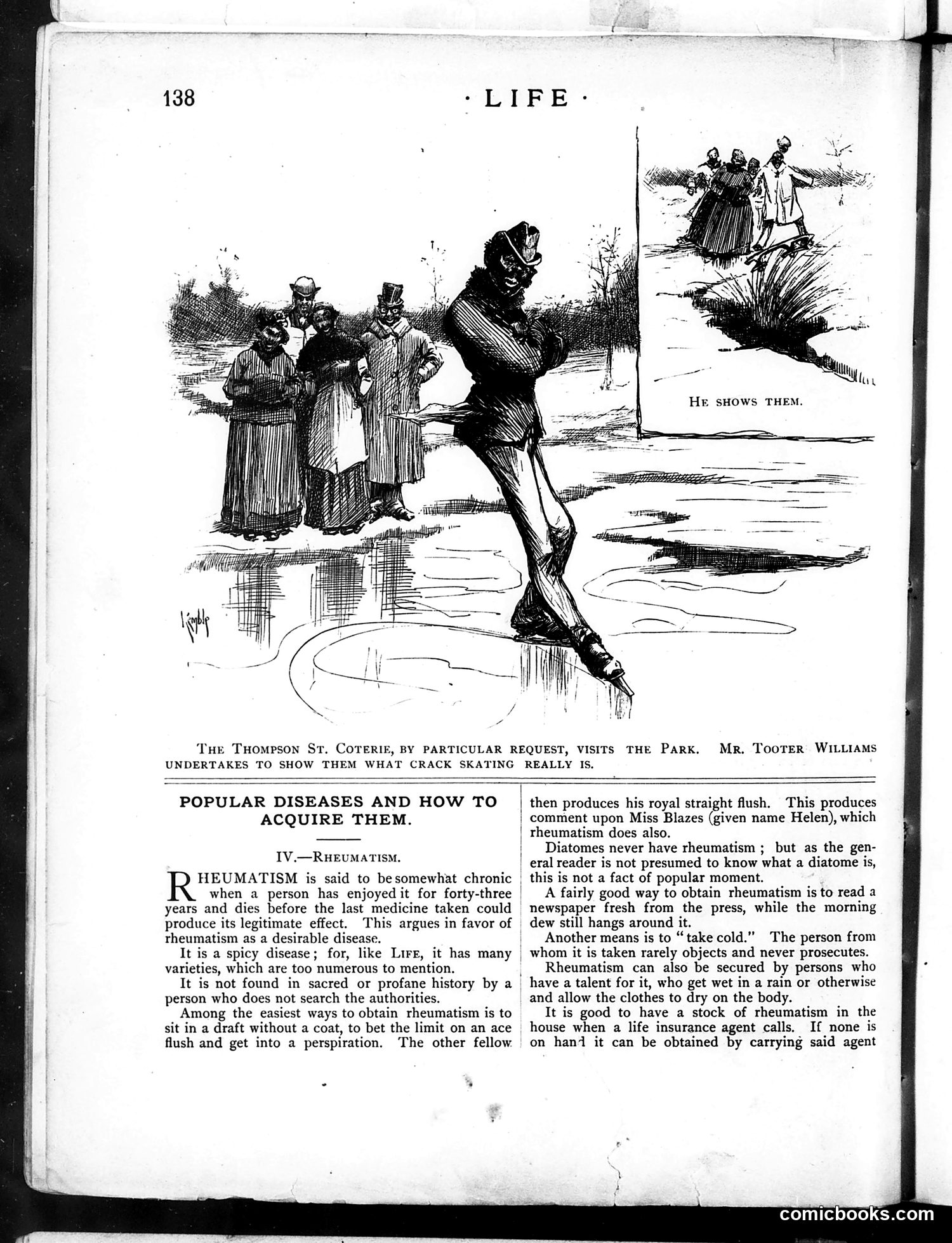
The top illustration satirizes the "Thompson Street Coterie"—likely a fashionable social group—visiting a park to watch ice skating. "Mr. Tooter Williams" performs trick skating for them, the humor lying in his exaggerated posture and the gap between his claimed expertise and the audience's impressed reaction. The lower section parodies medical writing through mock-serious pseudo-advice on acquiring rheumatism. The satire works by treating a disease as desirable and providing absurd "instructions" for catching it: sitting in drafts, gambling (losing at cards), reading damp newspapers, or getting wet. A final joke suggests obtaining rheumatism to discourage life insurance agents from calling. This reflects Life's characteristic turn-of-century humor: irreverent, class-conscious (mocking both fashionable society and medical pretension), and dependent on readers recognizing contemporary social types and insurance industry tropes.
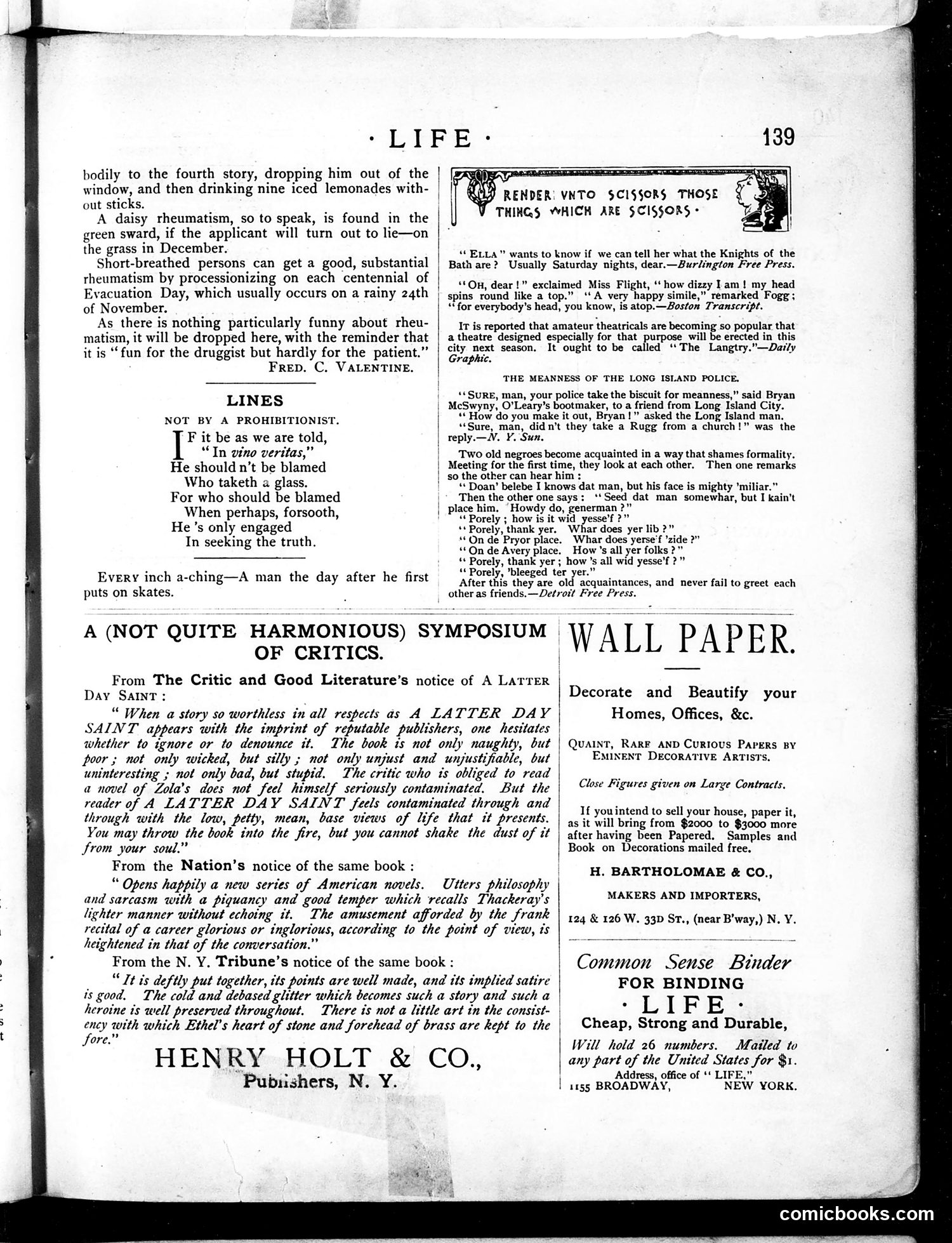
This page contains several short humorous items and advertisements rather than a single cartoon. Key satirical pieces include: **"Render unto Scissors"** — A biblical parody mocking the mundane (scissors as everyday objects worthy of scriptural reverence). **Rheumatism humor** — Satirizes medical quackery by listing absurd "cures" for rheumatism (dropping people from windows, lying on frozen grass), mocking both charlatan doctors and gullible patients. **Police meanness joke** — An Irish-immigrant character complains that Long Island police are so mean they stole a rug from a church, satirizing police corruption and ethnic stereotypes common to the era. **Black dialect piece** — Two African Americans meet using exaggerated dialect, reflecting period entertainment conventions (minstrelsy-influenced humor). **"Symposium of Critics"** — Contrasting book reviews of *A Latter Day Saint*, satirizing how different publications judge identical works wildly differently—one calls it contaminating filth, another praises it as clever social commentary. The page reflects typical early-20th-century Life magazine humor: ethnic stereotyping, medical satire, and literary criticism parody.
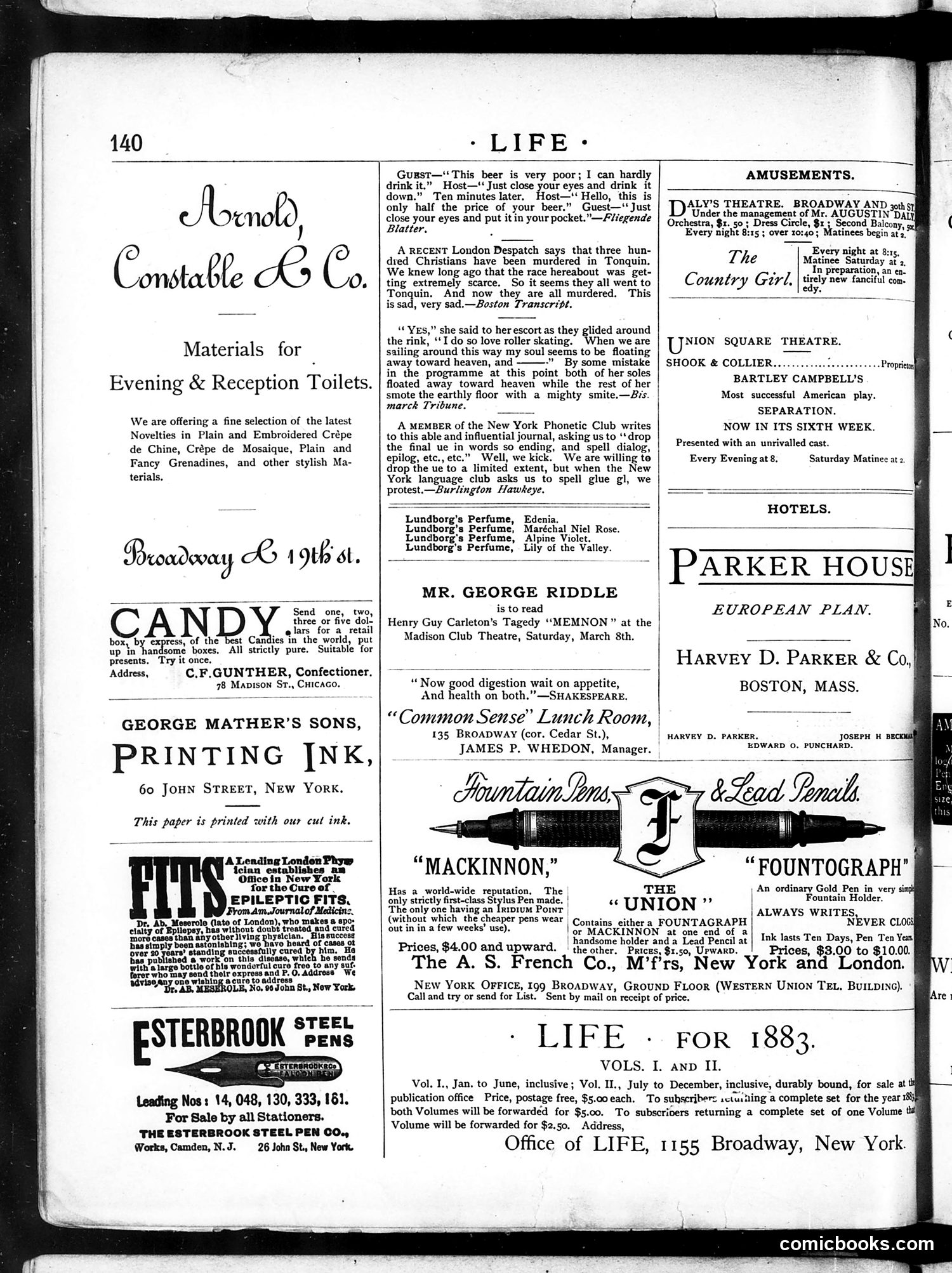
This is primarily an **advertising and announcements page** from Life magazine's January 1883 issue, with minimal editorial cartoons. The page contains several brief humorous anecdotes rather than political cartoons: 1. **Beer joke** (from German source *Fliegende Blätter*): A guest closes his eyes to drink poor beer, then realizes closing his eyes also helps him steal it—simple economic humor about deception and value. 2. **Tonquin reference**: A darkly comic news comment about 300 Christians murdered in Tonquin (Vietnam), sarcastically suggesting they'd all migrated there, making the loss seem inevitable rather than tragic. 3. **Roller-skating accident**: A woman's romantic musings about her soul floating heavenward during skating are literally interrupted when she falls, her "soles" (pun on "souls") meeting the floor instead. 4. **Phonetic Club satire**: Mocks a New York club proposing simplified spelling (like "dialog" for "dialogue"), humorously objecting to spelling "glue" as "gl." The remainder is theatre advertisements and commercial notices for printing inks, pens, candies, and hotels.
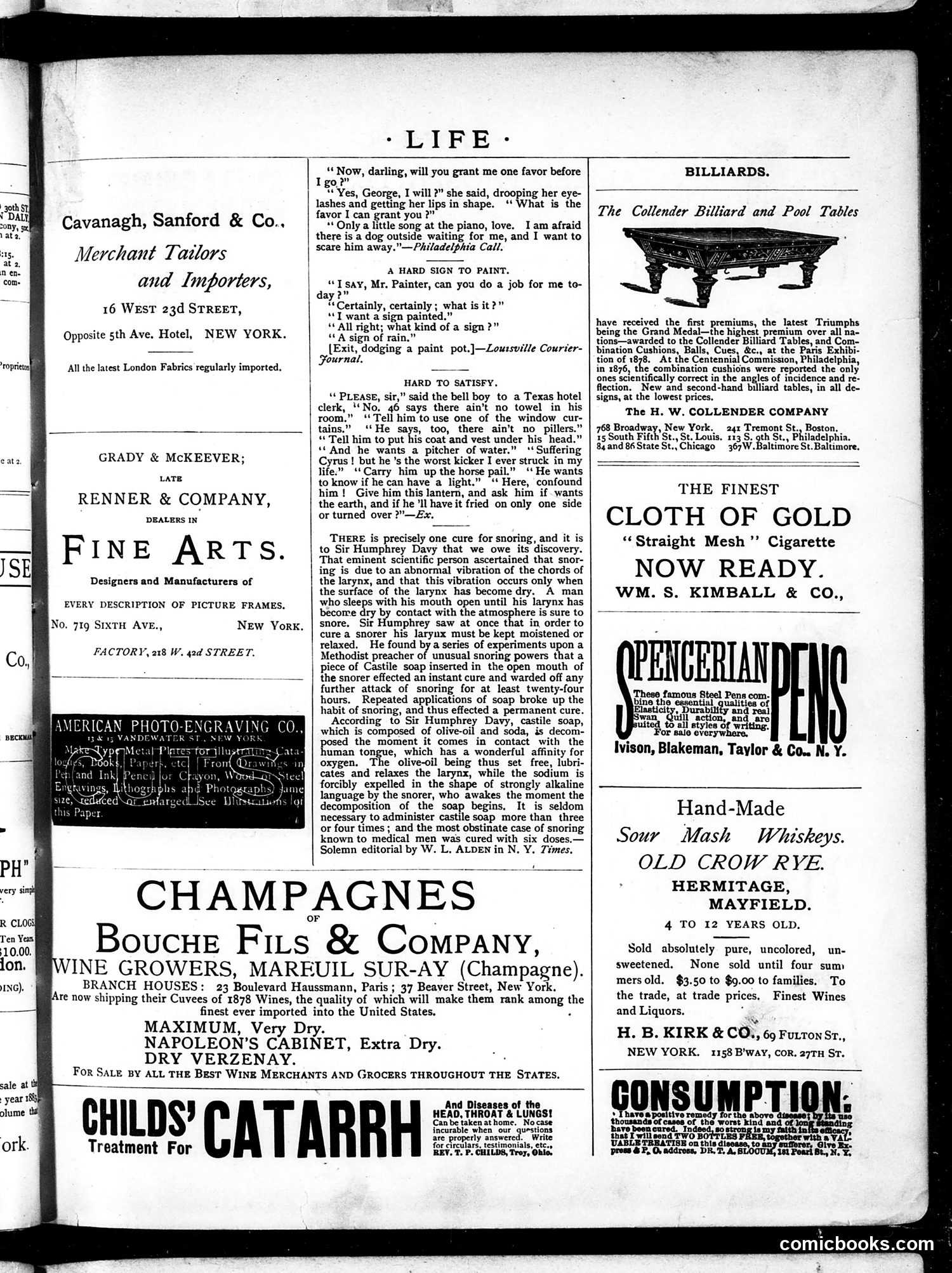
This page is primarily **advertisements and satirical humor pieces**, not political cartoons. The humor consists of three brief jokes: 1. **"A Hard Sign to Paint"**: A painter misunderstands a customer's request for "a sign of rain" as literal artwork, creating wordplay on the phrase's double meaning. 2. **"Hard to Satisfy"**: A Texas hotel guest makes increasingly absurd demands (no towel, no pillows, wants water pitcher, requests light, asks for "the earth fried"). The joke mocks both the demanding customer and the exasperated clerk's responses. 3. **Snoring "Cure"**: A satirical article (likely by W.L. Alden) humorously attributes snoring to dry larynx and proposes soap as treatment. The joke suggests Sir Humphrey Davy discovered that placing soap in a snorer's mouth causes them to wake from the awful taste—presented as pseudo-scientific humor. The advertisements promote luxury goods: merchant tailors, fine art frames, billiard tables, champagne, and whiskey—targeting wealthy readers. No significant political content appears on this page.
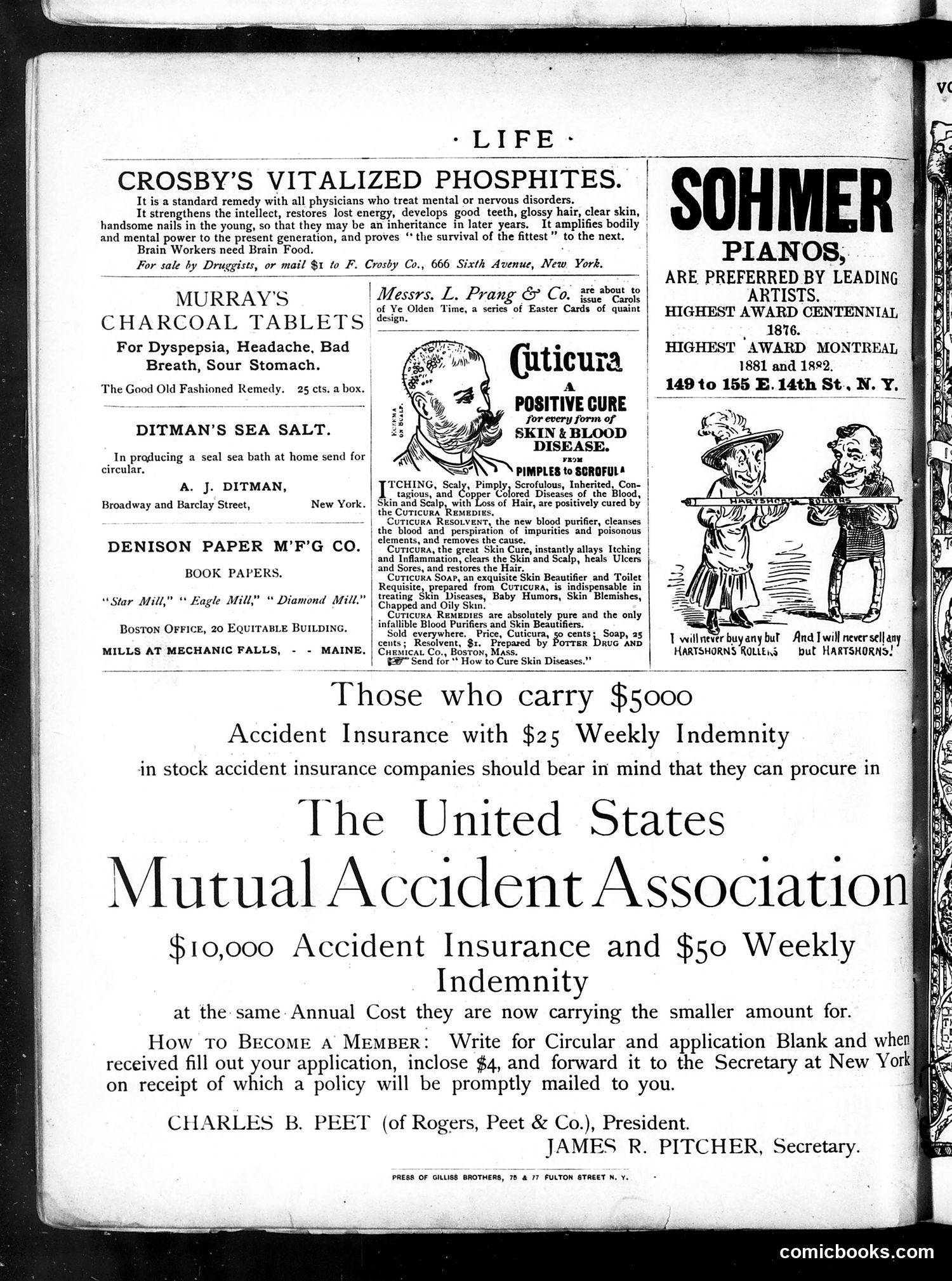
This page is primarily **advertising**, with one small cartoon illustration. The cartoon (center-right) shows two figures in period dress with exaggerated features, appearing to depict ethnic stereotypes common to 19th-century American humor. One figure says "I will never buy any but HARTSHORNS'" while the other responds "And I will never sell any but HARTSHORNS!" The joke advertises Hartshorn's Rollins (a cleaning/maintenance product), relying on caricature humor typical of the era. The rest of the page contains advertisements for patent medicines (Crosby's Phosphites for mental disorders, Murray's Charcoal Tablets, Cuticura for skin diseases), pianos, paper products, and accident insurance. These ads reflect late 19th-century concerns: unregulated medical products making dubious health claims, and emerging commercial insurance offerings. The page's overall tone reflects 1870s-1890s advertising practices: pseudoscientific health claims and ethnic caricature humor presented without irony.