
Life, 1884-03-06 · page 11 of 16
Life — March 6, 1884 — page 11: what you’re looking at
What you’re looking at
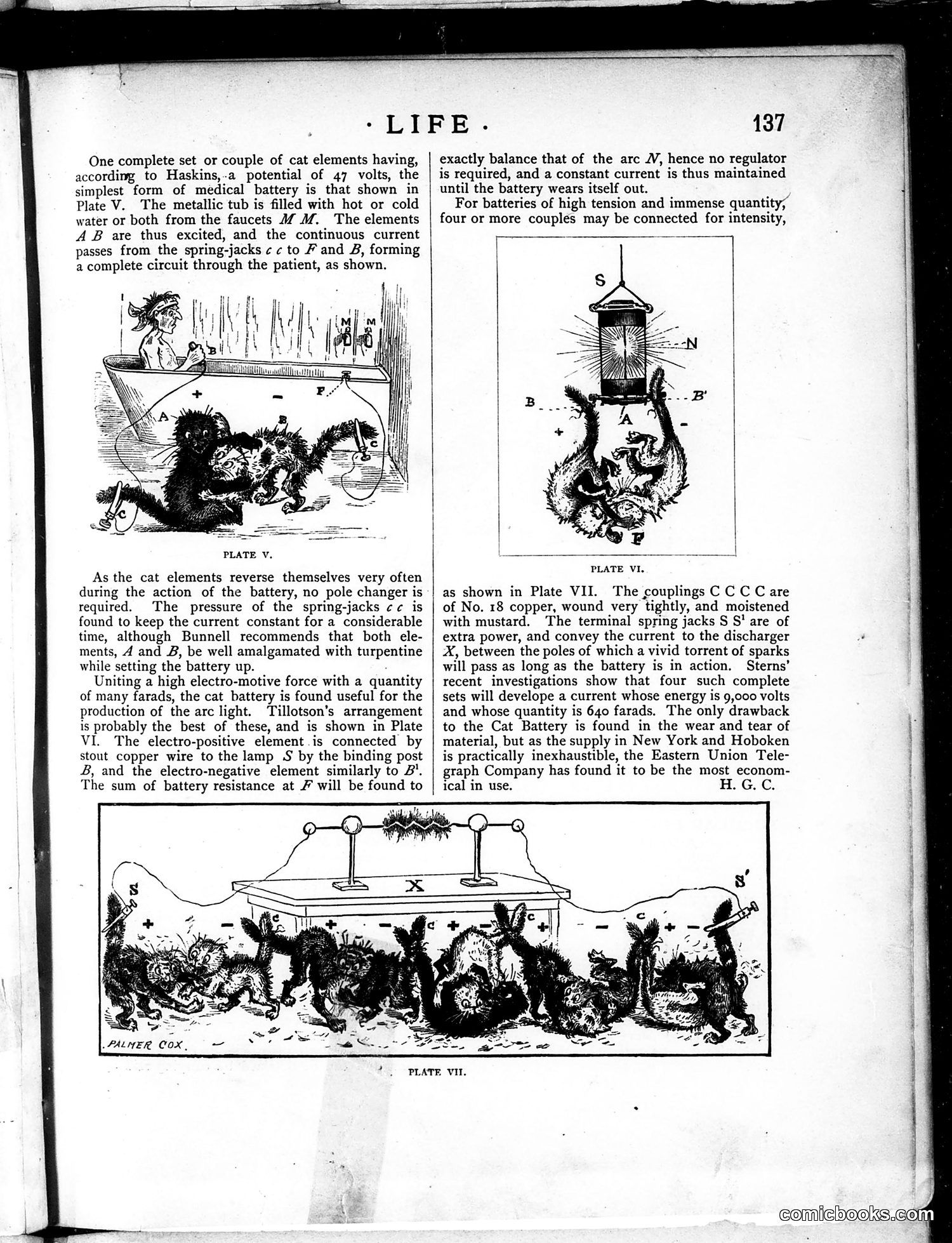
This is a mock-scientific article satirizing both pseudoscientific medical devices and the era's obsession with electrical "cures." The humor works on multiple levels: **The Setup:** The text presents absurd "scientific" instructions for using *cats as electrical batteries*—complete with technical jargon (volts, farads, electro-motive force) that sounds legitimate but describes pure nonsense. **The Joke:** The illustrations show cats wired into electrical circuits, with Plate VII depicting multiple cats harnessed together as a power source. The final detail—that the "Eastern Union Telegraph Company" uses them because New York and Hoboken have an "inexhaustible" cat supply—makes the satire explicit. **Context:** This mocks 19th-century quack medical electricity devices ("electrotherapy") that promised miraculous cures, often using dubious technology. By substituting cats for actual electrical apparatus, Life ridicules both the pseudoscience and the gullibility of patients who believed such treatments worked. The byline "H.G.C." and the technical tone maintain the parody throughout.
📄 Transcribed text from this page (OCR, searchable)
Machine-transcribed from the original scan — historical spelling and the odd misread are preserved.
‘LIFE. One complete set or couple of cat elements having, according to Haskins,-a potential of 47 volts, the simplest form of medical battery is that shown in Plate V. The metallic tub is filled with hot or cold water or both from the faucets MM. The elements AB are thus excited, and the continuous current passes from the spring-jacks ¢ c to ¥ and B, forming a complete circuit through the patient, as shown. PLATE V. As the cat elements reverse themselves very often during the action of the battery, no pole changer is required. The pressure of the spring-jacks ¢¢ is found to keep the current constant for a considerable time, although Bunnell recommends that both ele- ments, 4 and B, be well amalgamated with turpentine while setting the battery up. Uniting a high electro-motive force with a quantity of many farads, the cat battery is found useful for the production of the arc light. Tillotson’s arrangement is probably the best of these, and is shown in Plate VI. The electro-positive element is connected by stout copper wire to the lamp S by the binding post B, and the electro-negative element similarly to B’. The sum of battery resistance at ¥ will be found to 187 exactly balance that of the arc JV, hence no regulator is required, and a constant current is thus maintained until the battery wears itself out. For batteries of high tension and immense quantity, four or more couples may be connected for intensity, PLATE VI. as shown in Plate VII. The couplings C C C C are of No. 18 copper, wound very tightly, and moistened with mustard. The terminal spring jacks S S' are of extra power, and convey the current to the discharger X, between the poles of which a vivid torrent of sparks will pass as long as the battery is in action. Sterns’ recent investigations show that four such complete sets will develope a current whose energy is 9,000 volts and whose quantity is 640 farads. The only drawback to the Cat Battery is found in the wear and tear of material, but as the supply in New York and Hoboken is practically inexhaustible, the Eastern Union Tele- graph Company has found it to be the most econom- ical in use. H. G. C. PLATE VII. comichooks.co