
Life, 1884-03-06 · page 10 of 16
Life — March 6, 1884 — page 10: what you’re looking at
What you’re looking at
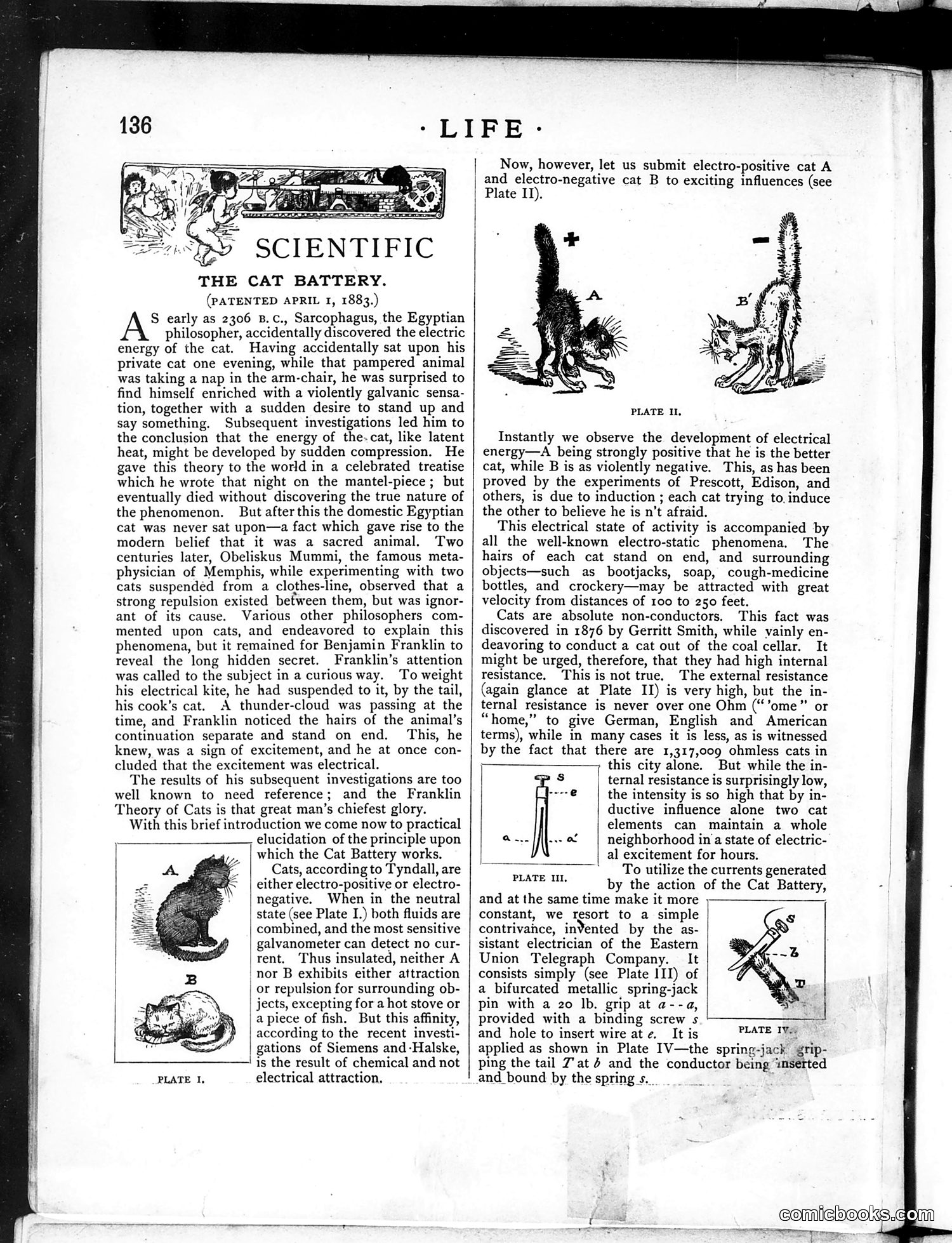
This is a mock-scientific article satirizing pseudo-scientific theories by presenting cats as electrical devices. The humor works on multiple levels: **The Setup:** It presents a fabricated history claiming ancient philosophers and Benjamin Franklin discovered cats generate electricity—a absurd premise presented with faux-academic authority, complete with invented authorities like "Sarcophagus" and fake experimental evidence. **The Joke:** The article describes two cats (A and B) as "electro-positive" and "electro-negative," then uses scientific language to describe ordinary cat behavior: standing fur, attraction to objects, and aggressive posturing. Phrases like "each cat trying to induce the other to believe he is n't afraid" translates scientific terminology into the mundane reality of cats being territorial and frightened. **The Target:** This mocks Victorian-era enthusiasm for electricity as a scientific cure-all and the tendency to apply new scientific concepts to everything, no matter how absurdly. The patent date (April 1, 1883) and ridiculous citations of real scientists (Edison, Franklin) enhance the satire by mimicking genuine scientific publication style.
📄 Transcribed text from this page (OCR, searchable)
Machine-transcribed from the original scan — historical spelling and the odd misread are preserved.
THE CAT BATTERY. (PATENTED APRIL 1, 1883.) S early as 2306 B.c., Sarcophagus, the Egyptian philosopher, accidentally discovered the electric energy of the cat. Having accidentally sat upon his private cat one evening, while that pampered animal was taking a nap in the arm-chair, he was surprised to find himself enriched with a violently galvanic sensa- tion, together with a sudden desire to stand up and say something. Subsequent investigations led him to the conclusion that the energy of the-cat, like latent heat, might be developed by sudden compression. He gave this theory to the world in a celebrated treatise which he wrote that night on the mantel-piece ; but eventually died without discovering the true nature of the phenomenon. But after this the domestic Egyptian cat was never sat upon—a fact which gave rise to the modern belief that it was a sacred animal. Two centuries later, Obeliskus Mummi, the famous meta- physician of Memphis, while experimenting with two cats suspendéd from a clothes-line, observed that a strong repulsion existed between them, but was ignor- ant of its cause. Various other philosophers com- mented upon cats, and endeavored to explain this phenomena, but it remained for Benjamin Franklin to reveal the long hidden secret. Franklin’s attention was called to the subject in a curious way. To weight his electrical kite, he had suspended to it, by the tail, his cook’s cat. A thunder-cloud was passing at the time, and Franklin noticed the hairs of the animal’s continuation separate and stand on end. This, he knew, was a sign of excitement, and he at once con- cluded that the excitement was electrical. The results of his subsequent investigations are too well known to need reference; and the Franklin Theory of Cats is that great man’s chiefest glory. With this brief introduction we come now to practical elucidation of the principle upon which the Cat Battery works. Cats, according to Tyndall, are either electro-positive or electro- negative. When in the neutral | state (see Plate I.) both fluids are combined, and the most sensitive galvanometer can detect no cur- rent. Thus insulated, neither A nor B exhibits either attraction | or repulsion for surrounding ob- jects, excepting for a hot stove or a piece of fish. But this affinity, according to the recent investi- gations of Siemens and -Halske, is the result of chemical and not electrical attraction, Now, however, let us submit electro-positive cat A and electro-negative cat B to exciting influences (see Plate II). PLATE Il, Instantly we observe the development of electrical energy—A being strongly positive that he is the better cat, while B is as violently negative. This, as has been proved by the experiments of Prescott, Edison, and others, is due to induction ; each cat trying to. induce the other to believe he is n’t afraid. This electrical state of activity is accompanied by all the well-known electro-static phenomena. The hairs of each cat stand on end, and surrounding objects—such as bootjacks, soap, cough-medicine bottles, and crockery—may be attracted with great velocity from distances of 100 to 250 feet. _Cats are absolute non-conductors. This fact was discovered in 1876 by Gerritt Smith, while vainly en- deavoring to conduct a cat out of the coal cellar. It might be urged, therefore, that they had high internal resistance. This is not true. The external resistance (again glance at Plate II) is very high, but the in- ternal resistance is never over one Ohm (“’ome” or “home,” to give German, English and American terms), while in many cases it is less, as is witnessed by the fact that there are 1,317,009 ohmless cats in | this city alone. But while the in- | 8 ternal resistance is surprisingly low, ¢ the intensity is so high that by in- ductive influence alone two cat elements can maintain a whole neighborhood in a state of electric- al excitement for hours. To utilize the currents generated by the action of the Cat Battery, and at the same time make it more —————____, constant, we resort to a simple contrivance, in¥ented by the as- | sistant electrician of the Eastern | Union Telegraph Company. It consists simply (see Plate III) of a bifurcated metallic spring-jack pin with a 20 Ib. grip at @--a, provided with a binding screw s and hole to insert wire ate. It is applied as shown in Plate IV—the spring-jack grip- ping the tail Z at 6 and the conductor being ‘inserted and bound by the spring s. PLATE Ill, PLATE IVs