
Life, 1884-03-06 · page 4 of 16
Life — March 6, 1884 — page 4: what you’re looking at
What you’re looking at
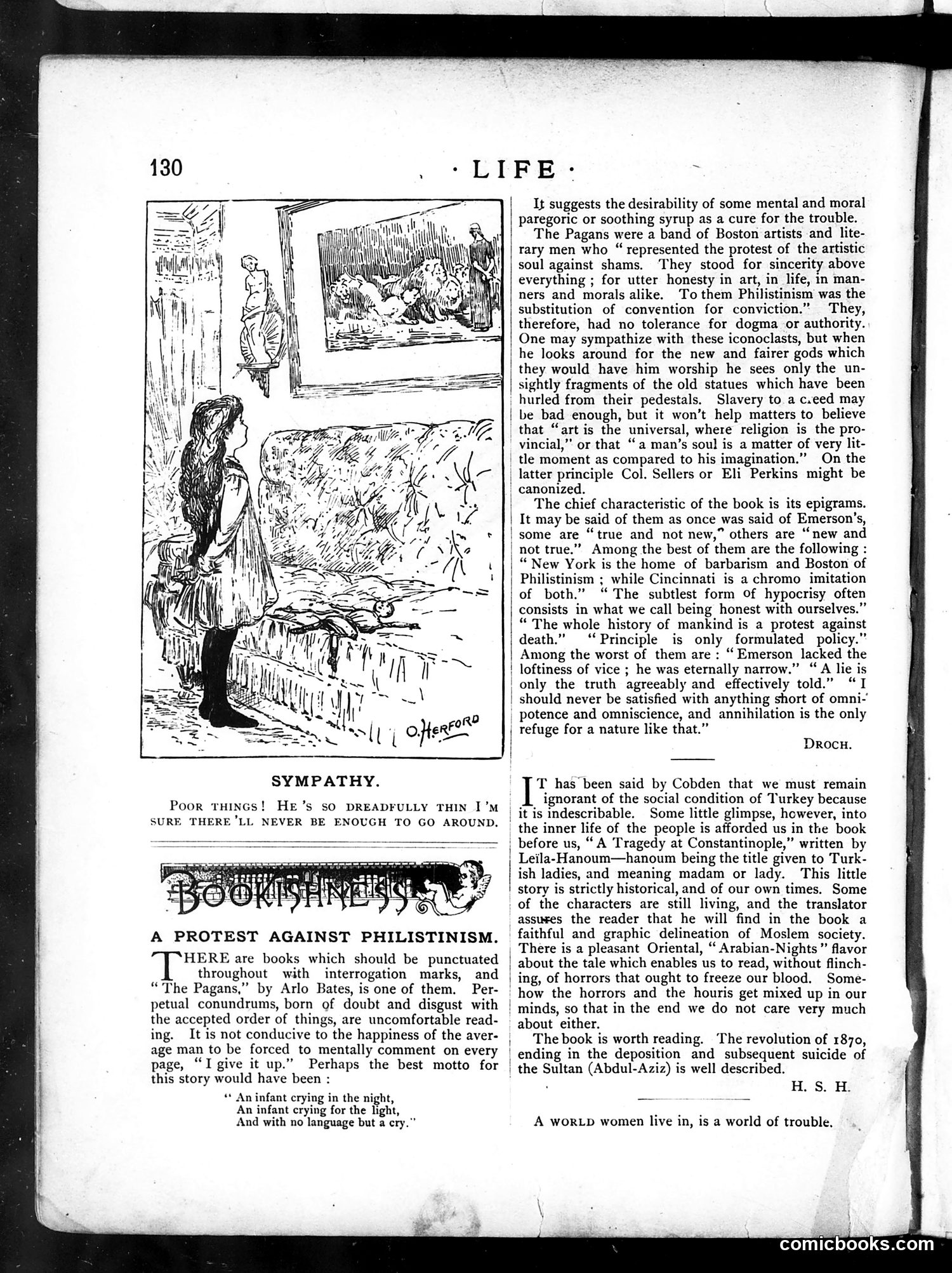
The page contains a sketch titled "SYMPATHY" depicting a poor woman or child in tattered clothing, with accompanying text lamenting poverty: "Poor things! He is so dreadfully thin I'm sure there'll never be enough to go around." Below is a book review of "The Pagans" by Afro Hates, critiquing a novel about Boston artists and intellectuals protesting against social convention. The review criticizes both the artistic "Pagans" and religious "Philistines," suggesting neither group possesses genuine virtue or honesty. The illustration and text together satirize both poverty and the self-righteous posturing of intellectual elites—those claiming moral superiority while actual human suffering persists. The juxtaposition suggests the magazine's skepticism toward bohemian artistic movements that ignored material social problems.
📄 Transcribed text from this page (OCR, searchable)
Machine-transcribed from the original scan — historical spelling and the odd misread are preserved.
‘LIFE: SYMPATHY. Poor THINGS! HE’s SO DREADFULLY THIN I’M SURE THERE'LL NEVER BE ENOUGH TO GO AROUND. A PROTEST AGAINST PHILISTINISM. | ‘HERE are books which should be punctuated | throughout with interrogation marks, and “The Pagans,” by Arlo Bates, is one of them. Per- petual conundrums, born of doubt and disgust with the accepted order of things, are uncomfortable read- ing. It is not conducive to the happiness of the aver- age man to be forced to mentally comment on every page, “I give it up.” Perhaps the best motto for this story would have been : “* An infant crying in the night, ‘An infant crying for the light, And with no language but a cry." ‘some are “true and not new,” others are | of both.” | it is indescribable. It suggests the desirability of some mental and moral paregoric or soothing syrup as a cure for the trouble. The Pagans were a band of Boston artists and lite- rary men who “ represented the protest of the artistic soul against shams. They stood for sincerity above everything ; for utter honesty in art, in life, im man- ners and morals alike. To them Philistinism was the substitution of convention for conviction.” They, therefore, had no tolerance for dogma or authority. One may sympathize with these iconoclasts, but when he looks around for the new and fairer gods which they would have him worship he sees only the un- sightly fragments of the old statues which have been hurled from their pedestals. Slavery to a c.eed may | be bad enough, but it won’t help matters to believe that “art is the universal, where religion is the pro- vincial,” or that “a man’s soul is a matter of very lit- tle moment as compared to his imagination.” On the latter principle Col. Sellers or Eli Perkins might be | canonized. The chief characteristic of the book is its epigrams. It may be said of them as once was said of Emerson's, “new and not true.” Among the best of them are the following : | “ New York is the home of barbarism and Boston of Philistinism ; while Cincinnati is a chromo imitation “The subtlest form Of hypocrisy often consists in what we call being honest with ourselves.” “ The whole history of mankind is a protest against death.” ‘Principle is only formulated policy.” Among the worst of them are: “ Emerson lacked the | loftiness of vice ; he was eternally narrow.” “ A lie is only the truth agreeably and effectively told.” “I | should never be satisfied with anything short of omni-’ potence and omniscience, and annihilation is the only refuge for a nature like that.” Drocu. T has been said by Cobden that we must remain ignorant of the social condition of Turkey because Some little glimpse, however, into the inner life of the people is afforded us in the book before us, “ A Tragedy at Constantinople,” written by | Leila-Hanoum—hanoum being the title given to Turk- ish ladies, and meaning madam or lady. This little story is strictly historical, and of our own times. Some of the characters are still living, and the translator assures the reader that he will find in the book a faithful and graphic delineation of Moslem society. There is a pleasant Oriental, “ Arabian-Nights” flavor about the tale which enables us to read, without flinch- | ing, of horrors that ought to freeze our blood. Some- how the horrors and the houris get mixed up in our | minds, so that in the end we do not care very much about either. The book is worth reading. The revolution of 1870, ending in the deposition and subsequent suicide of the Sultan (Abdul-Aziz) is well described. A WORLD women live in, is a world of trouble. comicbooks.com —