
Life, 1884-03-06 · page 6 of 16
Life — March 6, 1884 — page 6: what you’re looking at
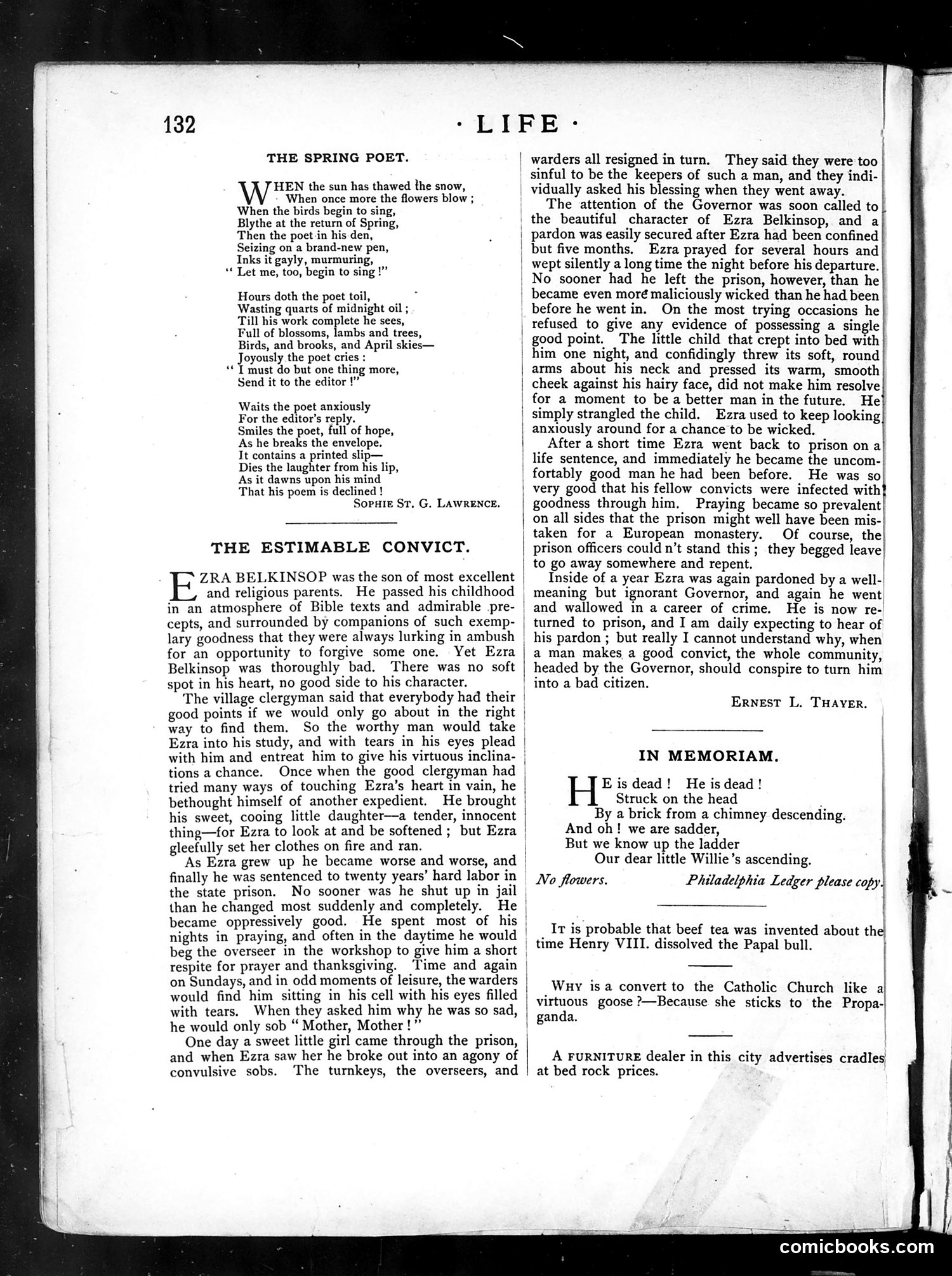
A restored page from Life, 1884-03-06. Page through the whole issue in the reader above.
📄 Transcribed text from this page (OCR, searchable)
Machine-transcribed from the original scan — historical spelling and the odd misread are preserved.
*EPRE* | warders all resigned in turn. They said they were too | THE SPRING POET. HEN the sun has thawed the snow, When once more the flowers blow ; When the birds begin to sing, Blythe at the return of Spring, Then the poet in his den, Seizing on a brand-new pen, Inks it gayly, murmuring, “Let me, too, begin to sing!” Hours doth the poet toil, Wasting quarts of midnight oil ; Till his work complete he sees, Full of blossoms, lambs and trees, Birds, and brooks, and April skies— Joyously the poet cries : I must do but one thing more, Send it to the editor !” Waits the poet anxiously For the editor's reply. Smiles the poet, full of hope, As he breaks the envelope. It contains a printed slip— Dies the laughter from his lip, As it dawns upon his mind That his poem is declined ! Sopuie St, G. LAWRENCE. THE ESTIMABLE CONVICT. ZRA BELKINSOP was the son of most excellent and religious parents. He passed his childhood in an atmosphere of Bible texts and admirable pre- cepts, and surrounded by companions of such exemp- lary goodness that they were always lurking in ambush for an opportunity to forgive some one. Yet Ezra Belkinsop was thoroughly bad. There was no soft spot in his heart, no good side to his character. . The village clergyman said that everybody had their | the beautiful character of Ezra Belkinsop, and a | but five months. | wept silently a long time the night before his departure. | became even moré maliciously wicked than he had been good points if we would only go about in the right | way to find them. So the worthy man would take Ezra into his study, and with tears in his eyes plead with him and entreat him to give his virtuous inclina- | tions achance. Once when the good clergyman had tried many ways of touching Ezra’s heart in vain, he | bethought himself of another expedient. He brought his sweet, cooing little daughter—a tender, innocent thing—for Ezra to look at and be softened; but Ezra gleefully set her clothes on fire and ran. As Ezra grew up he became worse and worse, and finally he was sentenced to twenty years’ hard labor in the state prison. No sooner was he shut up in jail than he changed most suddenly and completely. He became oppressively good. He spent most of his nights in praying, and often in the daytime he would beg the overseer in the workshop to give him a short respite for prayer and thanksgiving. ‘Time and again on Sundays, and in odd moments of leisure, the warders would find him sitting in his cell with his eyes filled with tears. When they asked him why he was so sad, he would only sob “ Mother, Mother!” ; One day a sweet little girl came through the prison, and when Ezra saw her he broke out into an agony of convulsive sobs. The turnkeys, the overseers, and | | good point. | for a moment to be a better man in the future. | taken for a European monastery. | prison officers could n’t stand this; they begged leave| | to go away somewhere and repent. | sinful to be the keepers of such a man, and they indi- | vidually asked his blessing when they went away. } The attention of the Governor was soon called to| pardon was easily secured after Ezra had been confined Ezra prayed for several hours and No sooner had he left the prison, however, than he before he went in. On the most trying occasions he refused to give any evidence of possessing a single The little child that crept into bed with him one night, and confidingly threw its soft, round arms about his neck and pressed its warm, smooth cheek against his hairy face, did not make him resolve He simply strangled the child. Ezra used to keep looking anxiously around for a chance to be wicked. After a short time Ezra went back to prison on a life sentence, and immediately he became the uncom-| fortably good man he had been before. He was so| very good that his fellow convicts were infected with goodness through him. Praying became so prevalent on all sides that the prison might well have been mis-| Of course, the Inside of a year Ezra was again pardoned by a well- meaning but ignorant Governor, and again he went and wallowed in a career of crime. He is now re- turned to prison, and I am daily expecting to hear of his pardon ; but really I cannot understand why, when a man makes a good convict, the whole community, headed by the Governor, should conspire to turn him into a bad citizen. Ernest L. THAYER. IN MEMORIAM. Eis dead! He is dead! Struck on the head ‘ By a brick from a chimney descending. And oh! we are sadder, But we know up the ladder Our dear little Willie’s ascending. No flowers. Philadelphia Ledger please copy: | t Ir is probable that beef tea was invented about the time Henry VIII. dissolved the Papal bull. | Way isa convert to the Catholic Church like a virtuous goose ?—Because she sticks to the Propa'| ganda. | A FURNITURE dealer in this city advertises cradles at bed rock prices. comicbooks.com