
A complete issue · 16 pages · 1884
Life — February 7, 1884
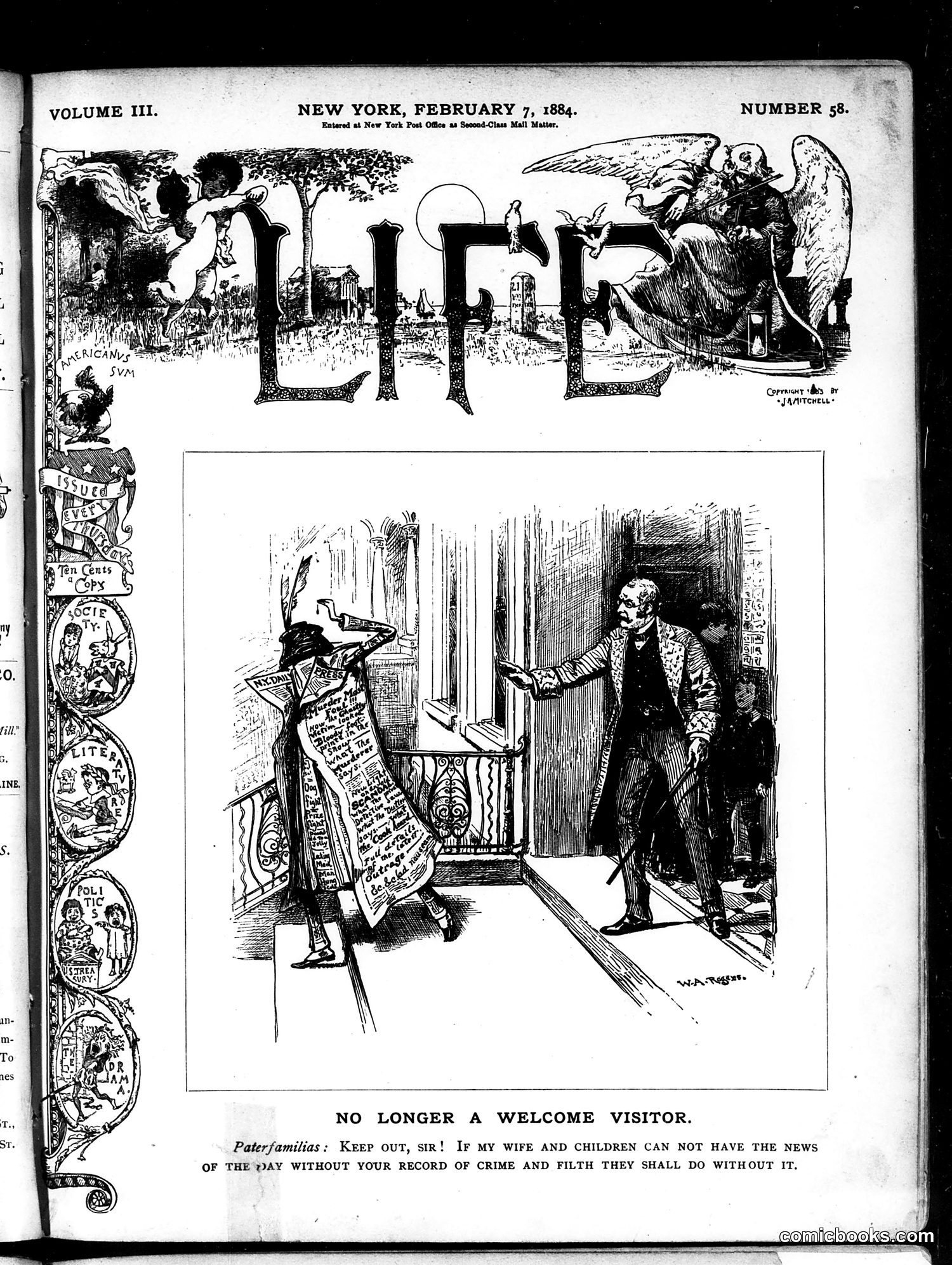
**The Cartoon: "No Longer a Welcome Visitor"** This satirical illustration depicts a newspaper vendor or paperboy being forcibly ejected from a home by its master. The vendor wears a coat covered in text (representing newspaper content), while the householder blocks the doorway, gesturing him away. **The Message:** The caption quotes the householder declaring newspapers unwelcome because they contain crime reports and filth unsuitable for wives and children. This appears to be social satire criticizing either: - Newspaper publishers' sensationalism and criminal coverage, OR - Prudish attitudes toward newspapers' content The cartoon mocks tensions between Victorian sensibilities and the emerging mass media's reportage of urban crime and scandal—suggesting the public's simultaneous demand for and disapproval of such "scandalous" news.
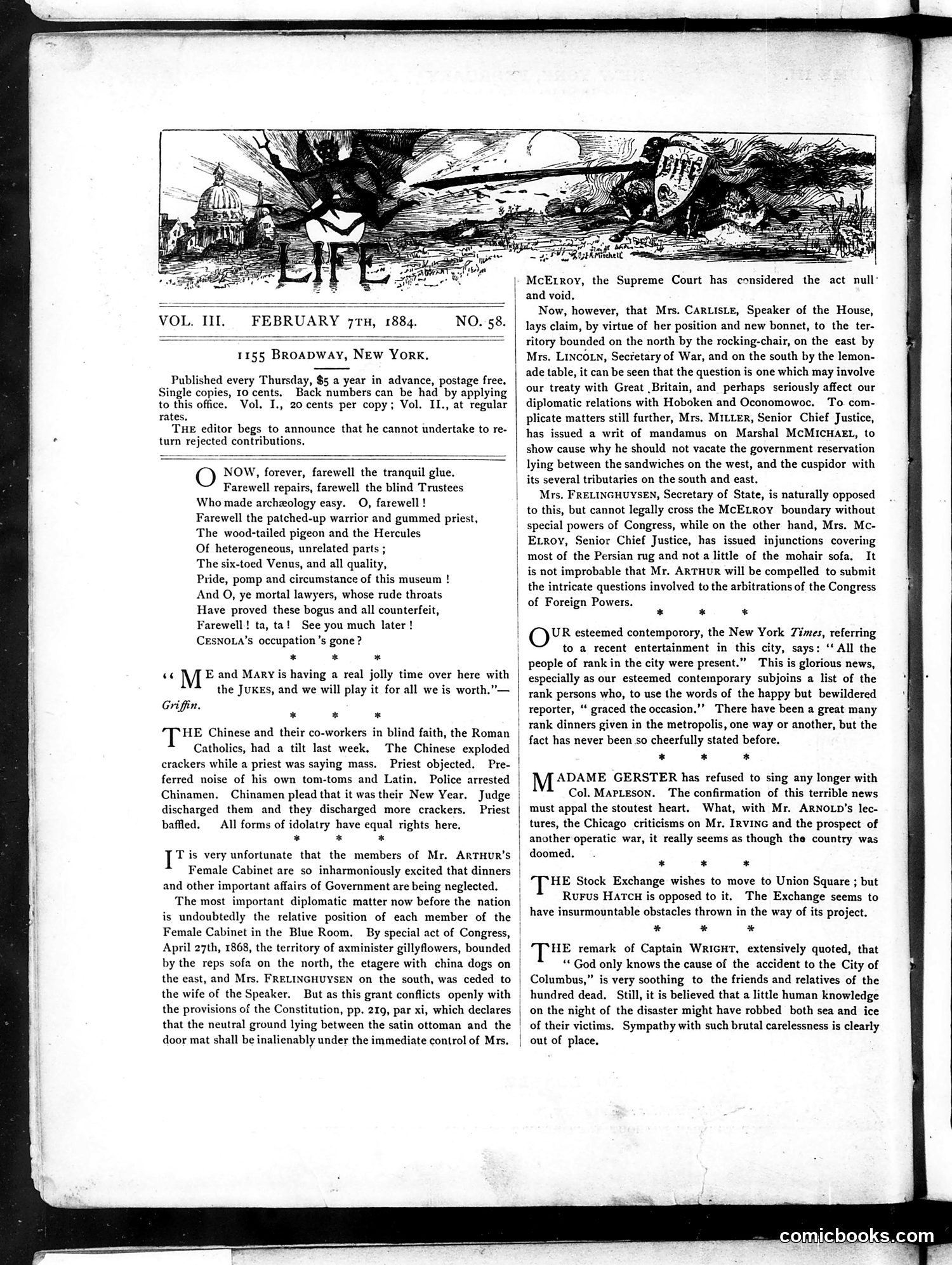
The top illustration satirizes recent political disputes over territory and diplomatic boundaries. The text references Mrs. Carlisle (Speaker of the House), Mrs. Lincoln (Secretary of War), and various justices debating contested land between government buildings—likely the McElroy Supreme Court case mentioned. The cartoon depicts these disputes as absurdly petty territorial squabbles between powerful women. The lower sections mock social and cultural events: Chinese workers celebrating New Year with fireworks, operatic scandals involving Madame Gerster and Colonel Mapelson, and the City of Columbus shipwreck disaster. The satire mixes serious political friction with trivial celebrity gossip and ethnic humor typical of 1880s American satirical journalism.
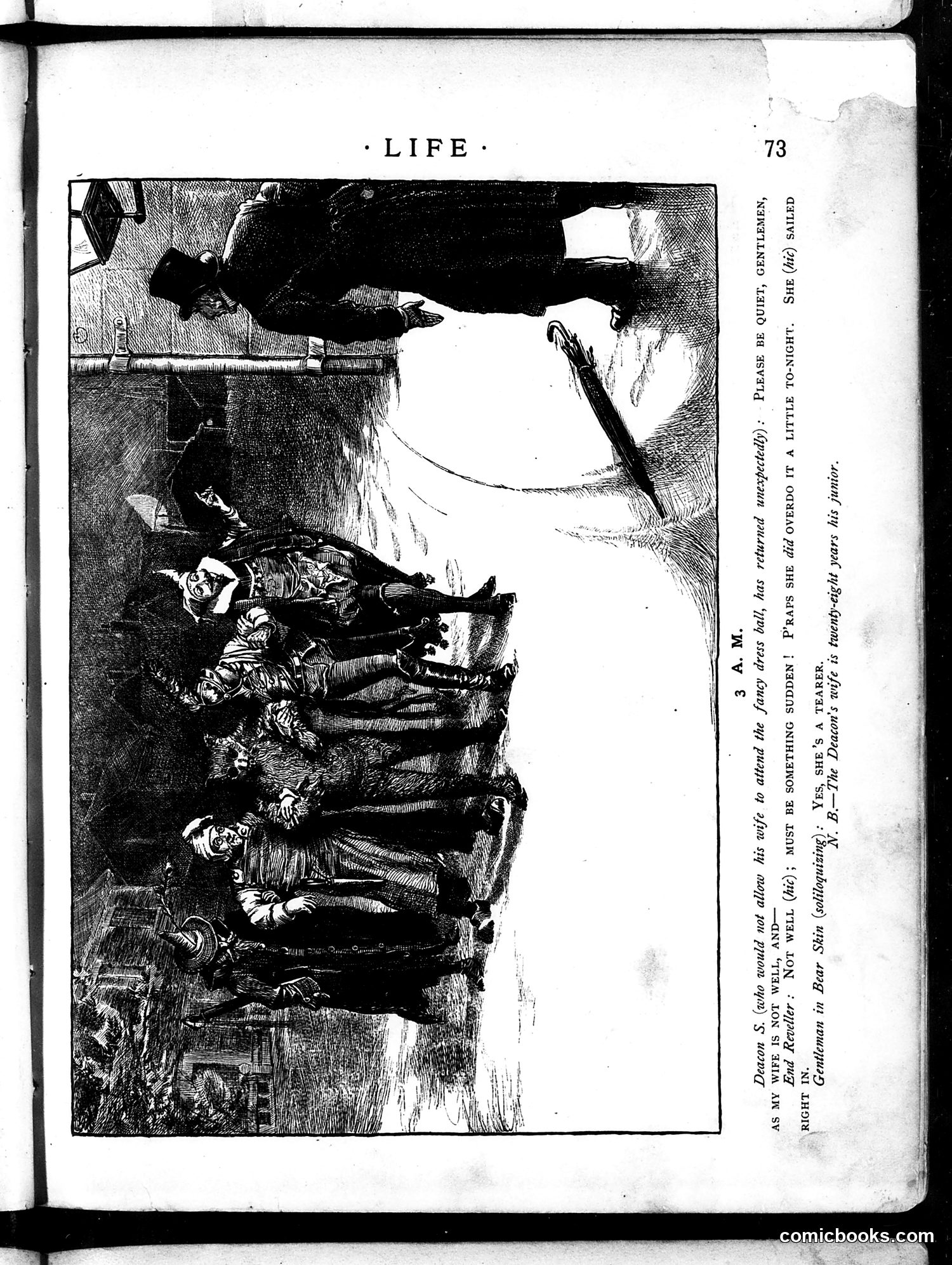
This page contains a satirical illustration (rotated 90 degrees) depicting what appears to be a social or political scene. The caption references "Disraeli" and mentions "his wife" attending something, with text about "Praise be quiet, gentlemen" and references to "sweetmeats" and "Government in Beer Saloon." The image shows multiple figures in period dress arranged in what seems to be a crowded interior scene, rendered in detailed cross-hatching typical of 19th-century engravings. **However, I cannot reliably identify:** the specific figures portrayed, the exact historical event referenced, or the precise satirical point without risking inaccuracy. The text is partially obscured and the image orientation makes detailed interpretation difficult. The reference to Disraeli suggests British politics, but further specifics would require clearer source material.
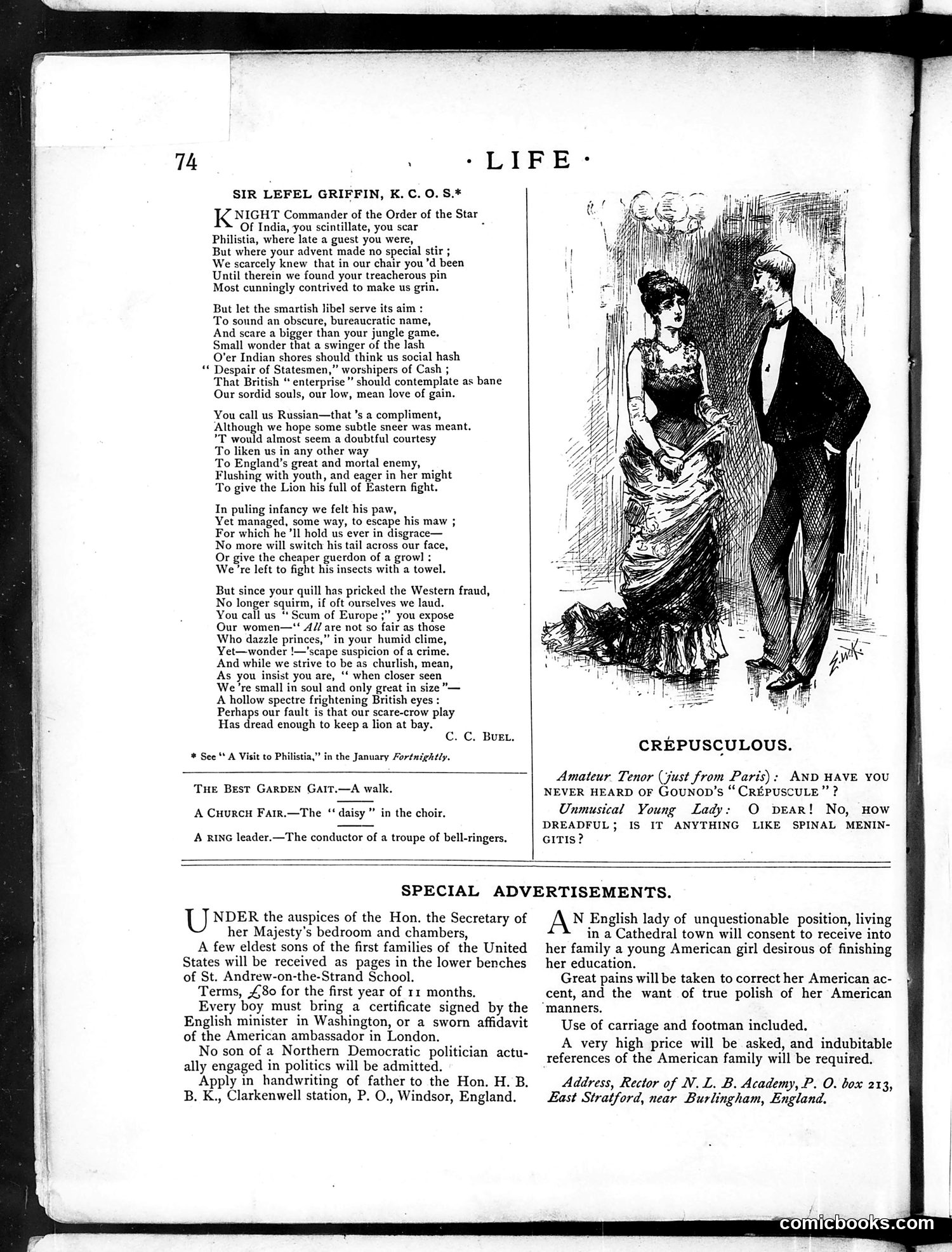
The main content is a satirical poem titled "SIR LEFEI GRIFFIN, K.C.O.S." by C.C. Buel, mocking an individual (likely a British colonial official in India) for pretentious behavior and moral hypocrisy. The poem criticizes him for adopting affected mannerisms, financial greed, and contradictory values—claiming to uphold British virtue while engaging in disreputable conduct. The accompanying sketch shows a well-dressed couple in formal attire, apparently depicting the subject's social pretensions. Below are miscellaneous satirical definitions (best garden gait, church fair, ring leader) providing quick social commentary. The page is primarily text-based satire rather than visual cartoons. The special advertisements—including one seeking an American girl for "finishing" in England—appear to contain their own satirical subtext about class aspiration and transatlantic social climbing.
This page contains two distinct pieces: **"Bella"** - A poem by H.P.C. offering romantic advice to a young woman, using flowery Victorian language about love and attraction. It's sentimental verse typical of the era. **"Divertissement à l'Harvard"** - A satirical prose piece about Philip Delphia, a wealthy Pennsylvania aristocrat attending Harvard. The satire mocks his superficial charm and social climbing. The narrative describes how Philip seduces Miss Nougat through flattery and romantic gestures, suggesting that his Harvard education and aristocratic background enable him to manipulate women rather than develop genuine character. The piece critiques both elite pretension and the vulnerability of young women to such calculated seduction. The overall page reflects turn-of-century American anxieties about class, education, and courtship rituals.
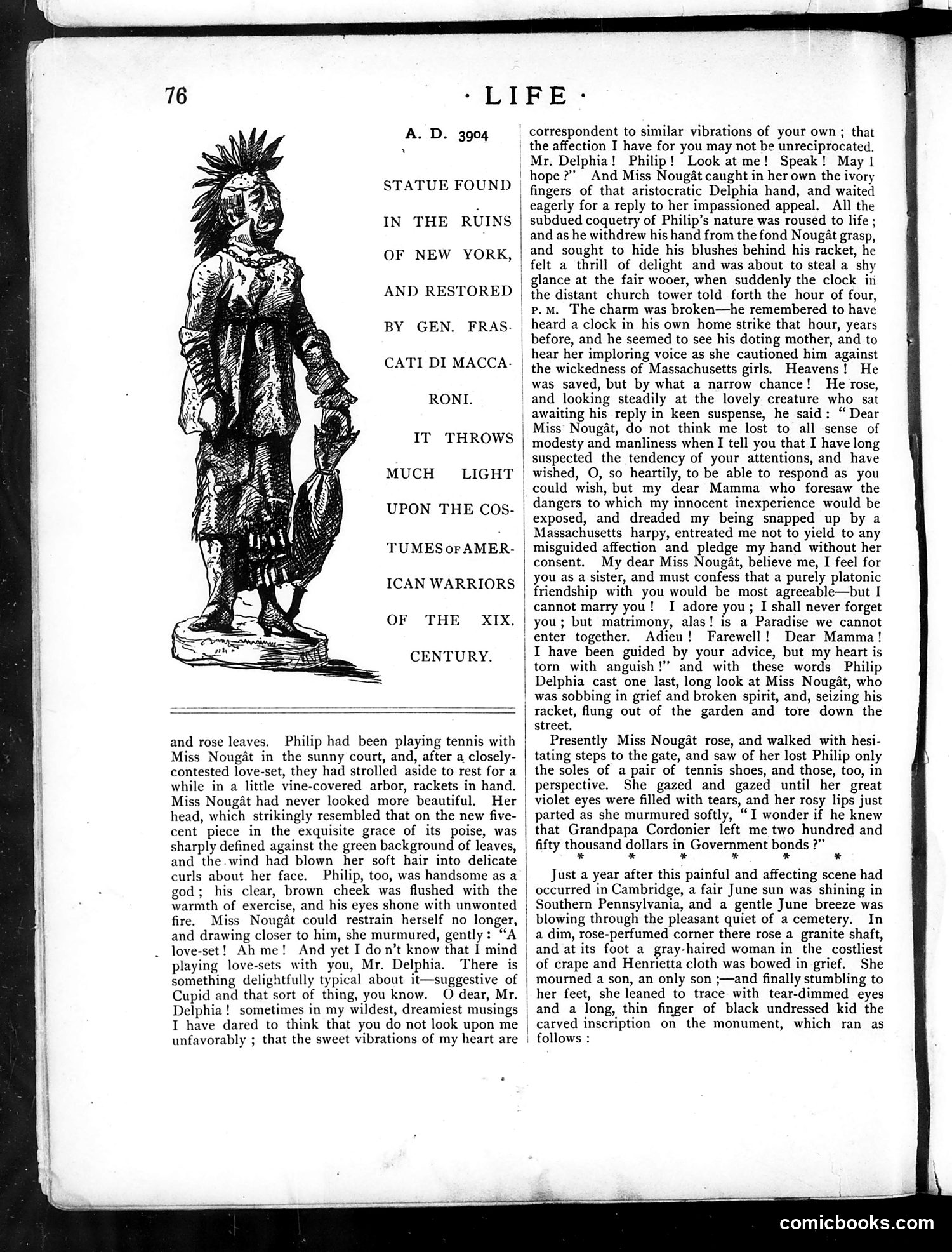
This page features an engraving of a Native American statue with the headline "STATUE FOUND IN THE RUINS OF NEW YORK, AND RESTORED BY GEN. FRAS. CATTI DI MACCARONI." The satire appears to be a **reverse-archaeology joke**: imagining a future civilization discovering American ruins and mistakenly attributing a Native American statue to Italian General Francesco Caccini di Maccaroni as its "restorer." This mocks both the tendency to misattribute historical artifacts and perhaps contemporary debates about Native American heritage and representation. The accompanying narrative describes a romantic drama between characters named Philip, Miss Nougat, and others—seemingly unrelated to the statue itself, suggesting the magazine mixed serial fiction with satirical commentary typical of 19th-century humor publications.
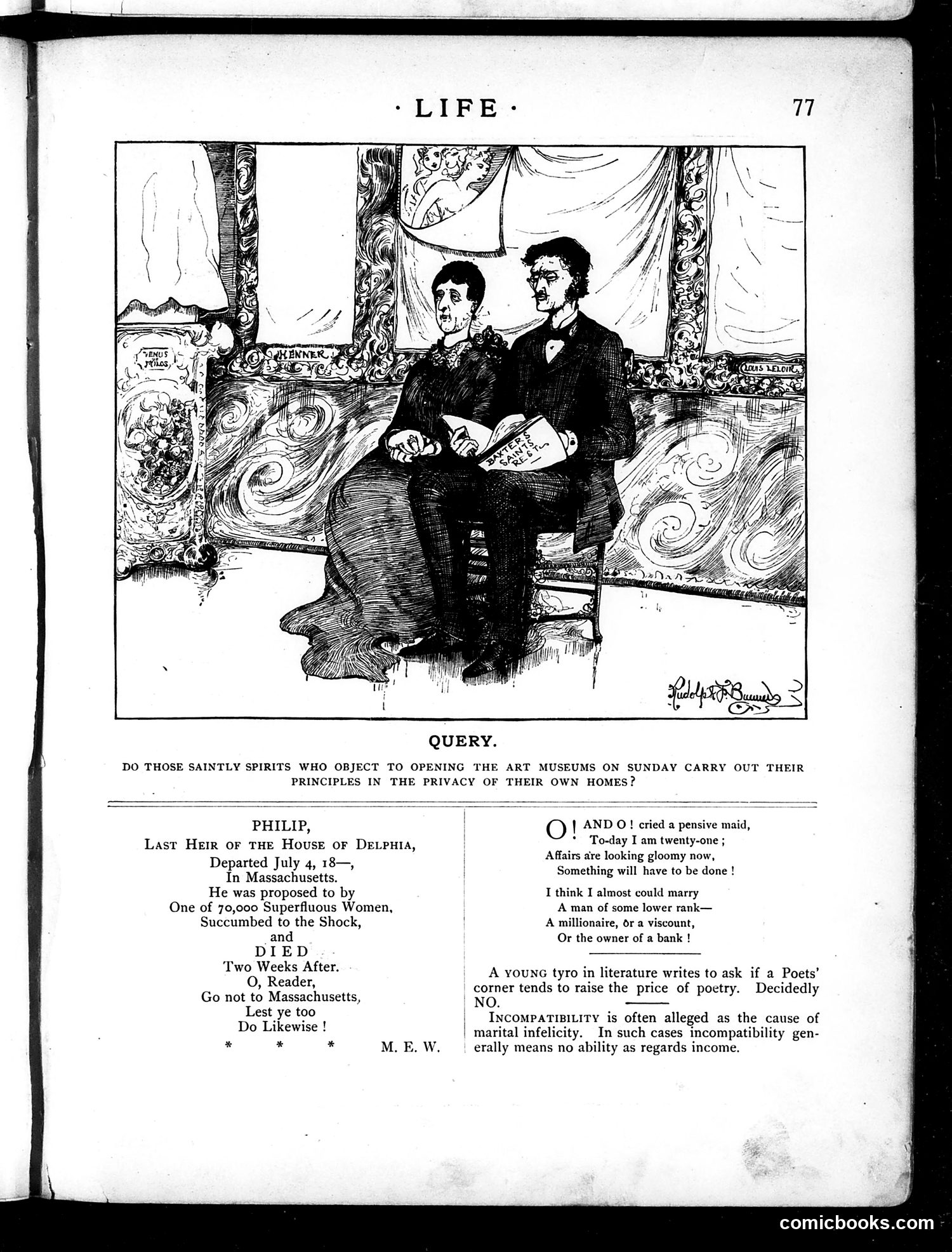
**The Cartoon:** The illustration shows two well-dressed men in an ornate theater box, engaged in conversation. The caption poses a rhetorical question about whether people who object to Sunday opening of art museums practice their principles at home. **The Satire:** This targets religious hypocrisy—specifically, those who publicly oppose Sunday museum hours on religious grounds while privately conducting worldly activities (suggested by the theater setting itself, ironically). The joke is that objectors likely don't maintain strict Sabbath observance in their private lives, making their public moral stance inconsistent. **The Sidebar Content:** Below appears an obituary-style notice and literary commentary, though these seem unrelated to the main cartoon's satirical point about Sunday blue laws and museum access—a significant cultural debate of the era.
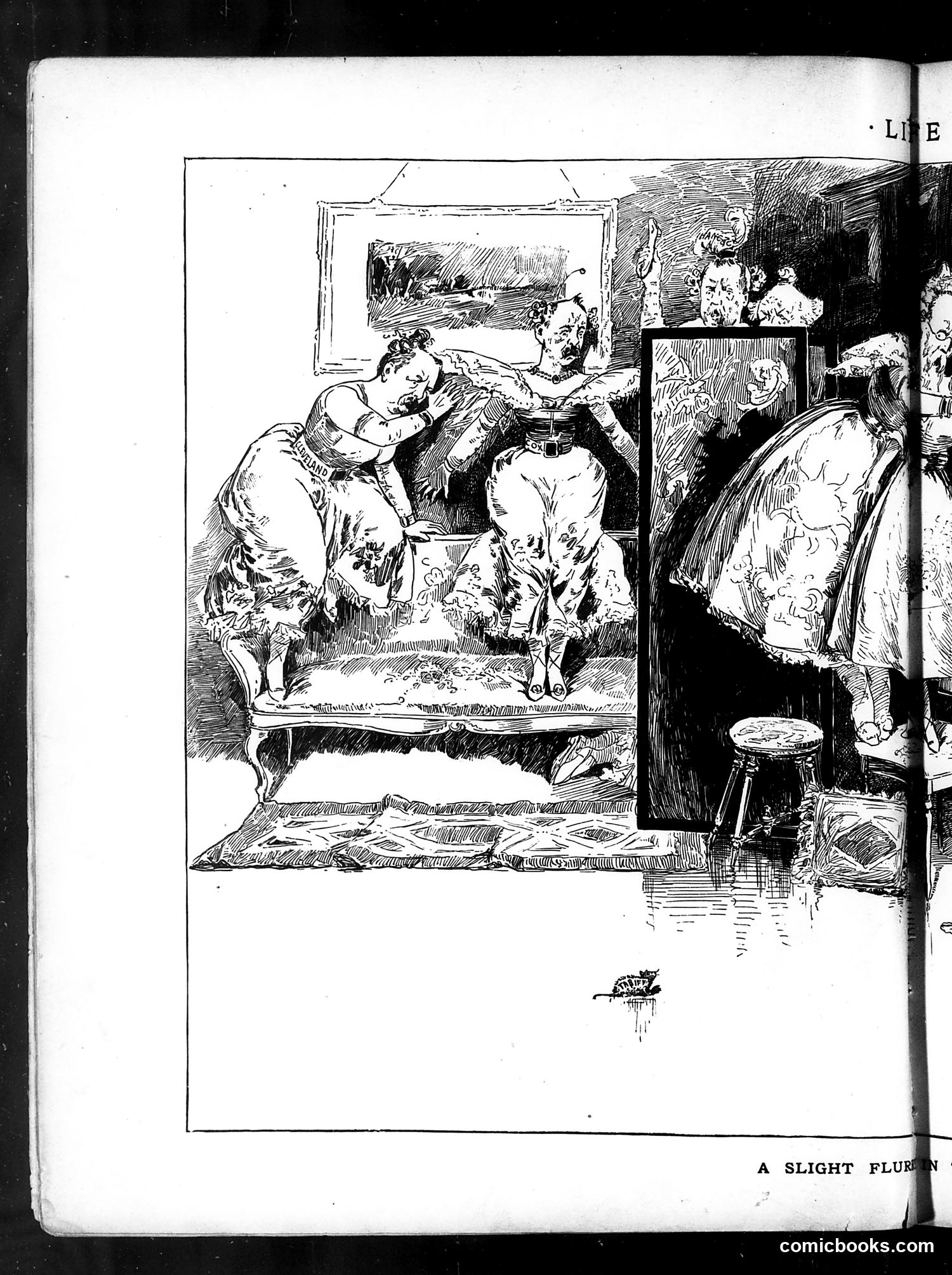
This satirical illustration depicts an upper-class social gathering disrupted by what appears to be a minor scandal or embarrassment—hence the understated title "A Slight Flurry." The scene shows well-dressed figures in an ornate interior, with one woman appearing to react dramatically to something while others observe. The style and clothing suggest this is from the late 19th or early 20th century. The satire likely mocks how the wealthy respond to social disturbances with exaggerated emotional reactions despite describing them as "slight" or trivial. The contrast between the supposedly minor nature of the incident and the characters' animated responses creates the humor—a commentary on upper-class pretension and their tendency to dramatize insignificant social disruptions.
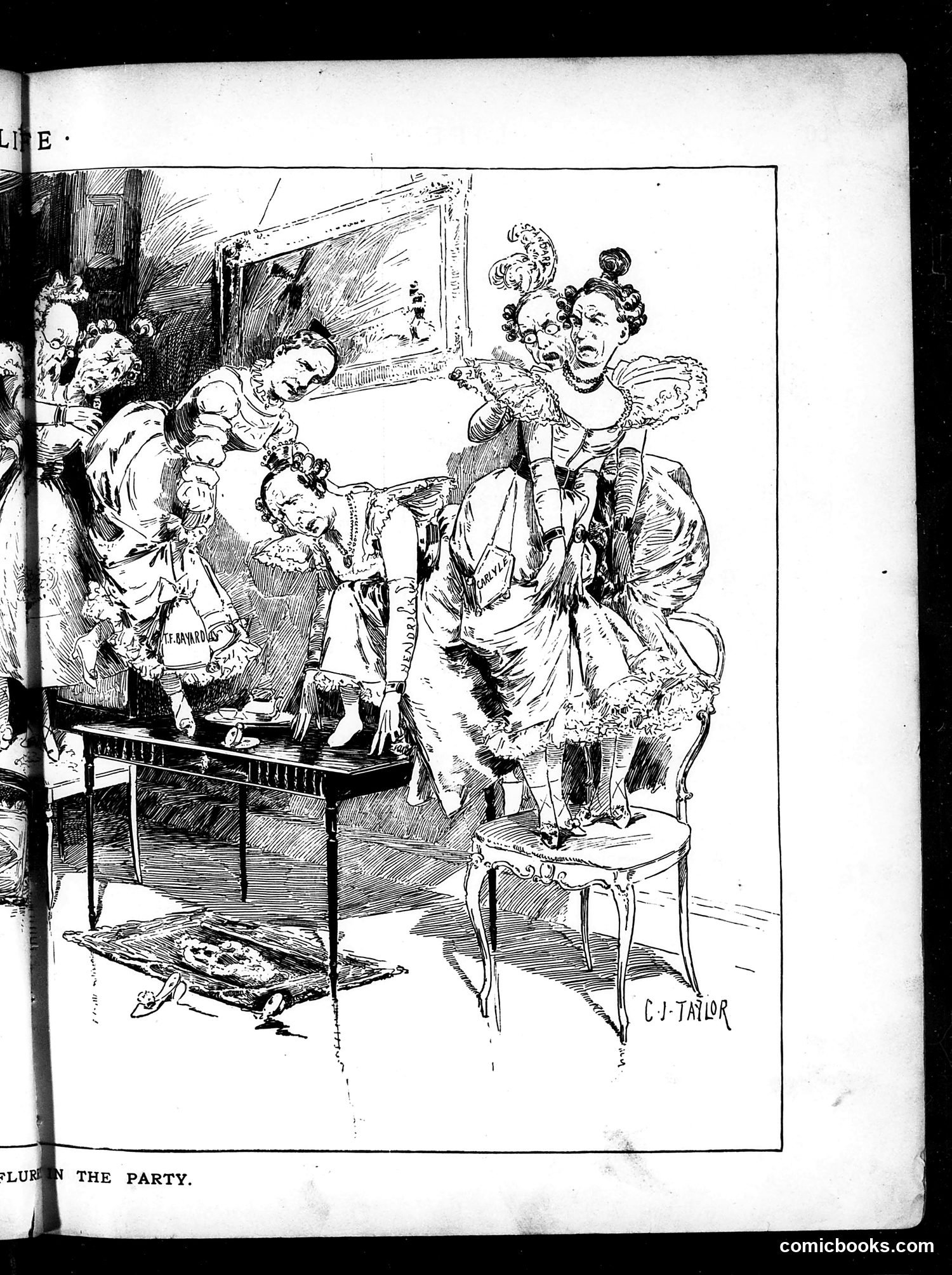
This satirical illustration by C.J. Taylor depicts a social gathering of elegantly dressed women in what appears to be an upper-class domestic setting. The caption "Fluff in the Party" suggests social commentary on superficiality or frivolity within a group—likely a political party or social organization. The women are portrayed with exaggerated features and fashionable period dress (appearing to be early 20th century), engaged in animated conversation. The artist uses caricature to mock what he views as vacuous or insubstantial participation. The scattered items on the floor may suggest disorder or carelessness. Without additional context from the magazine's date and surrounding articles, the specific political target remains unclear, though the satire clearly critiques women's involvement in a particular social or political sphere as lacking substance.
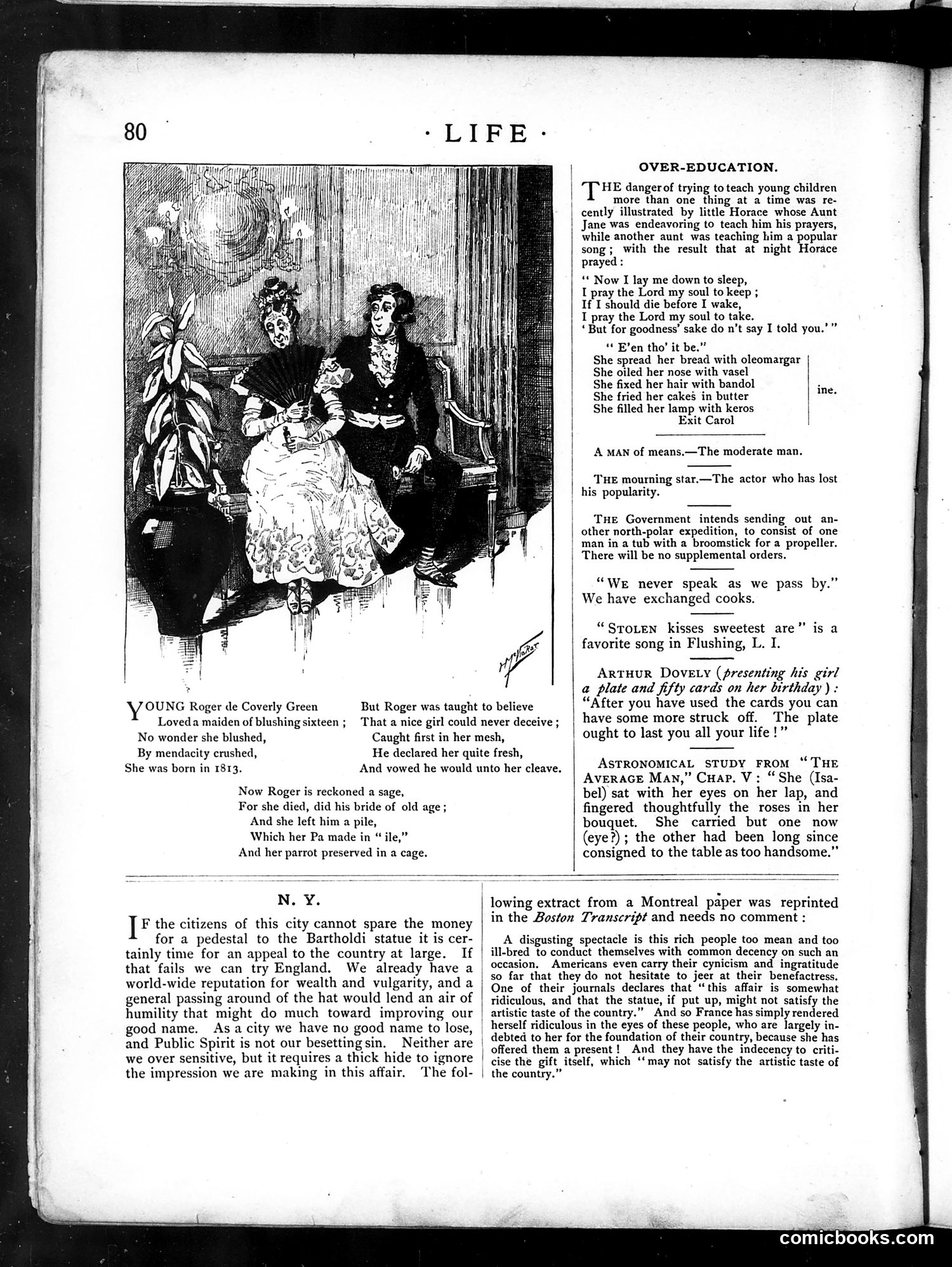
## Main Cartoon: "Over-Education" This satirical piece mocks the modern practice of overstimulating children with simultaneous instruction. Young Horace is taught prayers by one aunt and a popular song by another simultaneously, resulting in his bedtime prayer hilariously mixing the two: he adds "But for goodness' sake don't say I told you"—the song lyric intruding into sacred words. The joke critiques late-19th-century parental/educational excess, suggesting that divided attention produces absurd, corrupted results. ## Minor Items The page includes witty one-liners (definitions of "a man of means," "the mourning star") and satirical observations on contemporary life, including a jab at proposals for a north-pole expedition. ## N.Y. Section A serious critique of wealthy New York's failure to fund the Statue of Liberty pedestal, reprinting Canadian and Boston newspaper condemnations of American "cynicism and ingratitude" toward France's gift. The piece argues Americans' wealth and vulgarity are now globally infamous.
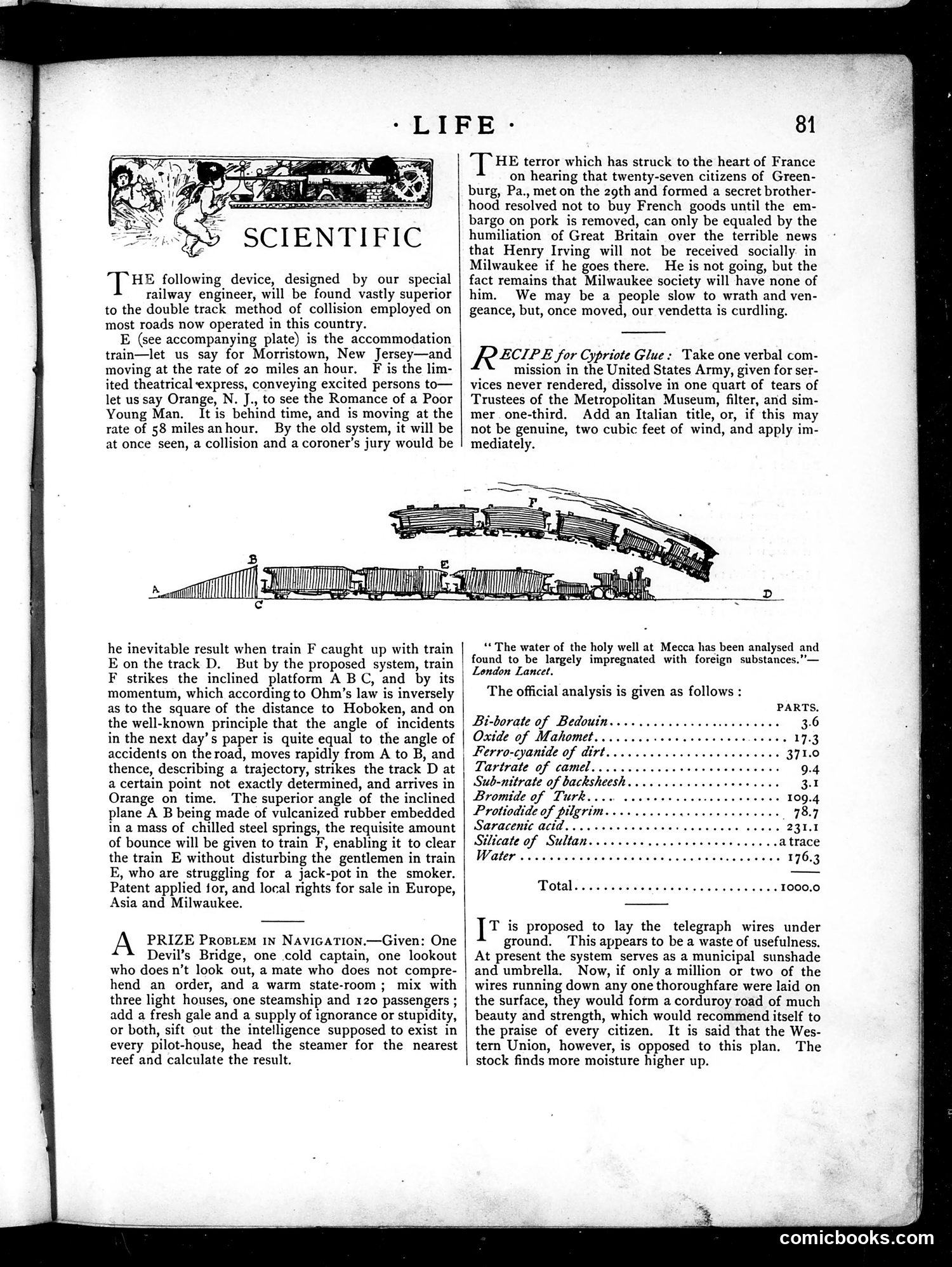
This page contains three separate satirical pieces mocking contemporary American society: 1. **Railway Collision Device**: A mock-serious engineering proposal with diagrams showing an absurd solution to train collisions—an inclined rubber platform that would bounce a speeding train safely over a slower one. The satire targets both railroad safety failures and pseudoscientific pseudo-engineering solutions, referencing real New Jersey locations (Morristown, Orange). 2. **French Boycott/Henry Irving Jab**: Brief mockery of American provincial pretension—specifically, citizens of Greenburg, Pennsylvania boycotting French pork over trade disputes, while Milwaukee society snubs British actor Henry Irving. The joke ridicules small-town American self-importance regarding international affairs. 3. **Mecca Holy Well Analysis**: A humorous "scientific analysis" listing absurd religious and cultural ingredients (Bedouin, Mahomet, pilgrim, Sultan) as chemical compounds in Mecca's water, satirizing both pseudo-scientific analysis and orientalist stereotypes. The overall tone lampoons American technological overconfidence, provincial vanity, and pseudo-intellectual pretension.
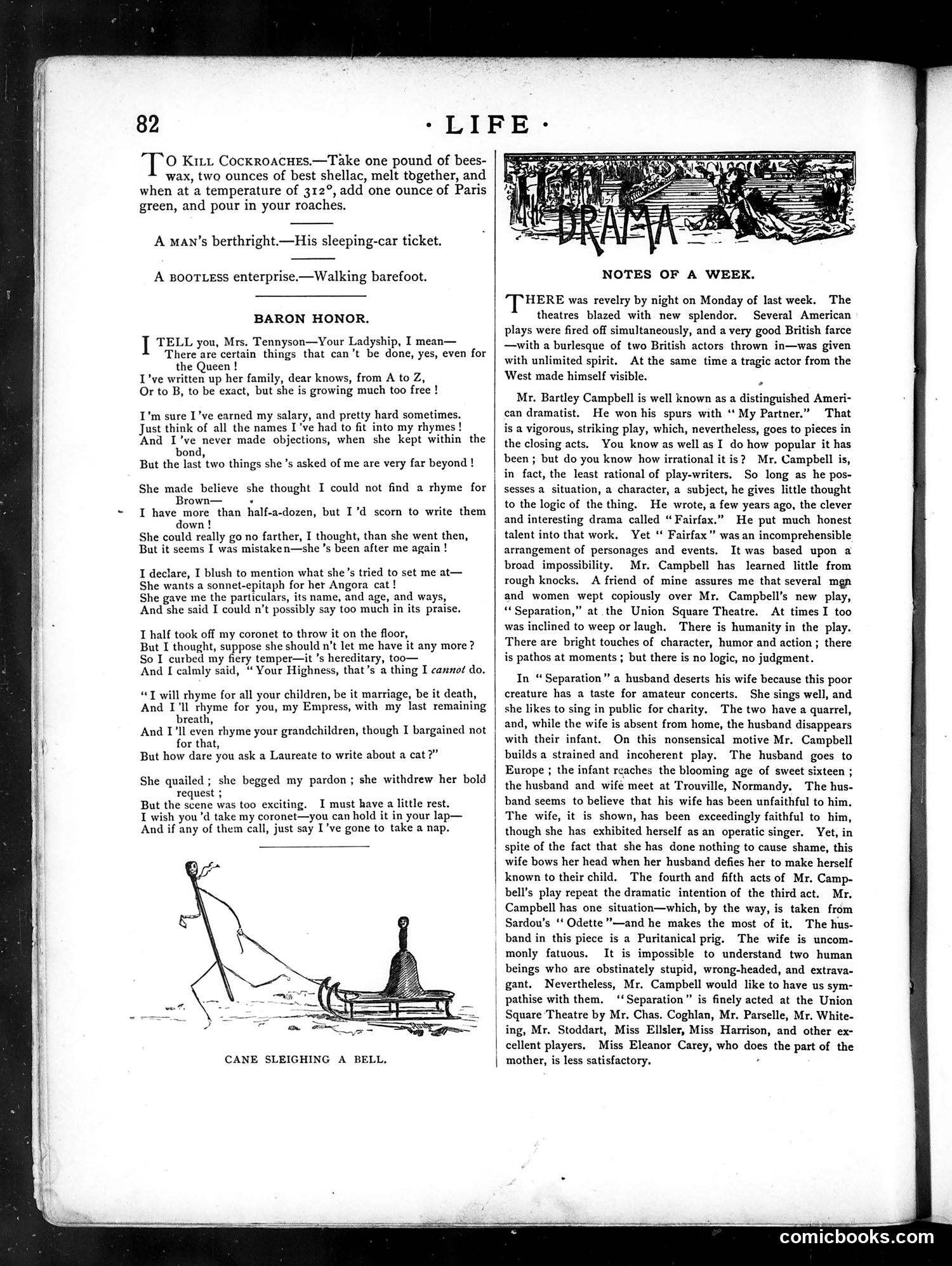
The page contains two distinct pieces of humor: **"Baron Honor"** is a narrative poem satirizing **Alfred, Lord Tennyson**, Britain's Poet Laureate. The speaker (Tennyson's persona) complains to "Mrs. Tennyson" about his employer's (Queen Victoria's) increasingly unreasonable demands. He's written about her family extensively but refuses his final indignity: composing a sonnet-epitaph for her Angora cat. The satire mocks both Tennyson's subservient position and Victorian aristocratic pretension—the absurd notion that a national poet laureate should be expected to celebrate a pet. **"Notes of a Week"** reviews recent theatrical productions, focusing on American dramatist **Bartley Campbell**. The critic praises Campbell's technical skill with situations and characters but faults his illogical plotting. His play "Separation" is dismissed as emotionally manipulative—audiences weep, but the husband and wife characters are "obstinately stupid" and their conflicts incomprehensible. The satire targets sentimental theater that prioritizes melodrama over coherent storytelling. Both pieces employ *Life*'s characteristic satirical tone: witty but sharp criticism of cultural figures through exaggeration and irony.
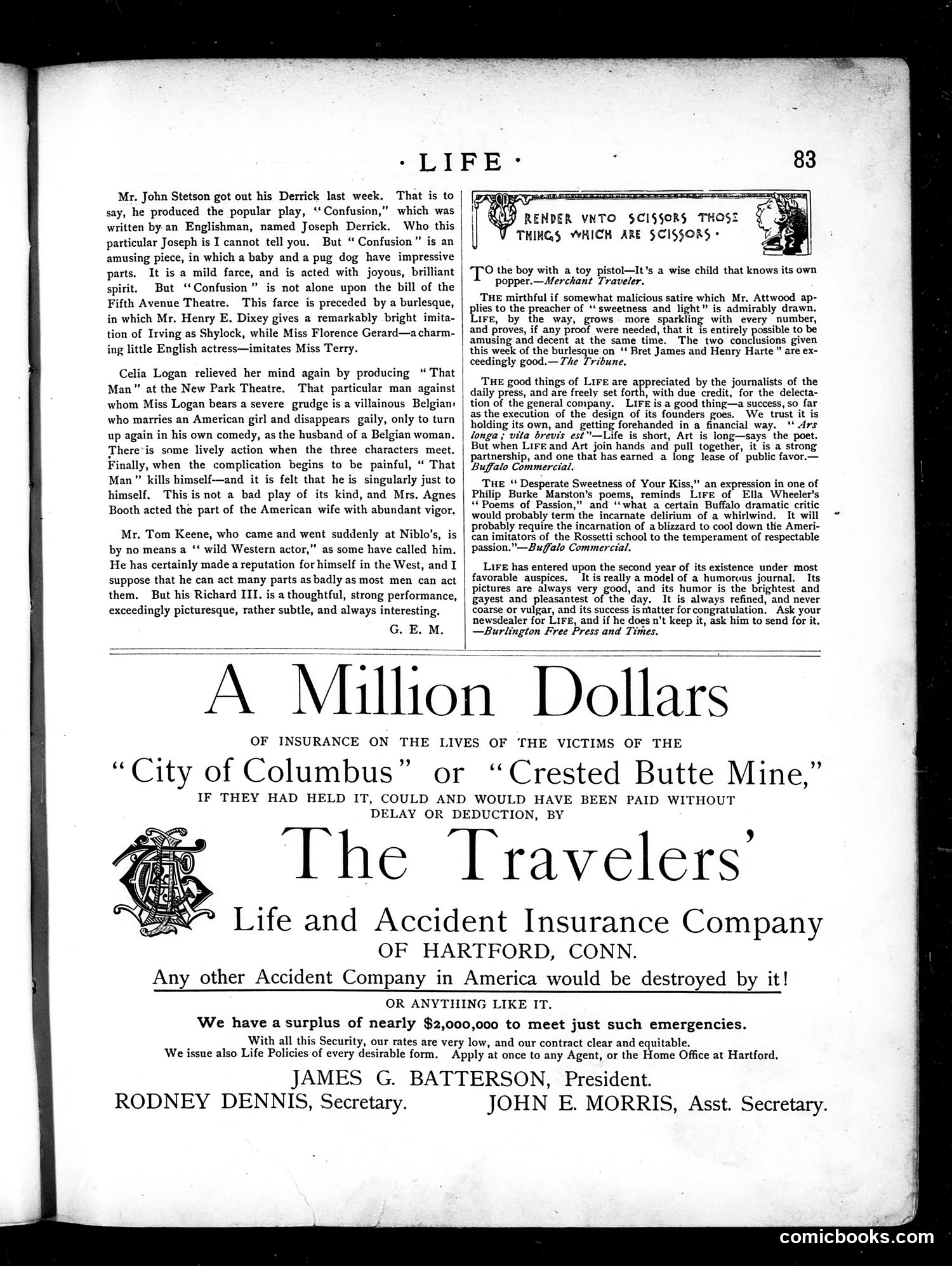
This page primarily contains theater reviews by critic G. E. M., discussing recent Broadway productions including "Confusion" (a farce with a baby and pug dog), "That Man" (featuring an American woman and a Belgian villain), and performances by actors Henry E. Dixey and Tom Keene. The top cartoon shows a boy with a toy pistol, captioned "Render unto scissors those things which are scissors"—a play on the Biblical phrase, humorously suggesting children should recognize the limits of their toys. The bulk of the page is a full-page advertisement for **The Travelers' Life and Accident Insurance Company** of Hartford, Connecticut, referencing a million-dollar potential payout regarding victims of either the "City of Columbus" or "Crested Butte Mine" disasters. The ad boasts the company's financial strength and favorable rates. Scattered throughout are favorable critical excerpts from other newspapers praising *Life* magazine itself as witty, refined, and successfully balancing humor with decency—essentially peer validation during *Life's* second year of publication.
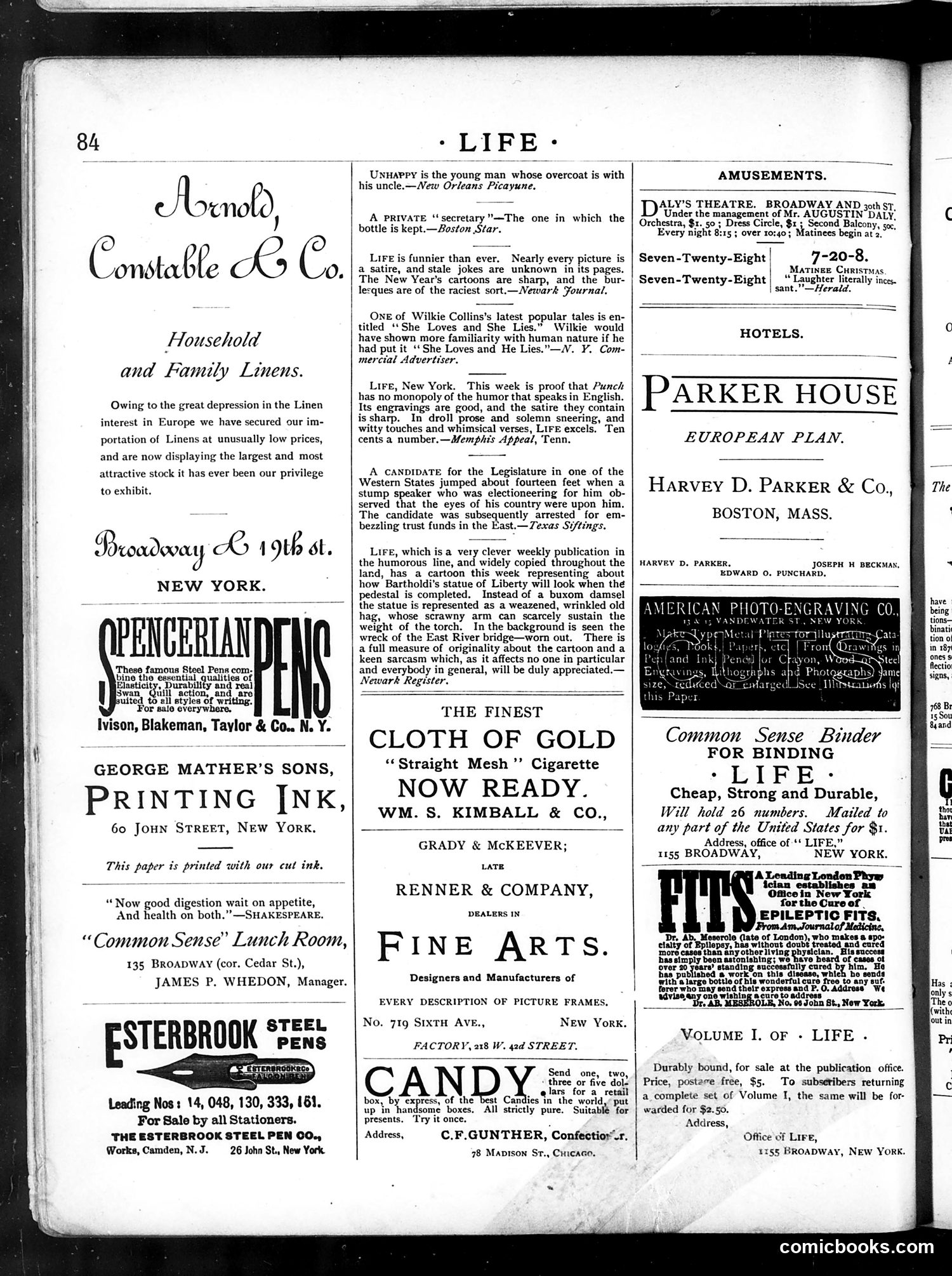
This page is primarily **advertising and editorial content** rather than featuring political cartoons. The notable exception is a referenced cartoon about the Statue of Liberty's pedestal. ## Key Content: **The Statue of Liberty Cartoon** (described in Newark Register excerpt): Life magazine published a satirical cartoon depicting Bartholdi's Liberty statue not as the intended "buxom damsel" but as a "weazened, wrinkled old hag" struggling to hold the torch, with the Brooklyn Bridge appearing as wreckage behind her. This **critiques the delayed pedestal construction**—a real infrastructure problem of the 1880s. The satire targets nobody specifically but "everybody in general," mocking the slow, troubled completion of this celebrated monument. **Humorous Quips**: Scattered one-liners mock human nature (wives lying more than husbands) and political corruption (a legislative candidate arrested for embezzlement). The rest comprises advertisements for printing supplies, pens, candy, hotels, and theaters—typical of period magazines.
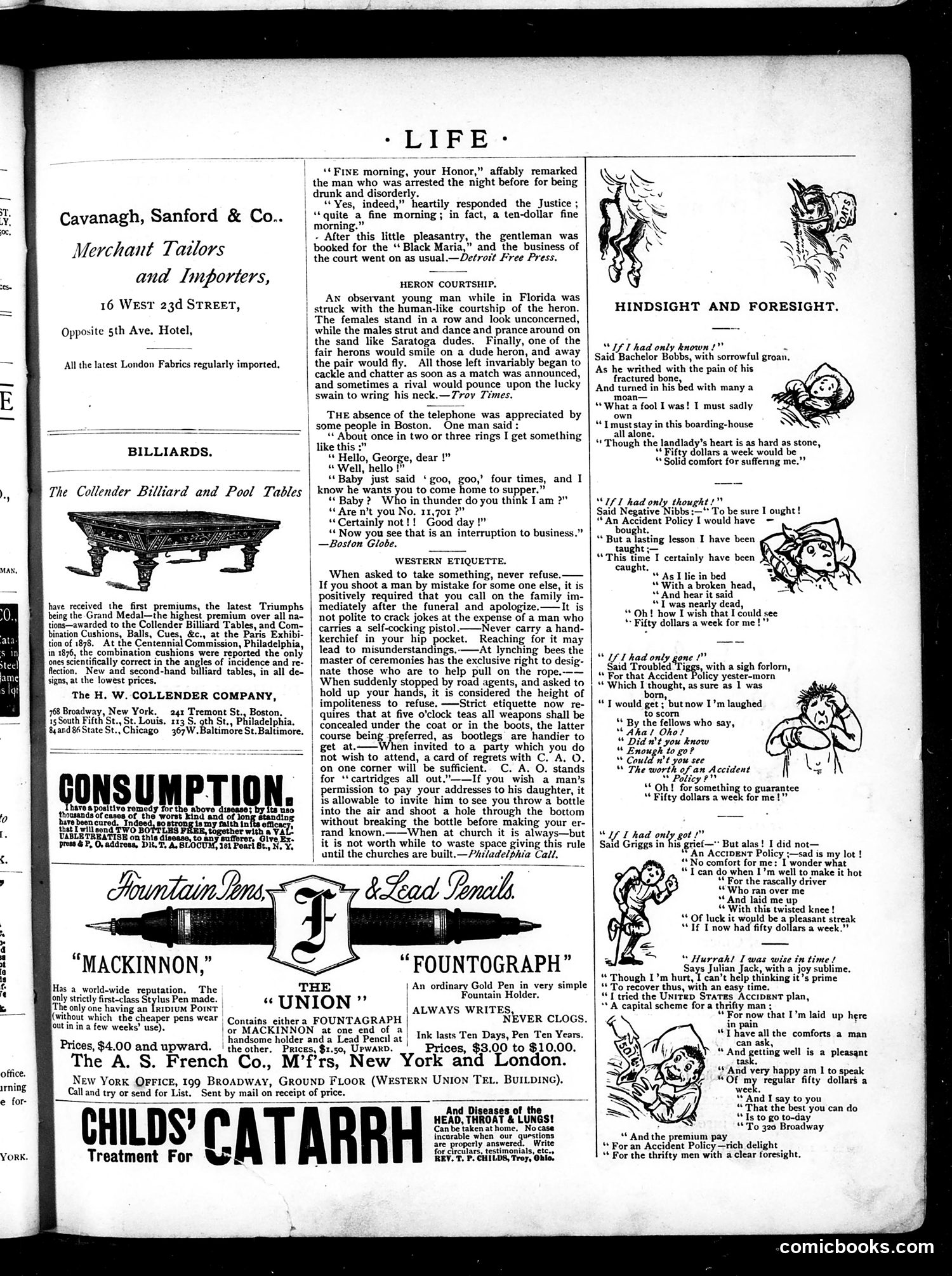
This page consists mainly of **period advertisements** (tailors, billiard tables, a dubious "consumption cure") with several **short humorous anecdotes** in the "Life" section. The cartoons appear to illustrate these jokes through whimsical drawings of characters in comic situations. The visible gags include: - A **drunk arrested for disorderly conduct** makes a pun about a "ten-dollar fine morning" with the judge - **Heron courtship** humorously compared to human behavior—females stand indifferently while males compete, with rejected suitors cackling like gossips - **Telephone interruption comedy**: a man repeatedly gets wrong numbers from someone calling about a baby - **Mock "Western Etiquette"**: satirical rules mocking rough frontier behavior, including references to gunplay, lynching, and concealed weapons The satire targets both urban absurdities (faulty telephones) and Wild West stereotypes (casual violence, vigilante justice). The humor relies on exaggeration and social observation typical of late-19th-century American humor magazines.
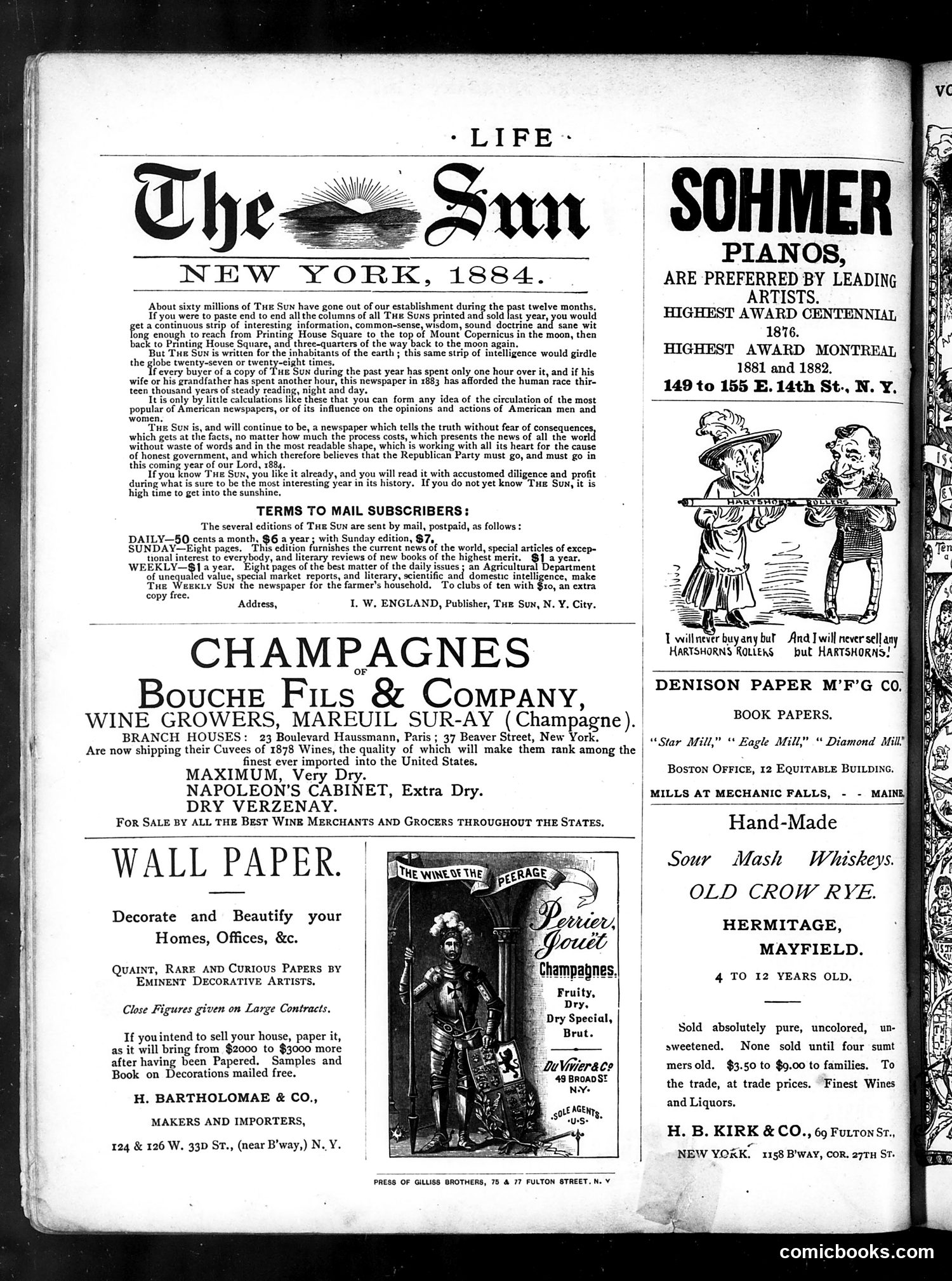
This is primarily an **advertising and masthead page** rather than a satirical cartoon page. The main content includes: **The Sun newspaper's self-promotion** (center): A lengthy statement boasting of the paper's massive circulation and influence, claiming their output could stretch to the moon and back. Notably political: *The Sun explicitly endorses the Republican Party and declares Democrats "must go" in the 1884 election.* **The cartoon** (right side): A small illustration showing two figures in period dress with dialogue: "I will never buy any but Hartshorns Rollers" / "And I will never buy but Hartshorns!" This advertises Hartshorn brand window rollers through comedic product endorsement. **Remaining content**: Advertisements for Sohmer pianos, champagne, wall paper, whiskey, and book papers—typical for Life's era as a magazine funded by advertising. The page reflects 1884 American consumer culture and explicit partisan journalism.