
Life, 1884-02-07 · page 12 of 16
Life — February 7, 1884 — page 12: what you’re looking at
What you’re looking at
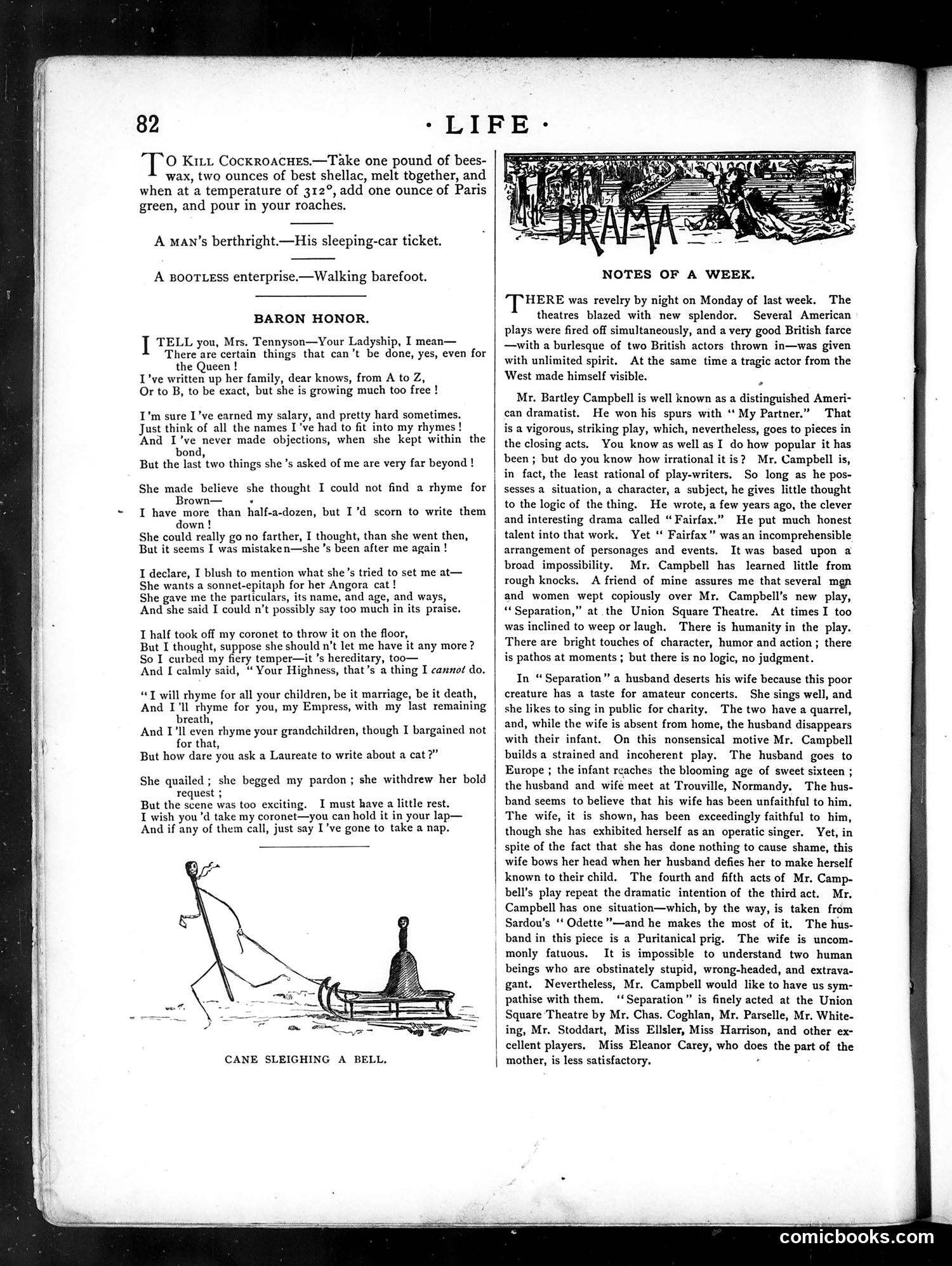
The page contains two distinct pieces of humor: **"Baron Honor"** is a narrative poem satirizing **Alfred, Lord Tennyson**, Britain's Poet Laureate. The speaker (Tennyson's persona) complains to "Mrs. Tennyson" about his employer's (Queen Victoria's) increasingly unreasonable demands. He's written about her family extensively but refuses his final indignity: composing a sonnet-epitaph for her Angora cat. The satire mocks both Tennyson's subservient position and Victorian aristocratic pretension—the absurd notion that a national poet laureate should be expected to celebrate a pet. **"Notes of a Week"** reviews recent theatrical productions, focusing on American dramatist **Bartley Campbell**. The critic praises Campbell's technical skill with situations and characters but faults his illogical plotting. His play "Separation" is dismissed as emotionally manipulative—audiences weep, but the husband and wife characters are "obstinately stupid" and their conflicts incomprehensible. The satire targets sentimental theater that prioritizes melodrama over coherent storytelling. Both pieces employ *Life*'s characteristic satirical tone: witty but sharp criticism of cultural figures through exaggeration and irony.
📄 Transcribed text from this page (OCR, searchable)
Machine-transcribed from the original scan — historical spelling and the odd misread are preserved.
82 T° Kitt Cocxroacues.—Take one pound of bees- wax, two ounces of best shellac, melt together, and when at a temperature of 312°, add one ounce of Paris green, and pour in your roaches. A man’s berthright—His sleeping-car ticket. A BOOTLESS enterprise.—Walking barefoot. BARON HONOR. J TELL you, Mrs. Tennyson—Your Ladyship, I mean— There are certain things that can’t be done, yes, even for the Queen ! I've written up her family, dear knows, from A to Z, Or to B, to be exact, but she is growing much too free ! I'm sure I’ve earned my salary, and pretty hard sometimes. Just think of all the names I've had to fit into my rhymes ! ‘And I’ve never made objections, when she kept within the bond, But the last two things she ’s asked of me are very far beyond ! She made believe she thought I could not find a rhyme for Brown— . I have more than half-a-dozen, but I’d scorn to write them down ! She could really go no farther, I thought, than she went then, But it seems I was mistaken—she ’s been after me again ! I declare, I blush to mention what she’s tried to set me at— She wants a sonnet-epitaph for her Angora cat! She gave me the particulars, its name, and age, and ways, ‘And she said I could n't possibly say too much in its praise. I half took off my coronet to throw it on the floor, But I thought, suppose she should n’t let me have it any more? So I curbed my fiery temper—it ’s hereditary, too— ‘And [ calmly said, “ Your Highness, that’s a thing I cannot do. «will rhyme for all your children, be it marriage, be it death, And I'll thyme for you, my Empress, with my last remaining breath, ; And I'll even rhyme your grandchildren, though I bargained not for that, But how dare you ask a Laureate to write about a cat ?” She quailed; she begged my pardon; she withdrew her bold request ; But the scene was too exciting. I must have a little rest. I wish you ’d take my coronet—you can hold it in your lap— And if any of them call, just say I’ve gone to take a nap. CANE SLEIGHING A BELL, | gant. | pathise with them. | Square Theatre by Mr. Chas. Coghlan, Mr. Parselle, Mr. White- NOTES OF A WEEK. “THERE was revelry by night on Monday of last week, The theatres blazed with new splendor. Several American plays were fired off simultaneously, and a very good British farce —with a burlesque of two British actors thrown in—was given with unlimited spirit. At the same time a tragic actor from the West made himself visible. Mr. Bartley Campbell is well known as a distinguished Ameri- can dramatist. He won his spurs with ‘t My Partner.” That is a vigorous, striking play, which, nevertheless, goes to pieces in the closing acts. You know as well as I do how popular it has been ; but do you know how irrational it is? Mr, Campbell is, in fact, the least rational of play-writers. So long as he pos- sesses a situation, a character, a subject, he gives little thought to the logic of the thing. He wrote, a few years ago, the clever and interesting drama called “Fairfax.” He put much honest talent into that work, Yet ‘ Fairfax” was an incomprehensible arrangement of personages and events. It was based upon a broad impossibility. Mr. Campbell has learned little from rough knocks. A friend of mine assures me that several mgn and women wept copiously over Mr. Campbell’s new play, “Separation,” at the Union Square Theatre. At times I too was inclined to weep or laugh. There is humanity in the play. There are bright touches of character, humor and action; there is pathos at moments ; but there is no logic, no judgment. In “Separation” a husband deserts his wife because this poor creature has a taste for amateur concerts. She sings well, and she likes to sing in public for charity. The two have a quarrel, and, while the wife is absent from home, the husband disappears with their infant. On this nonsensical motive Mr. Campbell builds a strained and incoherent play. The husband goes to Europe ; the infant reaches the blooming age of sweet sixteen ; the husband and wifé meet at Trouville, Normandy. The hus- band seems to believe that his wife has been unfaithful to him. The wife, it is shown, has been exceedingly faithful to him, though she has exhibited herself as an operatic singer. Yet, in spite of the fact that she has done nothing to cause shame, this wife bows her head when her husband defies her to make herself known to their child. The fourth and fifth acts of Mr. Camp- bell’s play repeat the dramatic intention of the third act. Mr. Campbell has one situation—which, by the way, is taken from Sardou’s ‘‘ Odette "—and he makes the most of it. The hus- band in this piece is a Puritanical prig. The wife is uncom- monly fatuous. It is impossible to understand two human beings who are obstinately stupid, wrong-headed, and extrava- Nevertheless, Mr, Campbell would like to have us sym- “Separation” is finely acted at the Union ing, Mr. Stoddart, Miss Ellsler, Miss Harrison, and other ex- cellent players. Miss Eleanor Carey, who does the part of the mother, is less satisfactory. , comicbooks.com