
Life, 1884-02-07 · page 5 of 16
Life — February 7, 1884 — page 5: what you’re looking at
What you’re looking at
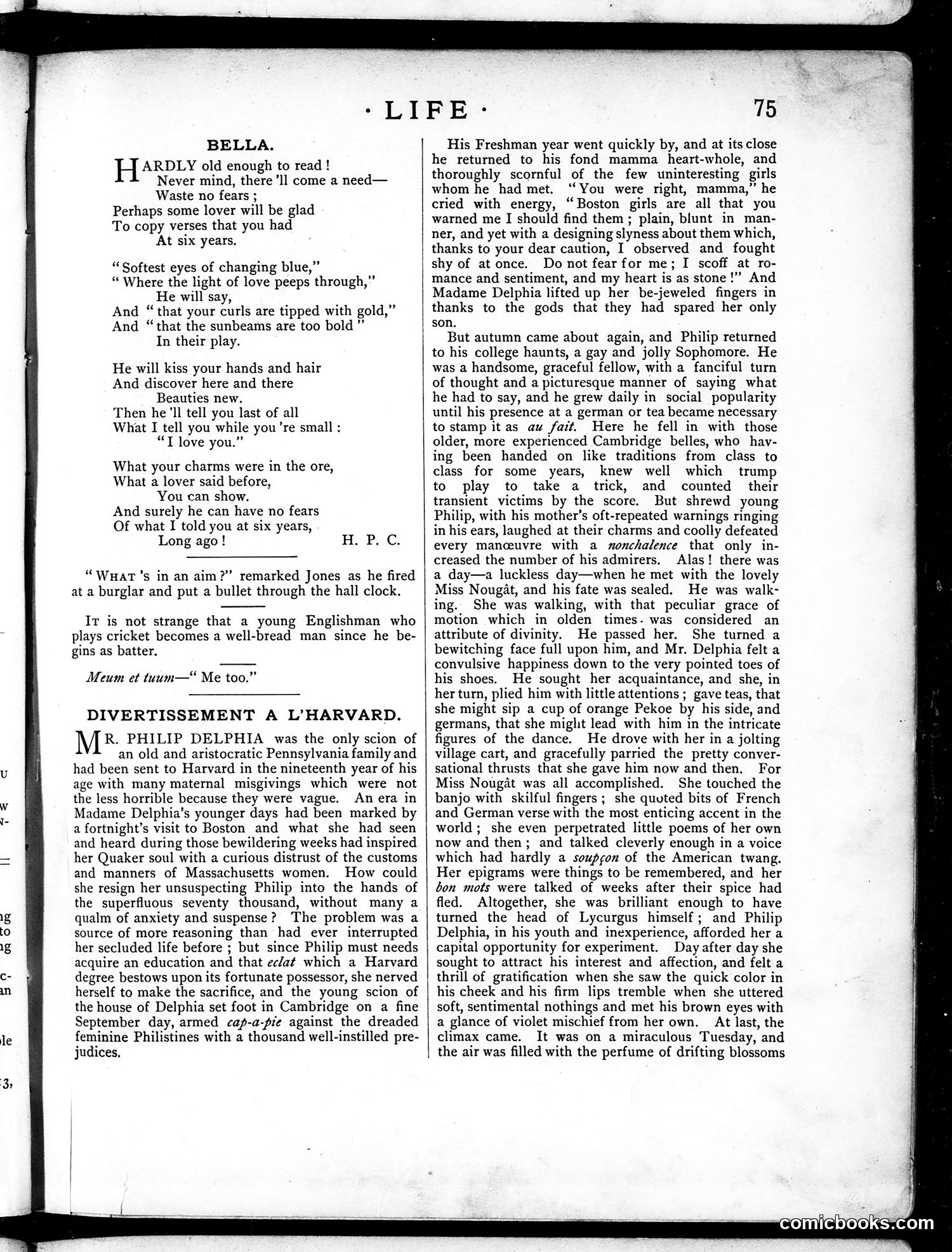
This page contains two distinct pieces: **"Bella"** - A poem by H.P.C. offering romantic advice to a young woman, using flowery Victorian language about love and attraction. It's sentimental verse typical of the era. **"Divertissement à l'Harvard"** - A satirical prose piece about Philip Delphia, a wealthy Pennsylvania aristocrat attending Harvard. The satire mocks his superficial charm and social climbing. The narrative describes how Philip seduces Miss Nougat through flattery and romantic gestures, suggesting that his Harvard education and aristocratic background enable him to manipulate women rather than develop genuine character. The piece critiques both elite pretension and the vulnerability of young women to such calculated seduction. The overall page reflects turn-of-century American anxieties about class, education, and courtship rituals.
📄 Transcribed text from this page (OCR, searchable)
Machine-transcribed from the original scan — historical spelling and the odd misread are preserved.
- LIFE: BELLA. HARDLY old enough to read ! Never mind, there ’ll come a need— Waste no fears ; Perhaps some lover will be glad To copy verses that you had At six years. “Softest eyes of changing blue,” “Where the light of love peeps through,” He will say, And “that your curls are tipped with gold,” And “that the sunbeams are too bold” In their play. He will kiss your hands and hair And discover here and there Beauties new. Then he'll tell you last of all What I tell you while you ’re small : “T love you.” What your charms were in the ore, What a lover said before, You can show. And surely he can have no fears Of what I told you at six years, Long ago! H, P. C. “Wuat's in an aim?” remarked Jones as he fired at a burglar and put a bullet through the hall clock. Ir is not strange that a young Englishman who plays cricket becomes a well-bread man since he be- gins as batter. Meum et tuum— Me too.” DIVERTISSEMENT A L’HARVARD. M® PHILIP DELPHIA was the only scion of an old and aristocratic Pennsylvania family and had been sent to Harvard in the nineteenth year of his age with many maternal misgivings which were not the less horrible because they were vague. An era in Madame Delphia’s younger days had been marked by a fortnight’s visit to Boston and what she had seen and heard during those bewildering weeks had inspired her Quaker soul with a curious distrust of the customs and manners of Massachusetts women. How could she resign her unsuspecting Philip into the hands of the superfluous seventy thousand, without many a qualm of anxiety and suspense? The problem was a source of more reasoning than had ever interrupted her secluded life before ; but since Philip must needs acquire an education and that ecdat which a Harvard degree bestows upon its fortunate possessor, she nerved herself to make the sacrifice, and the young scion of the house of Delphia set foot in Cambridge on a fine September day, armed caf-a-pie against the dreaded feminine Philistines with a thousand well-instilled pre- judices. | shy of at once. 75 His Freshman year went quickly by, and at its close he returned to his fond mamma heart-whole, and thoroughly scornful of the few uninteresting girls whom he had met. ‘You were right, mamma,” he cried with energy, “Boston girls are all that you warned me I should find them; plain, blunt in man- ner, and yet with a designing slyness about them which, thanks to your dear caution, I observed and fought Do not fear for me; I scoff at ro- mance and sentiment, and my heart is as stone !” And Madame Delphia lifted up her be-jeweled fingers in thanks to the gods that they had spared her only son. But autumn came about again, and Philip returned to his college haunts, a gay and jolly Sophomore. He was a handsome, graceful fellow, with a fanciful turn of thought and a picturesque manner of saying what he had to say, and he grew daily in social popularity until his presence at a german or tea became necessary to stamp it as au fait. Here he fell in with those older, more experienced Cambridge belles, who hav- ing been handed on like traditions from class to class for some years, knew well which trump to play to take a trick, and counted their transient victims by the score. But shrewd young Philip, with his mother’s oft-repeated warnings ringing in his ears, laughed at their charms and coolly defeated every manceuvre with a monchalence that only in- creased the number of his admirers. Alas! there was a day—a luckless day—when he met with the lovely Miss Nougat, and his fate was sealed. He was walk- ing. She was walking, with that peculiar grace of motion which in olden times- was considered an attribute of divinity. He passed her. She turned a bewitching face full upon him, and Mr. Delphia felt a convulsive happiness down to the very pointed toes of his shoes. He sought her acquaintance, and she, in her turn, plied him with little attentions ; gave teas, that she might sip a cup of orange Pekoe by his side, and germans, that she might lead with him in the intricate figures of the dance. He drove with her in a jolting village cart, and gracefully parried the pretty conver- sational thrusts that she gave him now and then. For Miss Nougat was all accomplished. She touched the banjo with skilful fingers; she quoted bits of French and German verse with the most enticing accent in the world ; she even perpetrated little poems of her own now and then ; and talked cleverly enough in a voice which had hardly a soupgon of the American twang. Her epigrams were things to be remembered, and her bon mots were talked of weeks after their spice had fled. Altogether, she was brilliant enough to have turned the head of Lycurgus himself; and Philip Delphia, in his youth and inexperience, afforded her a capital opportunity for experiment. Day after day she sought to attract his interest and affection, and felt a thrill of gratification when she saw the quick color in his cheek and his firm lips tremble when she uttered soft, sentimental nothings and met his brown eyes with a glance of violet mischief from her own. At last, the climax came. It was on a miraculous Tuesday, and the air was filled with the perfume of drifting blossoms