
A complete issue · 17 pages · 1883
Life — December 27, 1883
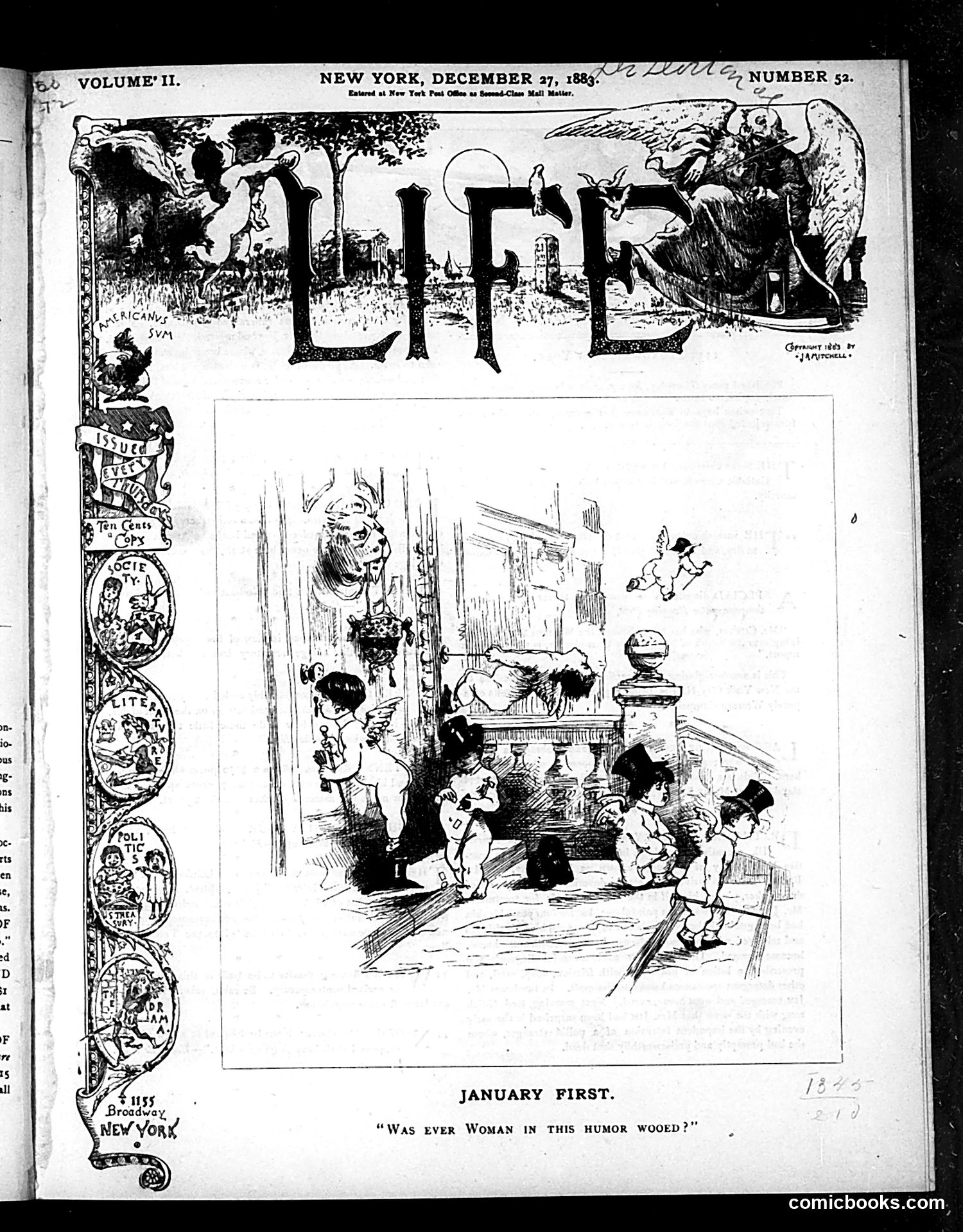
This page shows a New Year's themed cartoon titled "January First" with the caption "Was ever Woman in this Humor wooed?" The illustration depicts cherubs and cupids in an interior scene, apparently celebrating the New Year. The composition suggests romantic or amorous activity—fitting given the caption's literary reference (likely Shakespeare) questioning whether a woman was ever courted in such a playful state. The left margin features Life magazine's decorative masthead with classical medallions. The cartoon appears to be gentle satire about New Year's celebrations and romantic pursuits among the social set, using classical allegorical figures (cupids) to comment humorously on courtship customs. The exact social commentary remains somewhat unclear without additional context about 1883 New York society.
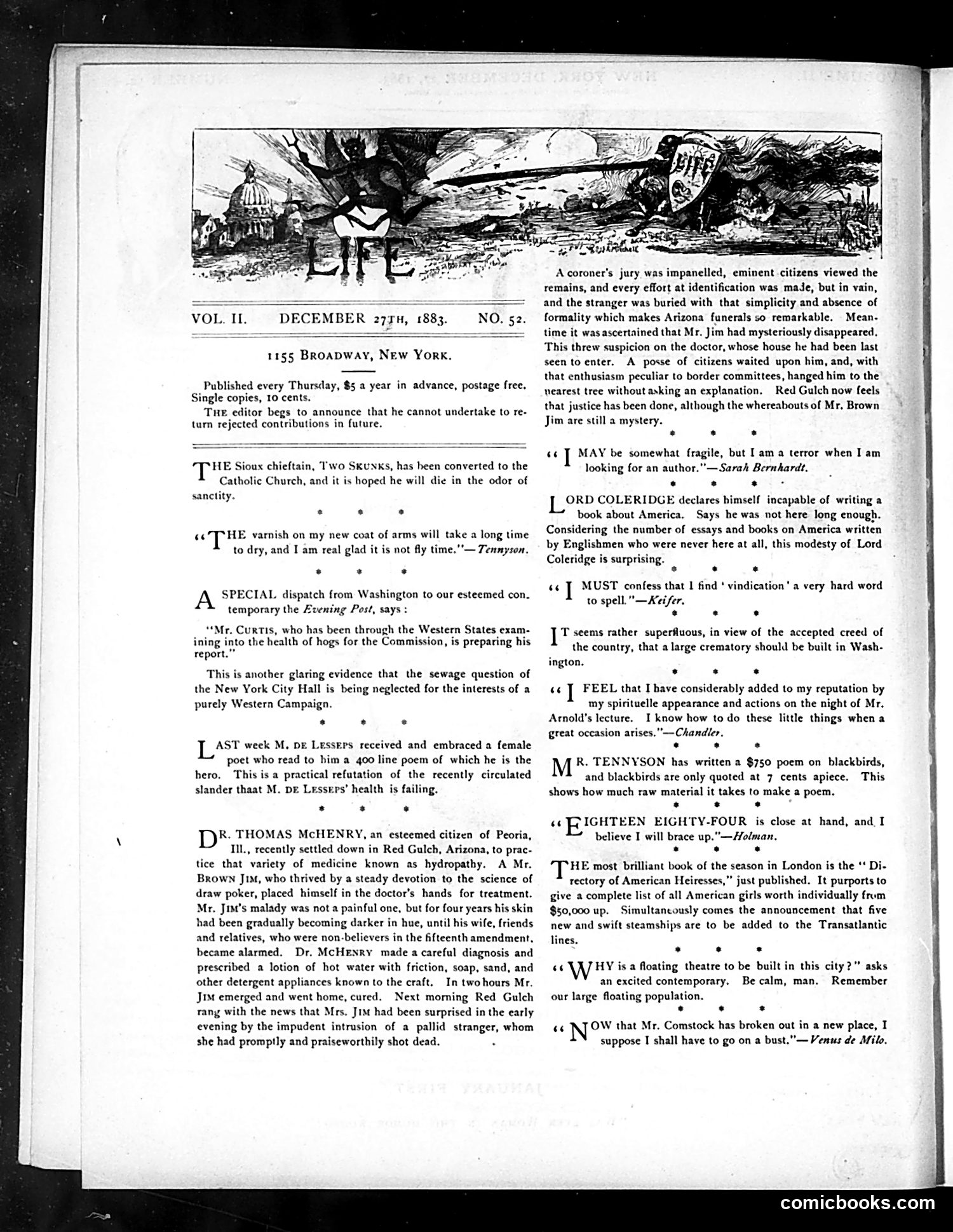
The page is primarily text-based commentary and gossip rather than political cartoons. The small illustration at top appears to show a seated figure, though details are unclear. The content consists of brief satirical notes about public figures and events. Notable items include: - **Dr. Thomas McHenry** in Arizona: A physician treating a patient named Jim with unconventional methods (detergents, soap, sand) who mysteriously died—the satire questions the doctor's competence and suspicious circumstances. - **Lord Coleridge**: Mocked for declaring himself incapable of writing about America despite numerous English books on the subject. - References to **Mr. Tennyson** and **Mr. Comstock**: Brief jabs at contemporary figures. The overall tone is gossipy mockery of minor public figures and social pretensions typical of 1880s American satirical magazines.
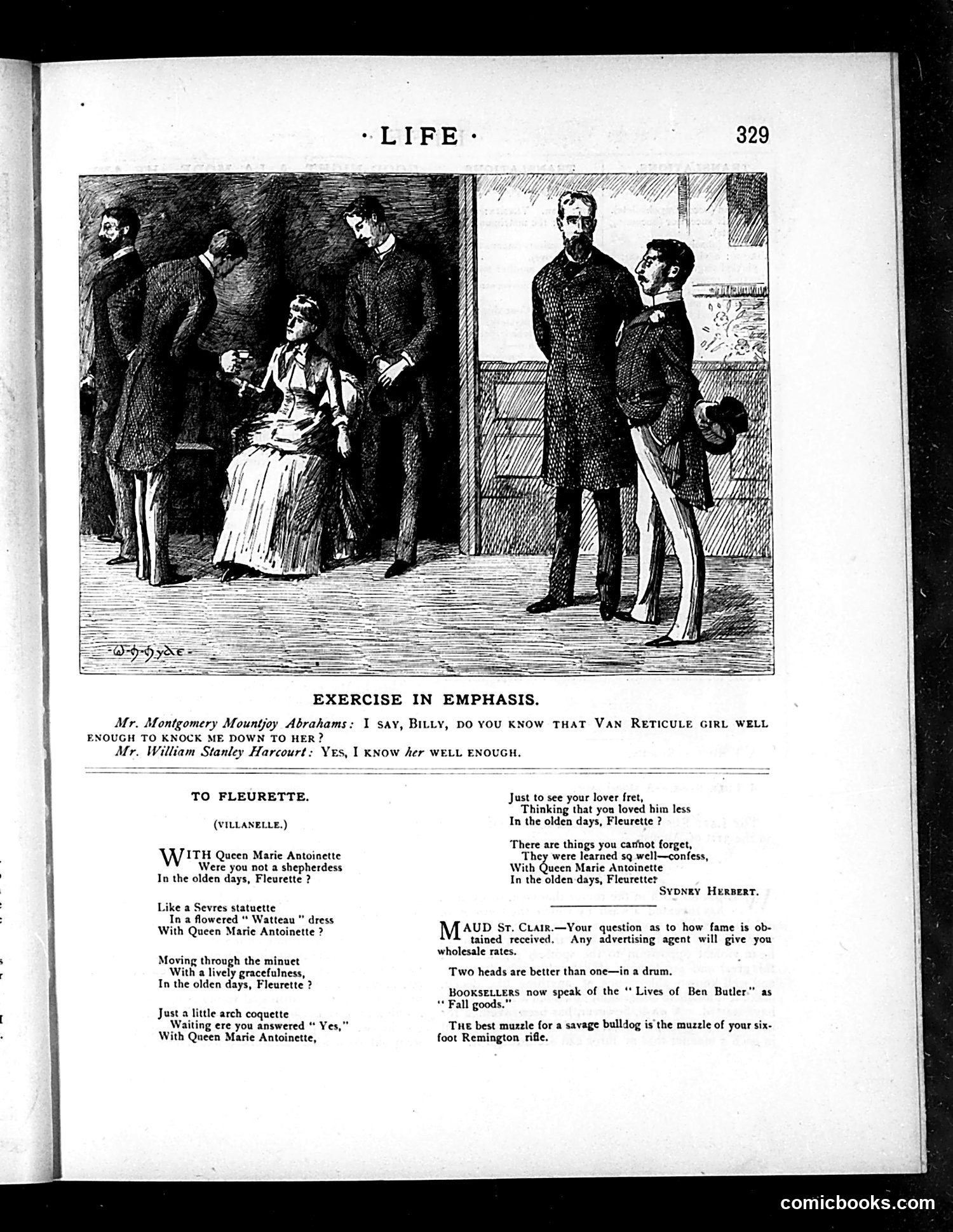
The main cartoon, titled "Exercise in Emphasis," depicts a social scene where Mr. Montgomery Mountjoy Abrahams boasts to Mr. William Stanley Harcourt about a woman's physical prowess—specifically that "Van Reticule girl" is strong enough to knock him down. Harcourt responds that he knows her "well enough." The humor appears satirical: Abrahams is using exaggerated language ("emphasis") to impress Harcourt with gossip about a woman's strength, which was unusual for the era. The joke likely mocks both male pretension and shifting social attitudes toward women's independence or athleticism. The page also contains poetry dedicated "To Fleurette" and brief satirical notes about advertising and book sales, typical of *Life* magazine's mixed editorial content.
This page contains primarily **literary content rather than political cartoons**. The main features are: 1. **"Translations"** section: Satirical definitions of marriage-related terms (husband, wife, courtship, etc.), mocking romantic and matrimonial concepts with cynical humor typical of Life's style. 2. **"Good-Night, à la Mode"** by Rondeau: A dialogue poem about saying goodnight, with social commentary on courtship rituals. 3. **"None But the Brave Deserve the Fair"**: A short story moral tale about two men and a woman at a musical party, referencing a classical phrase. 4. **"A Lie"**: Prose piece debunking a rumor about General di Consolaabout an invented horse-teeth washing procedure. The page demonstrates Life's satirical approach to **social customs, marriage, and contemporary rumors**—not political cartooning. It's primarily text-based social satire rather than visual humor.
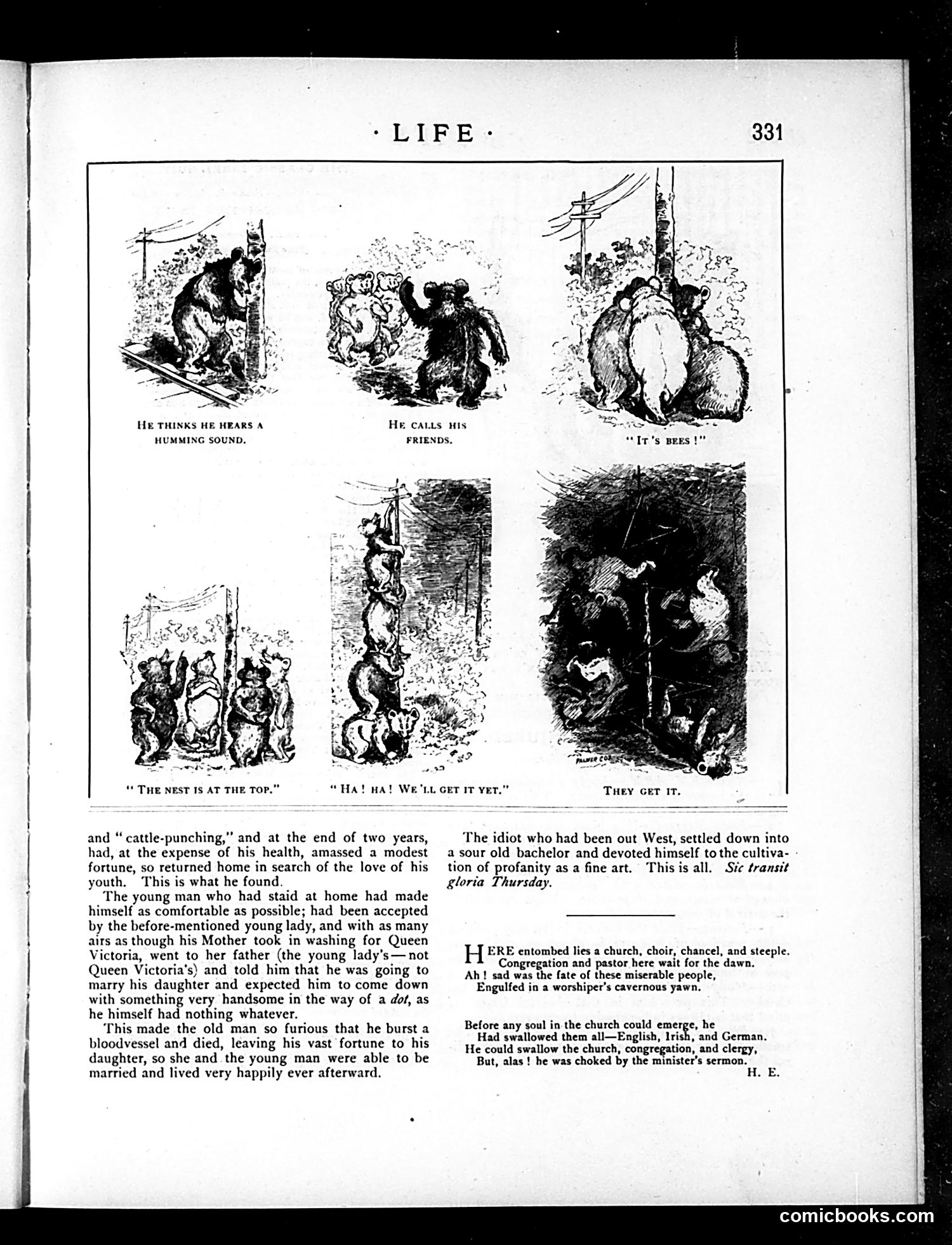
This page contains six comic panels depicting **anthropomorphic bears** in humorous situations. The captions read: "He thinks he hears a humming sound," "He calls his friends," "It's bees!", "The nest is at the top," "Ha! ha! We'll get it yet," and "They get it." The narrative shows bears attempting to obtain honey from a beehive, with escalating comic chaos. This appears to be a **straightforward animal humor strip** rather than political satire—it simply illustrates the classic comedic scenario of animals pursuing food despite obvious danger. The accompanying text discusses romantic relationships and fortune, unrelated to the bear illustrations, suggesting this is a **miscellaneous humor magazine page** combining different comic and literary content rather than unified satirical commentary.
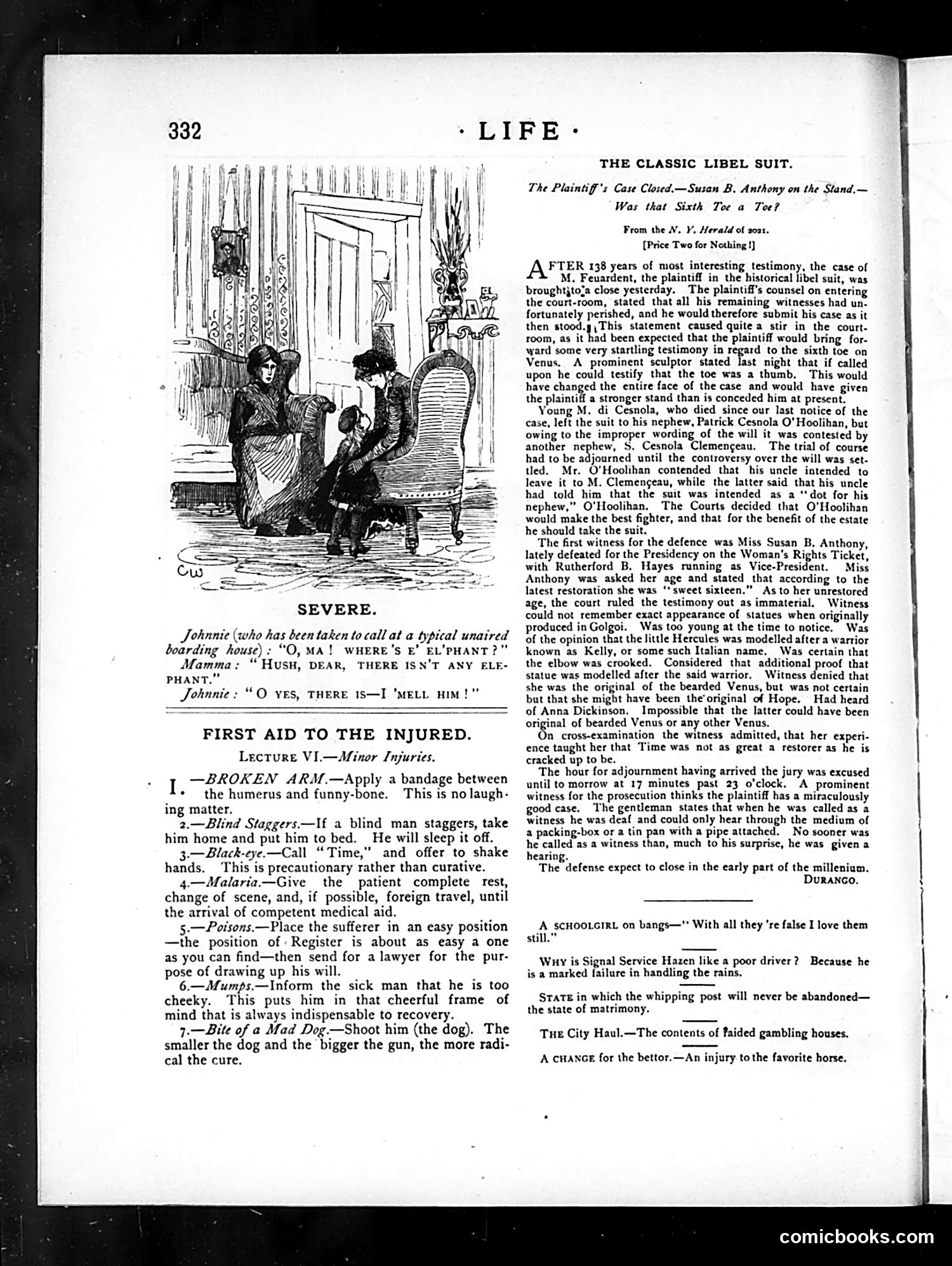
This cartoon depicts a domestic scene at a boarding house, showing two figures in conversation. The caption reads: "Johnnie (who has been taken to call at a typical unaired boarding house): 'O MA! WHERE'S E' ELEPHANT?' / Mamma: 'Hush, dear, there isn't any elephant.' / Johnnie: 'O yes, there is—I smell him!'" The satire targets the poor sanitation and musty conditions of cheap boarding houses. The child's innocent complaint about an "elephant" is actually a humorous way of commenting on the overwhelming stench—implying the smell is so strong it could only come from such a large animal. This was a common Victorian-era criticism of low-cost lodgings, which were notorious for inadequate ventilation and cleanliness.
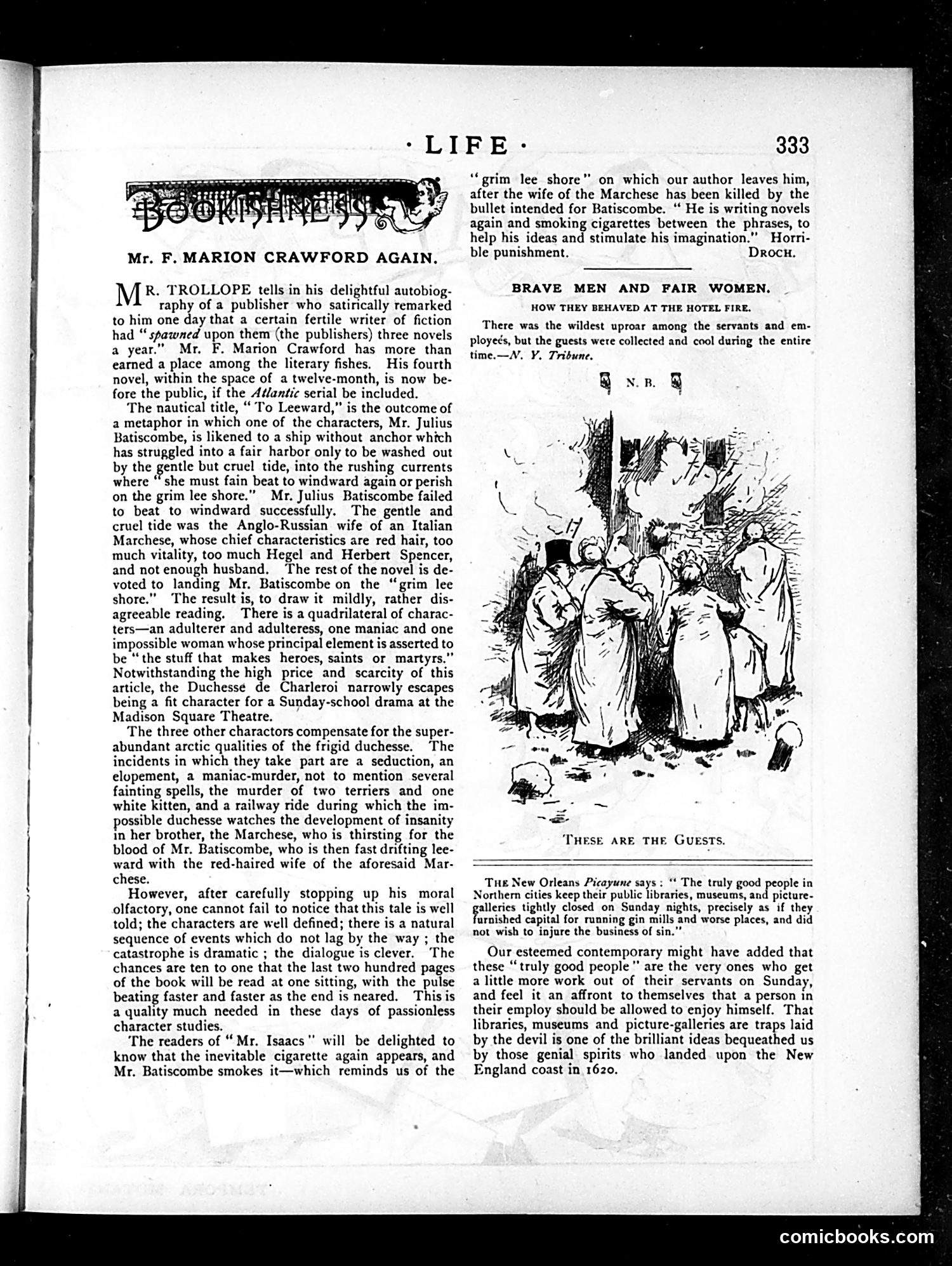
This page contains two distinct sections: **Top section** ("Mr. F. Marion Crawford Again"): A book review discussing novelist Marion Crawford's works, particularly praising his novel "To Leeward." The review details plot points involving characters named Julius Batiscombe and an Anglo-Russian marchioness, noting Crawford's skill at dramatic narrative and character development. **Bottom section** ("Brave Men and Fair Women"): An illustration captioned "These Are the Guests" showing what appears to be hotel staff or servants during a fire emergency. The accompanying text references a *New Orleans Picayune* quote about "truly good people" in Northern cities keeping galleries closed on Sundays—a satirical jab at Northern moral hypocrisy regarding servant treatment and business practices. The page is primarily literary criticism and social commentary rather than political satire.
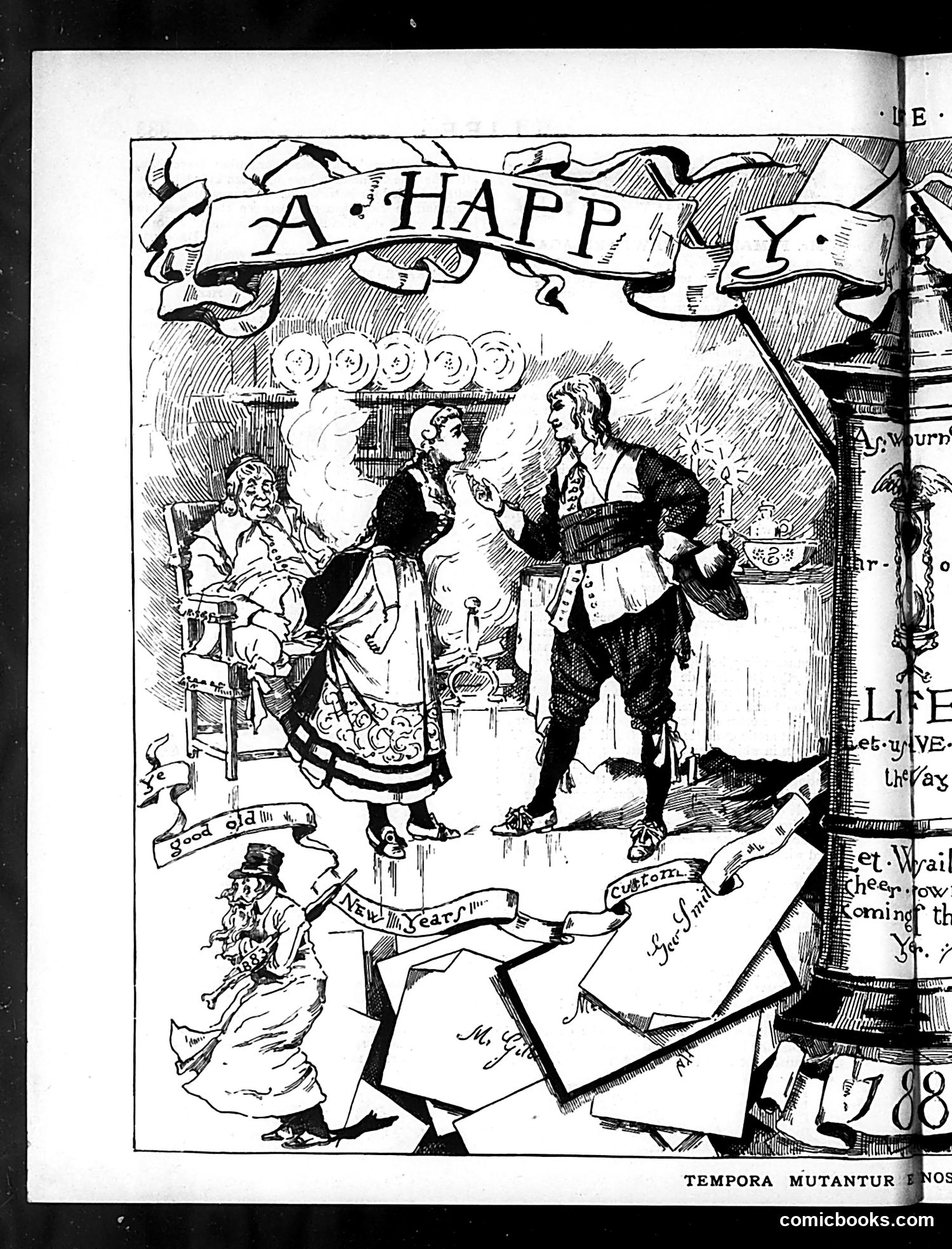
This Life magazine cartoon celebrates the New Year with satirical commentary on American social customs. The central scene shows three well-dressed figures in what appears to be a parlor, while below them a figure labeled "Old Year" departs carrying various burdens and papers. The scattered documents reference social obligations: "Good Old," "New Year," "Custom," "For Unit," and other text suggesting resolutions and social expectations. The cartoon satirizes how people shed old troubles at year's end while embracing new social rituals and customs. The contrast between the cheerful domestic scene above and the overburdened departing figure below suggests irony—the "happy life" comes at the cost of maintaining exhausting social conventions. This reflects Life magazine's typical satirical stance on Victorian-era American society and its contradictions.
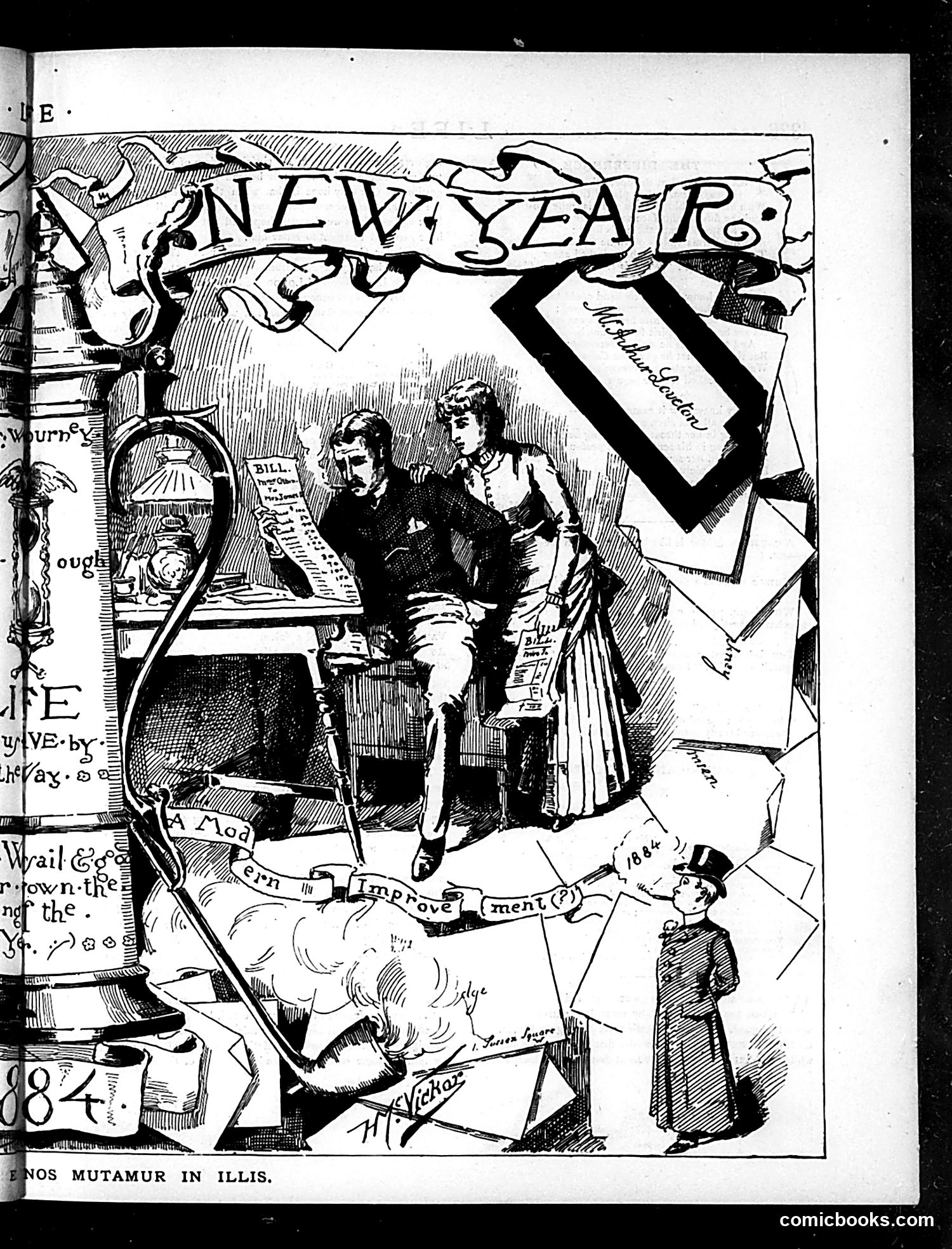
This appears to be a satirical cartoon from *Life* magazine titled "A New Year" (visible in the banner). The central scene shows two well-dressed figures examining documents at a desk, while below them a donkey labeled "Improvement(?)" appears to be pulling or struggling with various papers and proposals. A gentleman in a top hat stands observing on the right. The satire likely comments on New Year's resolutions or political/social reform efforts of the era. The donkey—a traditional symbol of obstinacy or the Democratic Party—struggling with "improvements" suggests skepticism about whether ambitious plans can actually be implemented. The scattered papers and documents reinforce the theme that good intentions often fail in execution. The specific political context remains unclear without additional dating information.
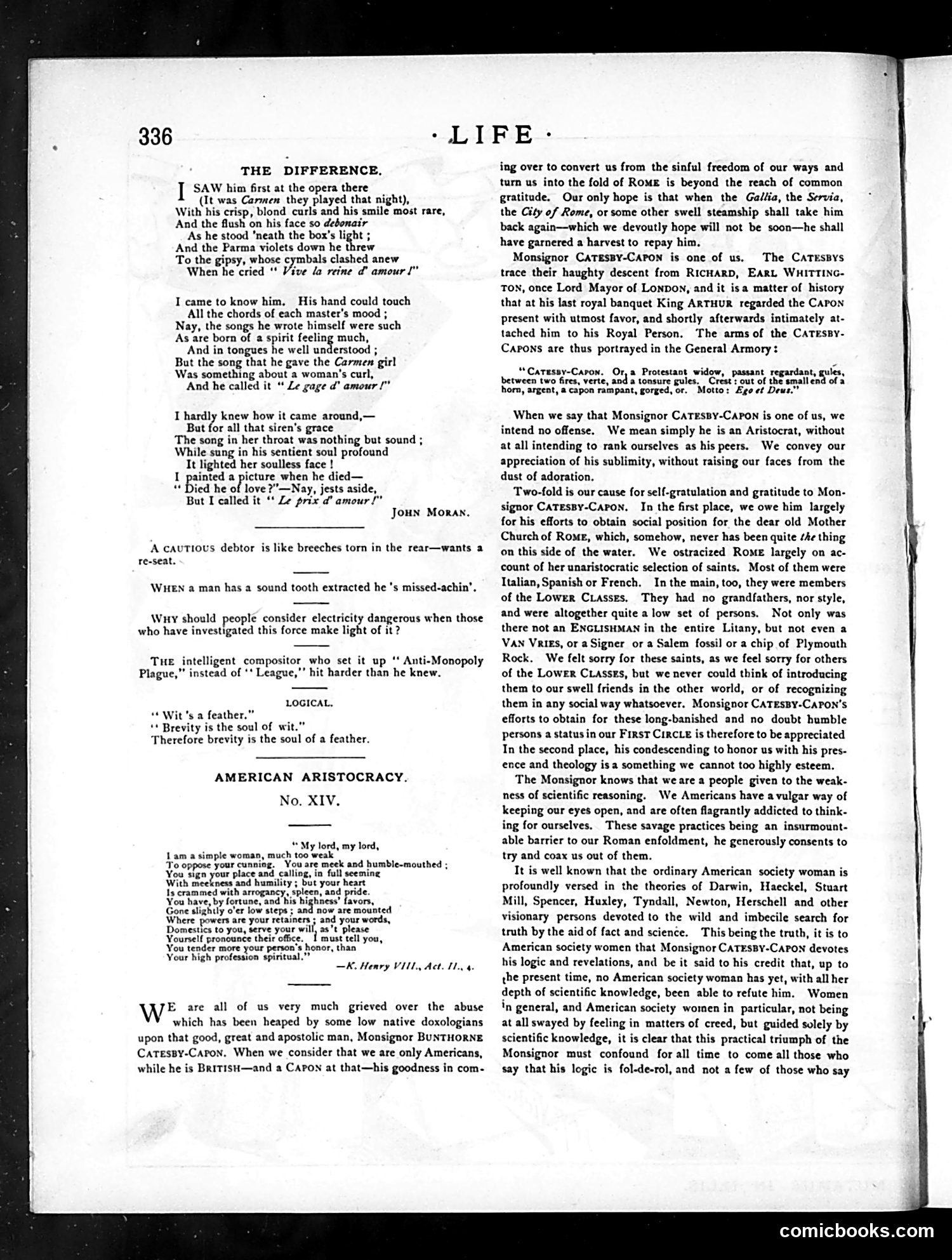
This page satirizes American social pretension and religious hypocrisy through two main pieces: **"The Difference"** (poem by John Moran): A romantic narrative contrasting genuine artistic feeling with empty performance. A male musician's soulful composition moves audiences, while the same song sung by a beautiful but shallow woman ("the Carmen girl") produces only meaningless sound. The satire suggests beauty without substance—a critique of superficial culture. **"American Aristocracy No. XIV"**: This section mocks Americans' deference to British clerics, specifically "Monsignor Bunthorne Catesby-Capon." The text is heavy with sarcasm: Americans apologize for "abusing" this British religious figure, while he converts them from their "sinful freedom." The fabricated genealogy tracing his family to Dick Whittington (a real historical Lord Mayor) and King Arthur, complete with absurd heraldic descriptions ("a capon rampant"), ridicules both British pretension and American worship of foreign aristocracy and authority. The satire targets American cultural insecurity and gullibility regarding European (particularly British) social superiority.
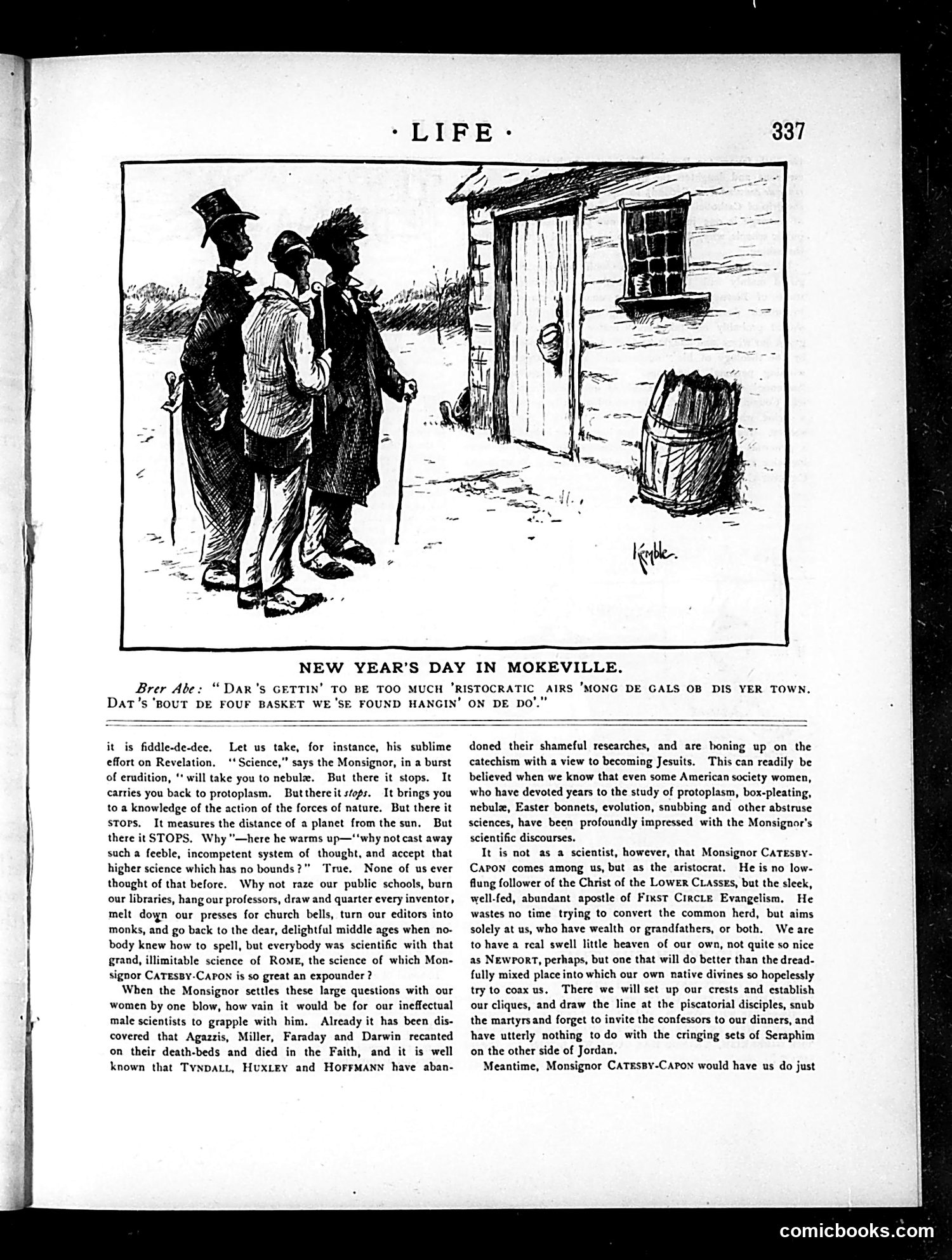
This cartoon satirizes class pretension and religious hypocrisy in rural America. The sketch depicts three fashionably dressed figures (one wearing a top hat) encountering a humble cabin—"Brer Abe" comments in dialect that "Dan's gettin' to be too much 'ristocratic airs" and references finding four baskets hanging on the door (likely a folk custom or joke about abundance/charity). The accompanying text attacks **Monsignor Catesby-Capon**, an apparent Catholic clergyman character, for selling elite "First Circle" religion to wealthy American women while dismissing scientific progress (Darwin, Huxley, Faraday). The satire suggests he offers wealthy patrons an exclusive heavenly society excluding "common" people and even "martyrs"—religion as social stratification rather than spiritual salvation. The piece mocks both religious authority figures who exploit the wealthy and the vanity of society women susceptible to such appeals.
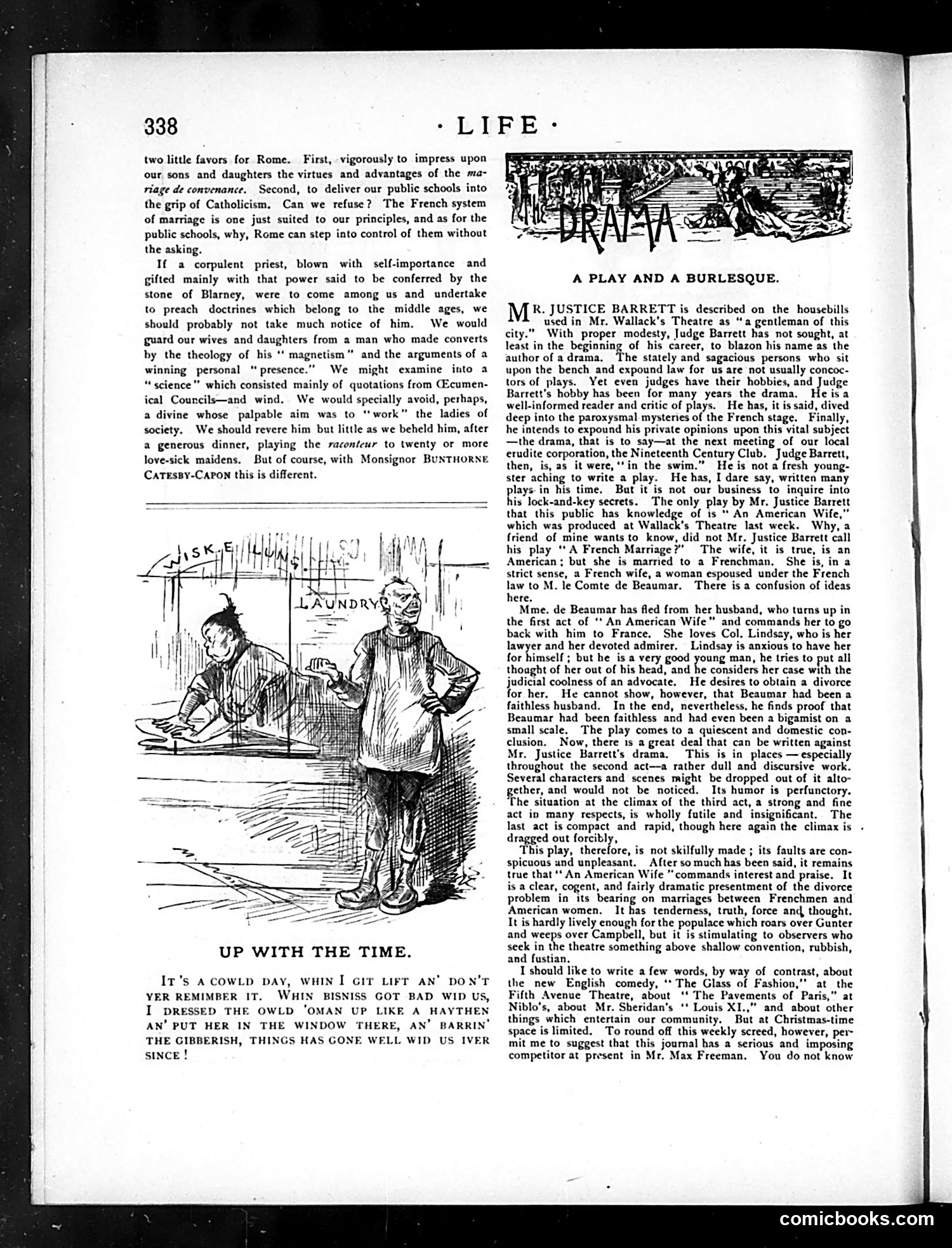
This page contains two distinct satirical pieces from 19th-century *Life* magazine. **The cartoon** (titled "Up With the Time") depicts an Irish immigrant man and woman, identifiable by the dialectical Irish speech ("cowld," "remimber," "owld 'oman"). The joke satirizes Irish poverty and desperation: the man dressed his wife "up like a haythen" and placed her in a window display, apparently to attract business—suggesting degradation born of economic hardship. The satire mocks both Irish working-class struggles and the crude survival strategies some employed. **The text section** reviews Judge Barrett's play "An American Wife," performed at Wallack's Theatre. The critic humorously notes the confusion of the title—the protagonist is American but married to a Frenchman, making her technically a "French wife." The review discusses the domestic plot: a woman fleeing her French husband, caught between devotion to her American lawyer-admirer and judicial propriety. Both pieces use comedy to examine social outsiders: Irish immigrants and judicial figures dabbling in drama.
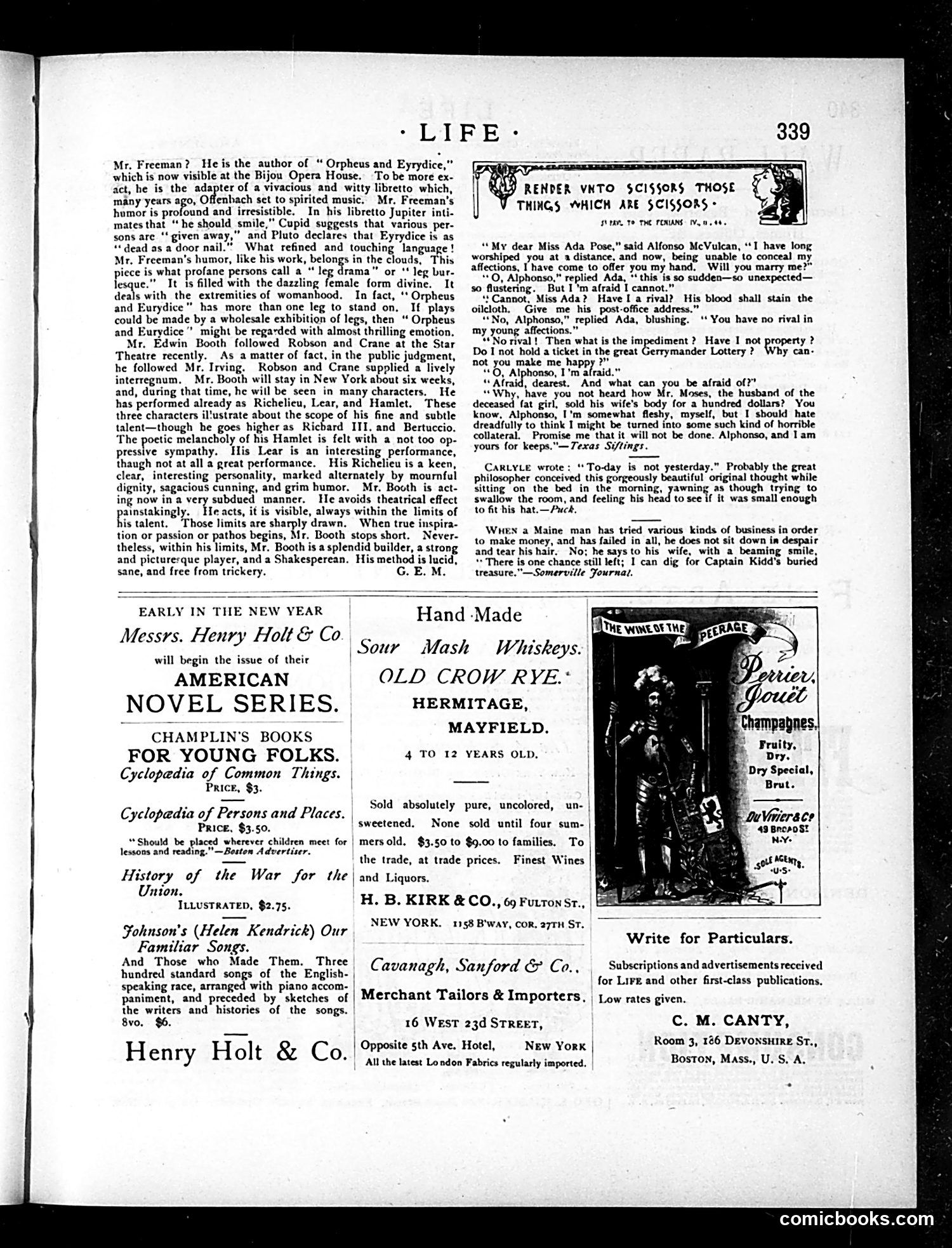
This page is primarily **text-heavy with advertisements** rather than political cartoons. The main content discusses theater reviews of contemporary productions, including Mr. Freeman's operatic adaptation "Orpheus and Eurydice" and Edwin Booth's Shakespearean performances. The only substantial cartoon/comic element is a brief dialogue titled "Render Unto Scissors Those Things Which Are Scissors," a satirical romantic exchange between characters "Alfonso McVulcan" and "Ada Pose." The joke appears to reference a contemporary scandal involving "Mr. Moses," a man who allegedly sold his deceased wife's body for money—a dark, macabre reference meant to be humorous. Ada's concern that her own "fleshy" body might suffer a similar fate is the satirical point, playing on anxieties about commercialism and the commodification of women's bodies. The page also advertises books, whiskeys, and merchant tailoring services typical of the era. Without additional historical context, the specific scandal referenced remains unclear.
This page is primarily advertisements and classified notices rather than cartoons or satire. However, the "FINANCIAL CIRCLES" section at top presents satirical "news items"—humorous one-liners mocking contemporary life. Notable examples include jokes about: - High gas bills causing financial concern - A woman's ambiguous answer about cold tongue (implying marital tension) - England and America's rivalry over expensive theatrical attractions (Mary Anderson and Henry Irving) - A failed public lecturer comparing himself to critic Matthew Arnold - A newspaper editor placing a marriage announcement under "Horrors of 1883" when learning the groom earned only seven dollars weekly (satirizing financial hardship and editorial cynicism) - Two city girls blaming an old farm horse's slowness on willfulness rather than age These brief satirical pieces reflect *Life* magazine's traditional format—gentle, urbane humor targeting middle-class anxieties about money, social pretension, and urban-versus-rural culture circa the 1880s.
This is primarily an **advertising page** from Life magazine, not a satirical cartoon page. The page consists almost entirely of commercial advertisements for products and services (steel pens, billiard tables, tea, printing ink, candies, hotels, medical devices). However, it includes a small **"LIFE" humor section** at the top with brief satirical anecdotes: 1. A joke about newspaper editors drinking excessively—deflecting the charge by claiming they read too much instead 2. A domestic humor piece about a wife planning to fake turkey dinner wealth by scattering feathers 3. A class commentary on New Jersey: a wealthy man leaves only $450 for rescuing his 200-pound daughter, sarcastically suggesting daughters are cheap commodities 4. A "Town Mouse/Country Mouse" exchange mocking provincial ignorance—a country cousin unfamiliar with famous London actor Richard Marvel, compared to an equally obscure rural figure The satire is gentle and focuses on **class pretension, domestic absurdity, and urban-rural cultural gaps**—typical of Victorian-era Life magazine's light humor.
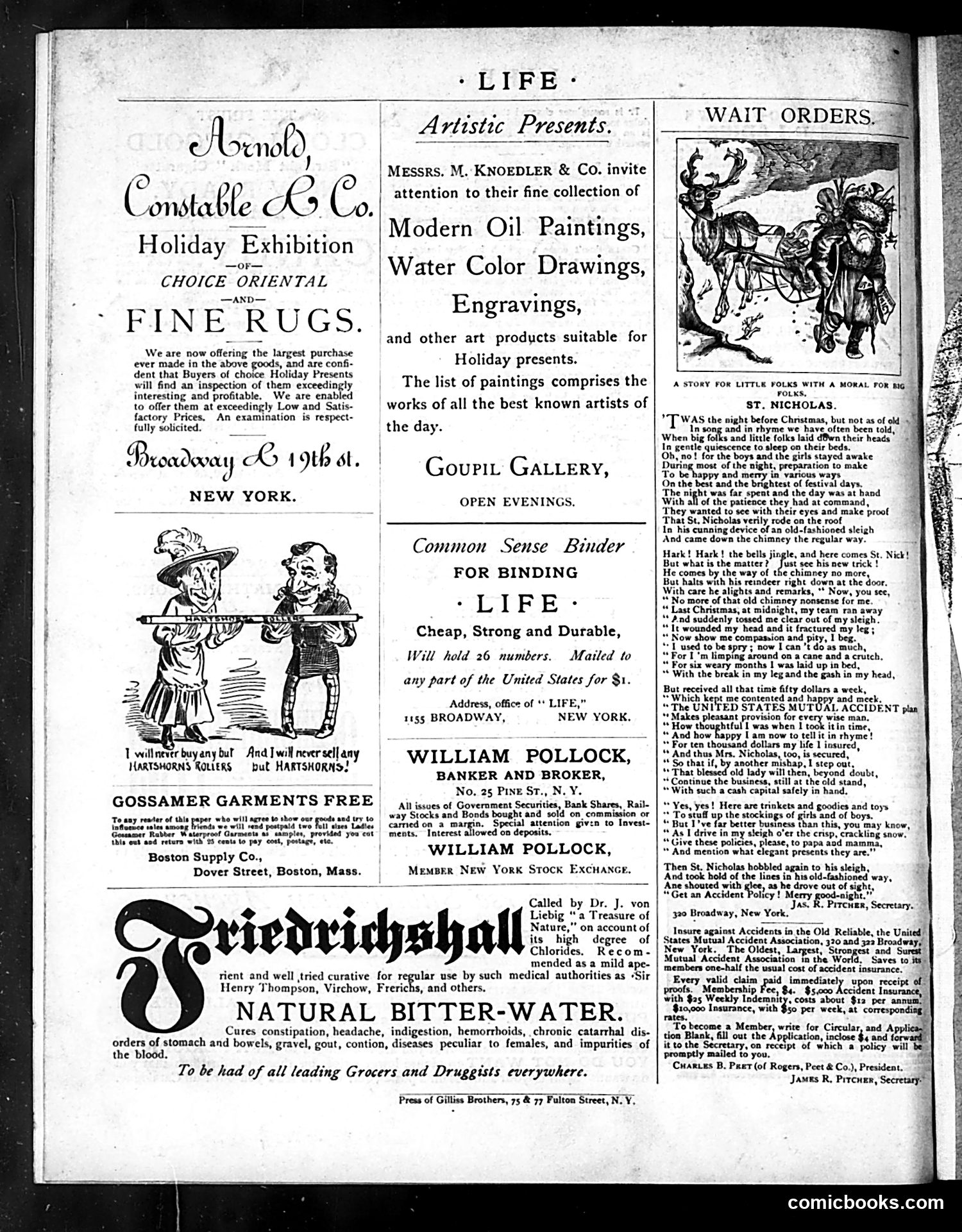
This is primarily an **advertising page** from Life magazine, not a political cartoon. The page contains multiple commercial advertisements for luxury goods and services typical of the Gilded Age (fine Oriental rugs, art galleries, banking services). The only substantial illustrated content is "A Story for Little Folks with a Moral for Big Folks" from *St. Nicholas* magazine, depicting a **reimagined Santa Claus**. The narrative subverts the traditional Christmas story: Santa, injured from last year's accident (broken leg, head wound), abandons the chimney route and now enters through the front door—a practical modern solution replacing romantic tradition. The moral appears satirical: it critiques nostalgia by showing how real-world consequences (workplace injuries, aging) force pragmatic change. For modern readers, this reflects late-19th-century anxieties about industrialization replacing cherished customs with efficiency. The cartoon's humor lies in Santa's mundane complaint about workers' compensation issues masquerading as children's literature.
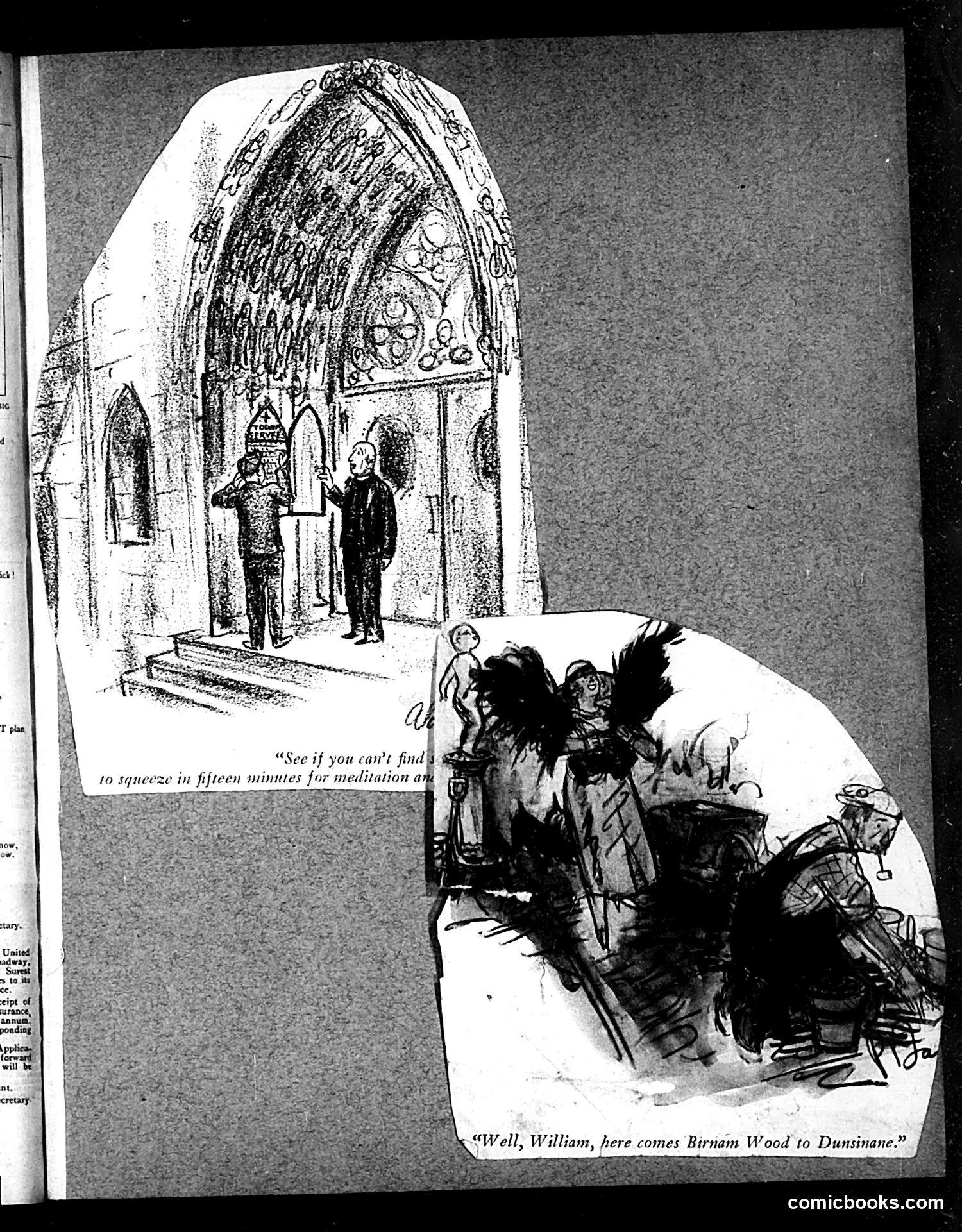
This page contains two cartoon panels with literary references: **Top panel:** Shows two figures in what appears to be a Gothic church or cathedral interior. The caption suggests someone should find "fifteen minutes for meditation"—likely mocking the busy modern person's inability to make time for spiritual reflection or quiet contemplation. **Bottom panel:** References Shakespeare's *Macbeth*. The caption "Well, William, here comes Birnam Wood to Dunsinane" alludes to the famous prophecy from the play. The sketch shows what appears to be a crowded, chaotic scene. Without clearer context, the specific satirical target is unclear, but it likely comments on an approaching social or political situation that seemed impossible but is now occurring—mirroring Macbeth's fatalistic moment when the impossible prophecy materializes. Both cartoons appear to use literary allusions for their satirical effect.