
Life, 1883-12-27 · page 12 of 17
Life — December 27, 1883 — page 12: what you’re looking at
What you’re looking at
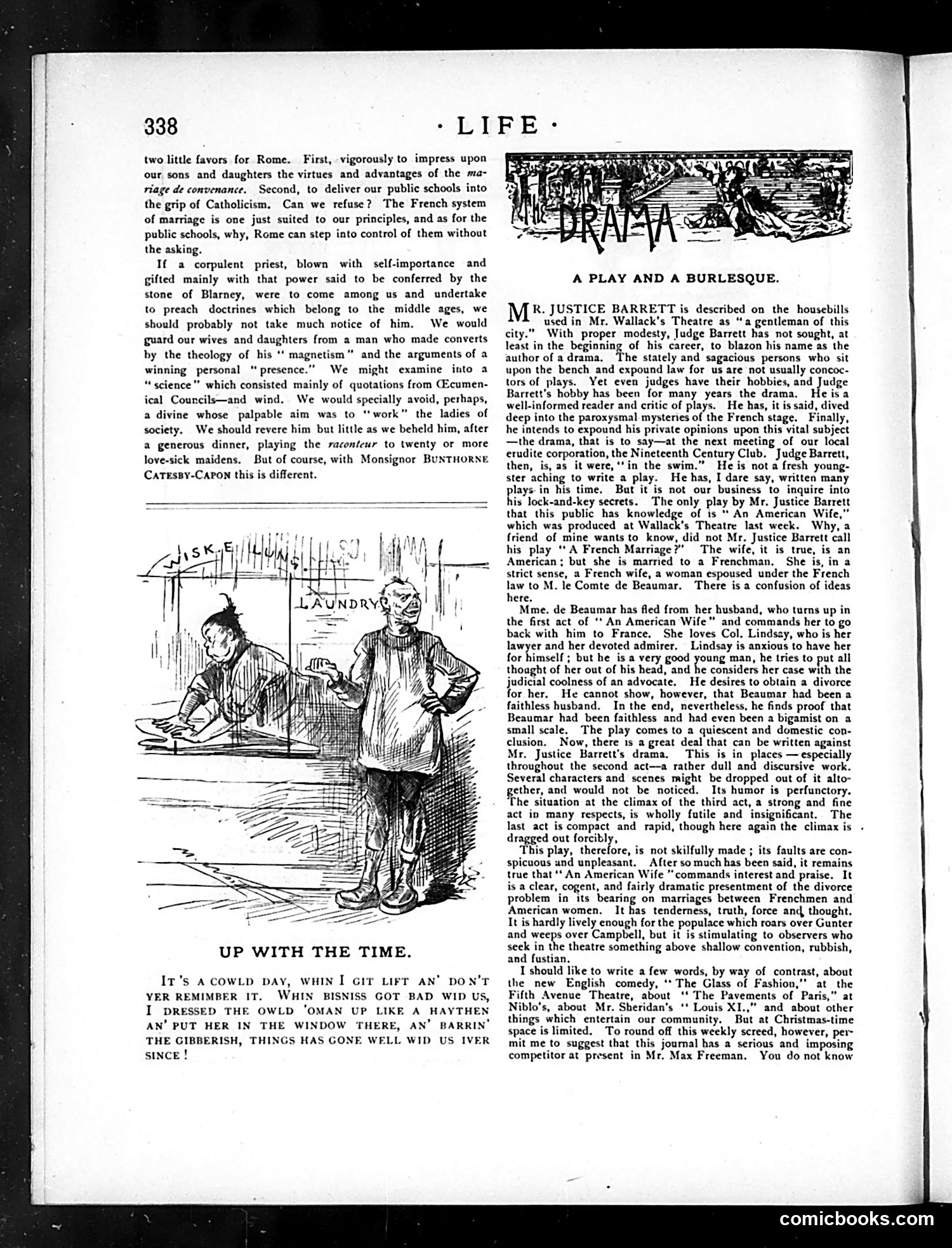
This page contains two distinct satirical pieces from 19th-century *Life* magazine. **The cartoon** (titled "Up With the Time") depicts an Irish immigrant man and woman, identifiable by the dialectical Irish speech ("cowld," "remimber," "owld 'oman"). The joke satirizes Irish poverty and desperation: the man dressed his wife "up like a haythen" and placed her in a window display, apparently to attract business—suggesting degradation born of economic hardship. The satire mocks both Irish working-class struggles and the crude survival strategies some employed. **The text section** reviews Judge Barrett's play "An American Wife," performed at Wallack's Theatre. The critic humorously notes the confusion of the title—the protagonist is American but married to a Frenchman, making her technically a "French wife." The review discusses the domestic plot: a woman fleeing her French husband, caught between devotion to her American lawyer-admirer and judicial propriety. Both pieces use comedy to examine social outsiders: Irish immigrants and judicial figures dabbling in drama.
📄 Transcribed text from this page (OCR, searchable)
Machine-transcribed from the original scan — historical spelling and the odd misread are preserved.
338 two little favors for Rome. First, vigorously to impress upon our sons and daughters the virtues and advantages of the ma- riage de convenance. Second, to deliver our public schools into the grip of Catholicism, Can we refuse? The French system of marriage is one just suited to our principles, and as for the public schools, why, Rome can step into control of them without the asking. If a corpulent priest, blown with self-importance and gifted mainly with that power said to be conferred by the stone of Blarney, were to come among us and undertake to preach doctrines which belong to the middle ages, we should probably not take much notice of him. We would guard our wives and daughters from a man who made converts by the theology of his ‘‘ magnetism” and the arguments of a winning personal “ presence.” We might examine into a “ science" which consisted mainly of quotations from CEcumen- ical Councils—and wind. We would specially avoid, perhaps, a divine whose palpable aim was to “work” the ladies of society. We should revere him but little as we beheld him, after a generous dinner, playing the raconteur to twenty or more love-sick maidens. But of course, with Monsignor BUNTHORNE CartesBy-CAPON this is different. UP WITH THE TIME. It's A COWLD DAY, WHIN I GIT LIFT AN’ DON'T YER REMIMBER IT. WHIN BISNISS GOT BAD WID US, I DRESSED THE OWLD ‘OMAN UP LIKE A HAYTHEN AN’ PUT HER IN THE WINDOW THERE, AN’ BARRIN’ THE GIBBERISH, THINGS HAS GONE WELL WID US IVER SINCE ! A PLAY AND A BURLESQUE. R. JUSTICE BARRETT is described on the housebills used in Mr. Wallack’s Theatre as “a gentleman of this city.” With proper modesty, Judge Barrett has not sought, at least in the beginning of his career, to blazon his name as the author of adrama, The stately and’ sagacious persons who sit upon the bench and expound law for us are not usually concoc- tors of plays. Yet even judges have their hobbies, and Judge Barrett’s hobby has been for many years the drama. He isa well-informed reader and critic of plays. He has, it is said, dived deep into the paroxysmal mysteries of the French stage. Finally, he intends to expound his private opinions upon this vital subject —the drama, that is to say—at the next meeting of our local erudite corporation, the Nineteenth Century Club. Judge Barrett, then, is, as it were, ‘tin the swim.” He is nota fresh young- ster aching to write a play. He has, I dare say, written many lays-in his time. But it is not our business to inquire into his lock-and-key secrets. The only play by Mr. Justice Barrett that this public has knowledge of is * An American Wife,” which was produced at Wallack’s Theatre last week. Why, a friend of mine wants to know, did not Mr. Justice Barrett call his play ‘*A French Marriage?" The wife, it is true, is an American; but she is married to a Frenchman. She is, in a strict sense, a French wife, a woman espoused under the French law to M. le Comte de Beaumar. There is a confusion of ideas here. Mme. de Beaumar has fled from her husband, who turns up in the first act of ‘* An American Wife" and commands her to go back with him to France, She loves Col. Lindsay, who is her lawyer and her devoted admirer, Lindsay is anxious to have her for himself ; but he is a very good young man, he tries to put all thoaght of her out of his head, and he considers her case with the judicial coolness of an advocate. He desires to obtain a divorce for her, He cannot show, however, that Beaumar had been a faithless husband. In the end, nevertheless, he finds proof that Beaumar had been faithless and had even been a bigamist on a small scale, The play comes to a quiescent and domestic con- clusion. Now, there 1s a great deal that can be written against Mr. Justice Barrett's drama, This is in places — especially throughout the second act—a rather dull and discursive work. Several characters and scenes might be dropped out of it alto- ether, and would not be noticed. Its humor is perfunctory. The situation at the climax of the third act, a strong and fine act in many respects, is wholly futile and insignificant. The last act is compact and rapid, though here again the climax is . dragged out forcibly, This play, therefore, is not skilfully made ; its faults are con- spicuous und unpleasant. After so much has been said, it remains true that ‘An American Wife "commands interest and praise. It is a clear, cogent, and fairly dramatic presentment of the divorce problem ‘in its bearing on marriages between Frenchmen and American women. It has tenderness, truth, force and thought. It is hardly lively enough for the populace which roars over Gunter and weeps over Campbell, but it is stimulating to observers who seek in the theatre something above shallow convention, rubbish, and fustian, I should like to write a few words, by way of contrast, about the new English comedy, ‘* The Glass of Fashion," at the Fifth Avenue Theatre, about ‘' The Pavements of Paris,” at Niblo's, about Mr. Sheridan's ‘* Louis XI.,” and about other things which entertain our community. But at Christmas-time space is limited. To round off this weekly screed, however, per- mit me to suggest that this journal has a serious and imposing competitor at present in Mr. Max Freeman. You do not know comicbooks.com