
Life, 1883-12-27 · page 7 of 17
Life — December 27, 1883 — page 7: what you’re looking at
What you’re looking at
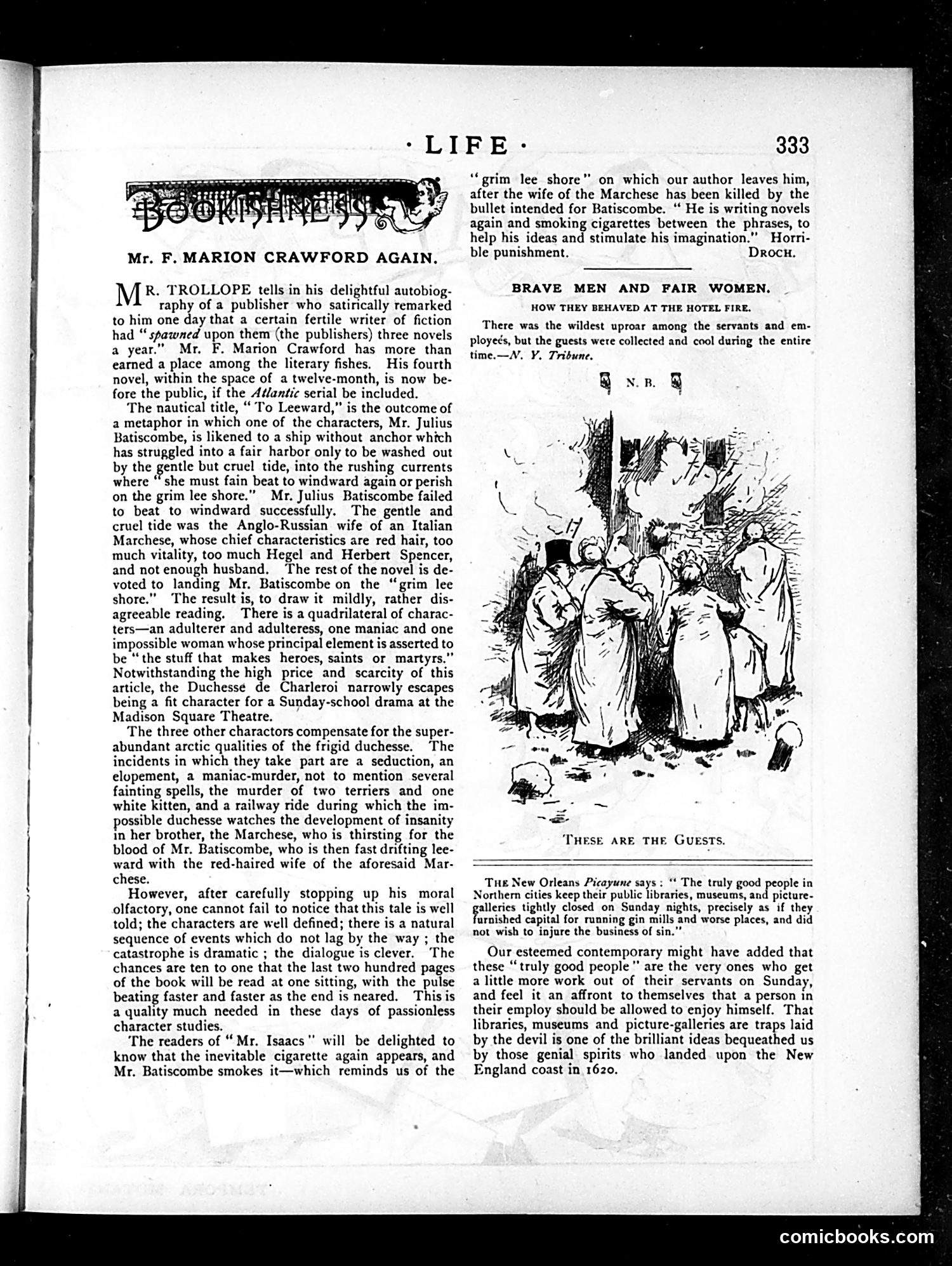
This page contains two distinct sections: **Top section** ("Mr. F. Marion Crawford Again"): A book review discussing novelist Marion Crawford's works, particularly praising his novel "To Leeward." The review details plot points involving characters named Julius Batiscombe and an Anglo-Russian marchioness, noting Crawford's skill at dramatic narrative and character development. **Bottom section** ("Brave Men and Fair Women"): An illustration captioned "These Are the Guests" showing what appears to be hotel staff or servants during a fire emergency. The accompanying text references a *New Orleans Picayune* quote about "truly good people" in Northern cities keeping galleries closed on Sundays—a satirical jab at Northern moral hypocrisy regarding servant treatment and business practices. The page is primarily literary criticism and social commentary rather than political satire.
📄 Transcribed text from this page (OCR, searchable)
Machine-transcribed from the original scan — historical spelling and the odd misread are preserved.
Mr. F. MARION CRAWFORD AGAIN. R. TROLLOPE tells in his delightful autobiog- raphy of a publisher who satirically remarked to him one day that a certain fertile writer of fiction had “‘ spawned upon them (the publishers) three novels a year.” Mr. F. Marion Crawford has more than earned a place among the literary fishes. His fourth novel, within the space of a twelve-month, is now be- fore the public, if the Aéantic serial be included. The nautical title, “ To Leeward,” is the outcome of a metaphor in which one of the characters, Mr. Julius Batiscombe, is likened to a ship without anchor which has struggled into a fair harbor only to be washed out by the gentle but cruel tide, into the rushing currents where “she must fain beat to windward again or perish on the grim lee shore,” Mr. Julius Batiscombe failed to beat to windward successfully. The gentle and cruel tide was the Anglo-Russian wife of an Italian Marchese, whose chief characteristics are red hair, too much vitality, too much Hegel and Herbert Spencer, and not enough husband. The rest of the novel is de- voted to landing Mr. Batiscombe on the “grim lee shore.” The result is, to draw it mildly, rather dis- agreeable reading. There is a quadrilateral of charac- ters—an adulterer and adulteress, one maniac and one impossible woman whose principal element is asserted to be “the stuff that makes heroes, saints or martyrs.” Notwithstanding the high price and scarcity of this article, the Duchess¢ de Charleroi narrowly escapes being a fit character for a Sunday-school drama at the Madison Square Theatre. The three other charactors compensate for the super- abundant arctic qualities of the frigid duchesse. The incidents in which they take part are a seduction, an elopement, a maniac-murder, not to mention several fainting spells, the murder of two terriers and one white kitten, and a railway ride during which the im- ossible duchesse watches the development of insanity in her brother, the Marchese, who is thirsting for the blood of Mr. Batiscombe, who is then fast drifting lee- ward with the red-haired wife of the aforesaid Mar- chese. However, after carefully stopping up his moral olfactory, one cannot fail to notice that this tale is well told; the characters are well defined; there is a natural sequence of events which do not lag by the way ; the catastrophe is dramatic ; the dialogue is clever. The chances are ten to one that the last two hundred pages of the book will be read at one sitting, with the pulse beating faster and faster as the end is neared. This is a quality much needed in these days of passionless character studies. ‘The readers of “Mr. Isaacs" will be delighted to know that the inevitable cigarette again appears, and Mr. Batiscombe smokes it—which reminds us of the -LIFE: 333 ‘‘grim lee shore” on which our author leaves him, after the wife of the Marchese has been killed by the bullet intended for Batiscombe. ‘‘ He is writing novels again and smoking cigarettes between the phrases, to help his ideas and stimulate his imagination.” Horri- ble punishment. Drocu. BRAVE MEN AND FAIR WOMEN. HOW THEY BEHAVED AT THE HOTEL FIRE. There was the wildest uproar among the servants and em- ployeds, but the guests were collected and cool during the entire time.—M. Y. Tribune, ‘THESE ARE THE GUESTS. Tue New Orleans Picayune says ; ‘ The truly good people in Northern cities keep their public libraries, museums, and picture- alleries tightly closed on Sunday nights, precisely as if they farnished capital for running gin mills and worse places, and did not wish to injure the business of sin.” Our esteemed contemporary might have added that these “truly good people” are the very ones who get a little more work out of their servants on Sunday, and feel it an affront to themselves that a person in their employ should be allowed to enjoy himself. That libraries, museums and picture-galleries are traps laid by the devil is one of the brilliant ideas bequeathed us by those genial spirits who landed upon the New England coast in 1620. comicbooks.com