
Life, 1883-12-27 · page 10 of 17
Life — December 27, 1883 — page 10: what you’re looking at
What you’re looking at
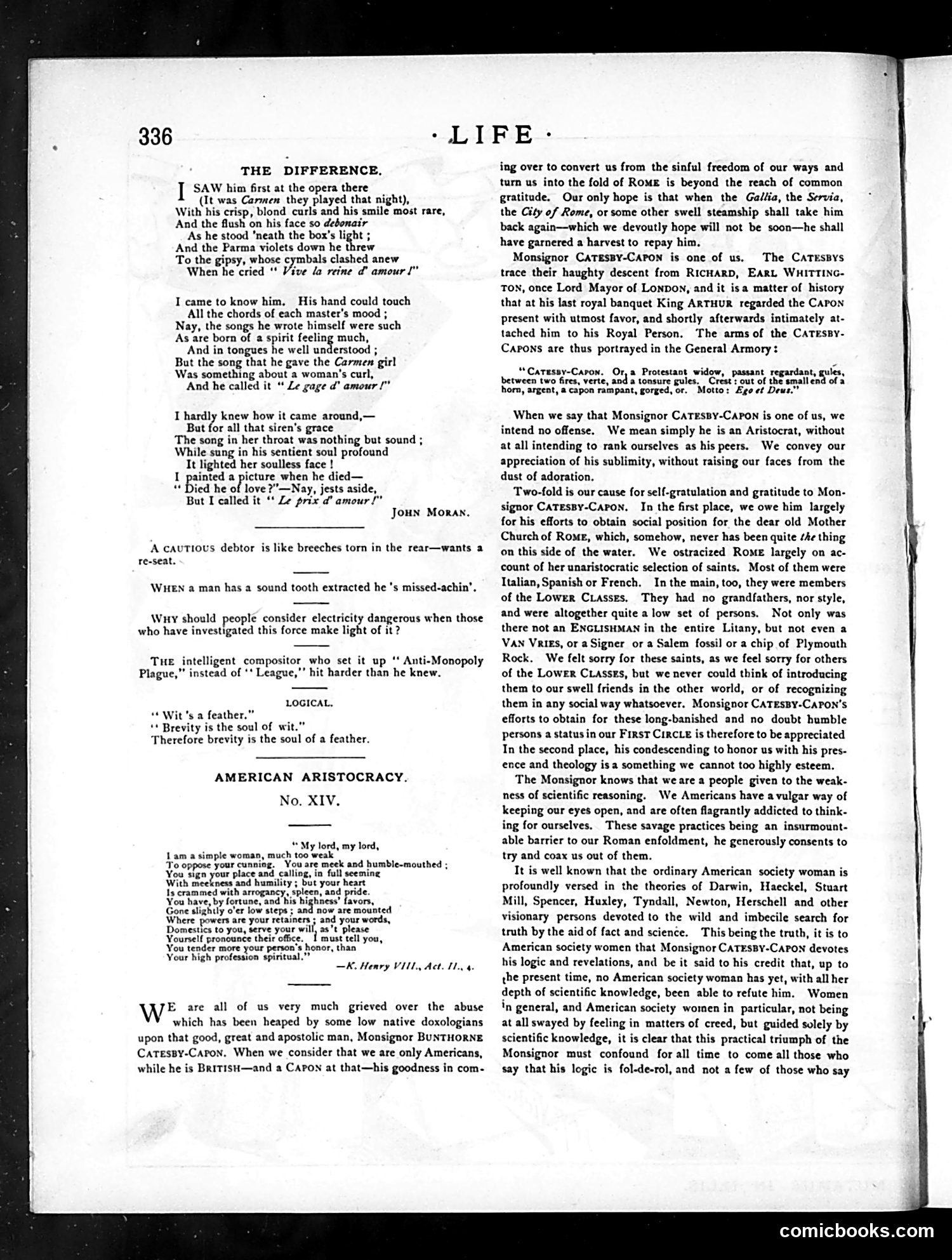
This page satirizes American social pretension and religious hypocrisy through two main pieces: **"The Difference"** (poem by John Moran): A romantic narrative contrasting genuine artistic feeling with empty performance. A male musician's soulful composition moves audiences, while the same song sung by a beautiful but shallow woman ("the Carmen girl") produces only meaningless sound. The satire suggests beauty without substance—a critique of superficial culture. **"American Aristocracy No. XIV"**: This section mocks Americans' deference to British clerics, specifically "Monsignor Bunthorne Catesby-Capon." The text is heavy with sarcasm: Americans apologize for "abusing" this British religious figure, while he converts them from their "sinful freedom." The fabricated genealogy tracing his family to Dick Whittington (a real historical Lord Mayor) and King Arthur, complete with absurd heraldic descriptions ("a capon rampant"), ridicules both British pretension and American worship of foreign aristocracy and authority. The satire targets American cultural insecurity and gullibility regarding European (particularly British) social superiority.
📄 Transcribed text from this page (OCR, searchable)
Machine-transcribed from the original scan — historical spelling and the odd misread are preserved.
THE DIFFERENCE, SAW him first at the opera there (It was Carmen they played that night), With his crisp, blond curls and his smile most rare, And the flush on his face so debonair As he stood ‘neath the box’s light And the Parma violets down he threw To the gipsy, whose cymbals clashed anew When he cried Vive la reine d amour!” I came to know him, His hand could touch All the chords of each master's mood ; Nay, the songs he wrote himself were such As are born of a spirit feeling much, ‘And in tongues he well understood ; But the song that he gave the Carmen girl Was something about a woman's curl, And he called it ‘ Ze gage d’ amour [” T hardly knew how it came around,— But for all that siren’s grace The song in her throat was nothing but sound ; While sung in his sentient soul profound It lighted her soulless face ! I painted a picture when he died— “ Died he of love ?”—Nay, jests aside, But I called it ** Le prix 2’ amour!" JouN Moran. A cautious debtor is like breeches torn in the rear—wants a re-seat. WHEN a man has a sound tooth extracted he 's missed-achin’, Wuy should people consider electricity dangerous when those who have investigated this force make light of it? THE intelligent compositor who set it up ‘* Anti-Monopoly Plague,” instead of ‘* League,’’ hit harder than he knew. LOGICAL, “* Wit 's a feather.” ‘* Brevity is the soul of wit.” Therefore brevity is the soul of a feather. AMERICAN ARISTOCRACY. No. XIV. © My lord, my lord, Lam a simple woman, much too weak To oppose your cunning. You are meek and humble-mouthed ; You sign your place and calling, in full seeming With meetnessand humility ; but your heart Is crammed with a jeen, and pride. You have, by fortune, and his highness’ Lavors, Gone slightly o'er low ste ‘now are mounted Where powers are your retainers ; and your words, Domestics to you, verve your will, as't please Yourself pronounce their office. / must tell you, You tender more your person's honor, than Your high profession spiritual.”” —K. Henry VIL, Act. M4. WE are all of us very much grieved over the abuse which has been heaped by some low native doxologians upon that good, great and apostolic man, Monsignor BUNTHORNE. CatesBy-Capon, When we consider that we are only Americans, while he is BritisH—and a Capon at that—his goodness in com- -LIFE- ing over to convert us from the sinful freedom of our ways and turn us into the fold of Rome is beyond the reach of common gratitude. Our only hope is that when the Gallia, the Servia, the City of Rome, or some other swell steamship shall take him back again—which we devoutly hope will not be soon—he shall have garnered a harvest to repay him. Monsignor CaTesBy-CAPon is one of us. The CaTEsBys trace their haughty descent from RICHARD, EARL WHITTING- ToN, once Lord Mayor of Lonpon, and it isa matter of history that at his last royal banquet King ARTHUR regarded the CAPON present with utmost favor, and shortly afterwards intimately at- tached him to his Royal Person. The arms of the CatesBy- Capons are thus portrayed in the General Armory: “Catussy-Caron. Or, a Protestant widow, passant r egardant, gules, between two fires, verte, and a tonsure gules, Crest’ out of the small end of a horn, argent, a capon rampant, gorged, or. Motto: Ego et Dews.” When we say that Monsignor CATESBY-CAPON is one of us, we intend no offense. We mean simply he is an Aristocrat, without at all intending to rank ourselves as his peers. We convey our appreciation of his sublimity, without raising our faces from the dust of adoration. Two-fold is our cause for self-gratulation and gratitude to Mon- signor CATEsBY-Capon. In the first place, we owe him largely for his efforts to obtain social position for the dear old Mother Church of Rome, which, somehow, never has been quite ¢he thing on this side of the water. We ostracized Rome largely on ac- count of her unaristocratic selection of saints, Most of them were Italian, Spanish or French. In the main, too, they were members of the Lower Crasses, They had no grandfathers, nor style, and were altogether quite a low set of persons. Not only was there not an ENGLISHMAN in the entire Litany, but not even a VAN Varigs, or a Signer or a Salem fossil or a chip of Plymouth Rock. We felt sorry for these saints, as we feel sorry for others of the Lower Crasses, but we never could think of introducing them to our swell friends in the other world, or of recognizing them in any social way whatsoever. Monsignor CATESBY-CaPon’s efforts to obtain for these long-banished and no doubt humble persons a status in our First CircLe is therefore to be appreciated In the second place, his condescending to honor us with his pres- ence and theology is a something we cannot too highly esteem. The Monsignor knows that we are a people given to the weak- ness of scientific reasoning. We Americans have a vulgar way of keeping our eyes open, and are often flagrantly addicted to think- ing for ourselves. These savage practices being an insurmount- able barrier to our Roman enfoldment, he generously consents to try and coax us out of them. It is well known that the ordinary American society woman is profoundly versed in the theories of Darwin, Haeckel, Stuart Mill, Spencer, Huxley, Tyndall, Newton, Herschell and other visionary persons devoted to the wild and imbecile search for truth by the aid of fact and science. This being the truth, it is to American society women that Monsignor CATESBY-CAPON devotes his logic and revelations, and be it said to his credit that, up to the present time, no American society woman has yet, with all her depth of scientific knowledge, been able to refute him. Women 'n general, and American society women in particular, not being at all swayed by feeling in matters of creed, but guided solely by scientific knowledge, it is clear that this practical triumph of the Monsignor must confound for all time to come all those who say that his logic is fol-de-rol, and not a few of those who say comicbooks.com