
A complete issue · 16 pages · 1883
Life — September 27, 1883
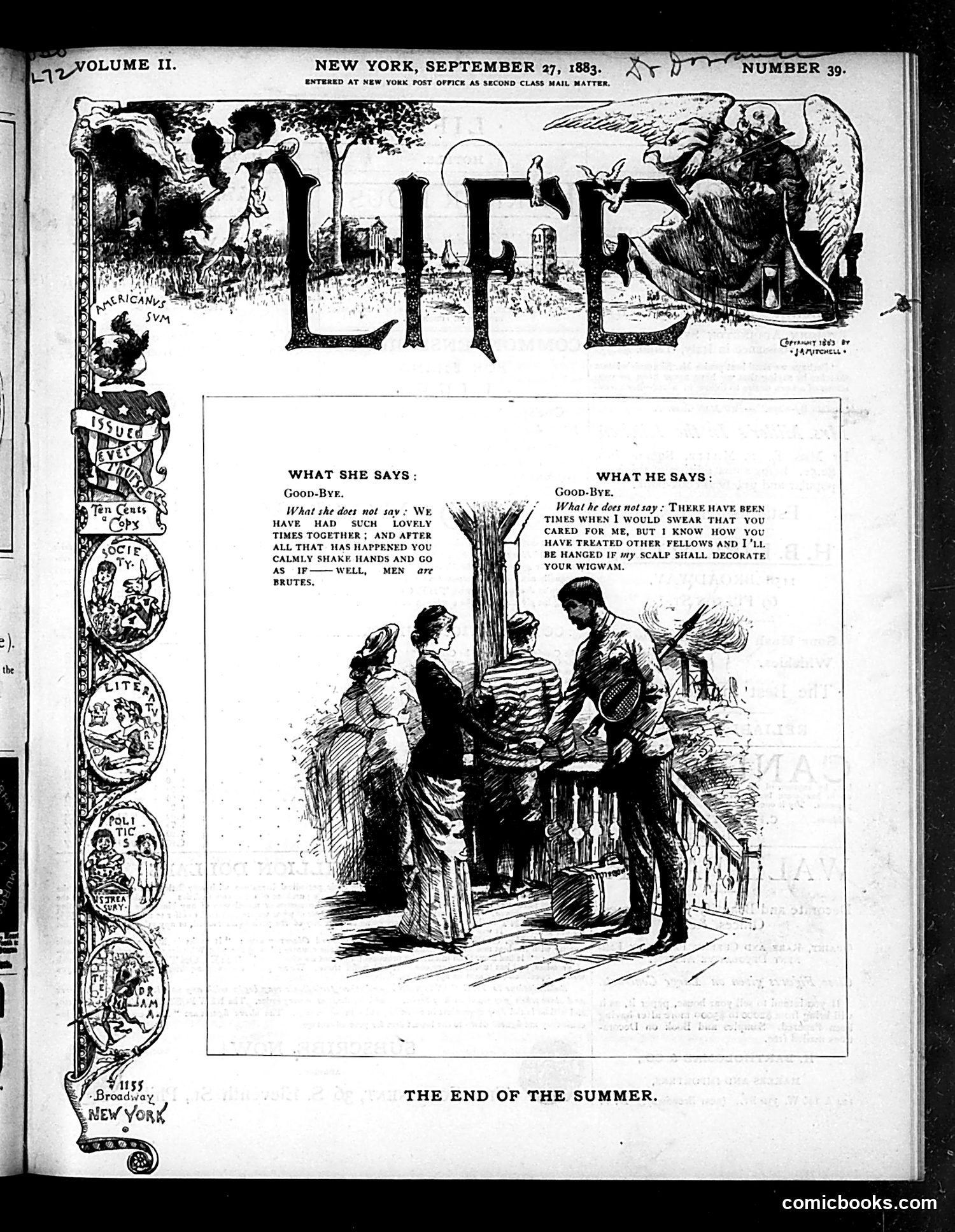
This satirical cartoon depicts a romantic parting between a couple at summer's end. The woman says farewell, noting they've spent "lovely times together" and suggesting they shake hands "as if...men are brutes." The man responds with a threatening oath, swearing he'd treat other fellows worse and "be hanged" if her "scalp shall decorate your wigwam." The satire appears to mock the melodramatic farewell rituals of Victorian romance and courtship—the exaggerated emotional stakes and theatrical language lovers employed. The man's crude, aggressive response contrasts darkly with the woman's genteel farewell, satirizing masculine posturing and the gap between civilized romance and crude male behavior. The "scalp" reference may evoke frontier imagery common to period literature and humor.
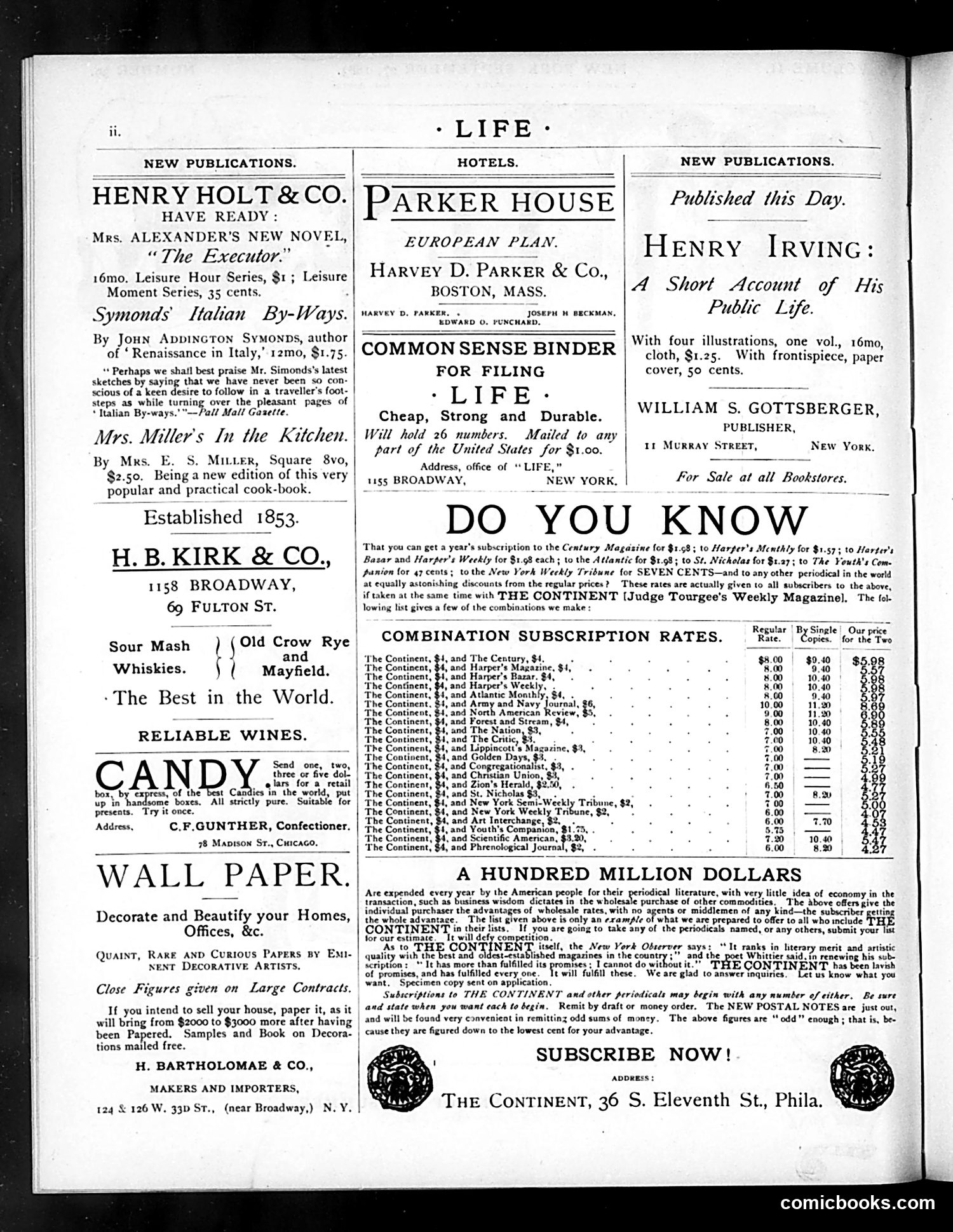
This page is **primarily advertising**, not satirical content. It contains advertisements for: - Books and novels (Henry Holt & Co., Henry Irving biography) - The Parker House hotel in Boston - A filing binder for "LIFE" magazine - Subscription offers for *The Century*, *Harper's*, and other magazines (with combination rates detailed) - Whiskey, candy, wallpaper, and other consumer goods The only substantive editorial content is a large section titled "A Hundred Million Dollars" discussing wholesale purchasing advantages for *The Continental* magazine subscribers—essentially a sales pitch. There are no political cartoons, caricatures, or satirical commentary visible on this page. It represents a typical late-19th or early-20th century magazine back page focused on revenue generation through advertising and subscription promotions.
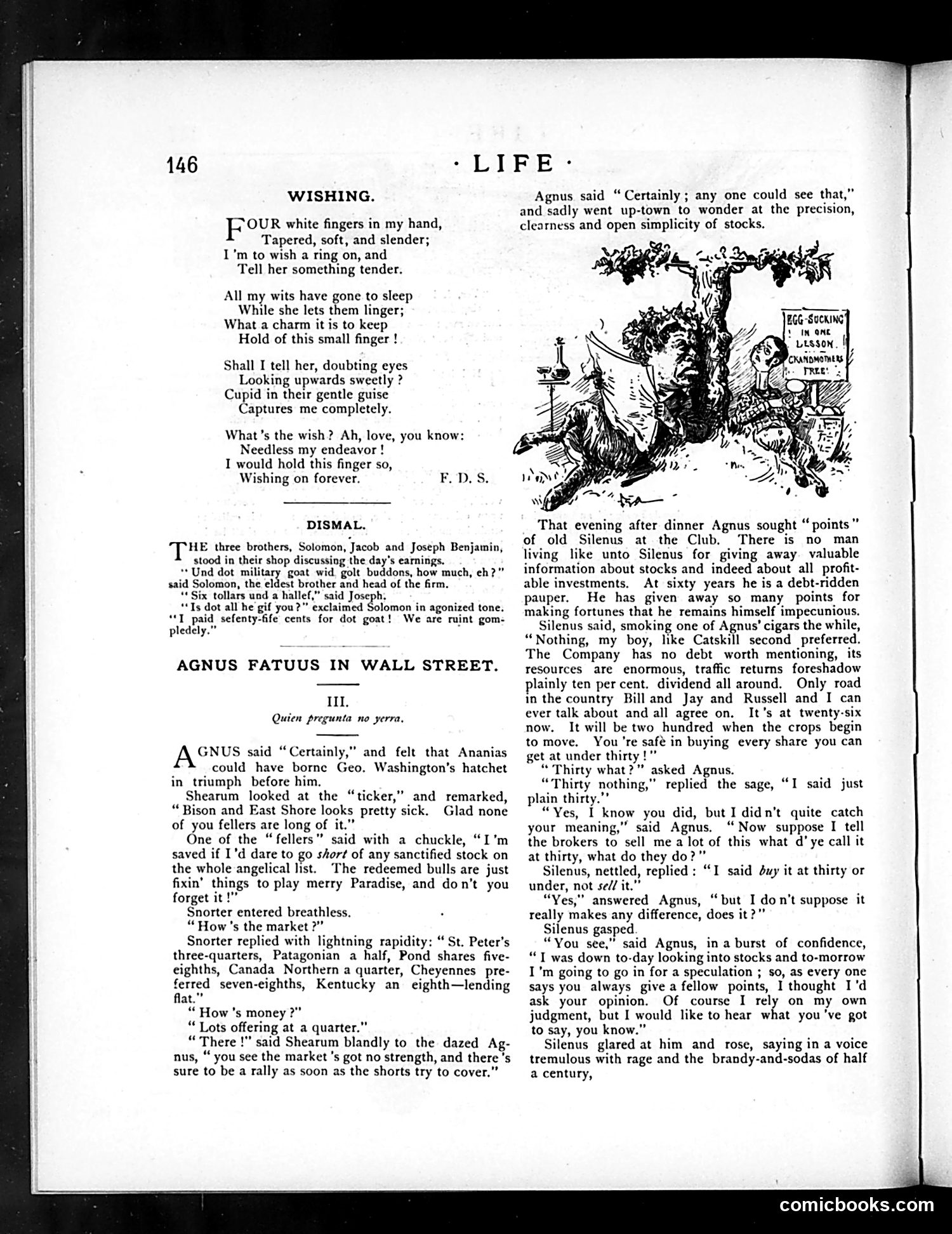
This page contains two distinct pieces: **"Wishing"** (left): A sentimental poem about romantic desire, likely contemporary verse rather than political satire. **"Agnus Fatuus in Wall Street"** (right): A satirical narrative mocking stock market speculation and Wall Street culture. Three brothers discuss the day's stock earnings with inflated confidence. The satire targets the absurdity of stock tips, market volatility, and get-rich-quick schemes—particularly the character Agnus, who peddles dubious investment advice to credulous investors. The illustration (top right) appears to show figures near a tree with a sign about "egg sucking" and lessons, likely emphasizing the naive, parasitic nature of stock-market manipulation. The piece ridicules both reckless speculators and the confidence-men who profit from them during this era of market enthusiasm.
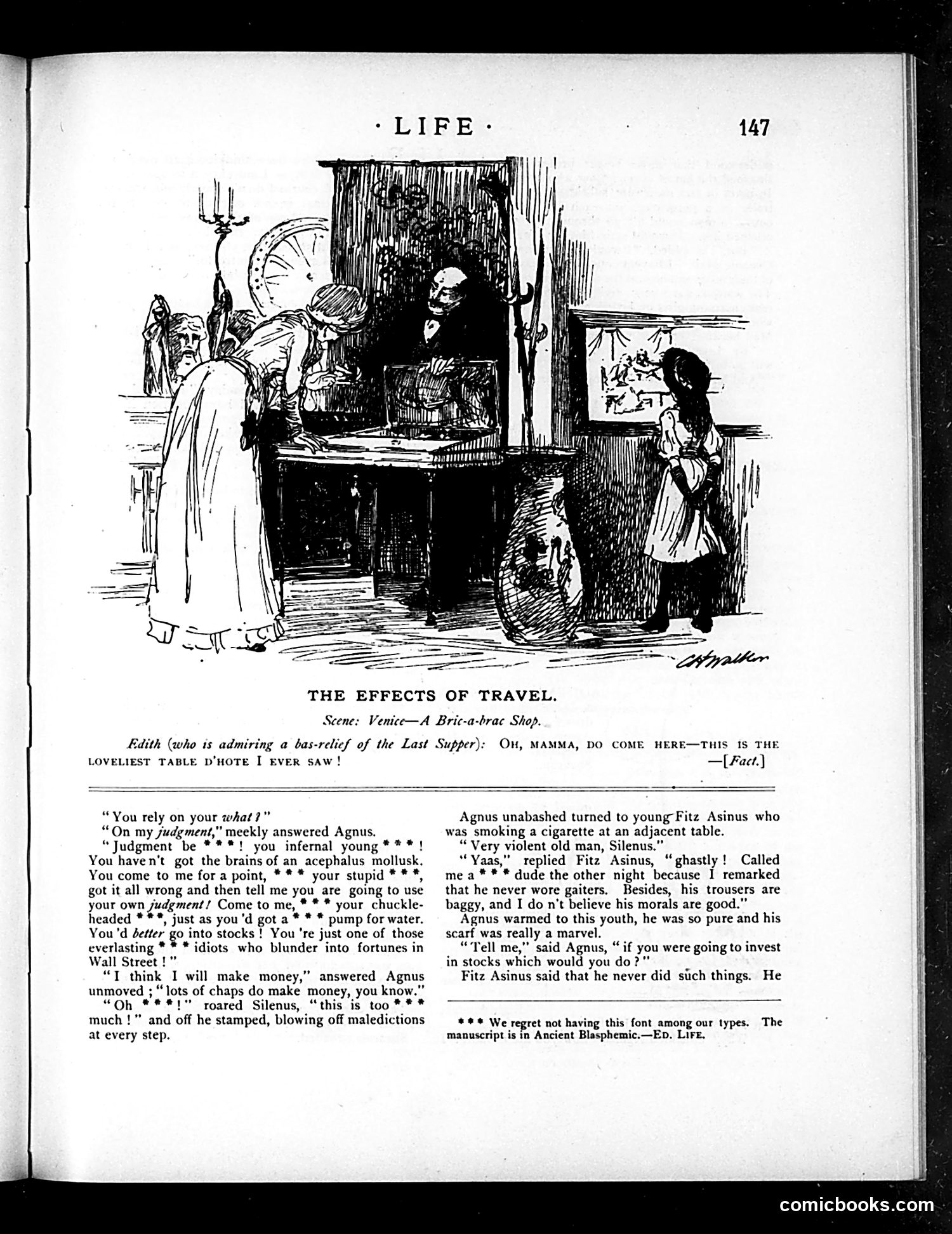
This satire depicts a Venice bric-à-brac shop scene. The cartoon mocks travelers who return home with exaggerated claims about their experiences abroad. The character Edith admires a "bas-relief of the Last Supper," claiming it's "the loveliest table d'hôte I ever saw!" — confusing a religious artwork with a dining establishment, suggesting her cultural ignorance. The dialogue between Agnus and young Fitz Asinus satirizes both wealthy tourists making pretentious investment decisions and the cynical merchants exploiting them. References to "stocks" and money-making schemes suggest tourists are financial dupes. The humor targets the Gilded Age phenomenon of wealthy Americans traveling abroad, returning home with dubious "authentic" purchases and inflated stories, demonstrating how travel sometimes reveals ignorance rather than cultivating sophistication.
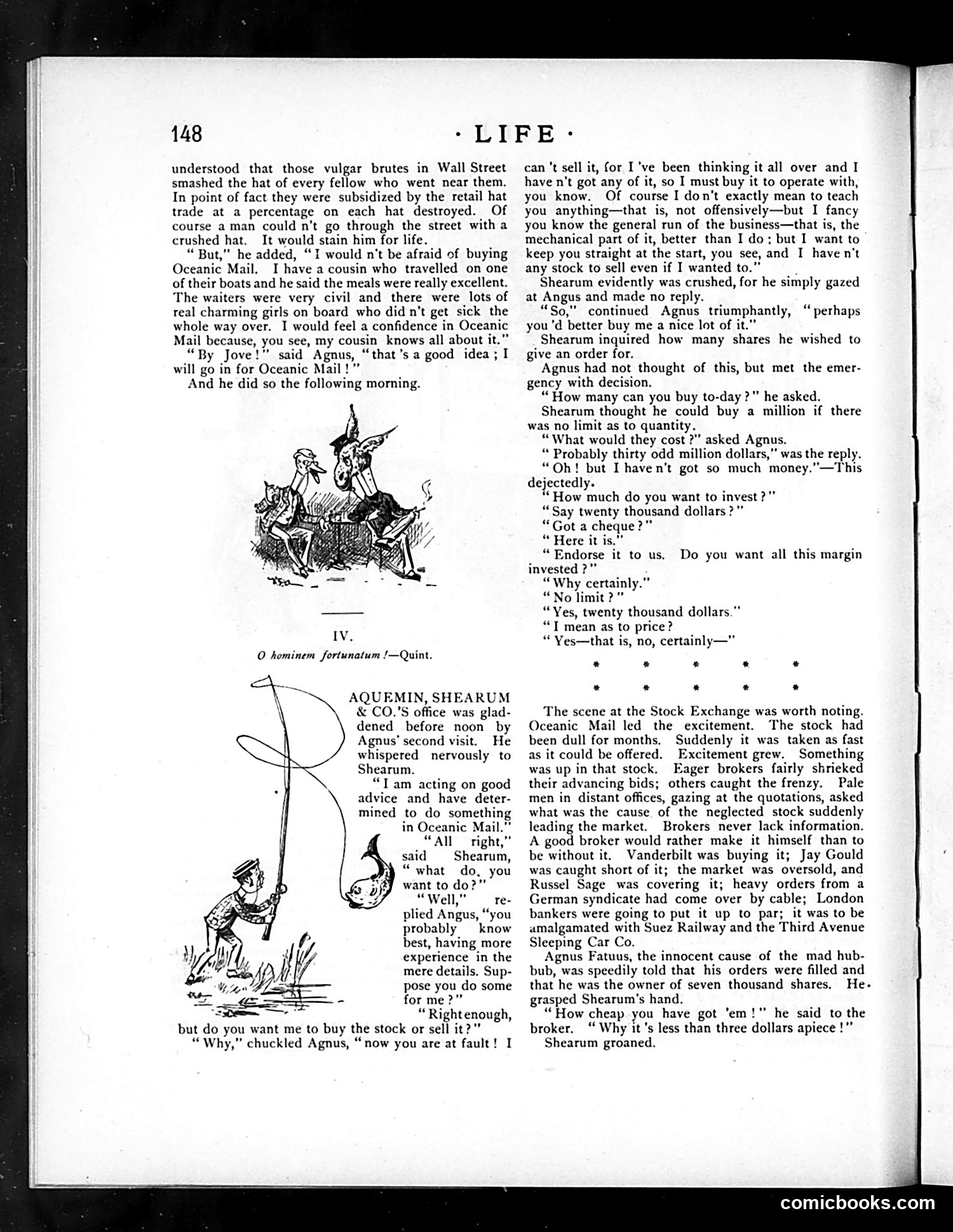
This page contains two satirical cartoons and a narrative story about stock market speculation. **Cartoon IV** ("O hominem fortunatum!") depicts a foolish investor who has struck it rich, shown as a grotesque figure riding a donkey—classic imagery for foolish or duped characters. **The second cartoon** shows a fisherman pulling in what appears to be a large catch, likely satirizing gullible investors being "hooked" by market schemes. The accompanying text describes the "Oceanic Mail" stock manipulation scheme, where insiders artificially inflate a stock's value to lure unsuspecting buyers. The narrative mocks both the greedy promoters and naive investors who chase quick profits during market excitement—a common target of *Life* magazine's satire on American financial speculation and get-rich-quick schemes.
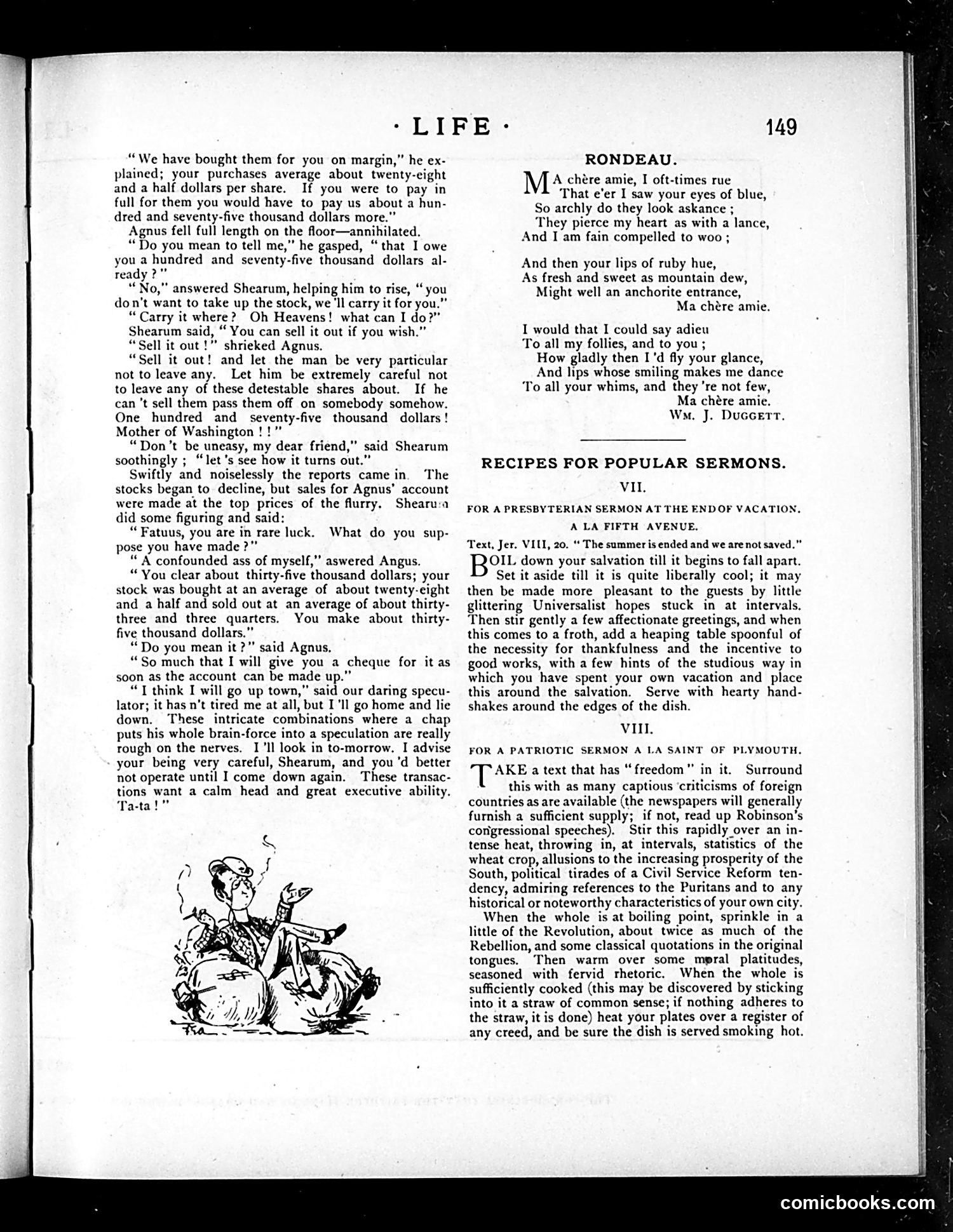
**The Main Cartoon:** The illustration depicts a rotund, disheveled figure juggling papers and money while appearing frantic. This likely satirizes a financial speculator or Wall Street operator managing unstable investments—a common Life magazine target during the Gilded Age and early 20th century. **The Text Context:** The surrounding dialogue concerns massive stock purchases (valued at $175,000) bought "on margin" (using borrowed money). The speakers debate whether such risky speculation is sustainable. One character advises caution, warning these transactions require "a calm head and great executive ability." **The Satire:** Life ridicules financial speculation and the precarious practice of buying stocks with borrowed funds—implying such schemes lack substance and will inevitably collapse, ruining participants.
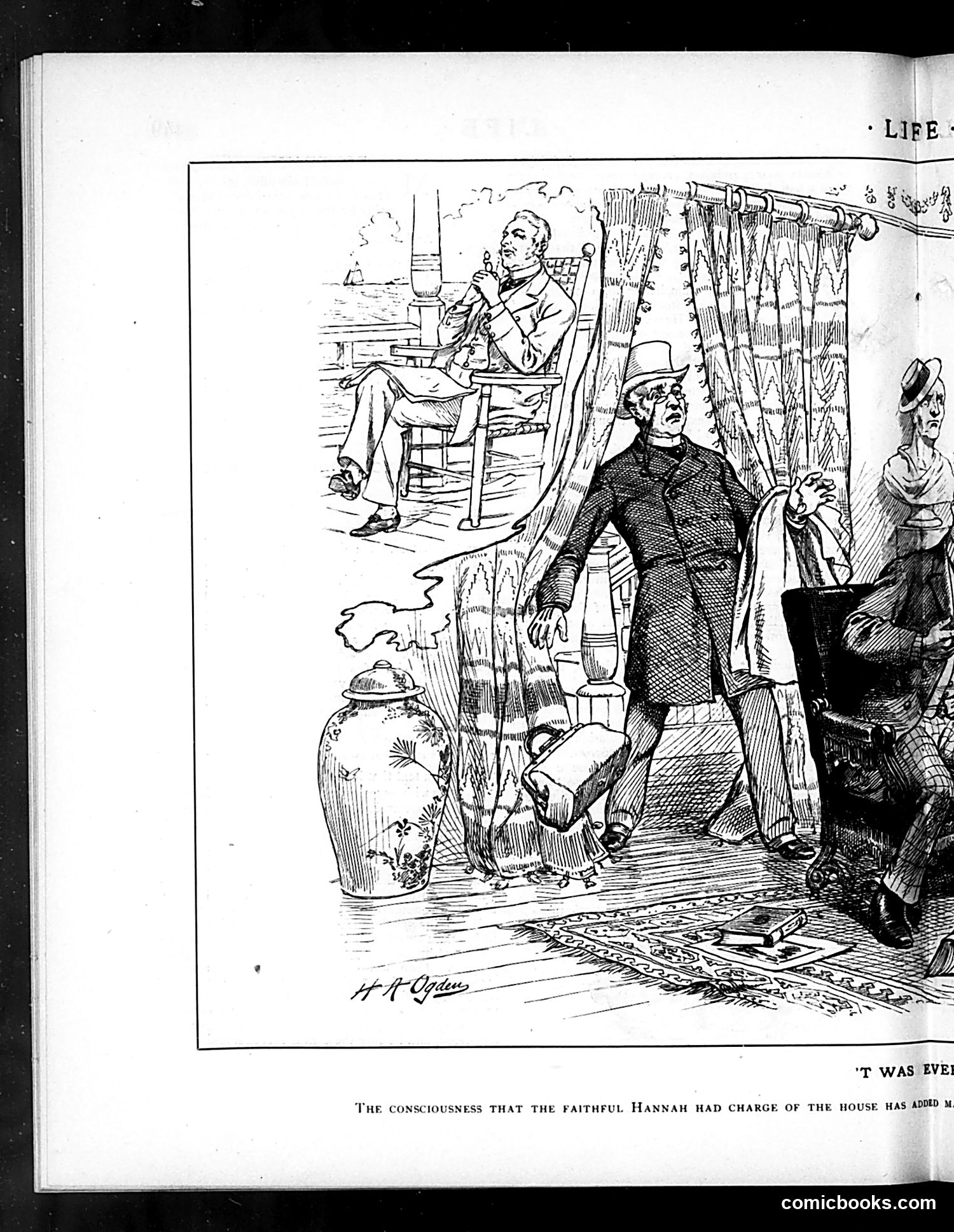
This is an illustration by H.H. Ogden from *Life* magazine. The caption reads: "The consciouness that the faithful Hannah had charge of the house has added much—" (text cuts off). The cartoon depicts a domestic scene with a man in a hat standing prominently in what appears to be a tent or draped interior space. A woman (presumably Hannah, a servant) is visible on the right. A man sits smoking in the background. An ornamental vase sits on the floor. The joke appears to be about domestic comfort and security afforded by having a reliable, trustworthy servant ("faithful Hannah") managing household affairs. The satire likely mocks middle-class anxieties about household staff and domestic management, or ironically comments on how much peace of mind comes from delegating household responsibilities to trusted employees—a relatable concern for the magazine's presumably affluent readership.
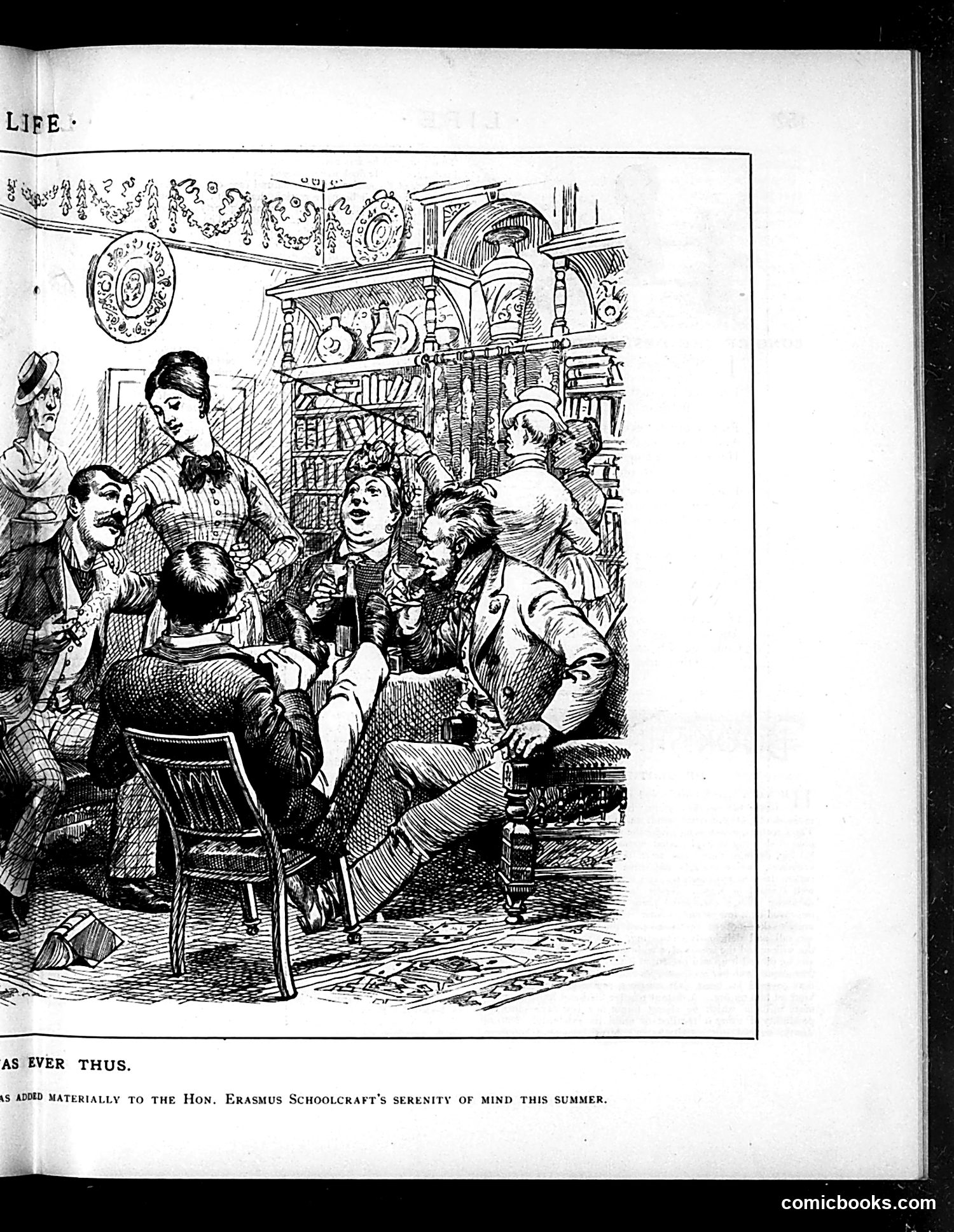
This appears to be a satirical illustration from *Life* magazine showing a domestic interior scene with multiple figures gathered around what seems to be a social gathering or parlor setting. The caption references "the Hon. Erasmus Schoolcraft's serenity of mind this summer." The satire likely mocks a specific public figure or social type—"Erasmus Schoolcraft" appears to be a fictional or pseudonymous name for someone whose composure or mental state was being publicly questioned or ridiculed that summer season. The ornate, cluttered setting with decorative objects visible in the background suggests upper-class pretension, which was a common target of *Life*'s satire. Without additional context about which year this appeared, the specific identity of the target remains unclear, though the satirical intent—questioning someone's claimed "serenity"—is evident.
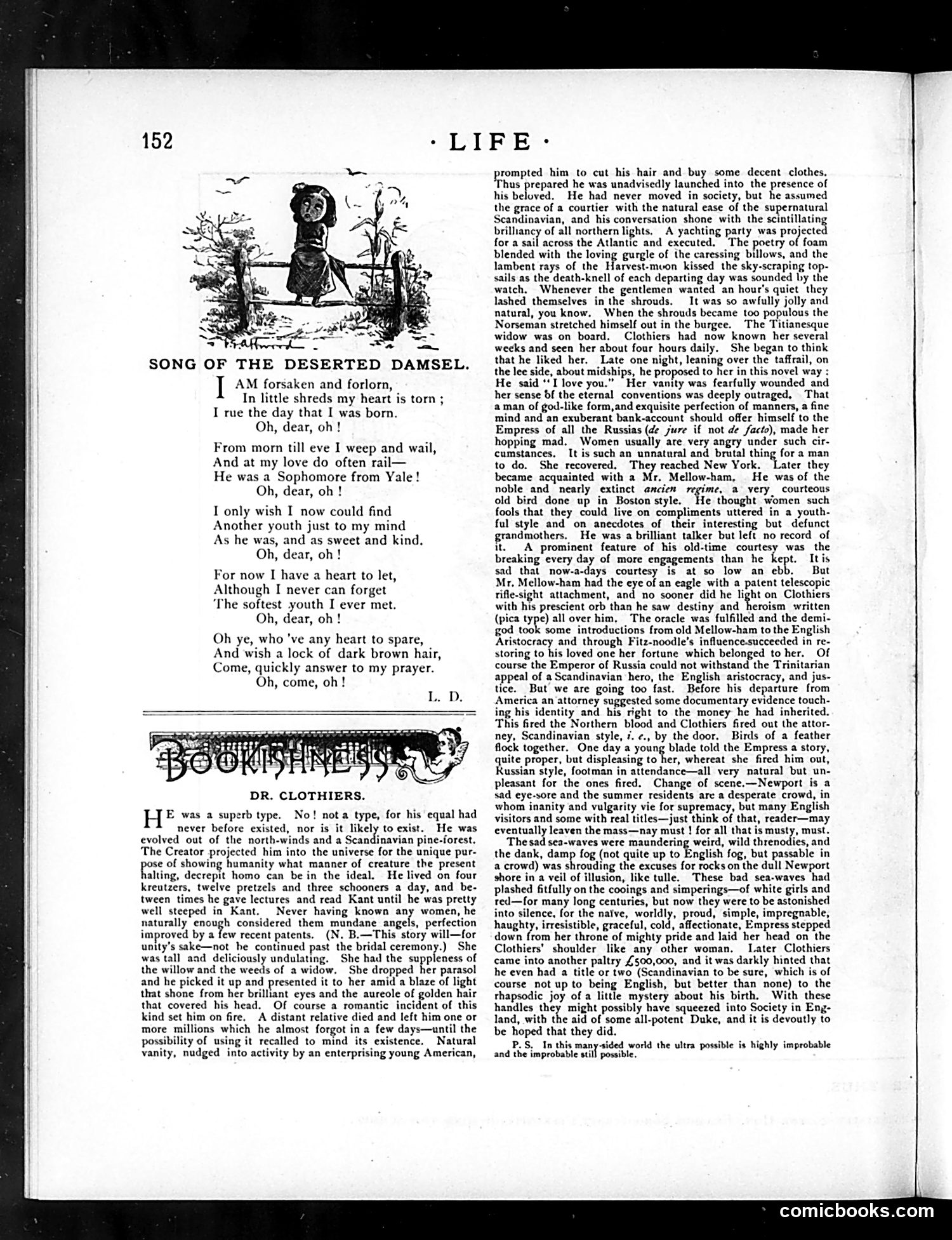
This page from *Life* contains two satirical pieces mocking romantic conventions and social pretension. The poem parodies sentimental "deserted woman" ballads—a damsel mourns her Sophomore boyfriend from Yale with exaggerated melodrama, then advertises herself for replacement. "Dr. Clothiers" satirizes a Scandinavian idealist who lives in poverty on philosophy and pretzels until inheriting wealth. He then acquires fashionable appearance and manners, winning a vain Russian widow. The satire targets his supernatural perfection and the absurdity of his sudden transformation through tailoring. When he clumsily declares love ("I love you") rather than observe proper courtship conventions, her vanity and sense of propriety are offended—the joke being that she found his crude sincerity barbaric despite his wealth and sophistication. The piece mocks both romantic naïveté and aristocratic pretension.
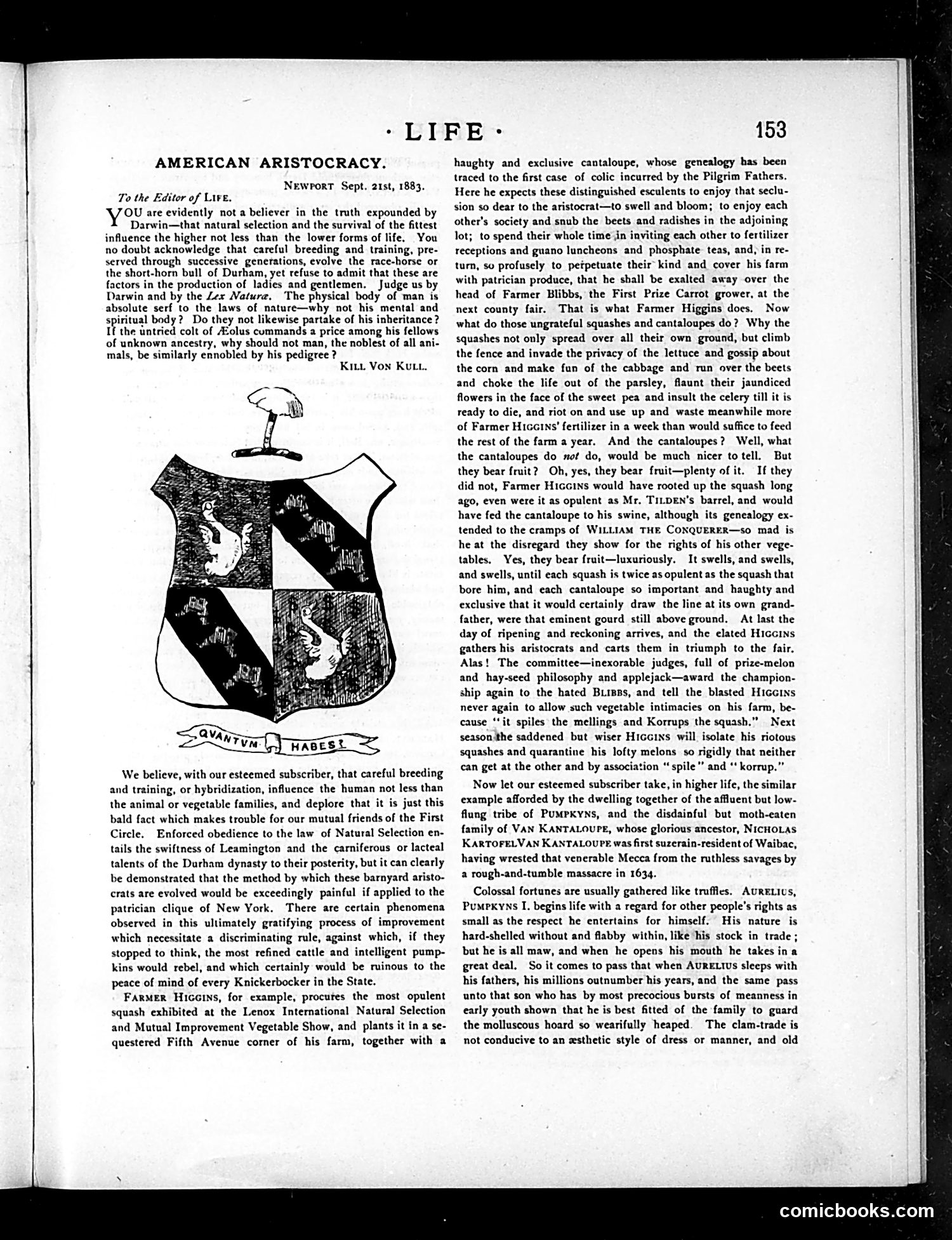
This satirical piece mocks New York's wealthy elite by applying Darwin's theory of natural selection to human society. A reader arguing that aristocrats should be valued like pedigree animals receives a pointed response from Life's editors. The joke: Farmer Higgins attempts to breed "aristocratic" vegetables—a haughty cantaloupe descended from Pilgrim stock, an elite squash—by isolating them from common produce. Instead of producing refined offspring, these vegetables become snobbish, invasive, and wasteful, spreading uncontrollably and choking out their humble neighbors. The satire equates New York's First Circle aristocrats with unruly, self-important vegetables. Their pedigree and exclusivity don't improve society; they merely create entitled chaos. The piece mocks both Social Darwinism (applying evolutionary theory to justify class hierarchies) and the pretensions of old-money New York families who believed breeding determined superiority.
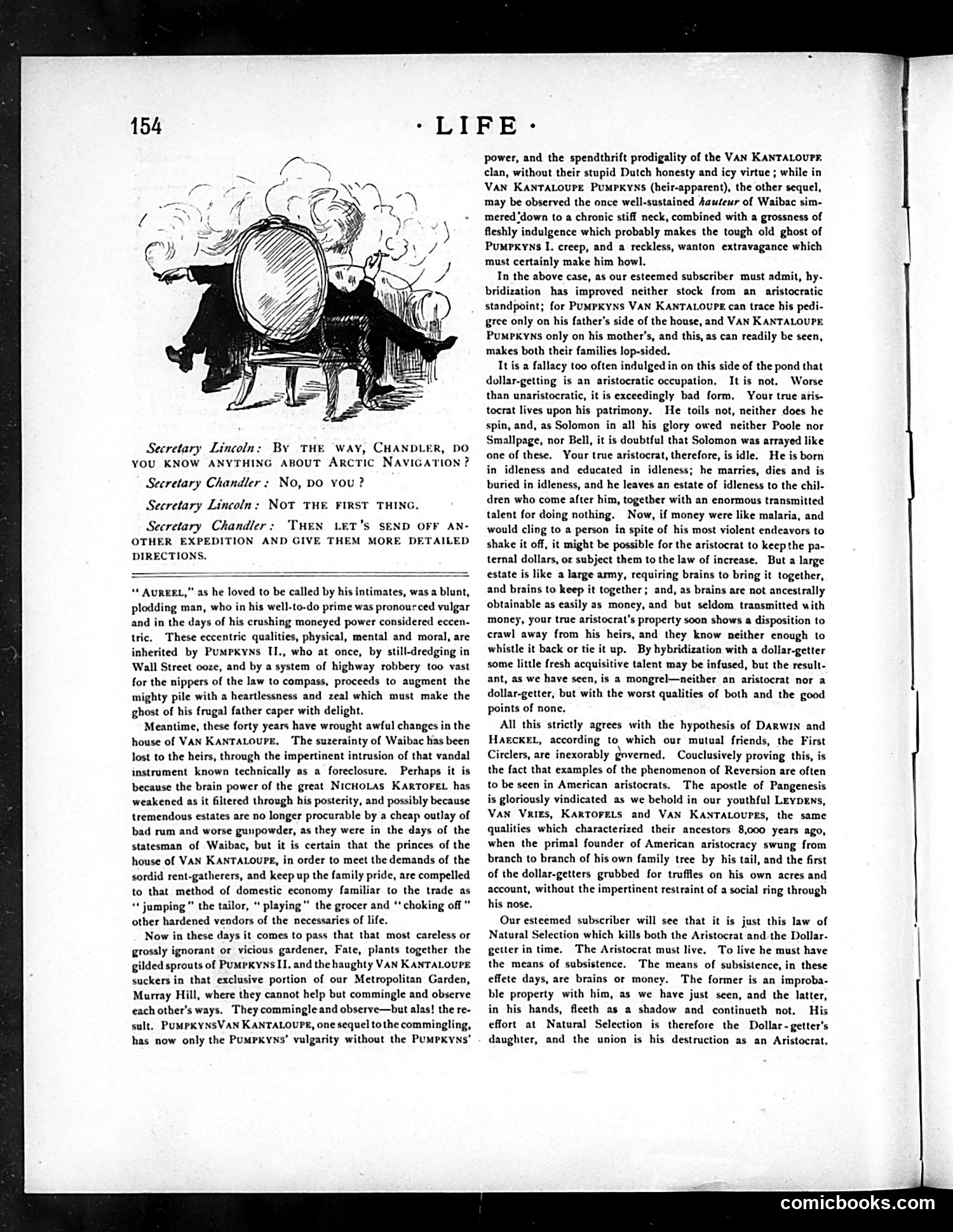
**The Cartoon:** The dialogue between Secretary Chandler and Secretary Lincoln mocks governmental incompetence. When asked if he knows anything about Arctic navigation, Chandler admits ignorance—then proposes sending *another* expedition anyway, with better directions. This satirizes wasteful government expeditions undertaken without actual expertise or purpose. **The Main Article:** The text satirizes American social climbing and class pretension. Two wealthy families—the nouveau-riche Pumpkyns and the declining aristocratic Van Kantaloupes—intermarry, producing two hybrids who possess only the worst traits of each family: vulgarity without wealth, or aristocratic pretense without actual means. The satire argues that American wealth-making is fundamentally *un-aristocratic*, that true aristocrats inherit and remain idle, and that attempting to bridge old money and new money creates only corrupt degenerate offspring. It's a biting critique of Gilded Age social ambition and the moral bankruptcy of both inherited privilege and aggressive capitalism.
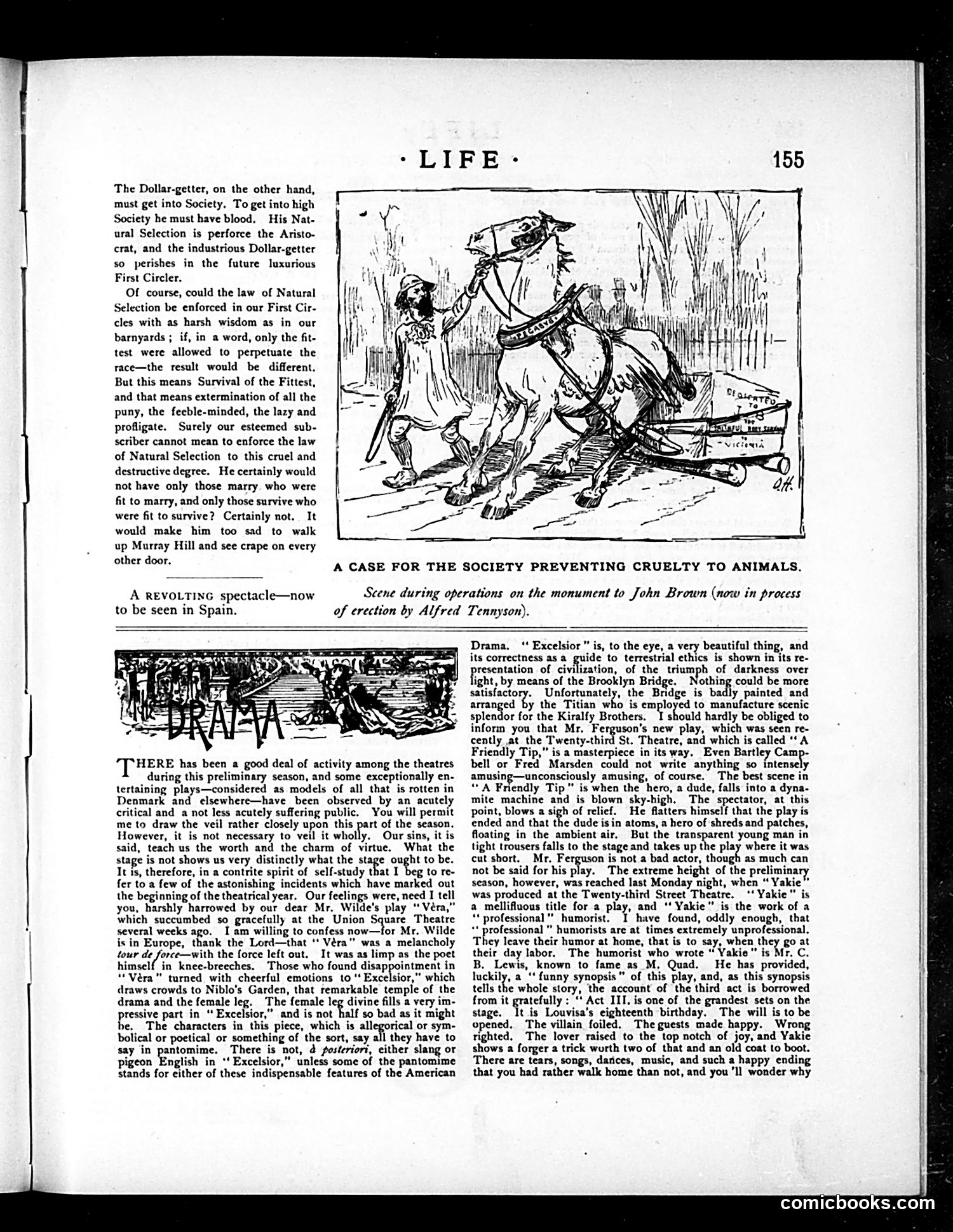
**The Top Cartoon:** This depicts animal cruelty during construction of a John Brown monument. A worker beats a horse while an observer looks on horrified. The caption sarcastically titles it "A Case for the Society Preventing Cruelty to Animals"—the joke being that such obvious abuse requires advocacy for animal protection laws. The image serves as social commentary on widespread indifference to animal suffering. **The Text Below:** The author discusses recent theatrical productions with biting wit. He mocks Oscar Wilde's failed play "Véra" as "a melancholy tour de force—with the force left out," and praises "Excelsior" (at Niblo's Garden) primarily for its female dancers rather than artistic merit. The piece satirizes both pretentious dramatic failures and the shallow aesthetics of popular entertainment, particularly the reliance on spectacle over substance.
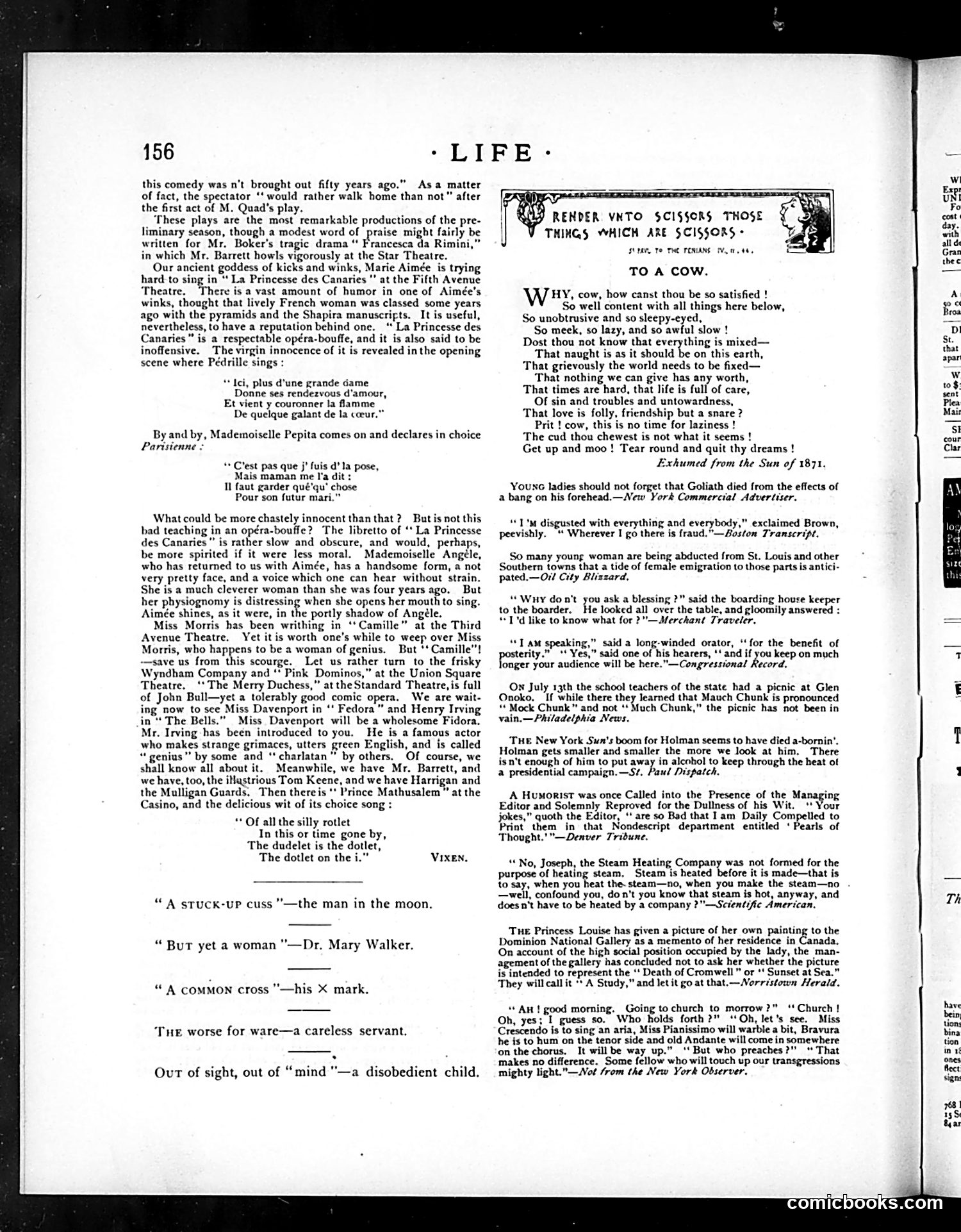
This page contains theater criticism and a satirical poem mocking bovine contentment. The main content is a review of contemporary plays (circa 1871), critiquing productions like "La Princesse des Canaries" featuring actress Marie Aimée, and "Camille." The critic dismisses some works while praising performers like Henry Irving and Miss Morris. The cartoon's central image shows a cow with the poem "To a Cow," which satirizes the animal's peaceful acceptance of life. The poem's speaker ironically questions why the cow isn't troubled by the world's problems—its lack of ambition, anxiety, and desire for "improvement" contrast sharply with human neurosis. The page's decorative definitions (marked with dashes) offer witty, cutting observations about human behavior: a "stuck-up cuss" is "the man in the moon," while a "common cross" is "his X mark." The satire targets both sentimental theater and human discontent, suggesting cows possess wisdom humans lack.
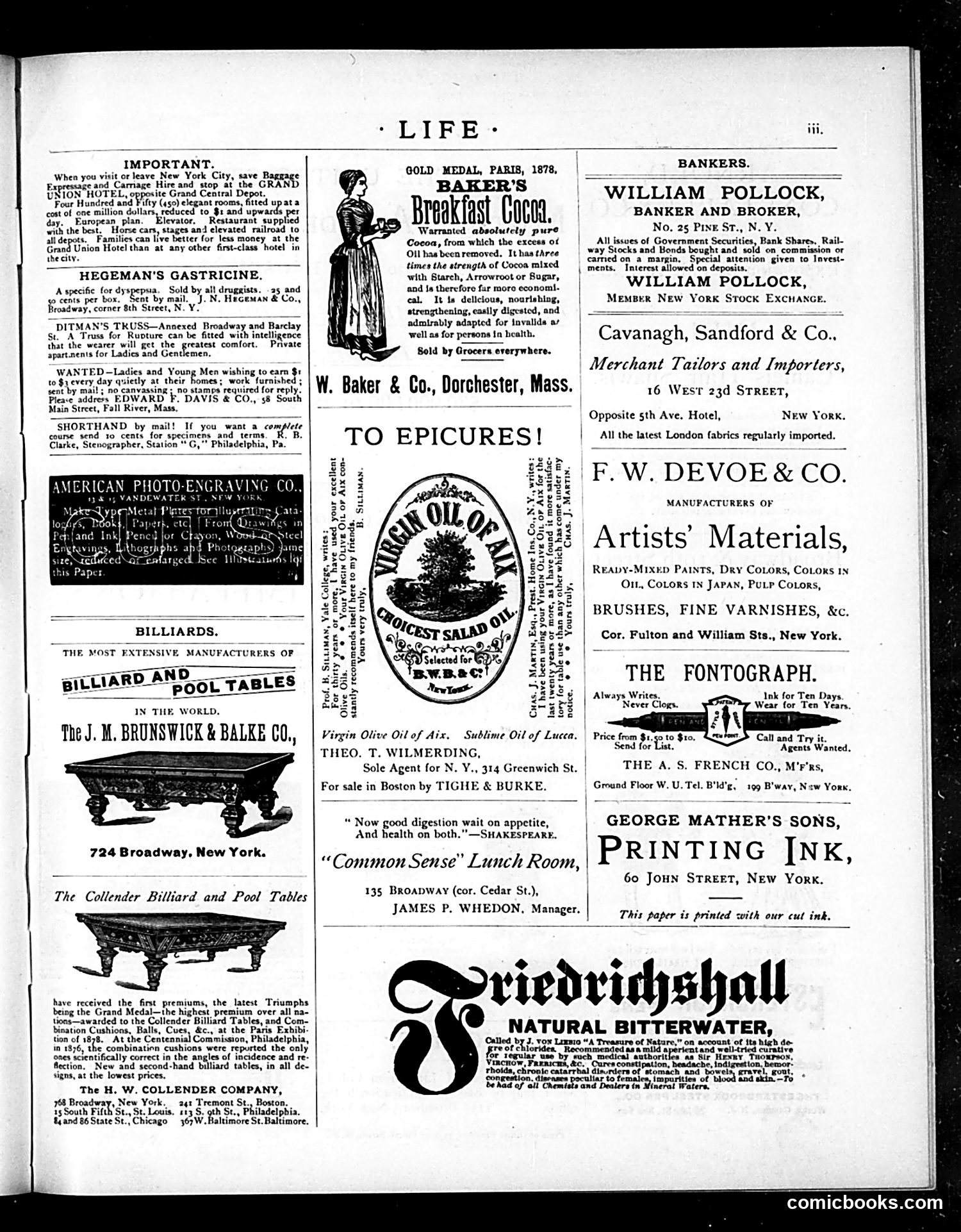
This is primarily an **advertisement page** from Life magazine, not a political cartoon or satirical content page. The page contains commercial advertisements for various products and services typical of late 19th-century New York: - **Hotels** (Grand Union Hotel) - **Patent medicines** (Hegeman's Gastricine for dyspepsia, Ditman's Truss) - **Food products** (Baker's Breakfast Cocoa, olive oils, lunch rooms) - **Services** (shorthand instruction, photo-engraving) - **Billiard tables** (J.M. Brunswick & Balke Co., Collender Company) - **Financial services** (William Pollock, banker) - **Merchant tailors** (Cavanagh, Sandford & Co.) - **Art supplies** (F.W. Devoe & Co.) - **Printing ink** (George Mather's Sons) The advertisements reflect consumer culture and industrial products of the Gilded Age. There is **no discernible political satire or cartoon commentary** on this particular page—it functions as a straightforward commercial directory for contemporary readers seeking goods and services.
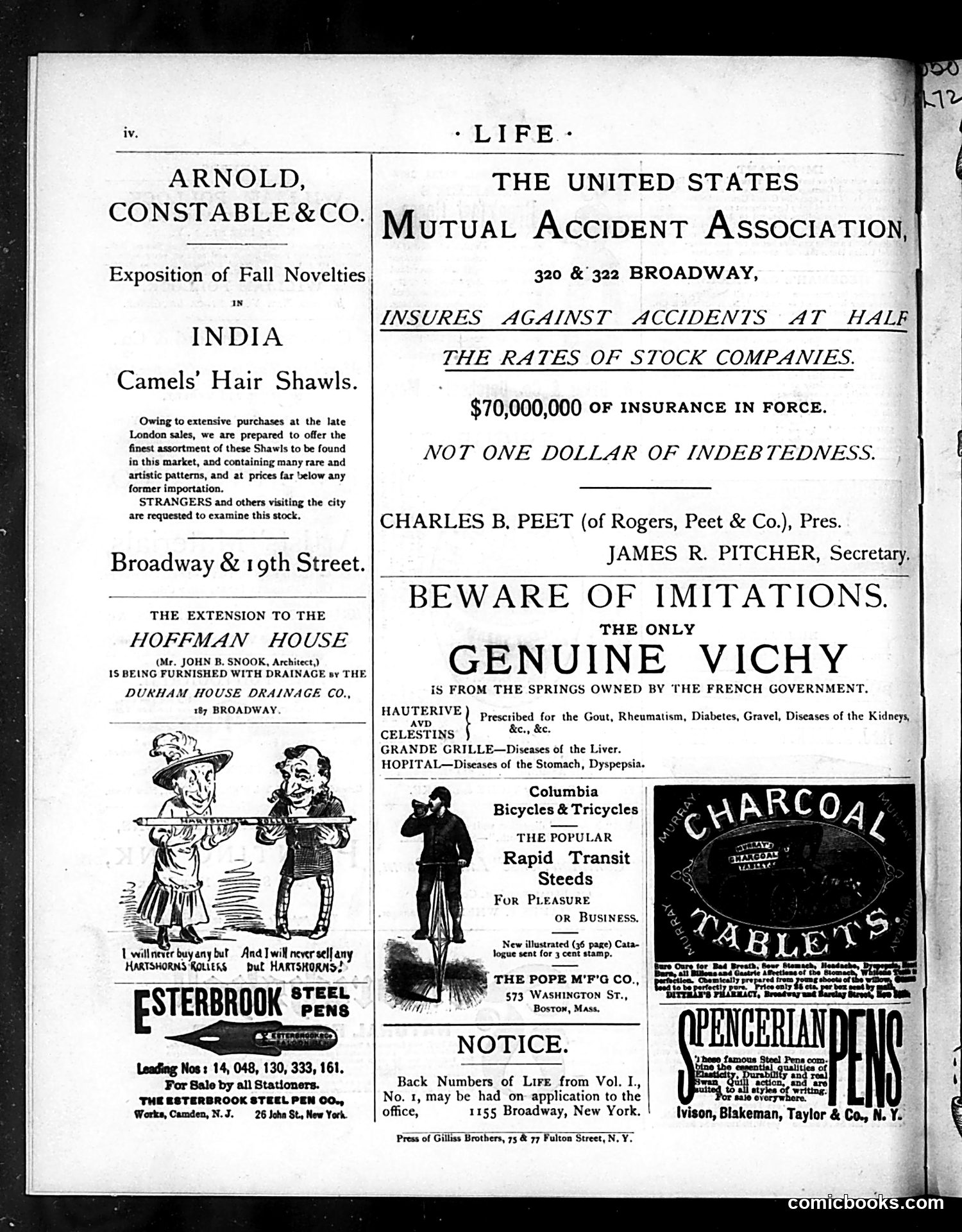
This is primarily an **advertising page**, not editorial content. The main satirical cartoon appears at bottom-left: two figures arguing over a bottle of **Hartshorne's Roach Exterminator**, with a woman saying "I will never buy any but Hartshorne's" while a man insists he'll only sell "Hartshorne's." The joke turns on competitive commercial rivalry—by having both parties fanatically insist on the same brand, the ad ironically suggests the product is so superior that even competitors prefer it. This is a humorous approach to brand loyalty advertising. The page otherwise features typical 1880s-90s advertisements: insurance, imported shawls, patent medicines (Vichy water for gout), bicycles, pens, and charcoal tablets. These ads reflect period consumer culture and health concerns (rheumatism, dyspepsia being common complaints). The satire is mild and commercial rather than political—its target is consumer psychology and brand marketing itself.