
Life, 1883-09-27 · page 11 of 16
Life — September 27, 1883 — page 11: what you’re looking at
What you’re looking at
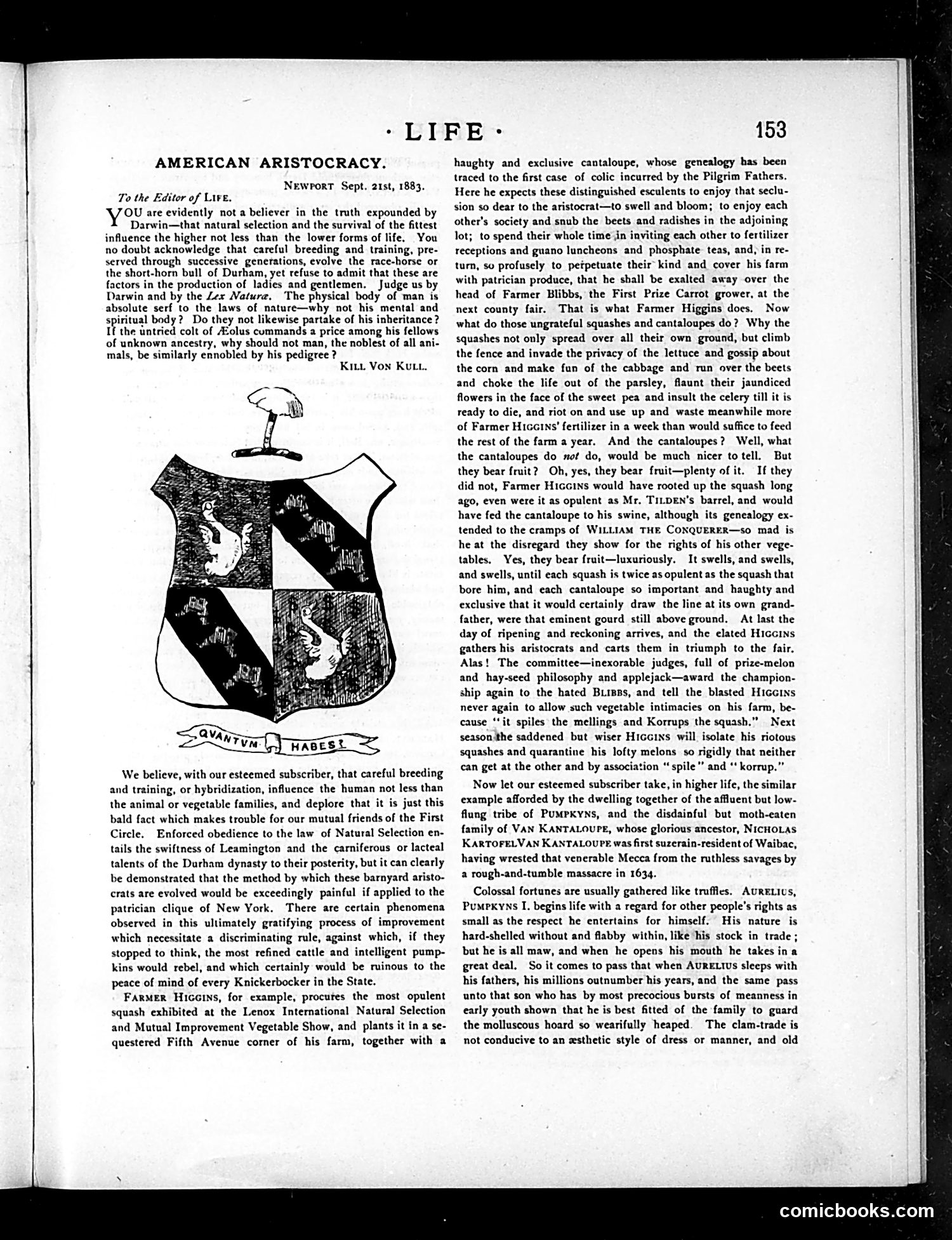
This satirical piece mocks New York's wealthy elite by applying Darwin's theory of natural selection to human society. A reader arguing that aristocrats should be valued like pedigree animals receives a pointed response from Life's editors. The joke: Farmer Higgins attempts to breed "aristocratic" vegetables—a haughty cantaloupe descended from Pilgrim stock, an elite squash—by isolating them from common produce. Instead of producing refined offspring, these vegetables become snobbish, invasive, and wasteful, spreading uncontrollably and choking out their humble neighbors. The satire equates New York's First Circle aristocrats with unruly, self-important vegetables. Their pedigree and exclusivity don't improve society; they merely create entitled chaos. The piece mocks both Social Darwinism (applying evolutionary theory to justify class hierarchies) and the pretensions of old-money New York families who believed breeding determined superiority.
📄 Transcribed text from this page (OCR, searchable)
Machine-transcribed from the original scan — historical spelling and the odd misread are preserved.
AMERICAN ARISTOCRACY. Newport Sept. 21st, 1883. To the Editor of Live. YOU are evidently not a believer in the truth expounded by Darwin—that natural selection and the survival of the fittest influence the higher not less than the lower forms of life. You no doubt acknowledge that careful breeding and training, pre- served through successive generations, evolve the race-horse or the short-horn bull of Durham, yet refuse to admit that these are factors in the production of ladies and gentlemen. Judge us by Darwin and by the Lex Natura. The physical body of man is absolute serf to the laws of nature—why not his mental and spiritual body? Do they not likewise partake of his inheritance ? Tf the untried colt of AZolus commands a price among his fellows of unknown ancestry, why should not man, the noblest of all ani- mals, be similarly ennobled by his pedigree ? Ki Von Kui. We believe, with our esteemed subscriber, that careful breeding and training, or hybridization, influence the human not less than the animal or vegetable families, and deplore that it is just this bald fact which makes trouble for our mutual friends of the First Circle. Enforced obedience to the law of Natural Selection en- tails the swiftness of Leamington and the carniferous or lacteal talents of the Durham dynasty to their posterity, but it can clearly be demonstrated that the method by which these barnyard aristo- crats are evolved would be exceedingly painful if applied to the patrician clique of New York. There are certain phenomena observed in this ultimately gratifying process of improvement which necessitate a discriminating rule, against which, if they stopped to think, the most refined cattle and intelligent pump- kins would rebel, and which certainly would be ruinous to the peace of mind of every Knickerbocker in the State. Farmer Hiccins, for example, procures the most opulent squash exhibited at the Lenox International Natural Selection and Mutual Improvement Vegetable Show, and plants it in a se- questered Fifth Avenue corner of his farm, together with a > LIFE: 153 haughty and exclusive cantaloupe, whose genealogy has been traced to the first case of colic incurred by the Pilgrim Fathers. Here he expects these distinguished esculents to enjoy that seclu- sion so dear to the aristocrat—to swell and bloom; to enjoy each other's society and snub the beets and radishes in the adjoining lot; to spend their whole time in inviting each other to fertilizer receptions and guano luncheons and phosphate teas, and, in re- tum, so profusely to petpetuate their kind and cover his farm with patrician produce, that he sball be exalted away over the head of Farmer Blibbs, the First Prize Carrot grower, at the next county fair. That is what Farmer Higgins does. Now what do those ungrateful squashes and cantaloupes do? Why the squashes not only spread over all their own ground, but climb the fence and invade the privacy of the lettuce and gossip about the corn and make fun of the cabbage and run over the beets and choke the life out of the parsley, flaunt their jaundiced flowers in the face of the sweet pea and insult the celery till it is ready to die, and riot on and use up and waste meanwhile more of Farmer Hicctns' fertilizer in a week than would suffice to feed the rest of the farm a year. And the cantaloupes? Well, what the cantaloupes do not do, would be much nicer to tell. But they bear fruit? Oh, yes, they bear fruit—plenty of it. If they did not, Farmer HiGoins would have rooted up the squash long ago, even were it as opulent as Mr. TILDEN’s barrel, and would have fed the cantaloupe to his swine, although its genealogy ex- tended to the cramps of WILLIAM THE CONQUERER—so mad is he at the disregard they show for the rights of his other vege- tables. Yes, they bear fruit—luxuriously. It swells, and swells, and swells, until each squash is twice as opulent as the squash that bore him, and each cantaloupe so important and haughty and exclusive that it would certainly draw the line at its own grand- father, were that eminent gourd still above ground. At last the day of ripening and reckoning arrives, and the elated Hiccins gathers his aristocrats and carts them in triumph to the fair. Alas! The committee—inexorable judges, full of prize-melon and hay-seed philosophy and applejack—award the champion- ship again to the hated Biipss, and tell the blasted Hiccins never again to allow such vegetable intimacies on his farm, be- cause ‘it spiles the mellings and Korrups the squash.” Next seasonithe saddened but wiser Hiccixs will isolate his riotous squashes and quarantine his lofty melons so rigidly that neither can get at the other and by association “ spile”’ and ‘‘ korrup.” Now let our esteemed subscriber take, in higher life, the similar example afforded by the dwelling together of the affluent but low- flung tribe of PumpKyNs, and the disdainful but moth-eaten family of VAN KANTALOUPE, whose glorious ancestor, NICHOLAS KARTOFELVAN KANTALOUPE was first suzerain-resident of Waibac, having wrested that venerable Mecca from the ruthless savages by a rough-and-tumble massacre in 1634. Colossal fortunes are usually gathered like truffles. AURELIUS, Pumpxyns I. begins life with a regard for other people's rights as small as the respect he entertains for himself. His nature is hard-shelled without and flabby within, like his stock in trade; but he is all maw, and when he opens his mouth he takes ina great deal. So it comes to pass that when AURELIWs sleeps with his fathers, his millions outnumber his years, and the same pass unto that son who has by most precocious bursts of meanness in early youth shown that he is best fitted of the family to guard the molluscous hoard so wearifully heaped. The clam-trade is not conducive to an zesthetic style of dress or manner, and old comicbooks.com