
Life, 1883-09-27 · page 13 of 16
Life — September 27, 1883 — page 13: what you’re looking at
What you’re looking at
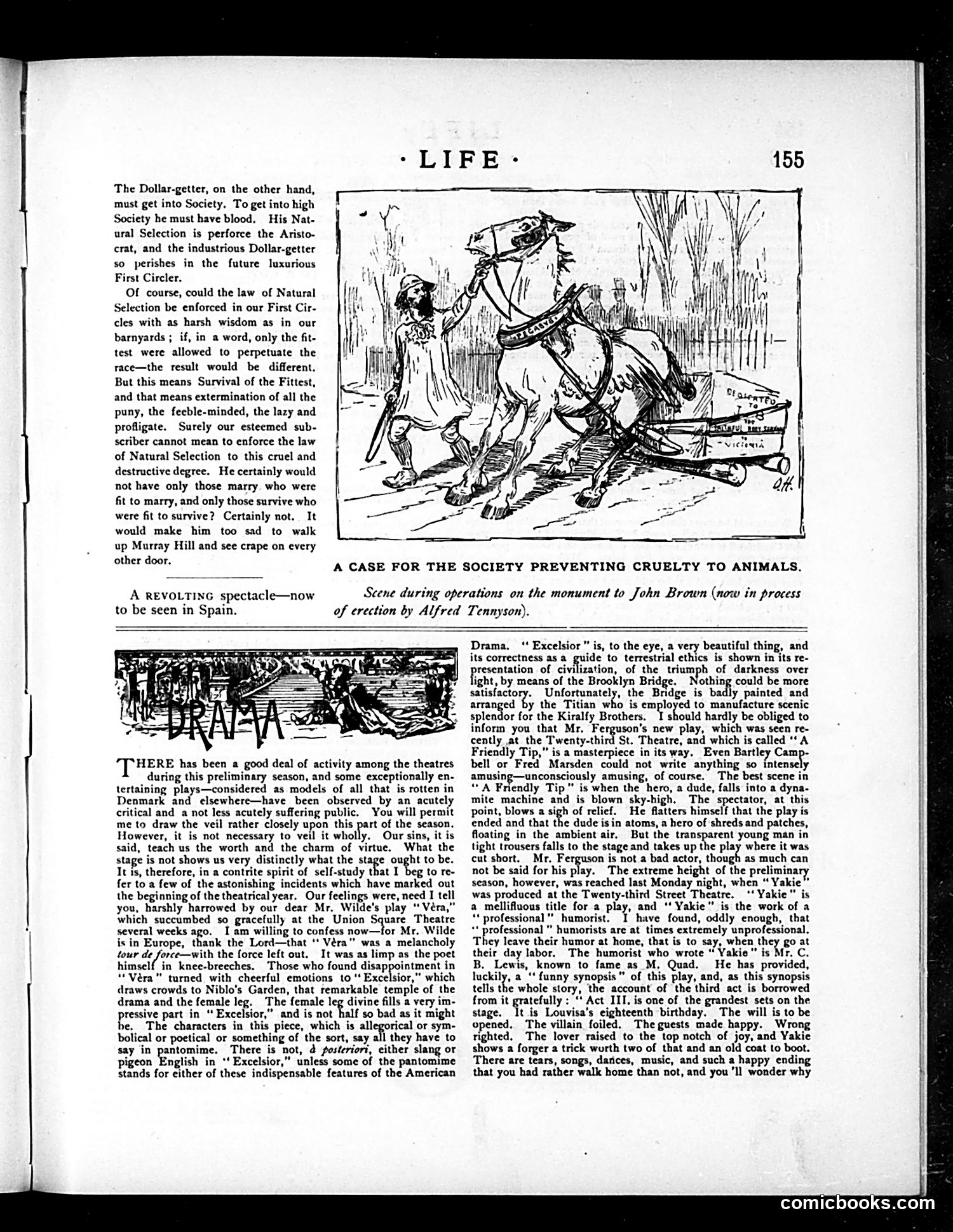
**The Top Cartoon:** This depicts animal cruelty during construction of a John Brown monument. A worker beats a horse while an observer looks on horrified. The caption sarcastically titles it "A Case for the Society Preventing Cruelty to Animals"—the joke being that such obvious abuse requires advocacy for animal protection laws. The image serves as social commentary on widespread indifference to animal suffering. **The Text Below:** The author discusses recent theatrical productions with biting wit. He mocks Oscar Wilde's failed play "Véra" as "a melancholy tour de force—with the force left out," and praises "Excelsior" (at Niblo's Garden) primarily for its female dancers rather than artistic merit. The piece satirizes both pretentious dramatic failures and the shallow aesthetics of popular entertainment, particularly the reliance on spectacle over substance.
📄 Transcribed text from this page (OCR, searchable)
Machine-transcribed from the original scan — historical spelling and the odd misread are preserved.
The Dollar-getter, on the other hand, must get into Society, To get into high Society he must have blood. His Nat- ural Selection is perforce the Aristo- crat, and the industrious Dollar-getter so perishes in the future luxurious First Circler. Of course, could the law of Natural Selection be enforced in our First Cir- cles with as harsh wisdom as in our barnyards ; if, in a word, only the fit- test were allowed to perpetuate the race—the result would be different, But this means Survival of the Fittest, and that means extermination of all the puny, the feeble-minded, the lazy and profligate. Surely our esteemed sub- scriber cannot mean to enforce the law of Natural Selection to this cruel and destructive degree. He certainly would not have only those marry who were fit to marry, and only those survive who were fit to survive? Certainly not. It would make him too sad to walk up Murray Hill and see crape on every other door, A REVOLTING spectacle—now to be seen in Spain. A CASE FOR THE SOCIETY PREVENTING CRUELTY TO ANIMALS. Scene during operations on the monument to John Brown (now in process of erection by Alfred Tennyson). ‘THERE has been a good deal of activity among the theatres during this preliminary season, and some exceptionally en- tertaining plays—considered as models of all that is rotten in Denmark and elsewhere—have been observed by an acutely critical and a not less acutely suffering public, You will permit me to draw the veil rather closely upon this part of the season. However, it is not necessary to veil it wholly. Our sins, it is said, teach us the worth and the charm of virtue, What the stage is not shows us very distinctly what the stage ought to be. It is, therefore, in a contrite spirit of self-study that I beg to re- fer to a few of the astonishing incidents which have marked out the beginning of the theatrical year. Our feelings were, need I tell you, harshly harrowed by our dear Mr. Wilde's play ‘ Véra,” which succumbed so gracefully at the Union Square Theatre several weeks ago. I am willing to confess now—for Mr. Wilde is in Europe, thank the Lord—that ** Véra” was a melancholy tour de force—with the force left out. It was as limp as the poet himself in knee-breeches. Those who found disappointment in “Véra” turned with cheerful emotions to" Excelsior,” which draws crowds to Niblo's Garden, that remarkable temple of the drama and the female leg. The female leg divine fills a very im- pressive part in ‘Excelsior,” and is not half so bad as it might be. The characters in this piece, which is allegorical or sym- bolical or poetical or something of the sort, say all they have to say in pantomime. There is not, 4 posteriori, either slang or pigeon English in ‘* Excelsior,” unless some of the pantomime stands for either of these indispensable features of the American Drama, ‘* Excelsior” is, to the eye, a very beautiful thing, and its correctness as a guide to terrestrial ethics is shown in its re- Eeereniaticn of civilization, of the triumph of darkness over ight, by means of the Brooklyn Bridge. Nothing could be more satisfactory. Unfortunately, the Bridge is badly painted and arran; ed by the Titian who is employed to manufacture scenic splendor for the Kiralfy Brothers. I should hardly be obliged to inform you that Mr. Ferguson's new play, which was seen re- cently at the Twenty-third St. Theatre, and which is called “A Friendly Tip,” is a masterpiece in its way. Even Bartley Cam bell or Fred Marsden could not write anything so intensely amusing—unconsciously amusing, of course. The best scene in “A Fnendly Tip” is when the hero, a dude, falls into a dyna- mite machine and is blown sky-high. The spectator, at this point, blows a sigh of relief, He flatters himself that the play is ended and that the dude is in atoms, a hero of shreds and patches, floating in the ambient air. But the Sela ker young man in tight trousers falls to the stage and takes up the play where it was cut short. Mr, Ferguson is not a bad actor, though as much can not be said for his play. The extreme height of the preliminary season, however, was reached last Monday night, when “ Yakie”’ was produced at the Twenty-third Street Theatre. ‘* Yakie” is a mellifluous title for a play, and ‘‘Yakie" is the work of a “+ professional” humorist. I’ have found, oddly enough, that ** professional " humorists are at times extremely unprofessional, They leave their humor at home, that is to say, when they go at their day labor. The humorist who wrote “ Yakie” is Mr. C. B. Lewis, known to fame as M. Quad. He has provided, luckily, a “funny synopsis” of this play, and, as this synopsis tells the whole story, the account of the third act is borrowed from it gratefully : ‘* Act III, is one of the grandest sets on the stage. It is Louvisa’s eighteenth birthday. The will is to be opened. The villain foiled. The guests made happy. Wrong righted. The lover raised to the top notch of joy, and Yakie shows a forger a trick worth two of that and an old coat to boot. There are tears, songs, darices, music, and such a happy ending that you had rather walk home than not, and you ’ll wonder why comicbooks.com